Leanan Sidhe, Spirit of the Celtic Tradition
By Ralf Ittermann · last reviewed on
Leanan Sidhe is the spirit of the Celtic tradition, a supernatural woman or fairy who appears to poets and artists, granting them inspiration while gradually consuming them. From a history-of-religions perspective, she represents the type of the “fairy lover,” a figure of boundary-crossing between the human world and the Otherworld.
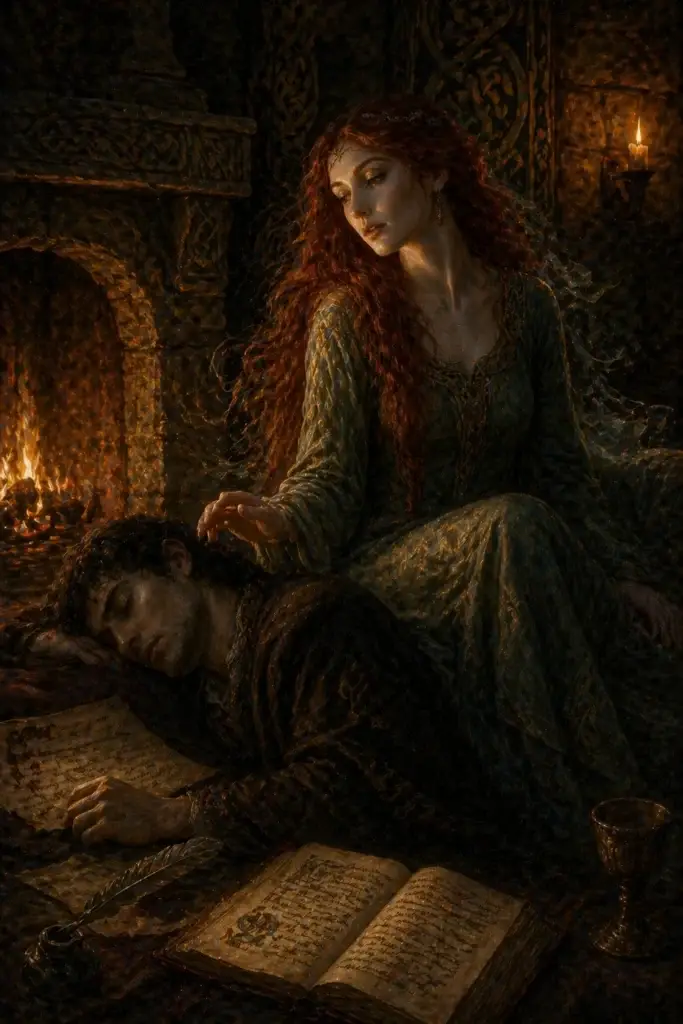
Leanan Sidhe
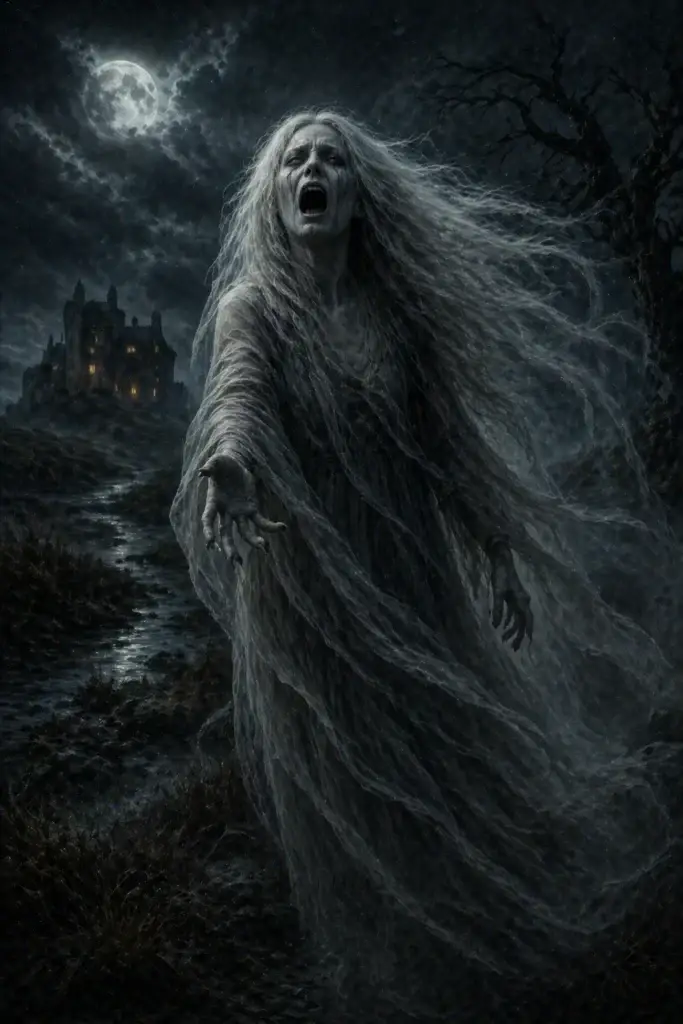
Leanan Sidhe (“fairy woman” or “fairy lover”) is depicted as a supernatural female force who bestows inspiration on poets, yet also brings suffering and wasting illness. She belongs to the Sidhe, the Irish fairy beings.
Tradition holds that she enters into amorous or spiritual relationships with poets such as Oisin and other artists, relationships that lead to artistic genius but also to madness or death. She embodies the ambivalent power of artistic inspiration.
Overview: Leanan Sidhe
Related motifs come from Irish saga cycles and poem cycles, particularly the Fenian Tales (Fiannaigecht), where fairy women appear as lovers or muses. There is no medieval literary tradition under this name.
The figure is attested across Celtic cultural zones (Ireland, Scotland, Wales) under variant names and functions. Modern folkloristic collections and literary treatments, notably by W.B. Yeats, have brought the figure to wider attention.
Classification
The figure of the Leanan Sídhe is attested under this name only in the collections of the 19th century, in which folklorists recorded the oral tales. W. B. Yeats included her in his anthology of Irish fairy and folk tales and shaped the familiar image of the consuming muse. In this literary form she lives on, changed from the village tradition, but clearly recognizable in her core as a dangerous lover.
The Leanan Sídhe was not a marginal motif but part of Irish fairy belief, which regulated the relationship of people to the Otherworld as a whole and thereby belonged to the self-image of rural communities. With the Irish emigration of the 19th century and through the writings of Yeats and other collectors, the stories about her reached Britain and North America, where they were retold in a remarkably consistent form.
Sources of related motifs include Irish heroic sagas and poem cycles (Fenian Tales), preserved fragmentarily in manuscripts such as the Yellow Book of Lecan and other medieval codices. Timeline: the narratives are orally pre-Christian, but written down under this name only in the 19th and early 20th centuries. The Otherworld mythology is characteristic of insular Celtic religion. Scholars such as Proinsias Mac Cana (Celtic Mythology) and Padraic Colum (Legends of Ireland) describe the Sidhe and fairy women. In the modern period, folkloristic studies by Katharine Briggs and others have continued this work.
Name
Leanan Sidhe is depicted in the various sources and artistic traditions with certain recurring iconographic elements that remain relatively constant over decades and across different geographic areas. These elements are not purely decorative or arbitrarily chosen, but are deeply encoded symbolically and carry great meaning.
What the Irish tales report about the Leanan Sídhe also describes her workings: her beauty, which attracts poets and musicians, her gift of awakening creative power, and the price she takes for it, namely the lifetime of her beloved. Even her name, roughly the fairy lover, sums up this double face. Anyone who knows the Irish storytelling tradition understands the signs at once: the artist who burned out early, working in a fever, was regarded as both her victim and her chosen one. W. B. Yeats took up this pattern of interpretation and described her as a muse whose love consumes. Every detail of the accounts belongs to this traditional image.
Characteristics
The practice was not arbitrary or improvised, but precisely transmitted and often guided by trained priests or other specialists. The continuity of these practices across many generations clearly shows they were regarded as effective and necessary.
Their functions were diverse: some preventive (warding off potential harm), some restorative (relieving illness or suffering), some transformative (accompanying transitions between life stages).
Profile: Leanan Sidhe
The profile examines Leanan Sidhe across six aspects: her origin in the Otherworld and Celtic mythology, her connections to poets and artists, her iconography and supernatural attributes, her ambivalent inspiring and harmful powers, as well as spiritual protective measures and cultural analogues. Together these aspects trace the outline of this enigmatic threshold figure.
Leanan Sidhe originates in the Otherworld (Tir na nOg, Mag Mell), the supernatural sphere of Celtic cosmology. She is often regarded as one of the Tuatha De Danann or as an independent fairy being.
Geographically she belongs to Irish tradition, with Scottish and Welsh variants. There is no medieval literary tradition under this name; the figure is shaped essentially by the written culture of the 19th and early 20th centuries, for instance through Yeats’ collection of 1888.
Leanan Sidhe was invoked by poets, singers, musicians, and artistically gifted individuals seeking inspiration and artistic genius. She appears primarily to male artists, especially warrior-poets (filid). Her veneration is not organized or cultic, but folkloristic and individual. In some traditions, offerings or acts of appeasement are attempted in order to channel her ambivalent influence.
Leanan Sidhe is often depicted as an extraordinarily beautiful, supernatural woman with refined or luminous features that indicate her non-human nature. Mythologically she wears fairy garments or shimmering textiles. In some narratives she appears with a greenish aspect or dressed in animal skins. She is youthful yet timeless, radiating desire and danger in equal measure.
The Leanan Sidhe is an ambivalent or daemonic figure from Irish-Scottish folklore, active in the domains of suffering and artistic inspiration.
She functions as a muse for poets and musicians, but the cost is often the madness or early death of the one she loves. Her influence operates in two areas: artistic inspiration (ecstasy, genius) and erotic ruin (obsession, wasting).
Leanan Sidhe is ambivalent: she inspires artistic genius, but at a high price, namely madness, wasting illness, or the death of the artist. She is not malevolent, but she is dangerous.
Protective practices involve limiting contact or maintaining distance through iron objects and chants. Some traditions advise invocation with respect but without emotional entanglement. Modern interpretation recommends psychological caution toward this “inspiring obsession.”
Comparable are the Muses (Greek) as inspirers of the arts, though they act with considerably less ambivalence. The Roman Libitina as a spirit associated with burial and death.
In European folklore: the Lorelei (Germanic), the fairies of the medieval period, and the Italian Streghe (witch-fairies). The type of the “supernatural lover” is found across Europe.
Warding Off in Daily Life
Rituals of Veneration and Appeasement
Celtic practice prescribes no direct invocation formulas; veneration occurs through poetry, music, and melancholic meditation at liminal spaces (riverbanks, hillsides, twilight hours).
Incantations and Invocations
No fixed incantation words are documented; rather, invocations are implicit within poetry and music.
Amulets and Protective Practices
Protection from Leanan Sidhe requires iron jewelry and the avoidance of fairy places at twilight.
Leanan Sidhe: Parallels in Other Cultures
Jewish Tradition: No direct equivalent. The most distantly related figure might be Lilith as a supernatural female force who seduces or harms Adam in apocryphal texts.
Greco-Roman World: The Muses as inspirers of the arts, though without sharing Leanan Sidhe’s ambivalence. Hera or Aphrodite in their role as dangerous seductresses. Also the Greek daemon Eros/Cupid as a blinding, ambivalent force.
Mesopotamia: Inanna as goddess of love and Underworld danger, seducing and condemning mortals. She shares Leanan Sidhe’s ambivalence between grace and destruction.
India and Asia: Apsaras (heavenly dancers and seductresses) in Hindu mythology, who corrupt or confuse the wise. Also the Japanese Kitsune as a supernatural seductress with a dual aspect of benefit and harm.
Source Criticism: Between Folk Tradition and Literary Construction
The Leanan Sidhe is a being whose source material requires particular caution. Unlike many figures of Irish mythology, there is no medieval literary tradition that knows her under this name and in this distinct form.
The term leannán sídhe combines leannán (“beloved,” “lover,” also “familiar companion”) with sídhe (genitive of síd, the “Otherworld” or “fairy mound”), meaning literally something like “beloved of the Otherworld.”
The now-familiar idea of a beautiful Otherworld woman who seeks out human artists as lovers, grants them inspiration, and consumes their lives in exchange so that they die young and glorious, is in this pointed form strongly shaped by the literary culture of the nineteenth and early twentieth centuries.
William Butler Yeats included the being in his 1888 collection Fairy and Folk Tales of the Irish Peasantry and gave it a defining literary form. The Anglo-Irish literature of the Celtic Revival embraced the motif eagerly because it united the romantic image of the artist who perishes for his art.
This does not mean that the Leanan Sidhe is a pure invention. The underlying belief in Otherworld lovers, in consuming supernatural love, and in dangerous inspiration is broadly attested in Irish and Scottish Gaelic folk tradition.
But the specific, coherent “artist’s muse” figure is a condensation achieved by literature alone. A rigorous presentation must keep these two levels separate: the scattered folklore material and the literary synthesis.
The Broader Context: Otherworld Lovers in Gaelic Tradition
Placing Leanan Sidhe in the broader context of Gaelic Otherworld beliefs makes her plausibility as a folkloristic figure visible. Medieval Irish literature contains numerous narratives of the aithed, the abduction or elopement, and of an Otherworld woman’s courtship of a mortal.
In texts such as Echtrae Connlai or Immram Brain, a woman from the síd invites a man into the Otherworld; the encounter changes his life irrevocably and withdraws him from the ordinary world.
These narratives are not uniformly ominous, but they all carry the implication that contact with the Otherworld woman detaches the person from his social order. He loses track of time, his ties to family and kin, sometimes his life.
The Scottish Gaelic tradition knows related figures, and the belief in a supernatural love partner who brings both fortune and ruin is well attested in the folkloristic collections of the nineteenth century.
Against this background, Leanan Sidhe appears as a sharpening of a widespread pattern focused on the special case of the artist.
The Otherworld love that in the old texts applies to kings and heroes is assigned in the modern figure to the poet, musician, and painter. This fits an era that placed the artist in the role once held by the hero.
From a religious-studies perspective, Leanan Sidhe can therefore be read as an example of how an ancient mythic schema is reoccupied in the modern period without the underlying logic, the dangerous exchange between the worlds, changing. Related figures of the Irish Otherworld are the Banshee and the inhabitants of the Aos Si.
The Exchange of Lifespan for Gift
The core motif of the Leanan Sidhe tradition is an exchange: supernatural talent and fame given in return for lifespan. This pattern is widespread in comparative folkloristics and is not limited to Ireland.
It belongs to a group of beliefs in which exceptional abilities are not freely available but demand a price that becomes due only late, and inescapably.
In its Irish form, the artist who is loved by Leanan Sidhe is productive and brilliant, yet restless and short-lived. The gift and the wasting are two sides of the same relationship.
Yeats and those who followed him interpreted this as an image of the romantic conception of genius, burning itself out in its work. The figure offered a mythic language for a real phenomenon: the early death of gifted artists, which could not be explained and was therefore translated into a supernatural relationship.
Notably, the tradition often leaves the person a choice, but one constructed as tragic. Whoever accepts the love of Leanan Sidhe gains the gift and loses the long life; whoever rejects her remains without the gift.
There is no good outcome, only different losses. This structure connects Leanan Sidhe to the great stories of the pact and the sold fortune.
She differs from them, however, in that no contract is drawn up and no debt is incurred: the artist is loved, not deceived. The price is built into the love itself.
It is precisely this fusion of affection and ruin that makes the figure so effective in literature and so revealing for the history of religions.
Sources and Literature
- William Butler Yeats: Fairy and Folk Tales of the Irish Peasantry. Walter Scott, 1888.