Dullahan, Spirit of the Celtic Tradition
By Ralf Ittermann · last reviewed on
The headless rider, death messenger of the Irish night. This entry presents the Dullahan as a Spirit of Irish tradition, the headless rider who heralds death by night.
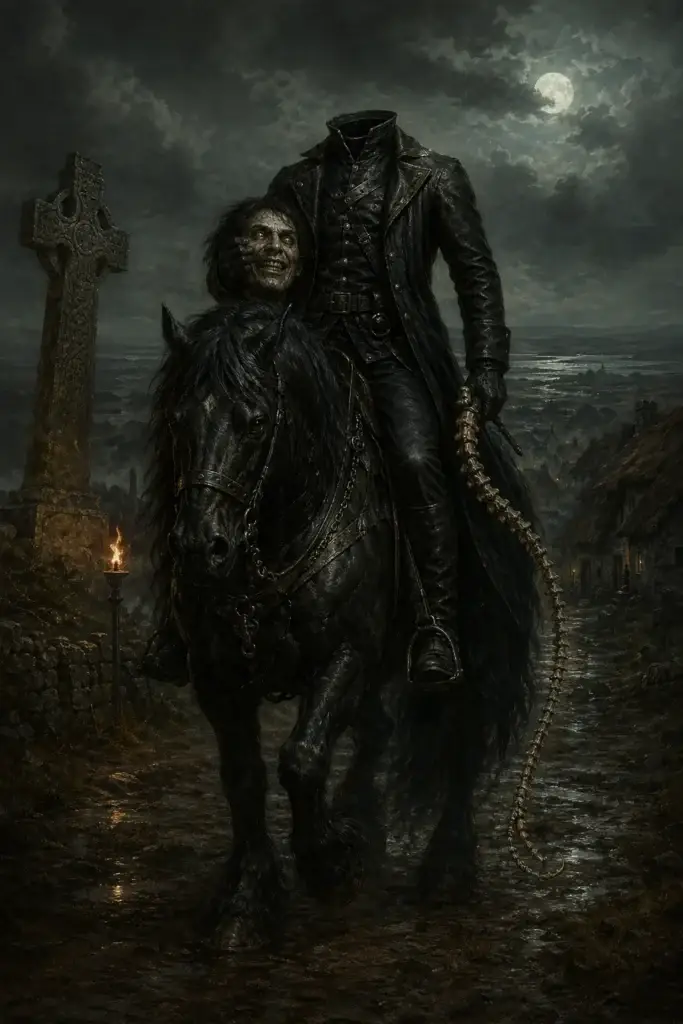
Dullahan
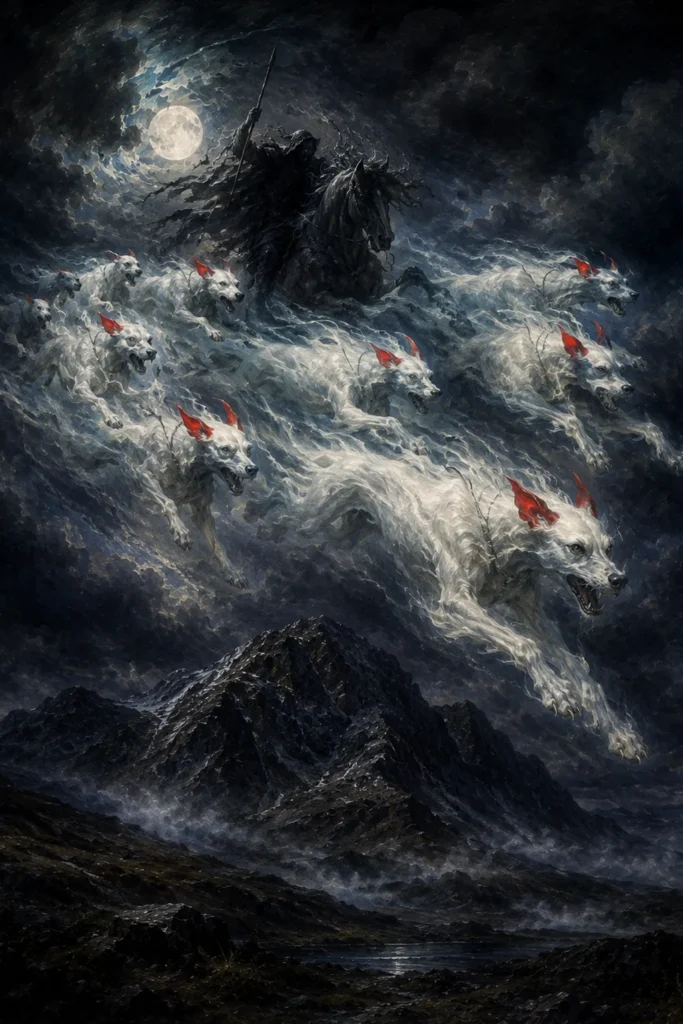
The Dullahan, Irish Dubhlachan or Gan Ceann (“without a head”), is one of the most striking death-messenger figures of the Celtic tradition. He rides at night on a black horse, carrying his own severed head under his arm.
When he stops and calls a name, the one called dies. He wields a whip made from a human spine and is sometimes accompanied by a black coach (Coiste Bodhar).
Like the banshee, the Dullahan announces death, through his appearance or by calling a name. His approach is absolute: doors open before him, his horse requires no bridle. One means of protection is gold.
A gold coin placed on his path forces him to stop or turn back. In modern reception, particularly through Washington Irving’s Sleepy Hollow story, the headless rider has become a worldwide horror icon.
Quick Overview: Dullahan
Type: Death messenger, headless rider
Origin: Celtic-Irish nocturnal tradition
Texts: Irish folk collections, Washington Irving (derived), modern popular culture
Period: 18th/19th century to present
Protection: Gold (one of the means)
Distinction from the Banshee: Unlike the Banshee, the female lamenting apparition, the Dullahan is a male headless rider of Irish folk tradition, who like her announces death.
Context
No medieval attestations, only modern records in Gaelic tradition. Richly documented in Irish folk collections of the 19th century. Washington Irving’s The Legend of Sleepy Hollow (1820) introduced the motif into American literature; subsequent films and fantasy popularized it worldwide.
Core region: Ireland, with regional variants. Scottish parallel figure less pronounced. Irving’s americanized “Headless Horseman” belongs to the Hudson Valley tradition. Modern reception is worldwide.
Irish folk collections (Yeats, Lady Gregory, Crofton Croker, Patrick Kennedy), Washington Irving’s tale, modern Celtic folklore archives.
Name
Irish: Dullahan, Dubhlachan; Gan Ceann (“without a head”); Far Dorocha (“dark man”, related figure).
Scottish Gaelic: less pronounced, but similar figures in folklore of the Highlands.
American: Headless Horseman (via Irving).
Coach variant: Coiste Bodhar, the black death coach, sometimes driven by the Dullahan.
The etymology is uncertain; possibly a Celtic pre-Christian root relating to “dark” or “hidden”. The Coiste Bodhar (“deaf coach” or “silent coach”) appears in the same tradition and is sometimes described as inseparable from the Dullahan.
Characteristics
Appearance
Headless rider on a black horse, carrying his own head under his arm. The head’s face grins grotesquely and is capable of sight and speech. The whip consists of a human spine. Sometimes accompanied by the black Coiste Bodhar with black horses and a coffin-shaped coachman’s box.
Behavior
Rides at night through villages and lonely roads. Stops before the house of a dying person and calls their name; the one called dies immediately. Doors open before him without human agency. He can see great distances because the detached head can be carried aloft.
Domain
Country roads, church paths, remote houses, at night. Anyone who encounters him directly without being summoned may be blinded or bear a permanent scar on their face. Border nights (Samhain and the eve of major festivals) are considered particularly dangerous.
Mythological Classification
Probably the transformation of an older Celtic death-deity figure (Crom Dubh?) through popular tradition. Influences from Germanic tradition (Wild Hunt, headless knight figures) are possible. After Christianization, reinterpreted as a demonic figure, without losing the function as a death messenger.
Profile: Dullahan
The most important aspects of the Dullahan at a glance.
Possibly a pre-Christian Celtic death-deity figure (Crom Dubh?) transformed within folk belief. Influences from Germanic rider figures are conceivable.
Those whose time has come. Not selective in the manner of the Banshee, which targets only certain families, but universal. Samhain and border nights are especially dangerous.
Headless rider, black horse. Head carried under the arm, grinning. Whip made from a human spine. Sometimes accompanied by a black coach (Coiste Bodhar).
Announces death. Calls a name, and the one called dies. Doors open of their own accord. A glance or a stroke of the whip can blind or mark a person.
Gold as one of the means of protection. Throwing a gold coin onto his path forces him to turn back. Do not ask about his coming, do not look at him, do not repeat what he says.
Encounter and Protection
The Gold Motif
In Irish folk tradition, gold is one of the means that stop the Dullahan.
A small coin on the road, a golden button on a garment, a wedding ring on the finger: these objects force the Dullahan to halt, sometimes to turn back, sometimes to deliver a lash of his whip that costs the person an eye.
Rules of Conduct
Do not walk alone at night on church paths. Do not look directly at him when you hear him. If he stops and knocks: do not open the door under any circumstances. Anyone who hears their own name spoken in a strange voice should remain silent and pray.
Protective Amulets
Rosary and cross after Christianization. Iron on the garment. A gold coin in the pocket; even the smallest amounts are said to be effective.
Reception
Washington Irving and Sleepy Hollow
The Legend of Sleepy Hollow (1820) draws on Dutch-American folklore for the figure of the headless rider in New York State. The American version combines the Celtic motif with that of a Hessian soldier; the story became known worldwide through film adaptations (Tim Burton, 1999).
Modern Popular Culture
The headless rider has become a Halloween icon. Fantasy role-playing games (Dungeons & Dragons) feature the figure as its own monster type. Japanese anime (Celty Sturluson in Durarara!!) and Western series draw directly on the Dullahan.
Symbolic Significance: The Dullahan concentrates three motifs: inescapable death, cosmic disorder (a living being without a head), and the individual summons (“Once your name is spoken, your time has come”). This makes him one of the most existentially resonant figures in the Celtic tradition.
Source Situation: A Being of Folk Narrative, Rarely of Ancient Texts
The Dullahan is not a figure of medieval Irish manuscript literature. He is absent from the major saga cycles, including the Ulster Cycle and the mythological narratives of the Tuatha De Danann.
His tradition belongs rather to the oral folk tradition of the 18th and 19th centuries, as recorded by the collectors of the Romantic era.
The most important early source is Thomas Crofton Croker’s Fairy Legends and Traditions of the South of Ireland, first published in 1825. Croker’s collection was translated into German by the Brothers Grimm, bringing Irish narratives into the European scholarly sphere.
In Croker and in later collections, including those of Lady Wilde and William Butler Yeats, the Dullahan appears as a headless rider who drives a black coach, the coiste bodhar or “silent coach”, whose appearance announces an impending death.
This late and literarily mediated tradition does not necessarily mean that the underlying belief is itself recent. Oral tradition can long predate its recording.
But it demands caution: much of what circulates today as “Celtic myth” concerning the Dullahan cannot be verified from Old Irish texts; rather, it emerged or solidified in the context of Romantic folklore collection.
The study of religion therefore treats the Dullahan as a regional phenomenon of early modern Irish narrative culture, not as a figure of a reconstructable pre-Christian pantheon.
The Motif of the Headless Rider in European Perspective
The headless rider is not an exclusively Irish phenomenon. The motif runs through European narrative tradition. Middle English literature presents, in the Green Knight from Sir Gawain and the Green Knight, a figure who picks up his severed head and continues speaking.
German legend knows headless ghosts, and Washington Irving’s The Legend of Sleepy Hollow of 1820 drew on Dutch-American traditions to produce one of the best-known versions of all.
Scholarship has proposed various interpretations. The loss of the head marks one who has died without crossing the normal threshold between life and death, a revenant of a particular kind. The head as the seat of identity and reason makes its absence especially disturbing.
In some Irish variants, the Dullahan carries his head under his arm or on the pommel of his saddle, and the face is said to grin and be capable of seeing over great distances.
In the Irish case, the connection with the announcement of death is characteristic. This brings the Dullahan close to the Banshee, with whom folk tradition occasionally places him. While the Banshee gives warning through lamentation, the Dullahan does so through his mere appearance or by pronouncing a name.
Whether one is an older layer and the other a more recent addition cannot be determined with certainty from the sources. What is clear is that both figures served the same need: to render sudden death narratable and furnished with signs.
Research Literature
Further standard works in the literature index.
The protective practices described here represent a scholarly classification of historical traditions. iWell Guard draws on this cultural-historical lineage of wearable protective objects and represents a contemporary form of it. More about iWell Guard →