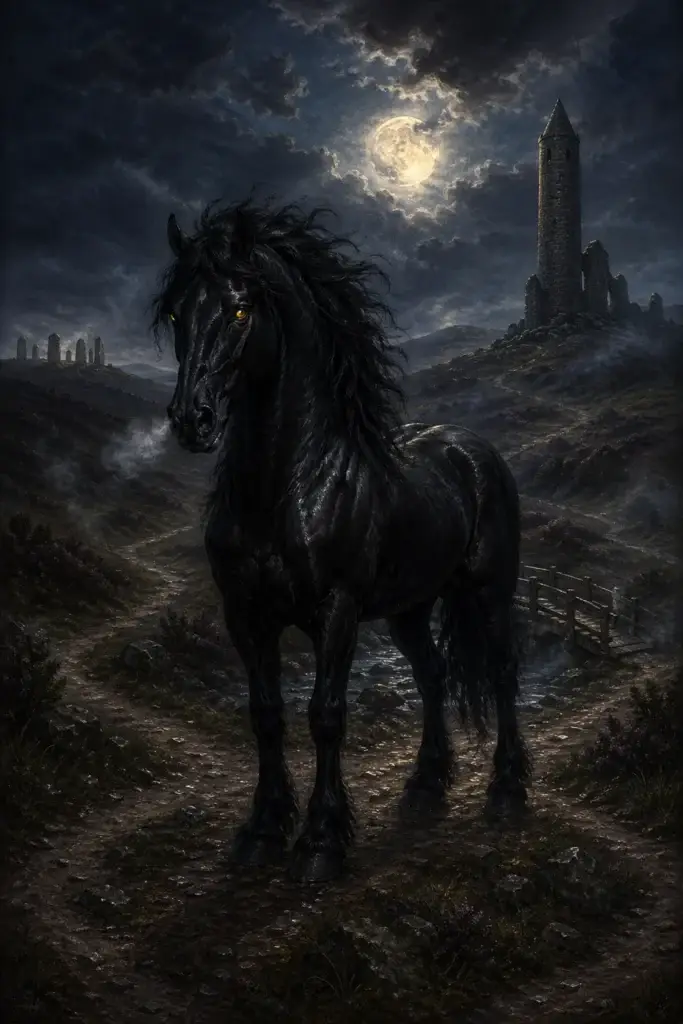
Knocker, the warner in the tin mines of Cornwall
By Ralf Ittermann · last reviewed on
The Knocker is a spirit of the Celtic tradition of Cornwall.
Its knocking warns of collapses and points to rich ore. The Knocker served as a warner in the tin mines of Cornwall, its sounds signalling danger below.
The Knocker, also called Tommyknocker or Bucca, is the knocking spirit of the tin and copper mines of Cornwall and Devon. Its knocking warns of collapses or indicates ore-rich veins; it usually remains invisible and is only heard.
Cornish miners, known as Cousin Jacks, carried this belief to America from the 1820s onwards, where the beings are called Tommyknockers. The Knocker is not warded off but appeased: with the last corner of the pastie and with good behaviour underground.
Type: Knocking spirit of the tin and copper mines
Origin: mining folklore of Cornwall and Devon
Texts: Hunt, Popular Romances; Briggs, Dictionary of Fairies
Period: documented from the 19th century
Appearance: small figure in miniature miner’s garb, usually only audible
Context of tradition
Period of the Texts
The Knocker belongs to mining folklore and is documented from the 19th century onwards; the classic collections come from Robert Hunt and Katharine Briggs.
Area of Diffusion
Cornwall and Devon, as well as the Cornish diaspora in the USA: from the 1820s onwards, emigrants carried the belief to Pennsylvania, Colorado, Nevada and California.
Sources
The source material is good: Robert Hunt documented the Cornish tradition in 1865, and Katharine Briggs classifies it lexicographically.
Name and variants
English/Cornish: knocker, dialectally knacker, comes from the knocking on mine walls, understood partly as an onomatopoeic term for the phenomenon and partly as an acting being. The alternative name Bucca is Cornish and corresponds to the Welsh Bwca, a goblin or spirit being.
Form and knocking signals
Appearance
The Knocker is a small figure of about sixty centimetres, with a large head, long arms, wrinkled skin and white whiskers, dressed in miniature miner’s garb. It is usually invisible and present only through sound.
Effect
Its knocking warns of collapses, in reality the cracking of rock and pit timber before giving way, and points to ore-rich veins. As a small mischief, it drives the theft of tools and food.
Profile: Knocker
The key aspects of the Cornish knocking spirit at a glance.
Knocking spirit of the tin and copper mines of Cornwall and Devon, carried by emigrants into US mining folklore as the Tommyknocker.
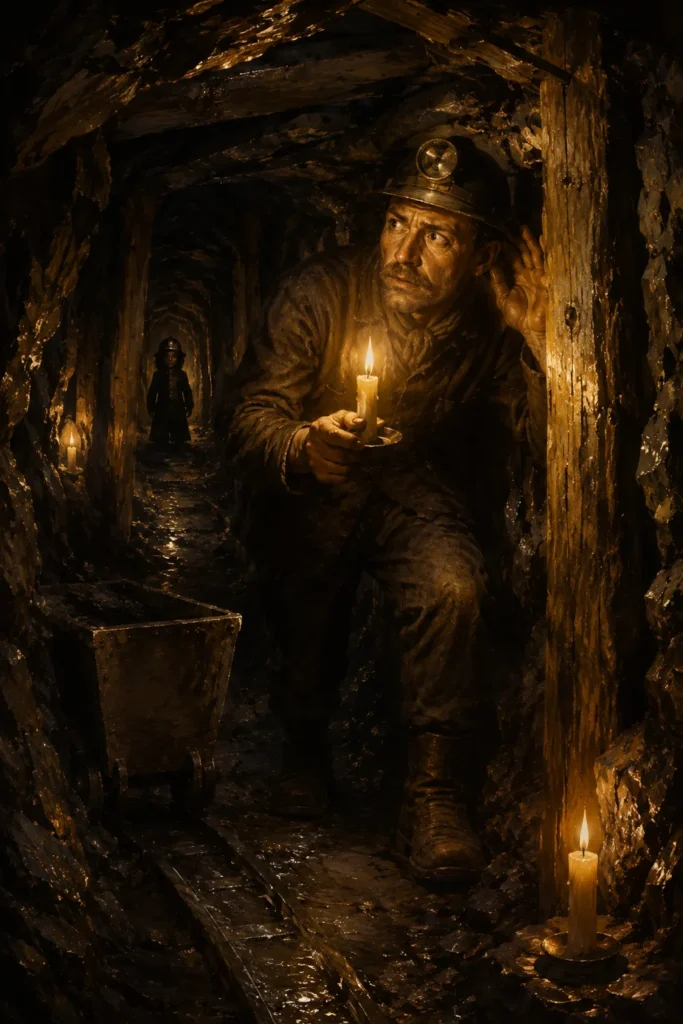
Miners underground: the Knocker warns of collapses and points to ore-rich veins, but demands respect in return.
About sixty centimetres tall, with a large head, long arms, wrinkled skin and white whiskers, dressed in miniature mining gear; usually only heard.
Warning of collapses and pointing to ore; alongside minor mischief such as stealing tools and food.
Appeasement rather than warding off: the last corner of the pasty for the mine, plus the taboo against cursing or whistling underground.
From the Cornish mine to the Tommyknocker
The name Knocker, dialectally knacker, comes from the knocking on mine walls, sometimes understood as onomatopoeic for the phenomenon, sometimes as an acting being. The alternative name Bucca is Cornish and corresponds to the Welsh Bwca, a Kobold- or spirit-like being.
From the 1820s onwards, Cornish miners carried this belief to the American mining regions of Pennsylvania, Colorado, Nevada and California, where the beings are called Tommyknockers; the migrants themselves were called Cousin Jacks. Thus a spirit of the Cornish tin mines became a figure of American mining folklore, faithfully tracing the path of those who carried it.
Reception between Cornwall and America
Stephen King’s 1987 novel The Tommyknockers popularised the name, without folkloristic fidelity. The Knocker is also present in US mining folklore and in Cornish cultural tourism.
From a religious-studies perspective, the Knocker is generally benign and warning; danger arises only from disregard and the loss of its favour. One clarification is important: the interpretation that Knockers are spirits of Jewish miners from the 11th or 12th century is a folk legend, not evidence of actual Jewish mining work in Cornwall, and should be reported only as a motif.
Appeasement rather than warding off
No banishing formula helps against the Knocker, for it is not warded off but appeased: the last corner of the pasty was thrown into the mine. Cursing and whistling underground were taboo, as they angered the Knockers; however, whether this whistling taboo relates specifically to Knockers or is a more general mining superstition remains uncertain.
Coblynau, Brownie and Bergmönch
Frequently asked questions about the Knocker
What is a Knocker?
The knocking spirit of the Cornish tin mines, whose knocking warns of collapses and points to ore.
What is a Tommyknocker?
The Knocker within the Cornish diaspora in the USA, brought there by the Cousin Jacks.
How is it appeased?
By giving it the last corner of the pasty in the mine and by not cursing or whistling underground.
Further links
Further reading:
- Celtic – all beings of the Celtic tradition
- Coblynau – the Welsh relatives of the Knocker
- Brownie – the helpful house spirit of the British Isles
- Amulet, Salt, Protective Candle – traditional protective means
- Protection Compass – an overview of protective means
Literature (selection)
Further standard works in the bibliography.
As a Cornish mine spirit and knocking spirit of the tin mines, the Knocker combines warning and goodwill: whoever leaves it the last corner of the pasty has an ally underground.