Púca, Spirit of the Celtic Tradition
By Ralf Ittermann · last reviewed on
Púca is a spirit of the Celtic tradition.
The Celtic shapeshifter, between Puck and the black horse.
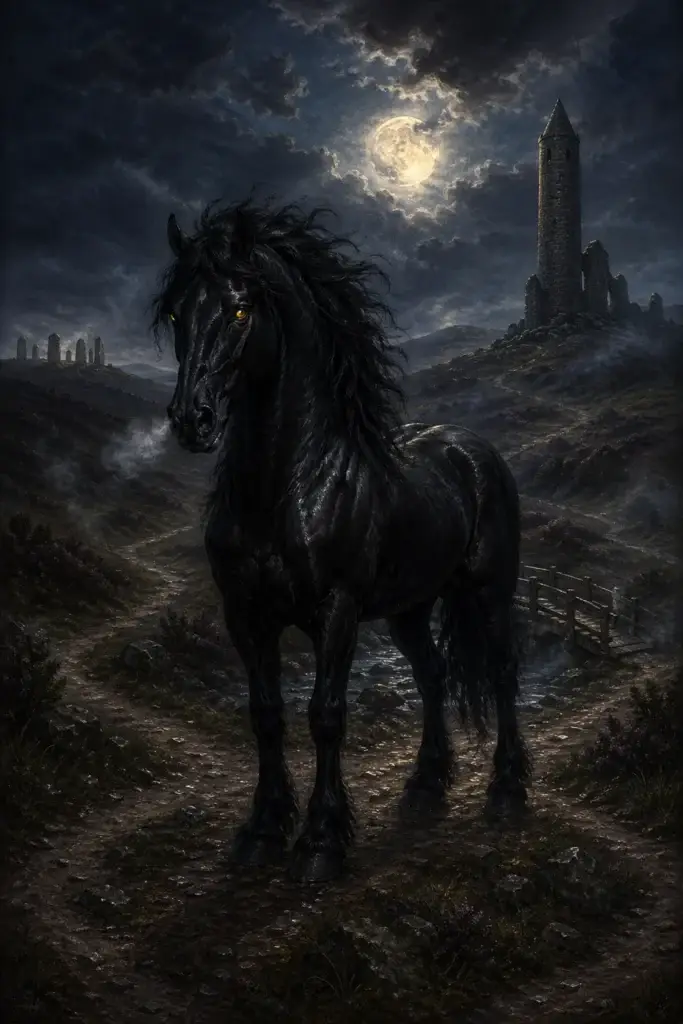
The Púca (Irish; Welsh Pwca) is the most prominent trickster figure of the Celtic tradition, a shapeshifter appearing as a black horse, goat, hare, dog, or in human form.
Its moods are unpredictable: it may take people on wild rides through the night (leaving them alive or dead), protect good harvests or ruin them after Samhain, and mislead the wise through bad counsel.
The English “Puck” (Shakespeare, A Midsummer Night’s Dream) and the Cornish “Pixie” are compared with the Púca; the name Puck derives from Old English pūca, and a derivation from the Irish Púca is not documented. Having become a defining literary figure, it often loses its darker aspects in popular perception. In Irish tradition it remains ambivalent: comic and dangerous at once, a being of the threshold between order and chaos.
Welsh Pwca and Irish Púca, name variants
The Celtic trickster being is recorded in several variants. In Welsh it is called Pwca (also Piwca), in Irish Púca or Pooka. The origin of these name variants is unclear; a borrowing from Germanic is considered likely.
The Welsh Pwca is often depicted as a goblin-like being, playful and sometimes malicious but rarely lethal. The Irish Púca shares similar traits but is often larger and more dangerous, sometimes appearing in horse form.
A secure derivation is difficult. The phonetic similarity across languages and regions is considerable and supports the hypothesis of a supra-regional traditional layer.
At a Glance: Púca
Type: Trickster, shapeshifter
Origin: Celtic Otherworld inhabitant, part of the Aes Sídhe
Texts: Irish and Welsh folk narratives, Shakespeare, Yeats
Period: medieval to present
Notable feature: after Samhain it spoils the remaining harvest
Context
Medieval sources with early attestations; literary flowering in the Early Modern period (Shakespeare 1595); folkloristic collections of the 19th century (Yeats, Crofton Croker); modern film and fantasy reception.
Ireland (Púca), Wales (Pwca), Cornwall (Pixie, developed into a playful-comic figure), Isle of Man (Phynnodderee). The English Puck became world-famous through Shakespeare.
Irish folk texts, Welsh legends, Shakespeare’s A Midsummer Night’s Dream, Crofton Croker’s Fairy Legends and Traditions of the South of Ireland (1825), Yeats collections, modern film adaptations.
Name
Irish: púca.
Welsh: Pwca.
Cornish: Pixie.
English: Puck, Pook.
Manx: Phynnodderee.
Etymology: unclear; possibly a pre-Indo-European substrate.
The term travels across Celtic and Anglo-Saxon tradition. Shakespeare makes Puck a light-footed comic figure, but omits the dangerous aspects; Yeats notes in his commentaries that the Irish Púca is considerably darker.
Description
Appearance
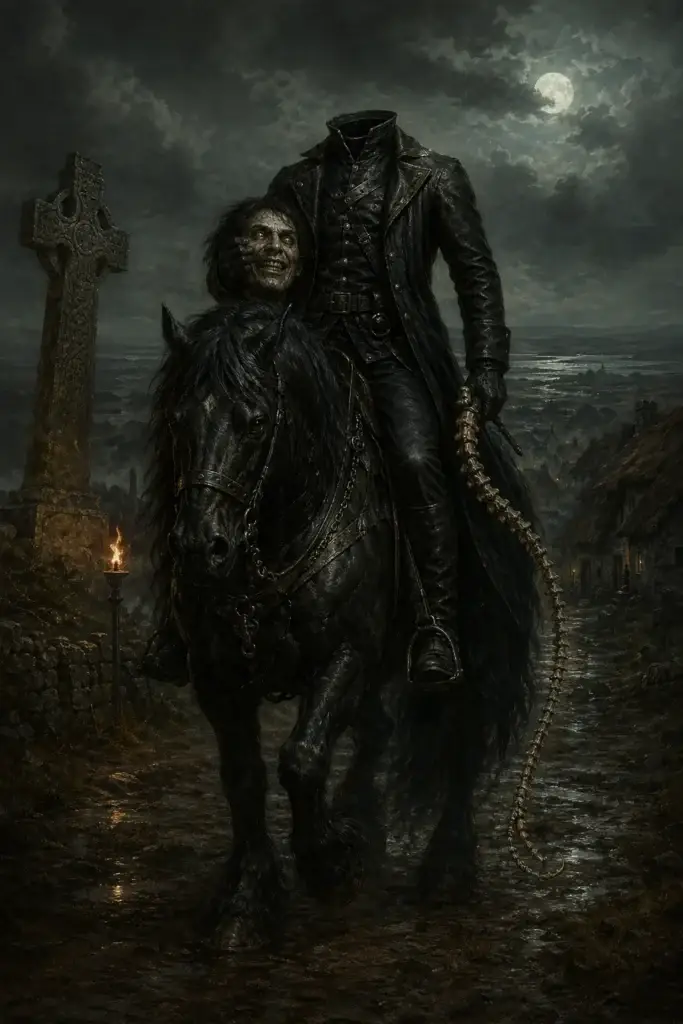
Usually black. In horse form: a black horse with yellow eyes, without saddle. In hare, dog, goat, or rooster form. In human guise: a black-clad stranger, often with horse-like features. Its eyes remain characteristically yellow in all forms.
Behaviour
Shapeshifting, unpredictable. It offers nocturnal rides; those who mount voluntarily experience wild journeys. Some return unharmed, others traumatized, and some not at all. At Samhain, 31 October, it is especially active; after that date all blackberries and field crops are considered spat upon by the Púca and unfit to eat.
Domain of Influence
Fields, forest edges, lonely paths, barns, mills. Specific Samhain days, transitional times, liminal situations.
Mythological Classification
Part of the Aes Sídhe, at its rebellious margin. Not a clear villain but rather a trickster figure that blends order and chaos. According to one tradition, the soul of a deceased person who refused to enter the regular Otherworld.
Shakespeare and the Puck figure in A Midsummer Night’s Dream
William Shakespeare’s A Midsummer Night’s Dream (ca. 1595) introduces Puck, a merry and cunning being that inhabits the forest and advances the plot through trickery. Puck is not portrayed as evil but as morally neutral, interested in chaos for its own sake.
Modern scholarship debates whether Puck is a direct descendant of the Celtic Púca/Pwca or whether Shakespeare reimagined an English folk figure shaped, among other influences, by Celtic traditions.
Shakespeare’s Puck has largely shaped the English-speaking perception of the trickster archetype. Subsequent literature frequently followed Shakespeare’s reading, a cheerful and irrational being rather than a dangerous demon. This literarization may have altered the understanding of the Celtic original figure under the influence of English discourse.
Profile: Púca
The most important aspects of the Púca at a glance.
Part of the Aes Sídhe, at the trickster margin. According to one interpretation, the soul of a deceased person who avoids the regular Otherworld.
Night travellers, farmers after Samhain, mill hands. Anyone travelling alone or staying outdoors too long after the harvest.
Black, yellow eyes. Horse, hare, goat, dog, rooster, or a black-clad man. Shapeshifting, usually at night.
Nocturnal rides, spoiling of crops after Samhain, dispensing counsel (dangerous or helpful), pranks. Capricious, ambivalent.
After Samhain, avoid eating blackberries, mushrooms, or late-season fruit. Courtesy toward unfamiliar black horses. Iron at the belt. Púca offering: a small bowl of milk at the front door.
Shakespeare’s Puck, Cornish Pixie, Germanic Kobold, Slavic Leshiy (shapeshifter), tricksters worldwide (Coyote, Loki).
Encounter and Respect
Samhain custom
31 October marks the end of edible wild fruits. Whatever still hangs on the bush after Samhain belongs to the Púca; eating it risks illness or poisoning. Modern botanical explanation: after the first frost, many wild fruits do in fact deteriorate rapidly.
Riding with the Púca
Those who encounter it must decide quickly. Courtesy helps; open fear does not. In one well-known account (Donegal), a man rides the Púca, speaks to it respectfully, and is set down at his own house in the morning with a golden horseshoe. Other versions end tragically.
Protective Practice
Iron at the belt, a rowan branch in the pocket, the sign of the cross when leaving the house after dark. A small bowl of milk or bread at the front door as a gesture of courtesy.
Reception
Shakespeare and the English Puck
In A Midsummer Night’s Dream (ca. 1595), Puck appears, a roguish assistant to Oberon who is compared with the Púca. The darker Irish dimension is lost; the literary Puck is charming and cunning, not dangerous. This version shapes English and worldwide reception.
Modern Fantasy
Tolkien, Susanna Clarke, and Neil Gaiman draw on the motif of the trickster shapeshifter. Roleplaying games and video games have established the Púca as a standard figure in Celtic-inspired settings.
Contemporary Irish Culture
Films such as Púca (Irish, 2020s) and the “Púca Festival” in Meath keep the figure alive. Together with the Banshee, it is the most widely received Celtic folklore figure worldwide.
W. B. Yeats and the literary collection of Irish traditions
The Irish poet and folklorist William Butler Yeats began publishing collections of Irish folk stories from 1888 onwards, including several Púca narratives.
Yeats portrayed the Púca as a being that oscillates between helpful and obstructive; sometimes it turns people away, sometimes it aids them. Yeats’ collection compiled printed sources (including Croker, Carleton, and Lady Wilde) and claimed ethnographic authenticity, even though his literary treatment romanticized the sources.
Yeats’ influence on modern Celtic folkloristics is considerable. His Púca portrayals became the standard reference text and inspired subsequent collectors. This literary mediation has, however, also coloured the canonical Púca figure; it is difficult to distinguish between Yeats’ vision and the original tradition.
The Púca in Irish and Welsh Tradition
The púca, in Welsh form pwca, in English spelling often pooka, belongs to the most widespread figures of the Celtic-language folklore of the British Isles.
The word is linguistically related to the Old English pūca and the Scandinavian environment of the puki, and the English figure of Puck, known from Shakespeare’s A Midsummer Night’s Dream, belongs to this broad etymological field as well.
Research sees in this an indication of an ancient type of mutable fright-spirit and goblin-spirit that spread across language boundaries.
The Irish púca is above all a shapeshifter. It appears as a black horse, a billy goat, a bull, a dog, a hare, or an eagle, and occasionally in semi-human form.
Its most familiar manifestation is that of the dark horse that pulls nocturnal wanderers onto its back and carries them through the landscape in a wild, breathless ride before setting them down unharmed but exhausted and frightened. The púca does not as a rule kill, but it frightens, confuses, and leads people astray.
Its ambivalence is characteristic. Folk narratives, collected among others by Lady Wilde and in the great Irish folklore collections of the 19th and 20th centuries, also show the púca as a being that can speak with people, give them counsel, or secretly operate a mill for them at night.
It is therefore not an unambiguous demon but a threshold being whose goodwill and malice depend on place, occasion, and human behaviour.
Samhain, Harvest Customs, and the Season of the Púca
In Irish folk tradition, the púca is closely connected to the cycle of the year and in particular to the feast of Samhain on 1 November, the transition from the light to the dark half of the year.
Samhain was regarded as a time when the boundary to the Otherworld became permeable, and the púca is among the beings that are especially active during this threshold period. In some regions, the day around Samhain was expressly called the day of the púca.
Connected to this is a concrete harvest custom. According to widespread belief, the púca claimed everything still standing in the fields after Samhain, that is, all fruits, berries, and field crops not brought in on time.
Anyone who collected and ate blackberries or other remaining produce after that date risked that the púca had spoiled or contaminated them. This custom served a practical function: it set a clear deadline for the harvest and sanctioned carelessness with the threat of the spirit.
Such customs show that the púca was not merely a narrative being but was embedded in the agricultural cycle of the year. It marked transitions, deadlines, and taboo zones.
Research into Irish folklore emphasizes that many of these spirit figures functioned as personifications of rules and boundaries: they made tangible when something was permitted and when it was not, where people could move freely and where they had to show restraint.
The púca of the Samhain season is in this sense a guardian of the boundary between human use and the no-longer-human world of the dark half of the year.
Research Literature
Further standard works in the literature index.
The protective practices described here represent a scholarly classification of historical traditions. iWell Guard draws on this cultural-historical lineage of wearable protective objects and represents a contemporary form of it. Learn more about iWell Guard →