Sluagh, Spirit of the Celtic Tradition
By Ralf Ittermann · last reviewed on
The unholy host of the dead, flying souls without a home.
Sluagh is a spirit of the Celtic tradition.
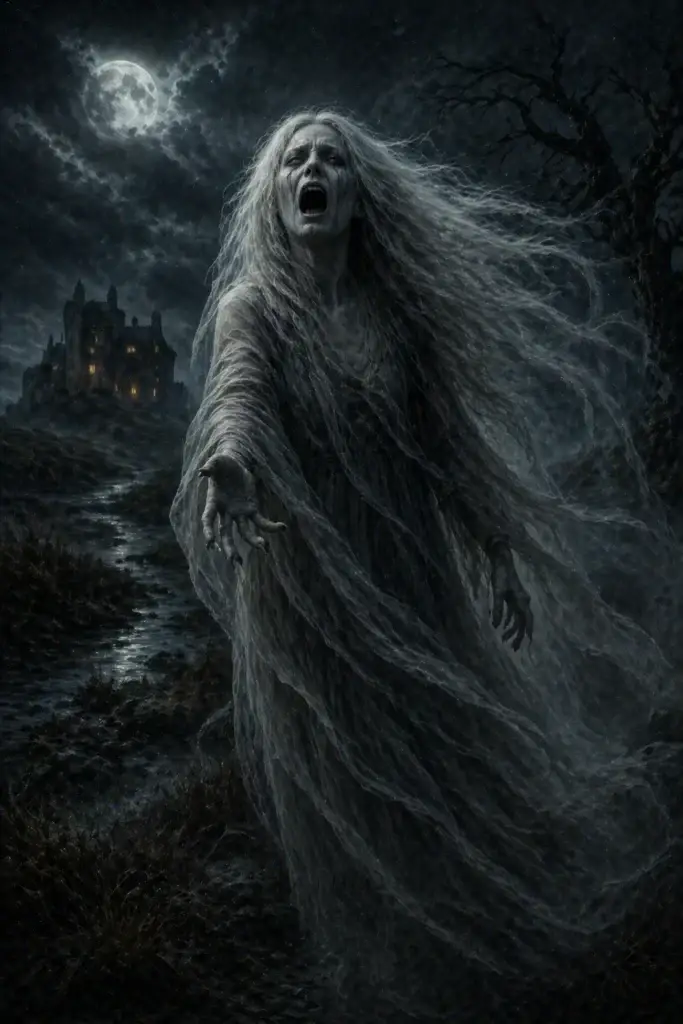
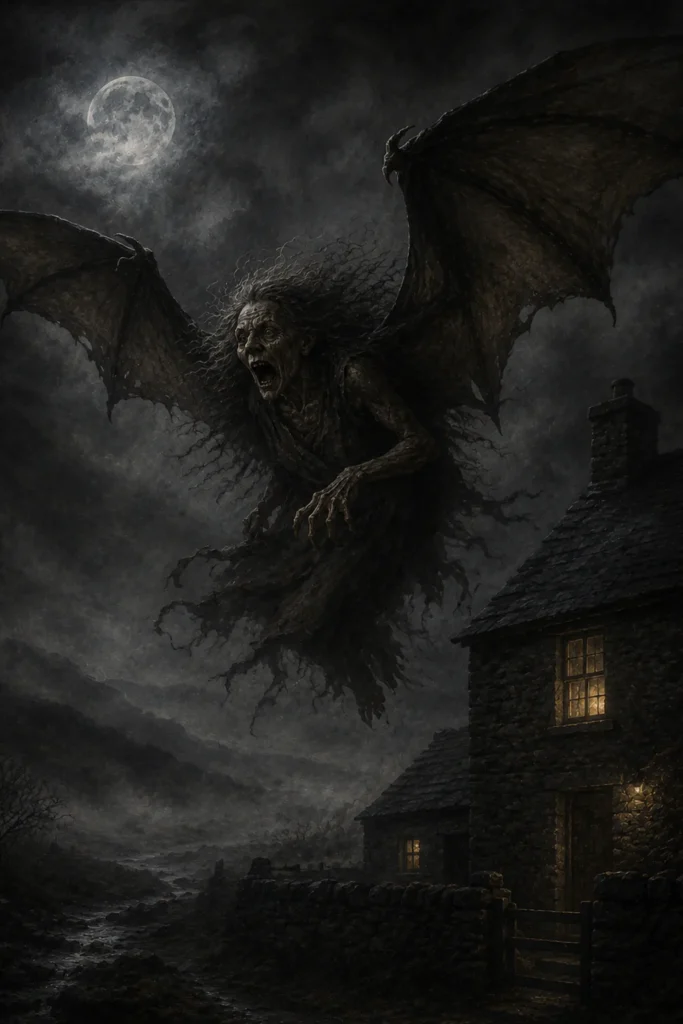
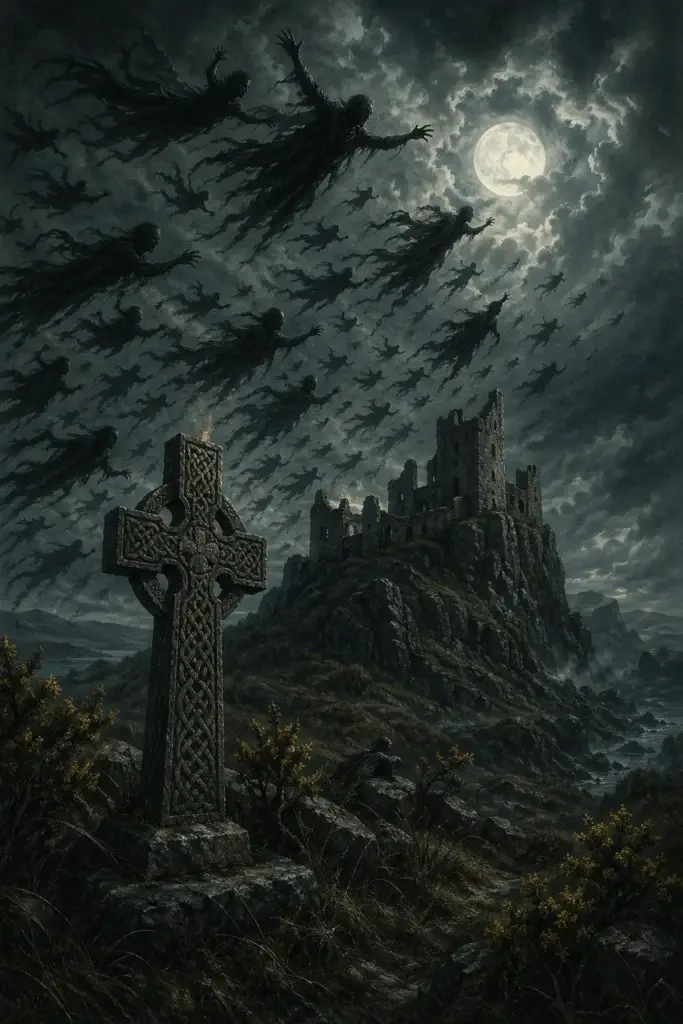
The Sluagh, Gaelic for “host,” are a collective of restless souls in Celtic (especially Scottish Gaelic and Irish) folklore. They form a flying swarm across the night sky, passing with great noise and capable of seizing the dying from their beds.
They are said to enter through the western window in particular; in many coastal regions of western Scotland, the west side of a house where someone was dying therefore remained closed and draped well into the twentieth century.
As a collective figure of the unredeemed dead, the Sluagh stand alongside the Banshee and the Dullahan as expressions of the Celtic relationship with death: not an individual adversary, but a community of the unreconciled.
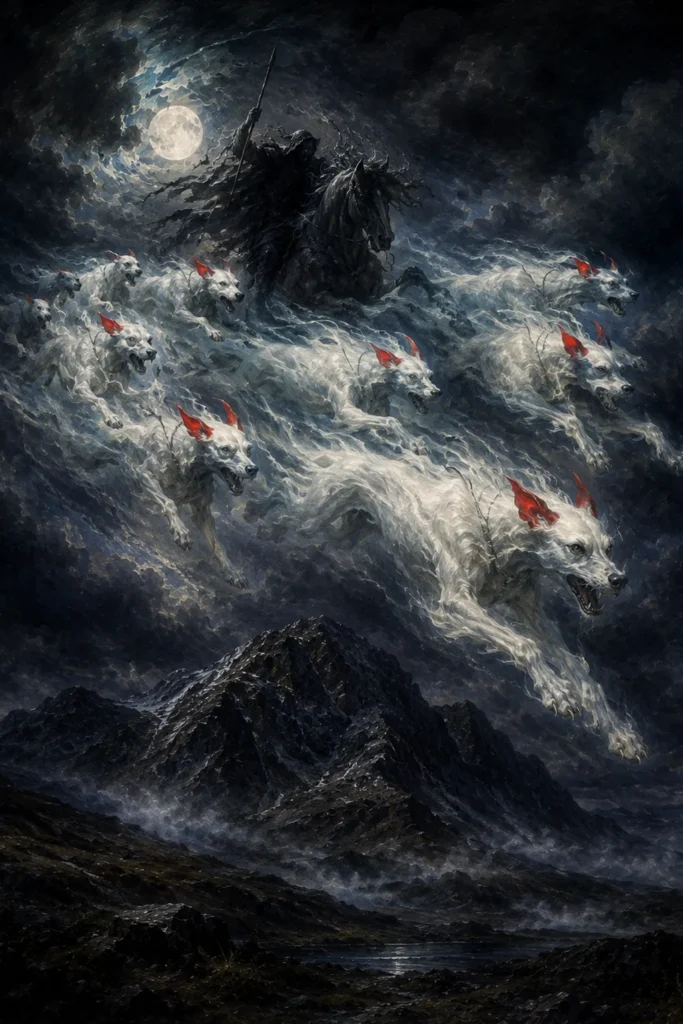
The figure has parallels in the Germanic Wild Hunt, in the Greek Keres, and in the Mesopotamian Gallu. In modern fantasy reception, it remains a living concept.
The Scottish-Irish Tradition of the Host of the Dead
The Sluagh (Irish: “multitude” or “host”) appears in Scottish and Irish tradition as a throng of the dead moving through the landscape at night. In Scottish Gaelic, the being is often called sluagh sídhe (host of the fairy mounds) or sluagh gaoithe (host of the wind).
This points to an ambivalence: the Sluagh may consist either of fallen fairies or of unquiet human souls; the sources do not resolve this clearly.
John Gregorson Campbell, a nineteenth-century Scottish folklorist, documented in his collections the Sluagh as a nocturnal apparition against which windows had to be kept shut so that the host could not enter the house. These precautions were standardized regionally, suggesting that the belief was not merely an individual fancy but collectively anchored.
At a Glance: Sluagh
Type: Collective of restless souls, flying host of the dead
Origin: The unredeemed, sinful, neglected dead
Texts: Scottish and Irish folk tradition, Evans-Wentz
Period: Medieval to the present
Warding: Western window closed, crosses, salt, iron
Historical Context
Medieval Gaelic sources, with a dense presence in Scottish and Irish folk literature, richly documented in Evans-Wentz’s Fairy-Faith in Celtic Countries (1911) and in the collections of Lady Gregory and J. F. Campbell.
Primarily Gaelic Scotland (Hebrides, Highlands) and Ireland. Related motifs appear in Breton tradition (anaon, the dead). The Germanic Wild Hunt is structurally cognate.
J. F. Campbell’s Popular Tales of the West Highlands (1860, 62), Evans-Wentz, Alexander Carmichael’s Carmina Gadelica (1900), folklore archives of the Hebrides, and modern ethnographic studies of the Scottish west.
Name and Variants
Scottish Gaelic: sluagh; sluagh na marbh, “host of the dead”; sluagh sìth, “host of the mounds.”
Irish: slua, sluagh, rarely used as a standalone term; more often a collective designation for restless dead.
Related: Breton anaon; Germanic Wild Hunt; northern French Mesnie Hellequin.
The Gaelic word sluagh originally means simply “host,” any crowd of people. In folk tradition it narrows to mean the host of the dead.
Description
Appearance
A swarm of dark birds across the evening sky, with unusually loud wingbeats. Or a swarm of black shadows moving like clouds. Individual Sluagh are sometimes individualized (with faces, lamenting voices), but usually experienced as a collective.
Behavior
They move through the night, especially toward the west. They can drag the dying from their beds and take them into their train; the soul then becomes part of the host. Sometimes they settle on houses; a wailing sound through the chimney is taken as a sign that someone in the house will follow them.
Sphere of Influence
The air above houses, especially in the evening and at night. The chamber of the dying, particularly when the western window stands open. Churchyards and their surroundings on certain threshold nights.
Mythological Classification
Part of the Aes Sídhe world, but at its dark edge. The Sluagh are not the mound-dwellers; they are those who found no mound. In Christianized interpretation, they are the souls that can reach neither heaven nor hell.
James Macpherson and the Ossian Reception
James Macpherson published in 1760 Fragments of Ancient Poetry, supposedly derived from the Gaelic poet Ossian. Macpherson presented these works as authentic medieval texts, which was later shown to be a fabrication.
Nevertheless, these texts had an enormous cultural impact. The Sluagh concept appears in the Ossian poems, amplified by Macpherson’s Romantic interpretation as the tragic host of the dead, a reading that had not previously been so central.
Macpherson’s Ossian fiction durably shaped the cultural perception of Scottish and Irish traditions. The Sluagh was romanticized through this literary mediation and carried to a wider European audience. Historians still debate how much of the modern Sluagh conception derives from genuine tradition and how much from Macpherson’s fiction.
Profile: Sluagh
The most important aspects of the Sluagh at a glance.
Collective of unredeemed souls, sinful, forgotten, neglected dead. Not individual figures, but a swarm.
The dying in their beds, especially when the western window is open. In a broader interpretation: people in liminal situations between life and death.
A swarm of dark birds or shadows, loud wingbeats. Individual faces occasionally visible, but usually experienced as a collective.
Seizes the dying, carries souls into the underworld. The passage itself brings misfortune to houses it passes.
Western window closed and draped during a death; crosses and images of saints in the chamber of the dying; salt on thresholds; iron at the window frame. When the Sluagh pass: take shelter indoors, do not go into the fields.
Protective Practices
Deathbed Practice
In the folk belief of western Scotland, the western window was bolted and draped with cloth when someone lay dying. Some families left a window on the north side open so the soul could depart through the north window, but never toward the west, where the Sluagh wait.
Protecting the Home
Trails of salt before western windows and at house entrances. Iron nails at the window frame. Burning candles that must not be allowed to go out. Prayers from the Carmina Gadelica (Alexander Carmichael’s collection) include specific texts for warding off the Sluagh.
Behavior When the Sluagh Appear
When the Sluagh pass: people take shelter indoors. Never go into the fields, do not look up at the sky. In some traditions, people fall to the ground and cover their face and ears until the procession has passed.
Parallels and Significance
European Parallels: The Germanic Wild Hunt, Odin or a mythic hunter with a retinue of the dead, is structurally the closest parallel. The Mesnie Hellequin in France, the Wütende Heer in parts of Germany, the Breton anaon: all share the motif of the flying collective of the dead.
Classical Parallels
Keres over the battlefield and Gallu as underworld enforcers present structurally similar collective images of death.
Cultural Context: The Sluagh conception reflects the Celtic tension between death and the Otherworld: not everything is received; some things remain uncannily in between. The motif has acquired an additional layer of contemporary resonance under colonial conditions and during the Great Famine, serving as an image of historical trauma.
Cosmological Function and the Boundary between Life and Death
The Sluagh marks, in Celtic conceptions, a boundary between the world of the living and the Otherworld. They are not damned in the Christian sense, but transitional, beings that move between worlds.
This cosmological positioning distinguishes the Sluagh from demonic beings that exist for their own purposes. The Sluagh is more a manifestation of a collective unrest, a transition that remains incomplete.
Modern religious-studies scholarship treats the Sluagh as a cultural externalization of grief and loss, a form through which societies process their dead and assign them a narrative space. This psychological or social interpretation does not replace the supernatural reading but complements it.
The Host of the Dead in Gaelic Tradition
The sluagh (Gaelic for host, band, multitude), frequently referred to in folklore as sluagh sidhe, the host of the Otherworld, ranks among the most uncanny figures of Scottish and Irish Gaelic tradition.
Unlike a single spirit, the sluagh is a collective being: a flying host of spirits moving through the night air. In the prevalent conception, these are the spirits of the restless dead, often specifically the souls of sinners, the unbaptized, or those for whom neither heaven nor earth nor an ordered Otherworld stands open.
Key evidence for the sluagh comes from the major collections of Scottish folklore, above all from the Carmina Gadelica by Alexander Carmichael, who recorded prayers, blessings, and folk-religious traditions on the Scottish islands and in the Highlands during the late nineteenth century.
There the sluagh appears as a host that fights in the air, whose traces could be seen in the morning as bloodstains on rocks, and that comes from the west.
The religious-studies classification emphasizes the mixture of layers. In the sluagh, pre-Christian conceptions of a wandering host of spirits combine with the Christian concern for the fate of the soul after death, particularly the souls that cannot reach peace.
The host of the dead is thus less a clearly defined mythological figure than a nodal point at which folk belief, Christian eschatology, and the experience of storms and night sounds condense.
Direction, Windows, and Protection from the Sluagh
In lived folk belief, the sluagh was associated with specific precautionary rules. A widely held conception concerned cardinal direction: the west was regarded as the dangerous side from which the host of the dead came.
The west was also the direction of sunset and, in Gaelic tradition, associated with the land of the dead. This gave rise to the practice of keeping windows facing west closed near the dying or at night, so that the sluagh could not enter and seize the soul of someone passing away.
For it was said of the sluagh that it tears people away with it. Those who were outdoors at night, especially the weakened, the dying, or the unwary, risked being seized by the host and carried off.
In some narratives, the sluagh even compels the one it has seized to take part in its destructive acts, such as shooting an arrow at livestock or at other people. The host is therefore not only a threat from outside; it can draw a person into its own destructive activity.
Protection from the sluagh thus lay above all in avoidance and shielding: remaining indoors at night, securing windows and doors on the dangerous side, not leaving the dying alone or unprotected. Carmichael also transmits blessings and protective prayers that belong to this context.
Read through a religious-studies lens, the sluagh functions as an explanation for sudden deaths, for nocturnal anxieties, and for the disappearance of people, and at the same time as a warning not to cross the threshold between day and night, inside and outside, life and death carelessly.
Selected Bibliography
Further standard works in the literature index.
The protective practices described here represent a religious-studies classification of historical traditions. iWell Guard connects to this cultural-historical line of wearable protective objects and represents a contemporary form of it. More about iWell Guard