Gallu, Demon of the Mesopotamian Tradition
By Ralf Ittermann · last reviewed on
Demons of the underworld, messengers and enforcers of the beyond.
Gallu
Gallu is a demon of the Mesopotamian tradition.
The Gallû are among the oldest attested demonic figures of Mesopotamia. They are close to the underworld and its mistress Ereškigal and appear in myths as well as in ritual texts as enforcers of death.
Typical of them is their inaccessibility: the texts emphasize that they accept neither food nor drink and know neither gifts nor sweetness. They cannot be bargained with.
In the famous tale of Inanna’s descent into the underworld, it is the Gallû who demand a substitute for the goddess and lead Dumuzi into the underworld. This scene shapes the picture to this day: the Gallû are the messengers who come when a person’s time has run out.
Gallu (Akkadian: gal-lu, a loanword from Sumerian gal₅-lá) are demonic beings or demons of the underworld in Mesopotamian mythology. They are attested in cuneiform texts from Sumer to Babylon and are often described as subordinates of the underworld goddess Ereshkigal or of the death god Nergal. They personify illness, plague and sudden death.
Context
Evidence for the Gallû ranges from early Sumerian myths (3rd millennium BC) into the Neo-Babylonian and Achaemenid period. No other type of demon is documented as consistently across Mesopotamian cultural history.
Mythological classification
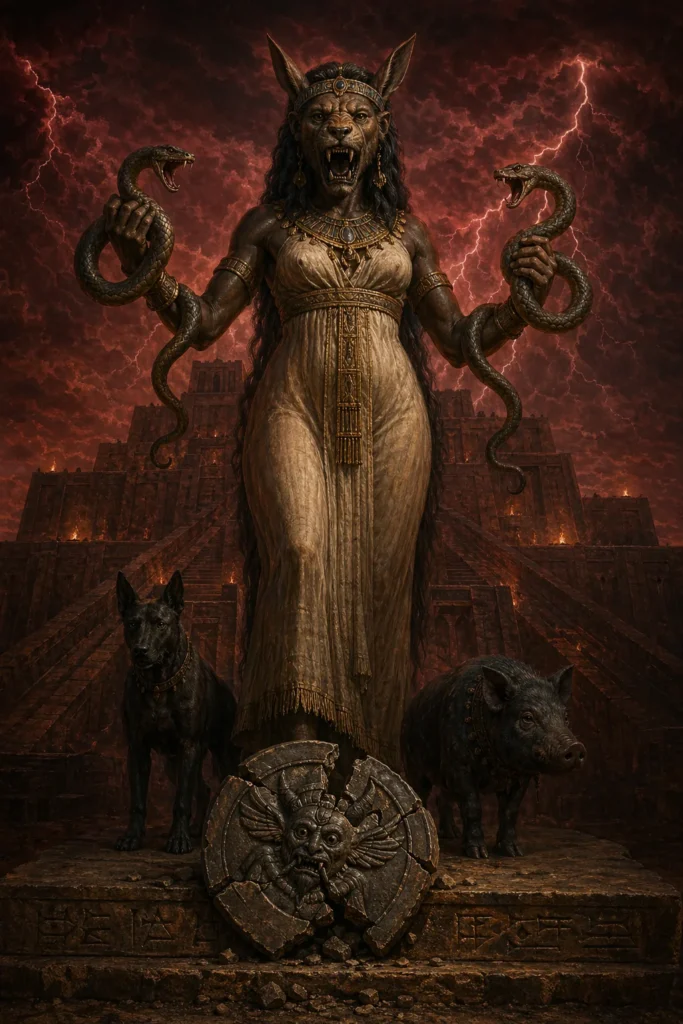
Gallu, one of the demons of the underworld, is a being that serves Ereshkigal, the queen of the underworld. Gallu are not necessarily evil in a moral sense, but rather the agents of Ereshkigal’s will, enforcers of her commands, catchers of souls and escorts of the dead into the underworld.
They are feared because their arrival signals death. Gallu can also be understood as demons of illness and swift death who fetch people from the world above. They represent the inevitability and impartiality of death.
Gallu are documented above all in Babylonian and Assyrian clay-tablet series, particularly in the accounts of the descent into the underworld (the Inanna-Ereshkigal cycle, with some parallel texts also in Hittite). They were feared throughout the land between the two rivers, from Sumer to Assyria, and were combated through incantations and apotropaic rituals.
The source situation for Gallu is fragmentary. The primary texts are cuneiform mythologemes and lists from Old Babylon (c. 1800, 1600 BC) as well as later Assyrian parallel texts.
The Assyriologists Bottéro, Wiggermann and Schwemer have analyzed this material and placed it within the context of Mesopotamian demonology. A secure identification of individual Gallu types is difficult today, since the tablets are often partly destroyed and show variations in the names.
Designation and Spellings
Sumerian: gal-lá.
Akkadian: gallû.
Common as a group: often the “seven Gallû”, a typical full-number motif of Mesopotamian demonology.
The etymology is disputed; connections to terms for “enforcer” or “violence” are discussed. More important than the derivation is the fixed role: the Gallû are always an executive organ, rarely an independent figure. They usually appear in groups, act on behalf of the underworld and are nameless.
Description
Appearance
The texts describe the Gallû more by what they are not. They know no food, no thirst, no gift, no sweetness. Where pictorial depictions can be grasped, they are shadowy, terrifying and hard to pin down. They thus belong rather to the non-figurative demons of Mesopotamia.
Behavior
The Gallû come to fetch. They bring the souls of the dying into the underworld, demand a substitute when order has been disturbed, and carry out the judgments of the realm of the dead. Their actions are purposeful and not open to negotiation; gifts or incantations work only within narrow ritual limits.
Sphere of effect
The transition between life and death, the deathbed, places of violent death, ritual threshold situations. They act where a decision about life or death is made, or where the cosmic order demands a substitute.
Mythological origin
The Gallû are servants of the underworld, especially of Ereškigal. In “Inanna’s Descent into the Underworld” they appear as a group that forces the goddess into the underworld and later demands Dumuzi as a substitute. Their role is thus structurally fixed: they are the outstretched tool of the underworld in the world of the living.
Appearance and symbolism
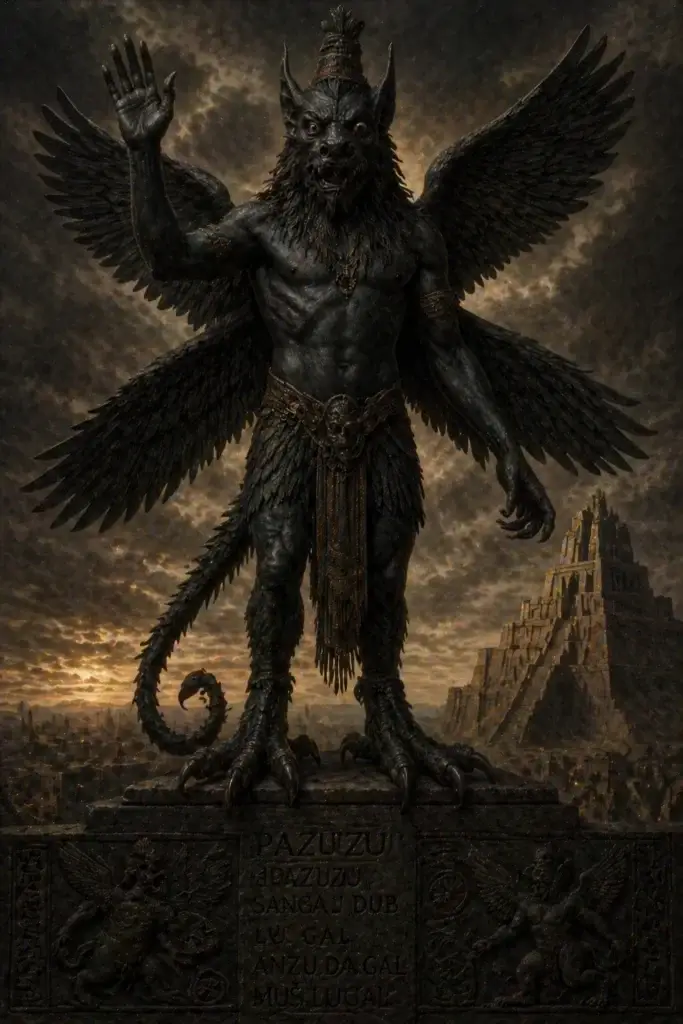
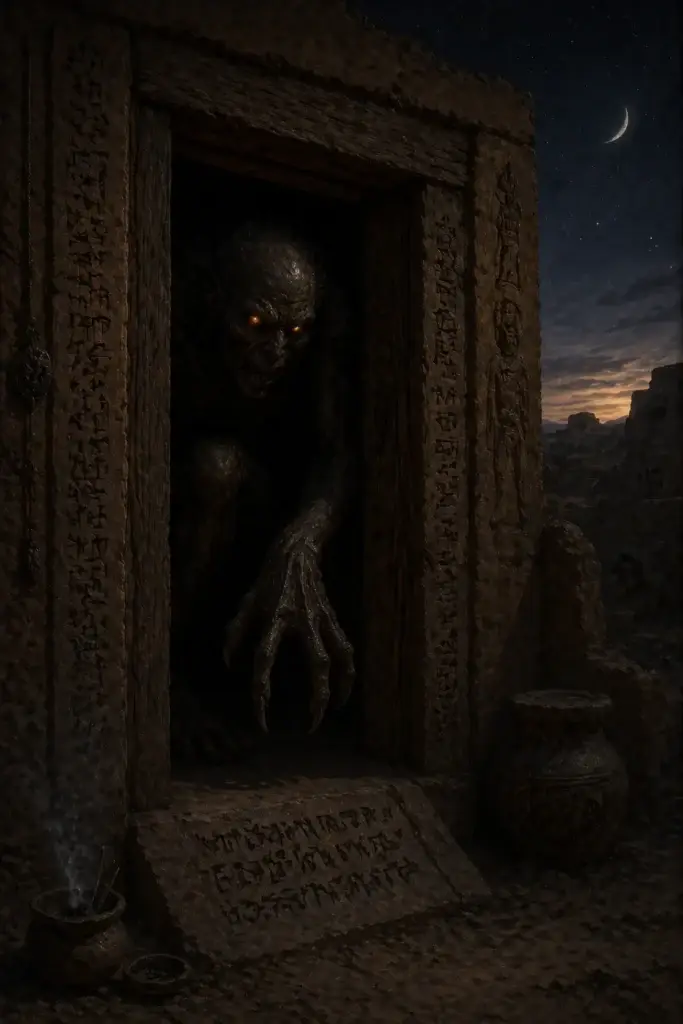
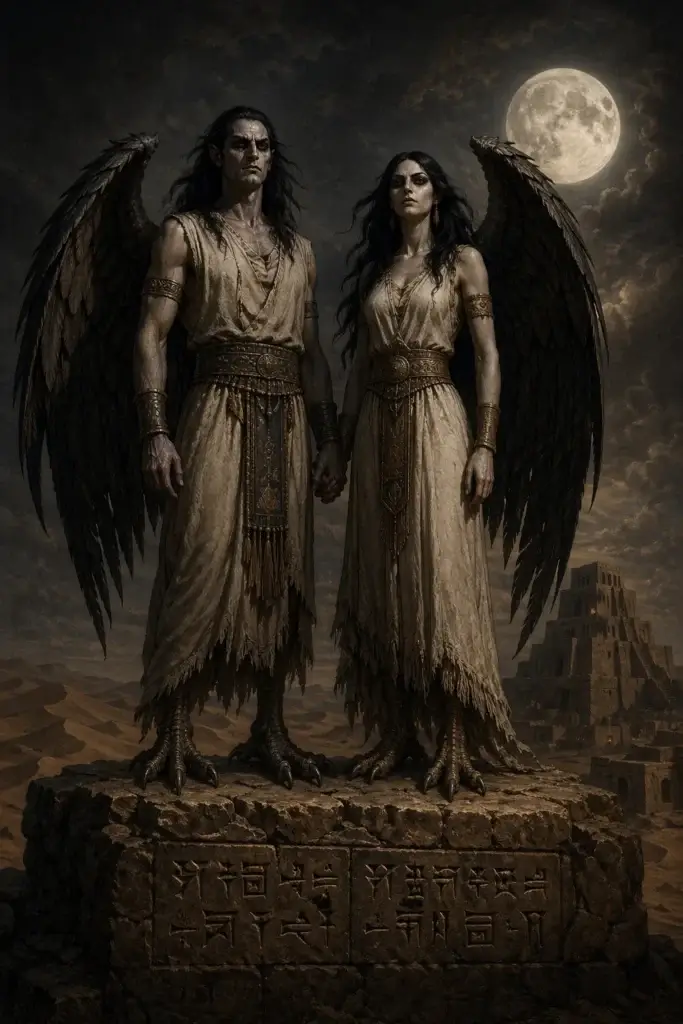
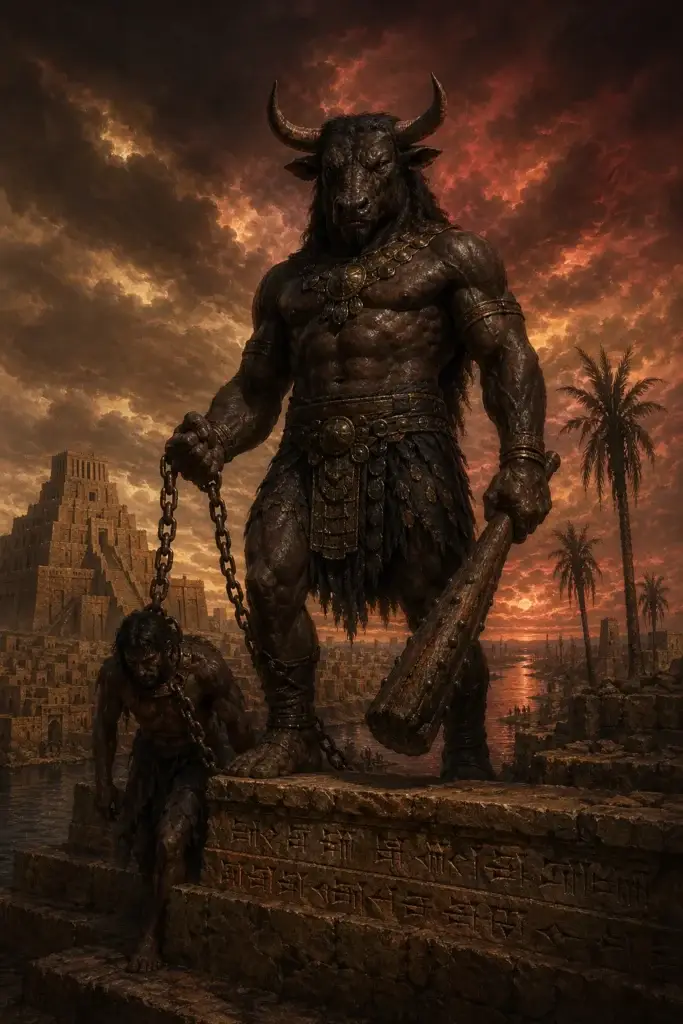
Gallu are imagined as terrifying, dark figures with supernatural features, possibly with glowing eyes and claws or talons. They can also be depicted as humanoid with demonic features, horns, a blackened face, a dreadful expression.
Gallu often carry bonds or chains, since they are the abductors and binders. Their body is dark, often colored black or deep red. They move quickly and unexpectedly. Their presence is cold and frightening.
Profile: Gallu
The most important aspects of the Gallû at a glance. You will find the detailed account of name, description, defense and parallels in the following sections.
Servants of the underworld, especially of Ereškigal. Often mentioned as a group, the “seven Gallû”. Not individual figures but collective enforcers.
The dying, people in a ritual threshold situation, breakers of taboo, the guilty, substitute persons given in exchange for others (such as Dumuzi for Inanna).
Unclear, deliberately withheld: “they eat no food, drink no water, know no sweetness”. Shadowy, terrifying, not fixed.
Sudden death, soul theft, swiftly progressing illness, ritually conditioned seizure. Their coming cannot be negotiated, only delayed or redirected.
Incantations calling for a return to the underworld, purification rituals, substitution offerings (a substitute figure taken along instead of the person).
Erinyes and Keres (Greek), Thanatos (Greek), Tzitzimime (Aztec), messenger-of-death motifs in Europe, the Grim Reaper figure in later folk belief.
Defense in Everyday Life
Rituals of defense
Rituals against the Gallû do not aim at their destruction but at delay or redirection.
The principle of substitution is well known: a symbolic replacement figure, an animal, a small shape made of dough or clay, is “handed over” to the Gallû instead of the person. The motif finds its strongest mythological expression in “Inanna’s Descent into the Underworld”.
Incantations
Formulas invoke the Gallû, name their origin and send them back into the underworld. Often a divine authority is also called upon, whose mandate makes the redirection possible. The structure remains similar in all Mesopotamian incantations: identify, legitimize, send back.
Amulets and protective symbols
Protective amulets against the Gallû were common; alongside them, commands of purity and collective protective rites for house, place or city play a role. Protection here rests not on the object alone but also on ritual discipline and the right relationship to the gods.
Cult and veneration
Gallu were not directly venerated like gods, but feared and warded off through incantations and protective charms. Protective amulets against Gallu were common, especially in houses where the sick or dying lay.
Magicians and priests carried out protective rituals to keep Gallu away. However, magicians sometimes summoned Gallu in magic to harm enemies or to achieve swift results. Gallu were treated with fear and dread, not veneration.
Gallu, Parallels in Other Cultures
The Greco-Roman world
The Keres and Erinyes are the clearest functional parallels. The Keres fetch the souls of the fallen, the Erinyes avenge blood guilt. Thanatos as the personification of death takes on similar messenger functions and passes onward as a motif into Roman and Hellenistic depictions.
Central America: The Aztec Tzitzimime are nocturnal demons that threaten human life at critical moments of the cosmic cycle. Their role as enforcers of a looming cosmic end resembles the Gallû motif in structure and function.
Europe (later folk lore)
The Grim Reaper figure of the European Middle Ages and the modern era bundles the motif of the impersonal, non-negotiable figure that fetches the dead. Even though a direct line cannot be proven, the basic pattern emerges: a messenger who comes when one’s time has run out.
The Gallu in the Tale of Inanna's Descent into the Underworld
The most important literary appearance of the Gallu is found in the Sumerian myth of Inanna’s descent into the underworld and in its sequel concerning the shepherd god Dumuzi. The text is preserved on clay tablets and is among the extensively reconstructed works of Sumerian literature.
The goddess Inanna descends into the underworld, the realm of her sister Ereshkigal, and is killed there and hung on a stake. Through the intervention of the god Enki she is brought back to life, but the underworld lets no one go free without a substitute.
Inanna must name a representative to descend in her place. On her ascent she is accompanied by the Gallu, the demons of the underworld.
The text describes these Gallu with great intensity. They know no hunger and no thirst, they eat no food and drink no water, they accept no offerings and no bribe. They know no family, no children, no friendship.
They tear the wife from the arms of her husband and the child from the breast of the wet nurse. They are thus the exact counter-image of a human or divine counterpart with whom one could negotiate.
As a substitute for Inanna her husband Dumuzi is finally chosen, because he had not mourned for her. The Gallu hunt him, he flees and transforms himself, but he is caught and dragged into the underworld.
Only through the sacrifice of his sister Geshtinanna, who takes his place for part of the year, is his fate eased. In this tale the Gallu are the incorruptible enforcers of the order of the underworld.
Gallu in Incantation Texts and the Defense Against Illness
Outside narrative literature, the Gallu appear above all in the incantation and apotropaic texts of Mesopotamia. These texts, preserved in Akkadian and Sumerian on numerous tablets, served as protection against illness, misfortune and demonic attack.
In the Akkadian form the name appears as gallu or in combination with other demon designations. A particularly frequent group is the Seven, a band of evil spirits in whose listings the Gallu recurs.
These texts describe how the demons penetrate through door and bolt, cling to paths and walls and afflict a person without his being able to defend himself.
The defense was carried out by incantation priests, called aschipu in Mesopotamia. They recited fixed formulas, called upon the great gods, especially Ea, his son Marduk and the fire god, against the demons, and performed accompanying acts, such as displaying or burning substitute figures, fumigation and sprinkling with water.
Protective figures and amulets played an important role in this practice. Small clay figurines of protective beings, buried beneath thresholds, are known from Mesopotamian houses, as are inscribed plaques.
The findings show that for people the Gallu was not an abstract mythical being but an experienceable threat, against which there was a worked-out ritual repertoire. The texts thus join demonology and the art of healing into a unity in which illness and demonic attack often mean the same thing.
From a Sumerian Word to an Akkadian Demon: Etymology and Classification
The name Gallu raises several questions of linguistic and religious history that are discussed in Assyriology. The word is of Sumerian origin and in the oldest attestations designates a demon of the underworld, a servant or bailiff of the world of the dead. It was taken into Akkadian as a loanword.
Scholarship places the Gallu within the larger system of Mesopotamian lower beings. This system knows a whole series of demon designations, including Utukku, Rabisu, Lilu and others, which denote partly clearly delimited, partly overlapping areas. The Gallu belongs to the group of beings associated with the underworld and with the violent removal of people.
A question of its own concerns the possible afterlife of the word. In the later Aramaic and in the Jewish tradition there are demon designations that recall gallu phonetically, and it has been considered whether a line of transmission from the Mesopotamian heritage exists here.
This question has not been conclusively settled; phonetic similarity alone is no proof, and the transitions between the demon systems of the ancient Near East are complex.
Important for an understanding is that Mesopotamian religion distinguished clearly between the great, named gods who were venerated with temples and the lower beings such as the Gallu.
The Gallu were not venerated; they were functional beings of the cosmic order, who were met not with cult but with defense. This distinction shapes the whole Mesopotamian relationship to the demonic.
Further Links
- Edimmu, a related Mesopotamian ghost of the dead
- Lamashtu, a related Mesopotamian demoness
- Pazuzu, apotropaic figure against Lamashtu and related demons
- Ereshkigal, mistress of the underworld, who commands the Galla
- Nergal, god of the underworld, ally
- Rabisu, a related “lurker” demon
- Mesopotamian tradition, overall context
Sources and Literature
The protective practice described here is a religious-studies classification of historical traditions. iWell Guard ties into this cultural-historical line of wearable protective objects and represents a contemporary form of it. More about the iWell Guard →