Rabisu, demon of the Mesopotamian tradition
By Ralf Ittermann · last reviewed on
Rabisu is a demon of Mesopotamia and of the Mesopotamian tradition.
The Lurking One, a demonic threshold dweller, a devourer of hope. Rabisu is not a single power but a class of demonic beings, the *Lurking Ones*. They crouch at doors, thresholds, forks in the road and wait.
They are not always malicious like the demons of other cultures, but rather compulsive, selfish, and in their own way sad. To see a Rabisu means misfortune; to have a Rabisu in your vicinity means that hope, too, has departed.
At a Glance: Rabisu
Type: Mesopotamian demon, demon of lurking and of thresholds
Pantheon: Sumer (related Rābiṣu), Akkad/Babylon/Assur (Rabiṣu)
Function: lurks at thresholds, door frames, paths, in lonely places
Main attributes: shadowy, present yet unseen, springs upon its victim
Main cult sites: none of its own, a demon to which protective rites are directed
Opposing power: Pazuzu (apotropaic protective demon), conjurer rituals
Classification
Period of the Texts
Rabiṣu (Akkadian “the lurker”) is attested in conjuration texts from the Old Akkadian period (3rd millennium BCE) onward. The main flowering of apotropaic practice against it: the Old Babylonian and Neo-Babylonian periods.
The Shurpu conjuration series names Rabiṣu among the powers to be banished. In the Hebrew Bible it is attested as a cognate in Robets (Genesis 4:7: “sin lurks before the door”).
Area of Distribution
Widespread throughout the Mesopotamian cultural sphere; in every city it was regarded as a threshold risk: door frames, crossroads, latrines, lonely paths at night. Protective practices are documented on thousands of conjuration tablets from Babylon, Nineveh, Mari and Susa. In every Mesopotamian house threshold, Pazuzu amulets were buried or conjuration clay nails were laid down.
State of the Sources
Central sources: the Maqlu conjuration series (“Burning”), the Shurpu series (“Burning 2”), the Utukku Lemnutu (“Evil Demons” series), the Lamashtu conjurations (Walter Farber). Secondary literature: Wiggermann, Mesopotamian Protective Spirits; Geller, Evil Demons; Black/Green, Gods, Demons and Symbols.
Designation and Spellings
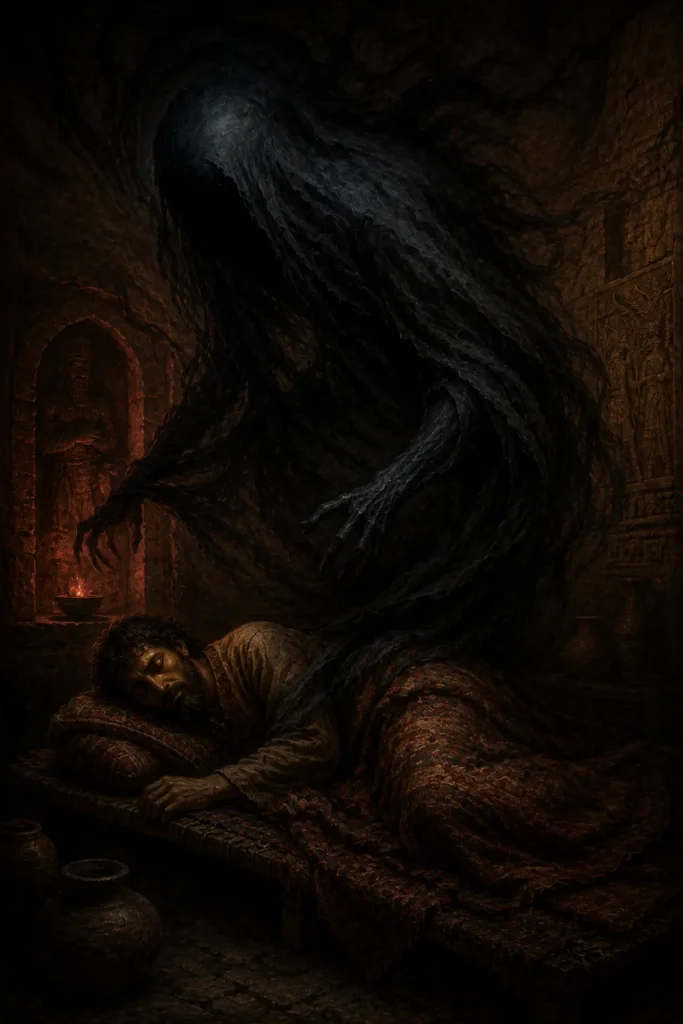
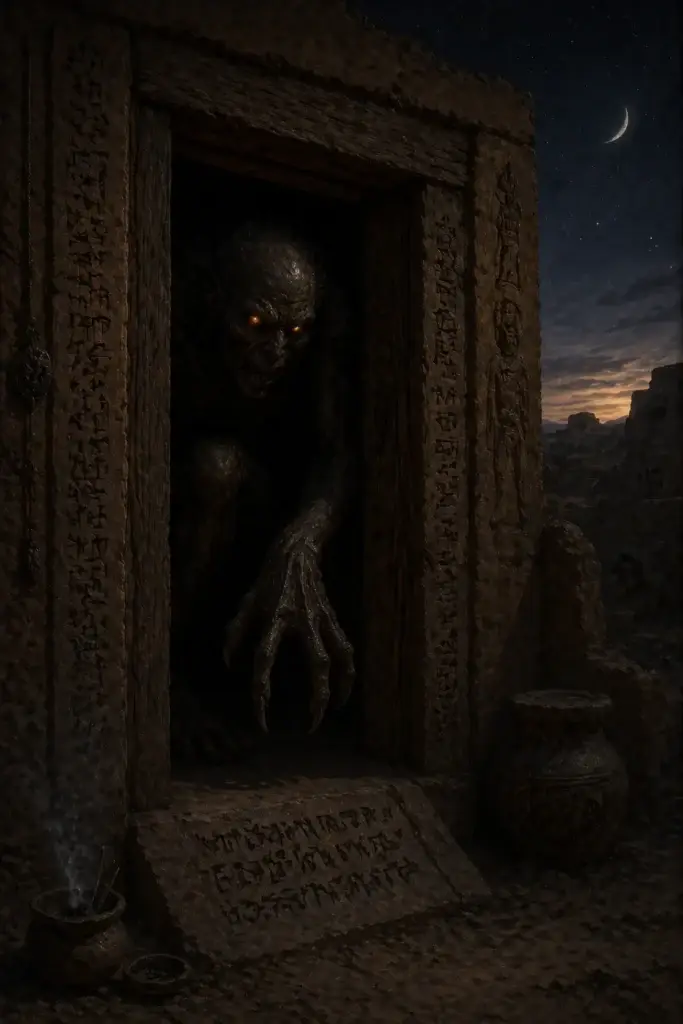
Rabisu is rarely depicted pictorially, since it is a concept rather than a single figure. When shown, it appears as a shadowy, bent or tensed body at a door or threshold, often with a grey or black appearance.
The demon of lurking might have a female silhouette with forearm joints, or appear entirely shapeless; the uncanny lies in its ambiguity. An amulet against Rabisu often shows an eye or a sharp gaze, in order to drive the demon away.
Character Traits
Rabisu is not venerated as a goddess but warded off as a demon. In houses, special door amulet formulas were affixed, inscriptions or clay figures meant to keep Rabisu away from the threshold.
Priests and magicians conjured Rabisu with conjuration formulas in order to banish it. It is regarded as the embodiment of lurking, a psychologically significant demon.
A house haunted by Rabisu loses its peace. In magical rituals it was feared, but not invoked; instead it was driven away.
Appearance and Symbolism
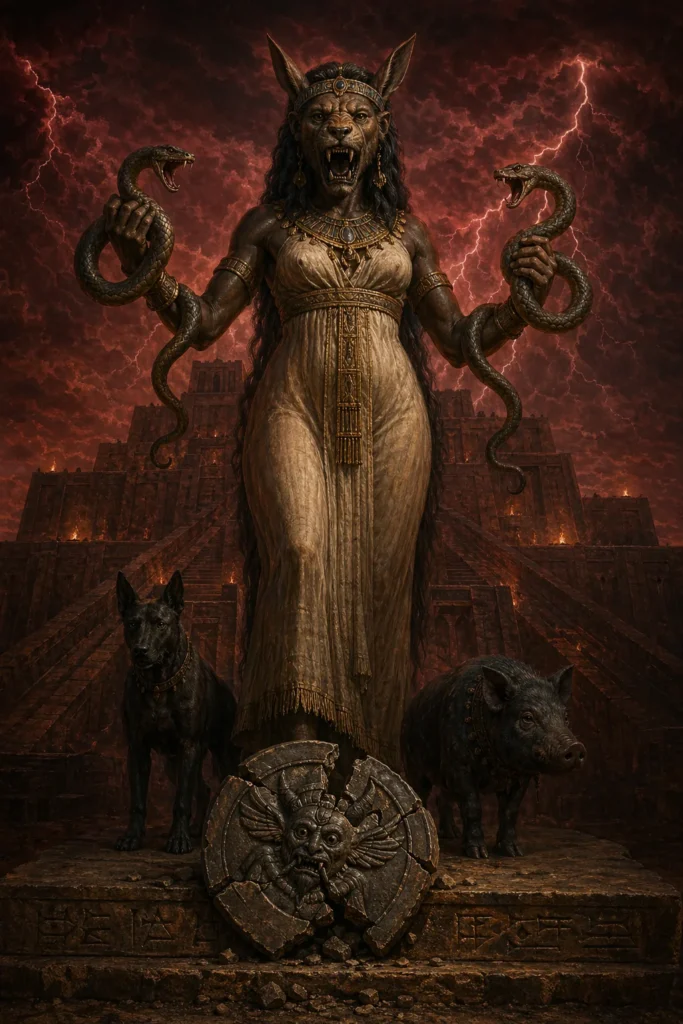
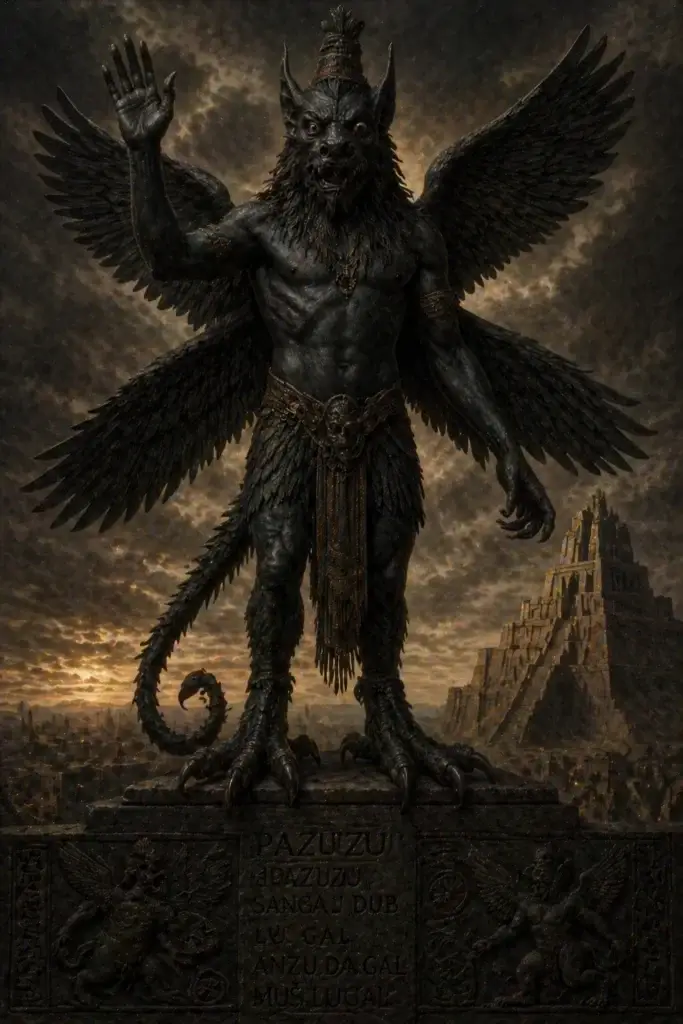
Rabisu is rarely depicted in a consistent form, since it is a kind of shadow spirit. When portrayed, it is often a dark, shadowy figure or a bat-like being with sharp claws and a distorted visage.
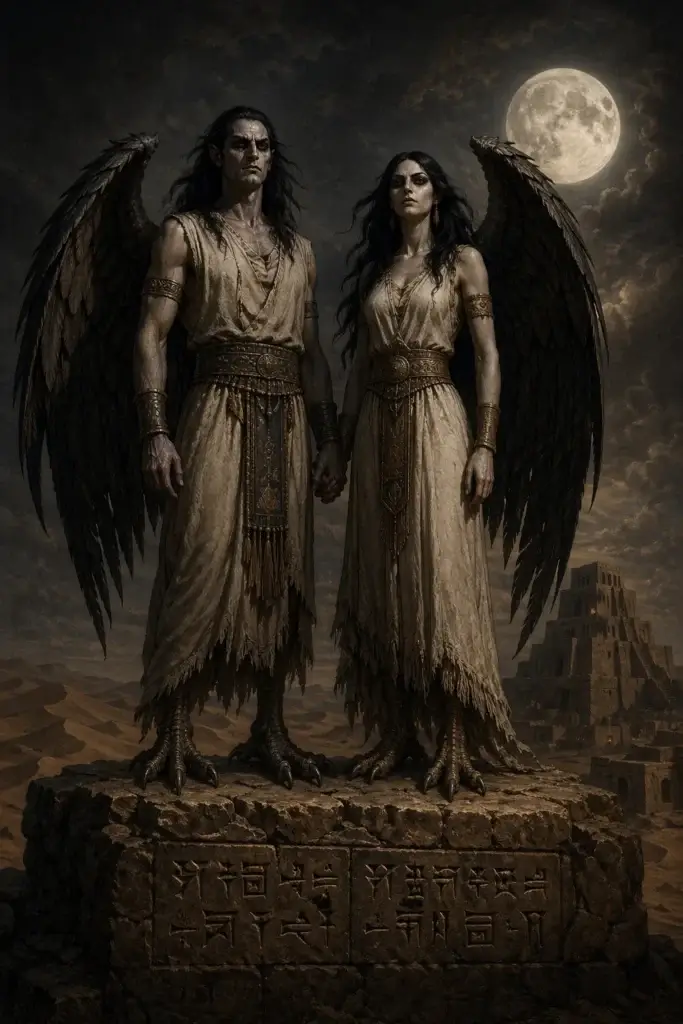
It can also appear as a humanoid with animal features: horns, fur, or wings. Its presence is marked by cold and darkness. Rabisu has no fixed form, because it is the unknown itself. Its symbols are shadows, ambushes and the wilderness.
Profile: Rabisu
The most important aspects of the Rabiṣu at a glance. The following fields summarize tradition, function, appearance, occurrence, symbols and parallels.
Rabiṣu is not a figure but a class of threshold demons. Sumerian precursors appear in the Utukku conjurations. In the Akkadian pantheon it is an independent class of demons, named in connection with other harm-bringing demons (Lamashtu, Asakku, Edimmu, Lilu/Lilitu). Unlike Lamashtu (deliberate intent to harm), Rabiṣu is opportunistic: it waits until someone passes by.
Lurks at thresholds and on paths, springs upon those who pass by. Causes sudden illnesses, especially seizures, dizziness and nervous disorders. In a broader sense also the cause of psychological crises that come without warning.
Unlike Lamashtu’s campaigns against pregnant women and children, Rabiṣu is opportunistic: every traveler and every person returning home is a potential victim.
Rabiṣu is not fixed iconographically. In the conjuration texts it is described as invisible or shadowy, a black figure crouching at thresholds in the twilight. Sometimes it is imagined as a distorted human-animal hybrid being.
On the rarer apotropaic tablets it is suggested only as a “springing-forward” shape. In the foreground of the Mesopotamian visual tradition stands Pazuzu as defense, not the Rabiṣu itself.
Sphere of effect: Rabiṣu attacks were strongly addressed in anti-conjuration practice. Protective practices: Pazuzu amulets on door frames and at the bed, clay nails with conjuration texts beneath the thresholds, fumigations with wormwood and marsh willow.
Travelers spoke short protective formulas before falling asleep in a strange inn.
Thresholds, door frames, lonely paths, twilight. Apotropaic countermeasures: Pazuzu amulets, conjuration clay nails, wormwood, marsh willow, asphalt pitch, white wool. Sacred number: 7 (the number of the principal demons in the anti-Sebitti tradition).
Robets (Hebrew, Genesis 4:7), Lamashtu (Mesopotamia, a sister demon with deliberate intent to harm), Pazuzu (Mesopotamia, its paradoxical antagonist and apotropaic figure), Edimmu (Mesopotamia, restless dead), Empusa (Greece, a threshold-lurking demon), Lilim (Jewish, descendants of Lilith), Mahr/Mara (Germanic, nocturnal pouncing demons), Mara (Buddhism, the tempter).
Protective Practice
Apotropaic Rituals
The rabīṣu (lurker) is, in Akkadian belief, a threshold demon that lies in wait at doors, crossroads and gates. Threshold apotropaics were central: door frames were fumigated with incense (erin, burāšu), door thresholds were anointed with plant oils (cumin oil specifically against Rabisu).
The bīt mēseri ritual (house enclosure) against black magic names Rabisu as a principal threat (Wiggermann, Mesopotamian Protective Spirits).
Conjuration Formulas
The Šurpu burning series names Rabisu among the powers to be destroyed through the burning of clay figures.
Amulets and Protective Symbols
Small bronze Pazuzu heads, hung on door and window frames, protected against Rabisu (cf. Black/Green; British Museum collection). Threshold statuettes of the “Seven Apkallu” (sages), fish-man-like figures, were buried when a house was newly built. Clay cylinders with “Rabisu ban” inscriptions were placed beneath the main beams.
Rabisu, Parallels in Other Cultures
Rabisu resembles the Greek Lamiae, female demons at boundaries, or the Norse Mara (nightmare demon). With the Hebrew Lilith (night demon) it shares the aspect of the threshold dweller.
In modern terms one might compare it to a poltergeist that is not violent but present and disturbing. Rabisu is not evil per se, since rābiṣu also denotes protective beings.
The Name and the Logic of Lurking
The name rābiṣu is linguistically transparent and gives immediate information about the being’s function.
It is a participle of the Akkadian root rabāṣu, which means “to lie down,” “to lodge,” “to lurk.” The rābiṣu is thus literally “the lurking one” or “the croucher,” a being that remains in one place and waits. This meaning explains its characteristic localization in the sources.
The rābiṣu is typically located at thresholds, in doorways, at house entrances, at wall corners and in lonely places. It is the demon of points of transition, of the places where one steps from one area into another and is especially vulnerable.
The Mesopotamian worldview attached a high degree of danger to such thresholds, and the rābiṣu is the personification of this danger.
It is noteworthy that the word rābiṣu did not carry an exclusively negative connotation. It could also designate an official, a kind of overseer or commissioner, and there were protective rābiṣu beings that stood like guardians at the side of a person or a building.
The notion of a personal protective spirit that accompanies a person could use the same term.
This duality is important from the standpoint of religious studies: the “lurking one” is not in itself evil; the question is on whose side it lurks. The harmful being combated in the conjuration texts is the hostile variant of a concept that is in itself neutral.
The rābiṣu in the Conjuration Series Against Illness-Causing Demons
The most important attestations of the harmful rābiṣu come from the great Mesopotamian conjuration series, above all from the texts against the powers designated as utukku lemnūtu (“evil Utukku demons”).
This extensive series, made accessible in a critical edition by Markham Geller, lists in long enumerations the hostile beings against which the conjuration priest (āšipu) defends the sick person. The rābiṣu appears there regularly alongside other demons such as the Edimmu, the restless ghost of the dead, and the gallû.
In these texts the rābiṣu rarely appears as an individual figure with its own story, but as a link in a chain.
The conjurations work through complete naming: by enumerating and banishing all possible causes of the affliction, the priest also includes the rābiṣu. This enumeration technique is characteristic of Mesopotamian ritual magic and explains why we almost never encounter the rābiṣu in isolation, but always in combination.
From these contexts its sphere of effect can be inferred. The rābiṣu is associated with sudden malaise, with paralysis, with being struck at a particular place. Whoever crossed a threshold and fell ill afterward could hold the lurker responsible.
The conjuration gave the afflicted person an explanation and a remedy at once. Methodologically, the rābiṣu shows particularly clearly that Mesopotamian demonology was not a narrative system but a practical one: the beings are defined by their effect and their ritual treatment, not by myths.
The Lurking Demon and the Biblical Parallel
A much-discussed question of comparative religious history concerns a possible trace of the rābiṣu in the Hebrew Bible. In the story of Cain and Abel in the fourth chapter of Genesis there is the difficult-to-translate phrase that sin “lodges” or “lurks” at the door.
The Hebrew verb rabats used here is linguistically related to the Akkadian rabāṣu, and several interpreters have proposed that the participle at this point does not simply mean “to lodge” but alludes to the demonic conception of the being lurking at the threshold.
This interpretation is attractive because it illuminates the image of the Genesis passage: sin would then not be an abstract condition but a lurking, dangerous something at exactly the place where the Mesopotamian tradition locates the rābiṣu, the doorway.
The Masoretic vocalization and the grammatical construction of the verse, however, present difficulties, and scholarship is not in agreement as to whether a deliberate adoption of the demon concept is really present here or only a coincidental linguistic contact.
From the standpoint of religious studies the case is instructive whichever way one decides. If the allusion is intended, we would have an example of how a concrete Mesopotamian demon conception seeps into a biblical text and is demythologized there, with the demon becoming a personified sin.
If it is not intended, the case shows how cautiously one must handle etymological bridges between cultures. The only certainty is that the image of the one waiting at the threshold was present in both cultures and that the linguistic root is the same.
Further Links
Sources and Literature
Further standard works in the literature index.
The protective practice described here is a religious-studies classification of historical traditions. iWell Guard ties in with this cultural-historical line of portable protective objects and represents a contemporary form of it. More about the iWell Guard →