The Phoenicians, inhabitants of the eastern Mediterranean coast (present-day Lebanon, northern Israel, Syria) from the late second millennium BCE onward, were the great seafarers and merchants of antiquity.
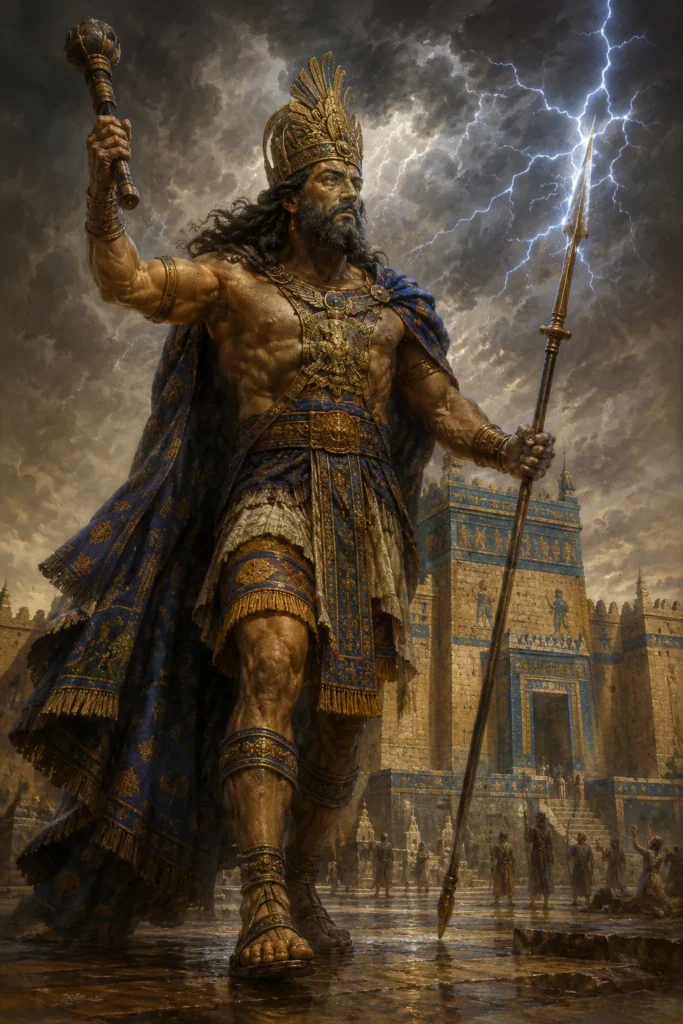
Their colonies, above all Carthage (founded 814 BCE), Gades, and Carthago Nova, spread Phoenician religion throughout the entire Mediterranean world. Baal, Astarte, Melqart, and Tanit stood at the center of a cult that held seafaring, city, and kingship together.
The Phoenician pantheon survives above all through local cults and colonies such as Carthage.
The Phoenician city-states, Tyre, Sidon, Byblos, Arwad, and Berytus, were largely independent kingdoms held together by a shared language (Canaanite-Phoenician, Semitic) and culture. They engaged in deep-sea trade, dyeing (purple), glassmaking, and the trade in timber and metals.
Their colonies, Carthage, Utica, Motya, Tharros, and Gades, were founded between the ninth and seventh centuries BCE. Carthage grew into a great power that collided with Rome in the Punic Wars and fell in 146 BCE.
The Carthaginian pantheon, shaped by the Libyan-Punic diaspora, gives particular prominence to Baal Hammon and Tanit and is regarded as the most influential expression of the Phoenician divine world in the western Mediterranean.
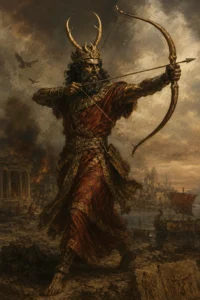
Baal (literally “lord”) is not a single god but a title: Baal Shamim (heaven), Baal Hadad (weather), Baal Hammon (Carthage), Baal Melqart (Tyre). Astarte is the most important goddess, associated with love, fertility, and war, with her own temple in Sidon and Aphaca.
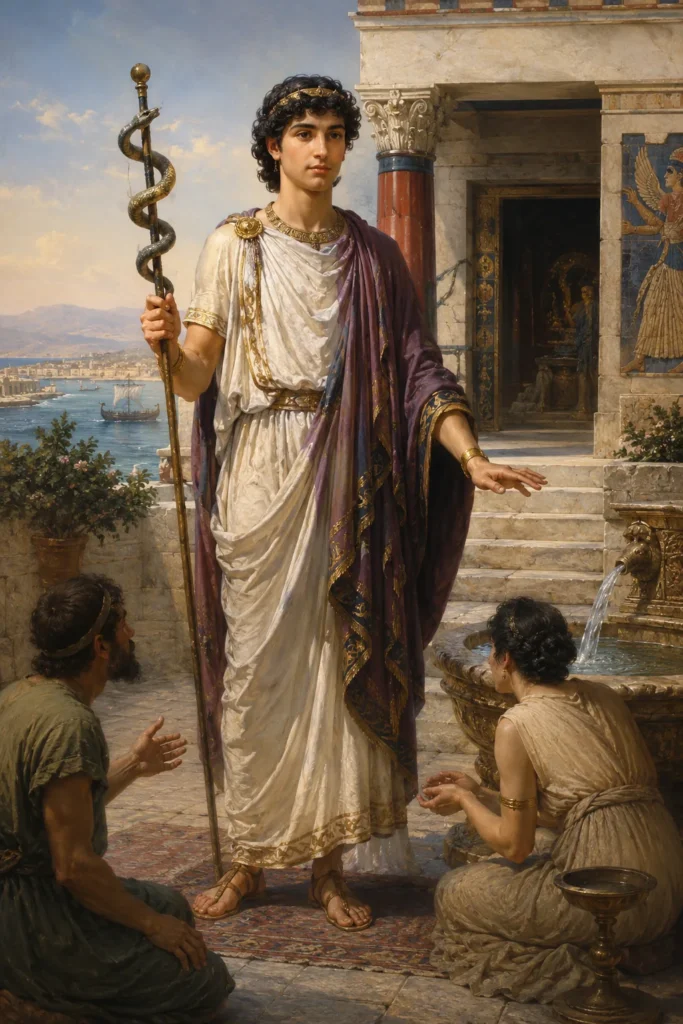
Melqart (literally Milk-Qart, “king of the city”) is the protective god of Tyre, associated with a spring resurrection rite. Eshmun in Sidon is a god of healing, and his sanctuary near Bostan esh-Sheikh was a major pilgrimage destination. In Carthage, Tanit appears as the “face of Baal,” placed on equal footing beside Baal Hammon.
In the western Mediterranean it was above all Carthage that shaped the Phoenician divine world: the Libyan-Punic diaspora placed Baal Hammon and Tanit at the centre of its cult.
In Carthage, Tanit (Tanit Pene Baal) became the highest goddess. Her symbol, a stylized female figure with raised arms, a triangular body, and a circular head, adorned stelae, mosaics, and portable pendants.
The Tophet sites of Carthage, Motya, and other Punic colonies are cemeteries for infants and young children, with inscriptions attesting to offerings to Tanit and Baal Hammon. The question of whether child sacrifice (mlk) was actually practiced, or whether the stelae commemorate deceased children, remains disputed within the study of religion.
Phoenician mythology survives only in fragments (Philo of Byblos, Eusebian quotations). A key source is the closely related Ugarit (Ras Shamra, 14th century BCE); clay tablets found there preserve the Baal Cycle: Baal’s battle against the sea god Yam, against the god of death Mot, his death and his resurrection.
These narratives shaped the background field of ideas of the Hebrew Bible (in which Baal appears as a rival of YHWH) and of the later Adonis myths.
The Phoenicians and Carthaginians worked in fine glassmaking and goldsmithing and produced protective pendants in great variety: eye talismans (forerunners of today’s nazar boncuk), hand amulets (forerunners of the hamsa), Tanit symbol pendants, scarabs (from Egyptian influence), Bes figurines (likewise imported from Egypt), and crescent pendants (lunulae).
The trans-cultural reach of Phoenician protective objects is enormous, from Spain to Mesopotamia.
Roughly 30 to 40 named gods are known from Phoenician-Canaanite sources, best documented by the Ugaritic texts (13th century BCE) and biblical references. The principal gods are El (father), Baal (the thunder son), Asherah (mother), Astarte/Anat (love/war), Melqart (royal city god), Eshmun (healing), Yam (sea chaos), and Mot (death).
In the Hebrew Bible, Baal is the chief adversary of Yahweh, and the Israelite prophets contend against his worship. The most famous episode is the contest on Mount Carmel (1 Kings 18), where Elijah defeats 450 priests of Baal. In the New Testament, Beelzebub (Baal-Zebul) became a synonym for the devil.
The Phoenicians were a Semitic seafaring people of the eastern Mediterranean (present-day Lebanon, Syria, and the coast of Israel), with the city-states of Tyre, Sidon, and Byblos.
They founded Carthage (in present-day Tunisia, 814 BCE), which rose to become a Mediterranean power until it was destroyed by Rome in 146 BCE. They were the inventors of the Phoenician alphabet, the model for the Greek, Latin, Hebrew, and Arabic alphabets.
Tophet (Hebrew for “drum”) were Phoenician-Carthaginian sanctuaries in which children were sacrificed, above all in molk rites to Baal Hammon. Archaeological finds from Carthage, Sardinia, and Sicily reveal tens of thousands of infant urns.
The practice is disputed within the study of religion: some see child mortality, others genuine offerings. The Hebrew Bible condemns the practice (Leviticus 18:21) and names the Valley of Hinnom in Jerusalem as a Tophet.

After 146 BCE, the Punic language and religion lived on in the Roman provinces of Africa and Hispania (with inscriptions into the fifth century). The worship of Saturn in Roman North Africa is a continuation of the cult of Baal Hammon.
Augustine of Hippo (354 to 430), of North African background, still knew the Punic tradition personally. The Mediterranean tradition of magic (defixiones, love and harmful spells) has strong Punic roots.
Phoenician original texts are short inscriptions; the most important are the Ahiram sarcophagus (Byblos), the Pyrgi tablets (in Etruria, trilingual), and stelae from Carthage. Important modern works include Sabatino Moscati’s The Phoenicians, Maria Eugenia Aubet’s The Phoenicians and the West, and Glenn Markoe. Religious aspects are treated by Corinne Bonnet and Paolo Xella.
Phoenician religion cannot be described as a single closed system, for the Phoenicians never formed a unified state. They organized themselves into independent city-states along the Levantine coast, above all Byblos, Sidon, Tyre, and Arwad.
Each city had its own constellation of gods, often headed by a divine couple consisting of a protective god and a goddess.
In Byblos, the oldest of the cities, the Lady of Byblos stood at the center, a goddess whom Greek observers equated with their own goddess of love.
In Sidon, Eshmun, a god of healing, and the goddess Astarte were preeminent; the sanctuary of Eshmun near Sidon is one of the few Phoenician sanctuaries that are well preserved in their architecture.
Tyre venerated Melqart, whose name literally means “king of the city” and who was closely bound to the royal house. His cult included an annual festival at which the awakening of the god was celebrated.
This binding of the gods to particular cities explains why Phoenician expansion across the Mediterranean was also a religious expansion. Colonists carried the cult of their mother city with them.
The Melqart of Tyre thus became the chief god of Carthage and was venerated as far away as Gades in present-day Spain. Research in the history of religion, such as the work of Corinne Bonnet, has shown that these gods did not remain rigid but adapted to their respective local surroundings.
The reconstruction of Phoenician religion suffers from a fundamental problem. The Phoenicians wrote on papyrus, which did not survive in the damp coastal climate.
A religious literature of their own, if it was extensive, is therefore almost entirely lost. What remains are inscriptions on durable material, above all votive inscriptions, funerary inscriptions, and building inscriptions on stone and metal.
These inscriptions are formulaic and brief. They name the gods, the dedicators, and the occasions, but give little information about myths or doctrines.
The most important longer text is the sarcophagus of King Eshmunazar of Sidon, whose inscription contains curses against grave robbers and details of temple endowments. From the colonies, especially from Carthage, come thousands of votive stelae, which are likewise composed according to a fixed pattern.
For myths and theology, we are dependent on accounts from outside. The most important is the so-called Phoenician History of Philo of Byblos, preserved only in fragments in the church father Eusebius. Philo invoked an older author named Sanchuniathon.
How reliable this tradition is has long been debated in scholarship, especially since Philo wrote in the Roman imperial period and interpreted his material in Greek terms. The finds from Ugarit in northern Syria, a related but older and not strictly Phoenician city, provide valuable parallels but must not be transferred uncritically to the Phoenicians.
Few topics in Phoenician-Punic religion are as disputed as the so-called Tophet sanctuaries. In Carthage and other western Phoenician sites, walled precincts were found containing thousands of urns that held the burnt bones of small children and young animals. Above the urns stood votive stelae, frequently dedicated to the gods Baal Hammon and Tinnit.
Ancient authors such as the Greek historian Diodorus reported ritual child sacrifices among the Carthaginians, often in tones of outrage. For a long time this portrayal was regarded as the hostile propaganda of those who had conquered Carthage.
One strand of scholarship therefore interpreted the Tophets as ordinary cemeteries for children who had died young. Other researchers, drawing on osteological studies and the inscriptional formulae, maintain the interpretation as a sacrificial precinct in which, in particular times of need or in fulfillment of a vow, children were consecrated.
The current state of research is cautiously differentiated. Much suggests that sacrificial acts did indeed take place in the Tophet, but that these did not have the mass, everyday character suggested by ancient polemic. The frequency, the regional distribution, and the precise ritual procedure remain uncertain.
The case shows in exemplary fashion how strongly the perception of a religion can be shaped by the sources of its opponents, and how difficult it is to judge a practice whose own voice has been lost.
Phoenician religion spread with trade and colony foundation across the entire Mediterranean world. Outposts arose on Cyprus, Sicily, Sardinia, and Malta, in present-day Tunisia, and along the Iberian coast.
In these colonies the Phoenician cult encountered indigenous traditions, and a wide range of hybrid forms emerged. On Cyprus the cult of Astarte combined with local and Greek conceptions, a process held partly responsible for the formation of the Greek Aphrodite.
Carthage developed from its Tyrian heritage a Punic religion of its own, in which Baal Hammon and the goddess Tinnit moved to the center. After the destruction of Carthage by Rome in 146 BCE, these cults lived on in Romanized form.
Baal Hammon was merged with the Roman Saturn, and in North Africa sanctuaries of Saturn flourished into the imperial period. Melqart, too, was widely equated with Heracles, which secured his veneration at sites such as Gades beyond the Phoenician epoch.
An indirect but momentous afterlife lies in writing. The Phoenician alphabet, a pure consonantal script, was adopted by the Greeks and expanded with vowel signs. By way of Greek and Etruscan, it eventually reached the Latin world.
From the standpoint of the history of religion, it is also significant that many divine names and cult forms of the Phoenicians were closely related to those of the neighboring Israelites.
The confrontation with the cult of Baal that the Old Testament describes is therefore at the same time an important, if partisan, source for the religion of the Levant.


Phoenician protective practice combined amulets of glass paste, Tanit symbols, and Bes heads with household altars for Baal and Astarte; archaeological finds from Carthage, Sidon, and Sardinia attest to a dense network of everyday apotropaic signs.
Related key terms: Phoenicians, Carthage, Tyre, Sidon, Byblos, Baal, Tanit, Melqart, Astarte, Eshmun, Moloch, Tophet, Punic.
The Phoenician-Punic tradition produced eye amulets (forerunners of the nazar boncuk), hand pendants (forerunners of the hamsa), Tanit symbol jewelry, scarabs, and lunula crescent pendants, one of the most influential portable traditions of protection in antiquity.
iWell Guard takes its place within this cultural-historical line of portable protective objects, in contemporary material architecture, crafted in Germany. 41 layers, genuine gold, platinum, silver. 30-day right of return.
Individual experiences may vary. Not a medical device. No promise of healing.