iWell Guard

Anat, Phoenician-Ugaritic Goddess of War and the Hunt

Anat (Phoenician and Ugaritic ʿnt) is the principal goddess of war and the hunt in the Ugaritic-Phoenician pantheon. She is the sister and companion of Baal, destroys Mot in the Baal Cycle, and thereby frees Baal from the underworld.

GoddessPhoenicianWar Goddess

Table of Contents

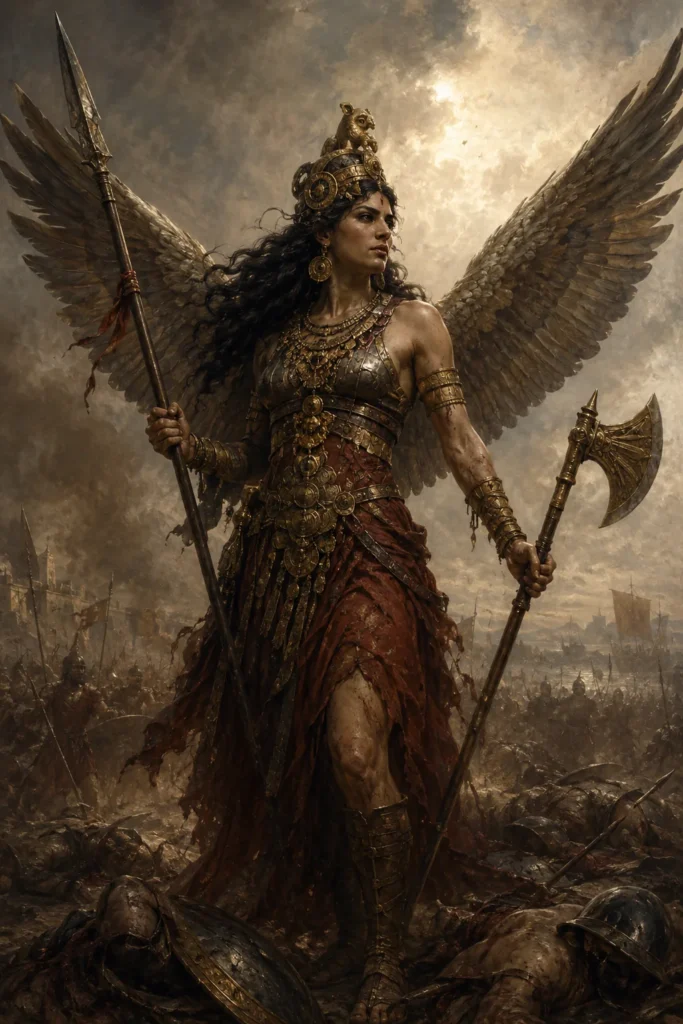
Anat Phoenix - Gods from the Phoenician tradition, historical illustration

Anat (Phoenicia) embodies the Phoenician-Ugaritic goddess of war and the hunt within the Ugaritic pantheon.

Classification and Short Profile

Anat is one of the oldest goddesses of the West Semitic tradition; she is attested from the Old Syrian period (3rd millennium BCE) and remains active into the Hellenistic-Roman period.

Mark Smith has shown in The Ugaritic Baal Cycle (1994/2009) that Anat plays a central role in the Baal Cycle as Baal’s fighting and protective companion; she is not primarily a mother or love goddess, but a warrior par excellence. Within the Phoenician tradition she is an independent major goddess alongside Astarte.

Peggy Day has examined Anat’s profile in detail in several studies, demonstrating that Anat has a very broad functional range: war goddess, hunt goddess, protective goddess of queens, companion of Baal, and destroyer of Mot. This multifunctionality is typical of ancient Near Eastern goddesses.

From a history-of-religions perspective, Anat belongs to the great West Semitic-Mesopotamian goddess family ʿAnat/Ištar/Astarte. While Astarte more strongly embodies the aspect of the royally urban high goddess, Anat represents the warlike-hunting component. Both frequently appear together in Ugaritic texts and are theologically closely intertwined.

A notable characteristic of Anat is her position between warrior goddess and love goddess; in some Ugaritic texts she appears as Baal’s sexually active companion, in others as a virginal, aggressive huntress.

This dual nature is not contradictory from a history-of-religions standpoint, but rather reflects the ancient Near Eastern conception of divine wildness, which does not resolve into modern categories.

A central research question concerns the exact relationship between ʿAnat and ʿAṯtartu (Astarte) in the Ugaritic texts. Both goddesses frequently appear together and are sometimes functionally conflated, yet they also retain clearly distinct profiles.

Name and Etymology

The name ʿnt is West Semitic; its etymology has not been definitively resolved. One plausible interpretation connects it to the root ʿny meaning ‘to answer, to intervene,’ which would suit her interventionist role. Another interpretation sees the name as connected to the word for ‘eye’ or ‘spring’ (ʿyn).

In Ugaritic texts she appears as ʿnt, and likewise in Phoenician texts. In Egyptian texts of the New Kingdom and the Late Period she appears as ʿAntit or ʿAnat, imported as an independent deity.

Pharaoh Ramesses II (13th century BCE) and Pharaoh Ramesses III erected temples and inscriptions for her; the Egyptian veneration of Anat is well documented.

In the Hebrew material, Anat appears as a place name (Anathoth, hometown of the prophet Jeremiah; Beth-Anath in Galilee); whether the biblical texts retain any memory of the goddess Anat is debated.

At Elephantine (5th century BCE) an ‘Anat-Yaho’ is venerated, a Syrian-Egyptian-Jewish syncretism with Yahweh that is highly instructive from a history-of-religions perspective and has been treated in detail in the studies of Bezalel Porten.

A particular etymological hypothesis connects her name to the Akkadian adverb annu meaning ‘now, immediately,’ which would suit her interventionist role. This etymology has not, however, found broad acceptance.

Description and Iconography

Anat appears in West Semitic iconography as a warlike goddess in a short kilt, with raised sword or spear, a shield or bow, and frequently a helmet. This pictorial tradition was particularly cultivated in pharaonic Egypt; on stelae from Memphis and Tanis she appears in full warrior armor alongside pharaohs as a protective deity.

Her sacred animal is the lion; in some reliefs she rides a lion or holds one by the tail. The griffin also occasionally appears as her companion animal. In pharaonic Egypt she is identified with the Egyptian goddess Sekhmet, a lion-headed goddess, which further reinforces her warlike aspect.

An important pictorial tradition shows Anat ‘bathing in blood’ after a battle; the Ugaritic texts describe how she wades up to her hips in the blood of her enemies and then bathes in it. This vivid depiction of her warlike ferocity is one of the most celebrated topoi of the Ugaritic Anat tradition and has been extensively commented on by Peggy Day and Neal Walls (The Goddess Anat in Ugaritic Myth, 1992).

In Egypt, Anat was frequently depicted as the ‘wife of Seth,’ since Seth, the ancient Egyptian god of desert and chaos, was identified with Baal. This ‘Anat-Seth’ constellation reflects the Phoenician-Egyptian religious-historical interconnection in the New Kingdom.

Mythological Narratives

Anat is a central figure in several Ugaritic texts. In the Baal Cycle she plays a key role: she supports Baal in building his temple, fights by his side against Yam, and ultimately destroys Mot.

Her scene of Mot’s destruction (‘she splits him, sifts him, burns him, grinds him, sows him’) is one of the most striking episodes in ancient Near Eastern mythology.

In the Aqhat Epic (KTU 1.17, 1.19) she appears as the antagonist of the hero Aqhat. She covets his magnificent bow and offers him wealth and immortality; Aqhat declines on the grounds that bows are a man’s concern.

In anger, Anat has Aqhat killed by an assassin; the narrative ends with a complex dynamic of retribution. This story offers a unique insight into the Ugaritic treatment of gender roles and divine arbitrariness.

Another narrative connects Anat with the hunt for the ‘Herev’ bull; the narrative survives only in fragmentary form but shows Anat as a wild huntress in the steppe. From a history-of-religions perspective, Anat belongs to the family of hunting goddesses found in nearly all Indo-European and Semitic pantheons.

In the Aqhat Epic, the hero’s destruction at Anat’s behest is followed by a complex act of revenge; Aqhat’s sister Paghat seeks out the assassin Yatpan and drinks wine with him in order to get him drunk and kill him, a direct parallel to the Hedammu-Shaushga sequence of the Hittite tradition.

This ruse-motif connection is instructive for the history of religions.

Cult and Veneration

Anat’s most important cult sites in Phoenicia were Sidon, Tyre, and Beirut; in the Egyptian sphere, Tanis and Memphis; in the Hittite world, Shamuha (as the Hurrian Shaushga, with whom she was functionally related). She was also venerated at Mari, Emar, and Ebla. Sabatino Moscati described her Mediterranean diffusion in Die Phöniker (1966).

In the Ugaritic festival calendar she received her own sacrifice days; the temple of Anat at Ugarit was located in the acropolis zone and has been archaeologically identified.

In Egypt, her cult belonged to the category of ‘Asiatic gods’ that were actively promoted in the New Kingdom, particularly by the Ramesside dynasty. Pharaoh Ramesses II called himself ‘Beloved of Anat’ and had a daughter named ‘Bint-Anat’ (‘Daughter of Anat’).

In the Elephantine inscriptions of the 5th century BCE, an ‘Anat-Yaho’ appears as a sworn and protective deity of the Jewish-Aramaic community there.

This remarkable syncretism with Yahweh is one of the most noteworthy findings in the religious history of the Hebrew-Semitic late period; Bezalel Porten documented it extensively in Archives from Elephantine (1968) and in several later studies.

In the Hittite imperial cult, the Hurrian Shaushga, the theological counterpart of Anat, was venerated as the sister of the storm god Teshub. Shaushga of Shamuha had her own temple at Hattusa and was particularly venerated by Great King Hattushili III.

Protective Practice and the Apotropaic

Anat was the protective goddess of warriors, queens, and pregnant women. In Ugaritic and Phoenician inscriptions she appears as a guarantor of oaths in oath formulas; her image or name stands on royal seals as a protective formula. In Egypt she was invoked by pharaohs before battles.

Apotropaic Anat figurines were placed in homes; small bronze figures of a warlike woman with helmet and spear are known from Phoenician and Egyptian sites. Scarabs with Anat motifs were also worn as protective amulets. Charles Krahmalkov compiled relevant inscriptions in A Phoenician-Punic Grammar (2001).

In Phoenician personal names, Anat theophoric elements are less common than those of Astarte or Baal, but are attested: Bin-Anat (‘Son of Anat’), Bat-Anat (‘Daughter of Anat’).

From a religious-studies perspective, Anat is a protective goddess of active defense, who does not merely protect her charges passively but actively engages their enemies. The iWell Guard records Anat as a historical-religious figure without references to current healing claims.

In Phoenician oath formulas, Anat regularly appears as the second goddess after Astarte; the double invocation of Astarte-Anat is attested on several stelae from Sidon and Tyre and underlines the close theological partnership of both goddesses.

Parallels in Other Cultures

Anat belongs to the great goddess family ʿAnat/Ištar/Astarte. She is closely related to the Ugaritic Ashtartu, the Mesopotamian Ishtar (particularly in her warlike function as Ishtar of Nineveh), the Hurrian Shaushga, and the Hittite Ishtar of Shamuha. With Shaushga she shares the warlike-hunting profile; with Ishtar of Uruk the multifunctionality.

Anat shares the war-goddess profile with the Greek Athena, and the hunt-goddess function with Artemis. Both Greek goddesses were syncretized with Anat in the Hellenistic-Roman period. In Egypt, Anat was identified with Sekhmet.

From a history-of-religions perspective, Anat is one of the most important goddesses of the ancient Near Eastern world.

Her warlike ferocity, her sexuality, and her cosmic function make her one of the theologically most complex figures of the Phoenician pantheon. With Hebat of the Hurrian-Hittite tradition she shares high-ranking status, but with a markedly different functional profile.

The Greek Aphrodite Areia (‘Aphrodite the Warrior’) also carries Anat heritage from a history-of-religions perspective, particularly in her Cypriot form. Stephanie Budin discussed this line of transmission in The Origin of Aphrodite (2003).

Contemporary Reception and Research

Anat scholarship today is at a high level. Peggy Day, Neal Walls, Mark Smith, and Bezalel Porten have made important contributions. Walls’ monograph The Goddess Anat in Ugaritic Myth (1992) is the standard reference for the Ugaritic Anat tradition; Porten’s Elephantine studies for the Jewish-Aramaic syncretism.

In popular reception, Anat is known primarily through the Ugaritic myths and through the Egyptian Ramesside veneration. A spiritual revival in a neo-pagan sense, particularly in feminist-neopagan circles since the 1970s, has received Anat as a ‘warrior goddess’; this modern reception is problematic from a history-of-religions perspective because it frequently simplifies her historical profile.

From a religious-studies standpoint, Anat today is regarded as a central object of study for ancient Near Eastern goddess religion.

Current research focuses on differentiating Anat/Astarte/Ashtartu, on the Elephantine syncretism, and on the question of ritual performances of the destruction scene of Mot. The iWell Guard records Anat as a historical pantheon member without reference to current healing claims.

Current research by Mark Smith, Theodore Lewis, and Helene Sader places Anat in a broader history-of-religions context: as a representative of a pre-Israelite theology that was critically reflected in the Hebrew material and productively developed further in the Elephantine syncretism.

Literature and Sources

The following selection brings together the most important standard works on Anat scholarship. It includes critical editions of texts, syntheses in the history of religions, and studies on the Elephantine syncretism. Walls’ monograph is the standard reference; Smith provides the Baal Cycle context; Porten the Jewish-Aramaic line; Day several important essays in Ugarit-Forschungen.

Anat in the Baal Cycle of Ugarit

The most extensive tradition concerning Anat comes not from the Phoenician heartland but from the clay tablets of Ras Shamra, ancient Ugarit on the northern Syrian coast.

The so-called Baal Cycle, a series of clay tablets in Ugaritic cuneiform from the 14th or 13th century BCE, portrays Anat as the sister and ally of the storm god Baal. In the episode concerning the construction of Baal’s palace, she acts as an advocate who obtains permission from the aged divine king El.

Particularly striking is the battle scene of the tablet usually cited as KTU 1.3. Anat wades up to her knees, then to her hips, in the blood of slain warriors, adorns herself with severed hands and heads, and does not return to calm until her rage is spent.

Scholarship long read this passage as evidence for an ecstatic warrior-cult, but Marguerite Yon and others caution against too quickly translating the literary stylization into lived practice.

After Baal’s death in battle against Mot, the god of drought and the underworld, it is Anat who searches for her brother, recovers his body, and buries him. She then confronts Mot, splits him with a sickle, winnows, grinds, and sows him across the field.

These images connect Anat closely with the agrarian annual cycle, without making her a pure vegetation goddess. The tablets were excavated from 1929 onward by Claude Schaeffer and first edited by Charles Virolleaud; they remain to this day the most important source for any study of Baal and his circle.

Anat in Egypt and the Problem of Identity

Anat appears in the Egyptian New Kingdom as a venerated deity, particularly under the Ramessides. Ramesses II named one of his sons and even a chariot after her, and had himself depicted on a stele as a warrior protected by Anat.

In Tanis and the eastern Delta, where a Semitic-speaking population lived, her cult found a firm place. The Egyptians integrated her into their own system by associating Anat with Seth, the god of desert, foreignness, and storm.

More difficult is the question of how the Egyptian Anat relates to the Ugaritic and Phoenician goddess. In Egyptian sources she repeatedly blurs together with Astarte; both are regarded as warlike goddesses of Syrian origin, both are associated with horses and chariots.

Some texts speak virtually of a dual deity. Whether this represents a genuine fusion or merely an Egyptian simplification of foreign religion has not been definitively resolved in scholarship.

There is also a significant finding from Egypt itself: in the Jewish military colony on the Nile island of Elephantine, whose Aramaic papyri date from the 5th century BCE, the name Anat-Yahu and Anat-Bethel appear.

A goddess named Anat appears there evidently alongside the Judean god. This finding has triggered a long debate about the religious history of early Judaism and shows how far the name Anat traveled beyond the Phoenician heartland, without the respective meaning necessarily remaining identical.

The Scholarly Debate on the Nature of Anat

Few deities of the Syrian-Palestinian region have received such contradictory interpretations as Anat. Earlier works, such as those of William Foxwell Albright, emphasized the aspect of the love and fertility goddess and brought Anat close to the Mesopotamian Ishtar.

This reading rested primarily on individual epithets and on the close connection to Baal, which in some quarters was understood as a sibling marriage.

Later investigations, especially the monograph by Peggy Day and the studies of Neal Walls, have corrected this picture. They point out that the Ugaritic texts nowhere clearly present Anat as a mother or as Baal’s sexual partner.

The emphasis lies on hunting, combat, and the role of a youthful, unattached goddess. The standing epithet btlt, often translated as ‘virgin,’ means according to this view not sexual untouched-ness but the status of a young woman not yet bound in marriage.

A third position, represented among others by Mark Smith in the context of his commentaries on the Baal Cycle, warns against any one-sided definition. Anat combines traits that later religious systems distributed among different goddesses. The modern tendency to assign deities to clearly defined functional domains, Smith argues, is alien to the Ugaritic sources.

The debate remains unresolved, and new textual finds from Ras Shamra could shift the picture further. For the Phoenician Anat herself, the source base remains thin, which means that nearly every statement about her is back-projected from the Ugaritic material, a methodological problem that is openly acknowledged in the literature.

The Language of the Anat Texts and Their Decipherment

The Ugaritic cuneiform in which most of the Anat texts are transmitted is one of the most significant script discoveries of the 20th century. Unlike Mesopotamian cuneiform, it uses only about thirty signs and is therefore an alphabet, but written in cuneiform technique on clay.

Decipherment was achieved in a remarkably short time after the first finds of 1929. Hans Bauer in Halle, Edouard Dhorme, and Charles Virolleaud worked partly independently and were able to make the script largely readable already in 1930 and 1931.

The language itself, Ugaritic, is a Northwest Semitic language and stands close to later Phoenician and Hebrew. This facilitates comparison but also carries the risk of too hastily filling gaps in the Ugaritic text from Biblical Hebrew.

For the Anat tablets this is a real problem, because many clay tablets are damaged, with line beginnings or entire columns missing.

The authoritative text edition today is the standard work Die keilalphabetischen Texte aus Ugarit, abbreviated KTU, edited by Manfred Dietrich, Oswald Loretz, and Joaquin Sanmartin, now in its third edition. Citations from the Baal Cycle generally follow this numbering.

Alongside it, the annotated translations by Mark Smith and Wayne Pitard as well as the French edition within the Textes ougaritiques series are fundamental. Anyone working with Anat must be aware that every translation already contains an interpretation, because many key terms are attested in only a few places.

Literature (Selected)

  • Neal Walls: The Goddess Anat in Ugaritic Myth (Atlanta 1992)
  • Mark Smith / Wayne Pitard: The Ugaritic Baal Cycle (Leiden 1994/2009)
  • Bezalel Porten: Archives from Elephantine (Berkeley 1968)
  • Sabatino Moscati: Die Phöniker (Stuttgart 1966)
  • Corinne Bonnet: Les enfants de Cadmos (Paris 2015)
  • Peggy Day in Ugarit-Forschungen (1991ff.)

Related key terms: Anat Phoenician war goddess Baal Cycle Aqhat Mot Sekhmet Elephantine.

iWell Guard and Protective Traditions

iWell Guard draws on the cultural-historical tradition of wearable protective objects, in the tradition of Phoenician and many other cultures worldwide. 41 levels, real gold, platinum, silver, crafted in Germany. 30-day return policy.

Personal experiences may vary. Not a medical device. No healing claims.

Classification & Protection

IIILEVEL
The Protection Compass assigns this being to influence level III, Burdensome influence.

Against its influence, cross-cultural tradition names these protective means:

Compare in the Protection Compass →

Recommended protective means

iWell Guard

The simplest protective means in this collection: 41 layers of fine gold 999, platinum, silver and silicon, manufactured in Ruhla, Thuringia. It requires no activation, is bound to no person, and is effective within a radius of around 50 meters, even without being worn.

All protective means at a glance →