Gabija, mistress of the Lithuanian hearth fire
By Ralf Ittermann · last reviewed on
Gabija is a goddess of Baltic tradition.
The mistress of the hearth fire, who is put to bed in the evening. Gabija is the Lithuanian goddess of fire and hearth, and the description that follows assigns her to the domestic sphere.
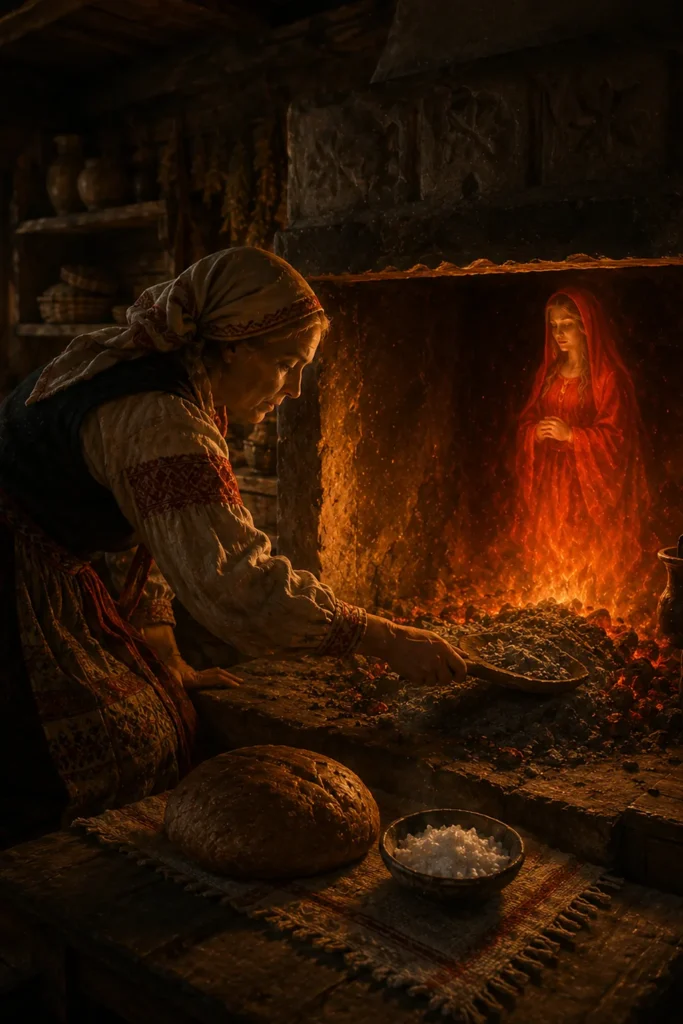
Gabija is the Lithuanian-Baltic goddess of the hearth fire and the protector of house and family. The hearth fire itself is venerated as Gabija: in the evening the embers are put to bed with ashes, and bread and salt are offered to her.
Her care has a darker side: if the goddess is disrespected or her fire fouled, it is said, she goes wandering and burns the house down. The tending of the fire falls to the mistress of the house; the earliest written record appears in the list of gods by Jan Lasicius from around 1582.
Type: goddess of the hearth fire, personified fire
Origin: Lithuania, Samogitia
Texts: Lasicius, De diis Samagitarum (c. 1582), folk tradition of the 19th and 20th centuries
Period: first recorded around 1582, folk belief into modern times
Appearance: as a cat, stork, rooster, or woman in red
Area of origin and sources
Period of the Texts
The earliest record appears in Lasicius, written around 1582 and printed in 1615; the actual body of material is folkloric, dating from the 19th and 20th centuries.
Area of Diffusion
Lithuania, especially Samogitia: there, the veneration of the hearth fire as Gabija is rooted in folk belief.
Sources
Moderate: the earliest record in the list of gods by Lasicius is regarded as partly valuable, partly unreliable; the rich elaboration stems from more recent folk tradition.
Name and variants
Lithuanian: Gabija, with the spelling variants Gabieta and Gabeta. The etymology is disputed: either from Lithuanian gaubti, to cover and protect, which fits the nightly covering of the embers, or from Saint Agatha via a form Gafija.
Form and effect
Appearance
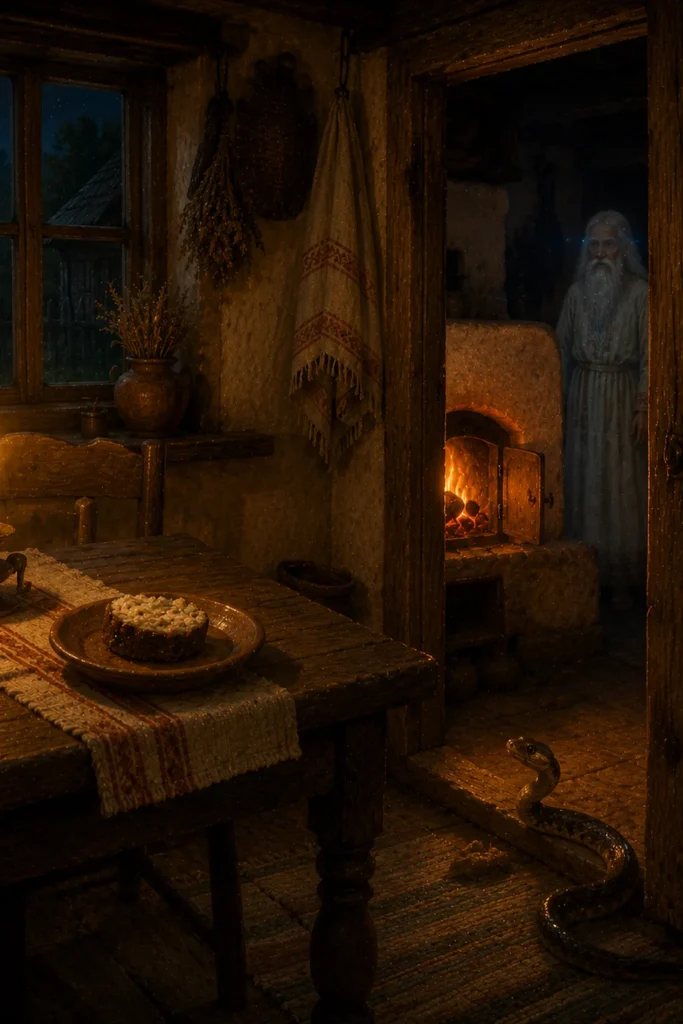
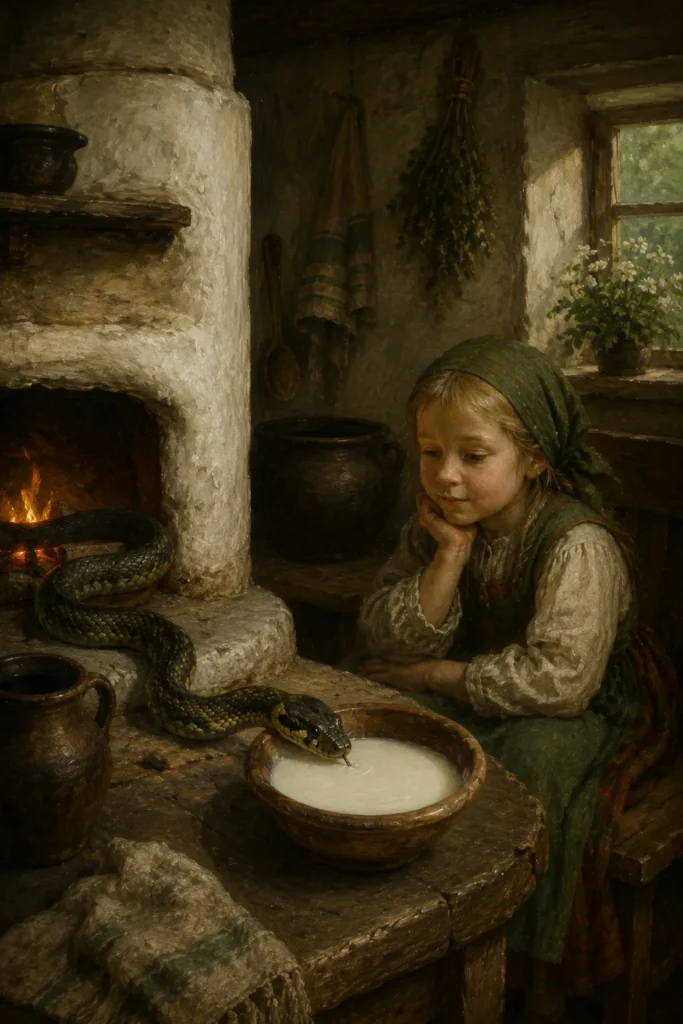
Gabija is personified fire. In zoomorphic form she appears as a cat, stork or rooster, in anthropomorphic form as a woman in red; the hearth fire is her seat and sign.
Effect
As a hearth goddess, Gabija protects house and family; her keeper is the mistress of the house. If she is angered or treated carelessly, the fire wanders and burns the house down. She is not malevolent, but the force she embodies is destructive.
Profile: Gabija
The most important aspects of the hearth goddess at a glance.
Central figure of Lithuanian hearth-fire veneration, first recorded by Lasicius, richly elaborated in folk tradition.
House and family; the mistress of the house is entrusted with tending the fire and thus with dealing with the goddess.
Personified fire: as a cat, stork or rooster, and in human form as a woman in red.
Protection, warmth and the strength of the house; if disrespected, the force turns, the fire wanders and destroys.
The evening bedding of the embers with ashes, offerings of bread and salt, and strict purity taboos surrounding the fire.
From Lasicius to living folk tradition
The etymology is disputed: either from Lithuanian gaubti, to cover and protect, which fits the nightly covering of the embers, or from Saint Agatha via a form Gafija; spelling variants include Gabieta and Gabeta. The earliest written record appears in the list of gods by Jan Lasicius, De diis Samagitarum, written around 1582 and printed in 1615; this list is regarded as partly valuable, partly unreliable.
The actual body of material is folkloric, dating from the 19th and 20th centuries: the customs of putting the embers to bed, the offerings of bread and salt, and the tales of the fire that goes wandering when disrespected. From these testimonies, Gabija emerges as mistress of the hearth fire and protector of the house.
Revival and classification
Gabija was revived in the Lithuanian native-faith movement Romuva, with fire rituals and the Rasos festival; she also lives on as a given name and cultural symbol.
From a religious-studies perspective, Gabija is a prime example of the Baltic veneration of the hearth fire with purity commandments and food offerings. Three clarifications belong here: the first record is brief and problematic in terms of source criticism. The derivation from Saint Agatha is a syncretistic reinterpretation. And the harvest deity Gabjauja is to be distinguished from Gabija.
Putting the fire to bed
Well attested is the evening ritual of putting the embers to bed with ash. Bread and salt are offered to Gabija, and in some cases a bowl of clean water is placed by the hearth so that she can wash herself. Strict purity taboos apply: do not spit into the fire, do not step into it, do not defile it. Tending the fire is the responsibility of the mistress of the house, who thereby also guards the household’s relationship with its goddess.
Hearth goddesses from Rome to Lithuania
Gabija corresponds to the Roman Vesta, the Greek Hestia and the Vedic Agni as hearth and sacrificial fire, as well as to the Latvian fire mother Uguns māte and the Albanian Nëna e Vatrës. The Slavic Matka Gabia found in circulation is poorly attested. Within the Baltic sphere she is close to the drying-kiln fire spirit Jagaubis, who belongs to the same fire complex but is bound to the grain-drying kiln rather than the hearth.
Frequently asked questions about Gabija
What does putting the fire to bed mean?
In the evening the embers are covered with ash to lay Gabija to rest; in the morning the fire is roused anew.
Why does the house burn down if she is disrespected?
According to belief, a neglected or desecrated fire goes wandering, meaning it gets out of control and destroys the house.
Is Gabija an ancient, well-attested cult?
The first record around 1582 is brief and problematic in terms of source criticism; the rich elaboration stems from more recent folk tradition.
Further links
Further reading:
- Jagaubis – the Lithuanian spirit of the drying-kiln fire
- Vesta and Hestia – the hearth goddesses of Rome and Greece
- Agni – the Vedic sacrificial fire
- Protective candle, salt, amulet – traditional protective means
- Protection Compass – protective means at a glance
Literature (selection)
Further standard works in the bibliography.
As the Lithuanian fire goddess and Baltic hearth goddess, Gabija combines care and severity: whoever tends her fire and keeps it clean has in her the protector of the house; whoever disrespects it risks, according to old belief, that the fire will go wandering.