Hestia, Goddess of the Hearth Fire
By Ralf Ittermann · last reviewed on
Hestia is the goddess of the hearth fire and keeper of the home, whose quiet flame formed the center of house and city. In the Greek pantheon, Hestia is the goddess of the hearth fire and of domestic order.
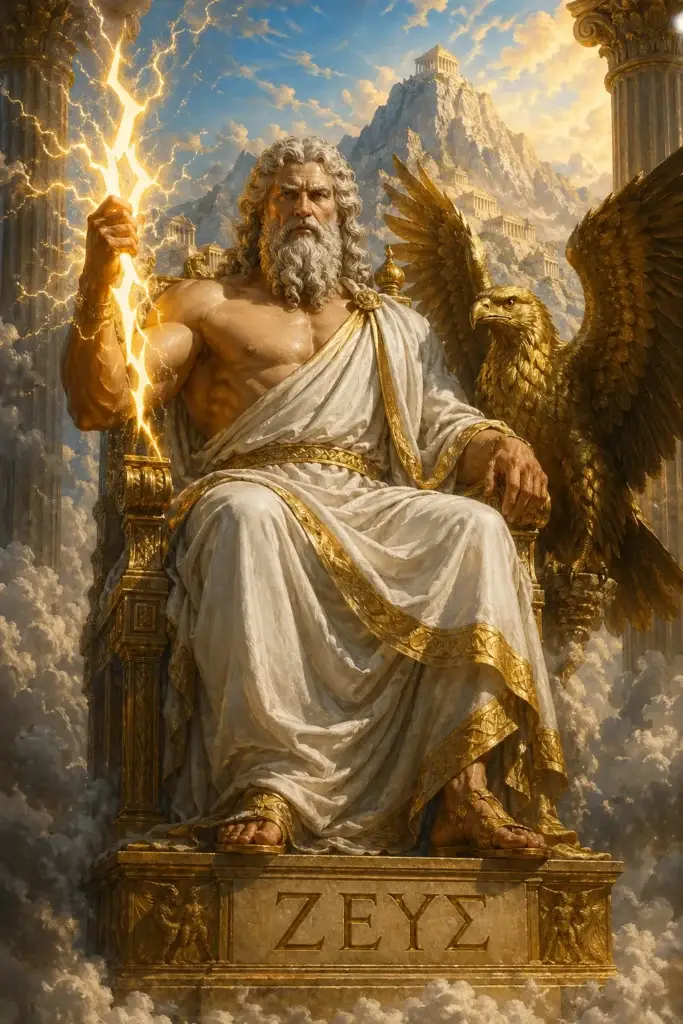
She is the eldest of the siblings of Zeus and, like him, Hera, Demeter, Hades, and Poseidon, belongs to the children of Cronus who were swallowed by Cronus and rescued through Rhea. In the «Theogony» (verses 453 to 458), Hesiod names her as the first of the just-begotten sisters, which establishes her status as firstborn.
Unlike her siblings, she scarcely appears as an acting figure in myth: she has no love affairs, no conflicts, no jealousy, no journeys.
This mythical reticence is not a deficiency, however, but her actual profile: Hestia is the abiding one, the center, the unmoved pole around which the movement of the other Olympians circles. Her epithet «Prytanis», the «presiding one», marks her constitutional rank as keeper of the Prytaneion fire, which embodied the continuous existence of the polis.
Myth and Genealogy
As the firstborn daughter of Cronus and Rhea, Hestia is the first to be swallowed by her father, because a prophecy had foretold his downfall through a child.
When Zeus grows up and administers the emetic to Cronus, Hestia is the first to be put in but the last to be spat out again; in this reversal of order she becomes at once first- and last-born, which establishes her special position as the «alpha and omega» of Olympus.
This mythical double position is commented upon in the Delphic hymn of Homer and in the Orphic tradition.
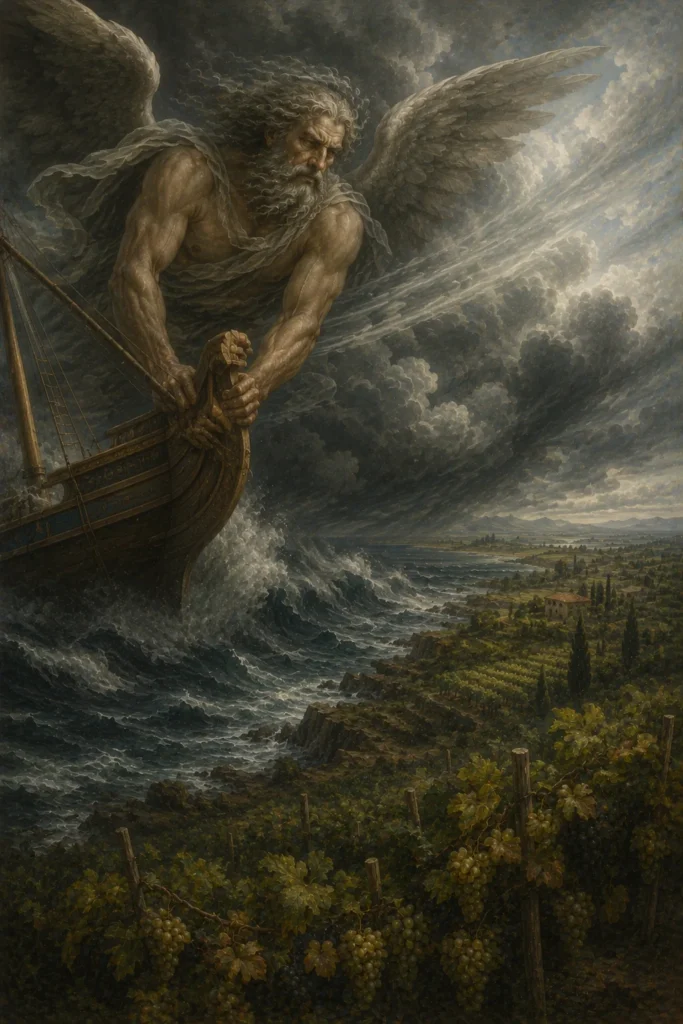
Both Poseidon and Apollon courted Hestia, but she swore eternal virginity by Zeus, for which reason the father of the gods assigned her a position of honor at the center of every Greek household and at the center of every polis assembly hall (Homeric Hymn to Aphrodite 21 to 32).
At every sacrifice and feast, whether private or public, Hestia received the first and last share. This ritual practice is a central feature of the Greek cult of the gods and lends Hestia a cultic omnipresence that stands in contrast to her mythical reticence.
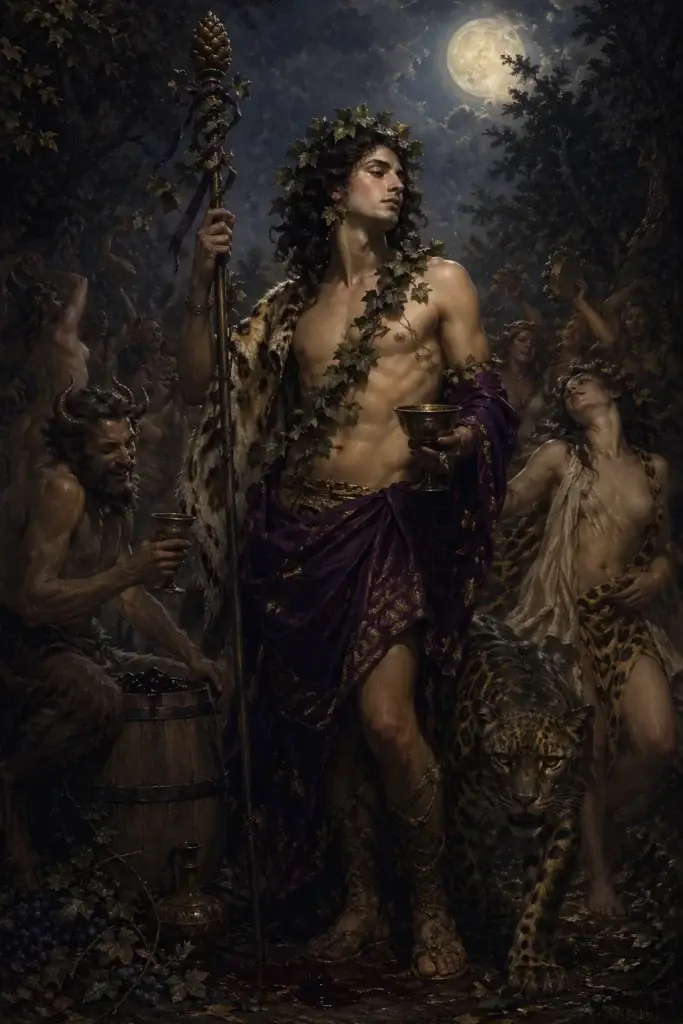
Unlike her sisters Demeter and Hera, Hestia has no children, no rivals, and no marital history. In the Olympian list of the twelve, her place is taken in some sources by Dionysos, who represents the younger generation; Hestia then appears as the thirteenth or as a constantly present background goddess.
In ancient theology this shift is understood not as a demotion but as an elevation: Hestia is not one among twelve, but the resting center from which the twelve are counted.
A rare narrative episode is preserved by Ovid in the Fasti: Priapos, the fertility god, one night visits the sleeping Hestia, but a donkey wakes her with a loud cry; Hestia springs up, Priapos flees in disgrace, and the donkey is thereafter honored by Hestia.
This mythical aetiology explains the donkey sacrifice at the festivals of Priapos and underscores the inviolable virginity of Hestia.
Symbols, Iconography, and Attributes
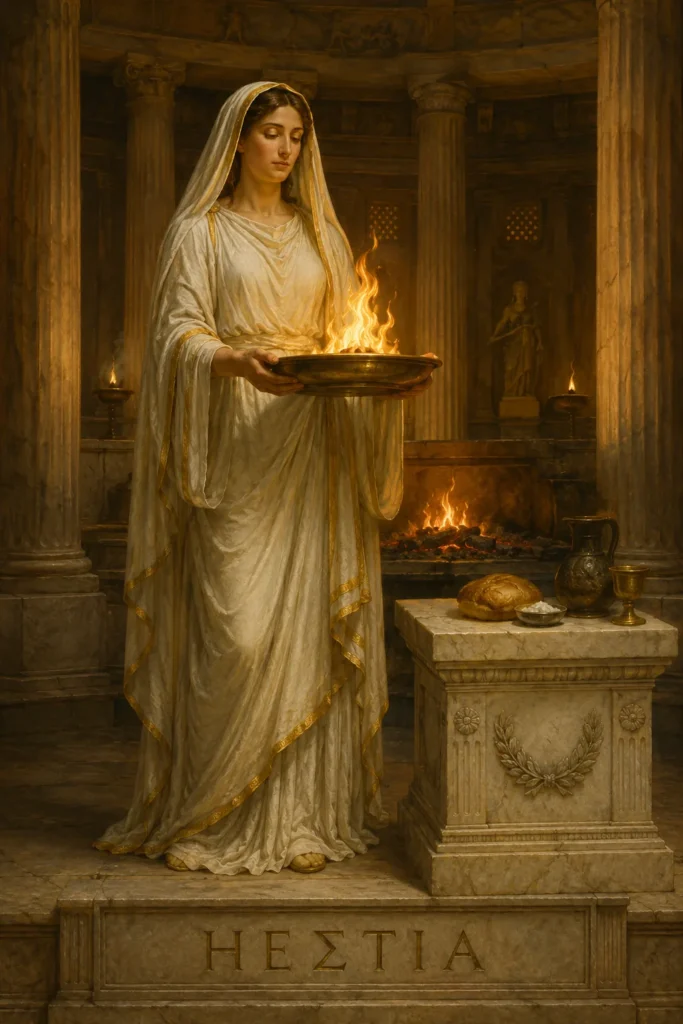
Hestia is depicted with restraint in Greek visual art, in keeping with her mythical stillness. She appears as a modestly veiled woman of middle age, with a headscarf or simple diadem, often with a torch in her hand.
Her principal attribute is the burning fire itself, which she need not grasp because she is it. In the rare scenes of assembled gods she sits quietly in the background, without being set apart in depiction.
The hearth (eschara, hestia as a generic term) is her sanctuary in the house and in the polis. In every Greek city an eternal fire burned in the Prytaneion, maintained by dedicated priestesses (or, where there were Hekate associations, by widows).
When founding a new city, the colonists carried embers from this mother-city fire with them; the lighting of the mother hearth in the daughter city was the formal act of the city’s founding.
Whoever let the embers go out endangered the very existence of the polis, which is why responsibility for the fire was entrusted to a high magistrate.
In sculpture, Hestia is represented by the «Hestia Giustiniani» (now Museo Torlonia, Rome), a Roman copy of a Greek original from around 470 before the Common Era.
The statue shows a modestly standing goddess in a heavy peplos, with a headscarf, without martial or erotic attributes. The strict frontality and the hieratic veiling make the figure the embodiment of the dignity of the private and of the domestic norm.
In the vase painting of the archaic and classical period, Hestia appears at the assemblies of the gods, for example at the wedding feast of Peleus and Thetis (François Vase, around 570 before the Common Era), as a modestly seated or standing figure.
She is seldom depicted alone, which reflects the difficulty for artists of depicting a god without a striking action. In the later Roman imperial period, the identification with Vesta becomes more frequent in sculpture: Vesta reliefs and statues with the torch or phiale were created down into late antiquity.
Cult and Veneration
The Hestia cult was omnipresent in the Greek world, but also unspectacular. Every house, every family, and every polis possessed a hearth, and at each of these hearths Hestia was honored.
When a bride entered the house of the bridegroom, she was led to the hearth, where the transition from the paternal family into the new family was accomplished.
For a newborn, on the «Amphidromia» day, the fifth or seventh day of life, the child was carried three times around the hearth, by which it was received into the family.
The Prytaneion was the political center of the polis, in which the eternal Hestia fire burned. In Athens it lay east of the Acropolis, in its later location next to the Bouleuterion.
Here the honored guests of the polis (xenoi) were feasted; the Olympic victors and the families of soldiers who had fallen for the city received lifelong sustenance (sitesis).
This practice linked Hestia’s domestic profile with the public honoring of the meritorious. Pausanias (I, 18, 3) reports of Hestia images in the Athenian Prytaneion as well as of an eternal fire in the Prytaneion of Sparta.
In sacrificial rituals Hestia always received the first and last share. The Homeric Hymn to Hestia (Hymn.
Hom. 29) opens with the invocation: «Hestia, you who have obtained an eternal seat in the high houses of all the immortal gods and of earth-born humans, a venerable honor and a fair gift.» This formulaic placing of Hestia first at every sacrifice becomes proverbial: «to begin with Hestia» (aph’ Hestias archesthai) meant, down into the language of late antiquity, «to begin rightly».
In the mantic cult of Delphi, Hestia played her own role. The Omphalos, the mythical central stone of the world, stood in connection with the eternal Apollon-Hestia fire; before every oracular consultation, those consulting had to sacrifice at the Hestia altar.
In Olympia the Hestia fire burned in the Prytaneion next to the temple of Hera. The Olympic torch, by contrast, is a modern invention (Berlin 1936) and is not attested for antiquity.
Outside the Greek heartland, Hestia was also venerated in Ionian colonies such as Miletus, Ephesus, and Olbia; the Olbia Prytaneion had an eternal fire maintained through public endowments.
In the Hellenistic period the royal dynasties incorporated Hestia into their state cult: the Ptolemies in Alexandria, the Seleucids in Antioch, and the Attalids in Pergamon had a royal Hestia fire that made the continuity of their rule visible.
Important Sanctuaries and Temples
Unlike most of the other Olympians, Hestia had no independent monumental temples. Her sanctuaries were embedded in the Prytaneia, the assembly halls of the polis.
The Delphic Prytaneion with the Hestia-Hekate fire (Pausanias X, 24, 4) was regarded as the most venerable and stood in direct ritual connection with the Apollon temple. The Athenian Prytaneion lay at the foot of the Acropolis and housed, besides the Hestia fire, also the images of the lawgiving heroes Solon and Dracon.
In the Heraion of Olympia stood a Hestia altar. Pausanias (V, 15, 8 to 9) describes the Prytaneion of Olympia and the perpetual fire that was never allowed to go out.
In Naupaktos, in Olbia, in Halikarnassos, and in many other Ionian and Dorian cities, Prytaneia with a Hestia cult can be attested.
A rarer independent Hestia sanctuary existed in Ermioni in the Argolid; Pausanias (II, 35, 1) mentions it briefly, without closer description. In Hermione there was a Hestia temple.
In the Roman imperial period the temples of Vesta took over the monumental principal representation: the Vesta sanctuary on the Forum Romanum, with the famous round-plan temple and the adjacent Atrium Vestae complex, is regarded as the institutionally most important Hestia site of all, albeit in Roman form.
Mythical Narratives
Mythical narratives concerning Hestia are rare. The most important is the courtship myth: both Poseidon and Apollon, that is, the elder brother and the younger brother or nephew respectively, ask for her hand. Hestia refuses and swears eternal virginity by Zeus.
Zeus honors this oath and establishes the practice that Hestia is to receive the first and last sacrifices in every house and in every temple (Hymn. Hom. Aph. 21 to 32). With this, Hestia receives a distinction that the other Olympians cannot surpass through any sanctuary: she is everywhere.
The second transmitted myth is the Priapos episode. One night at the banquet of the gods Hestia falls asleep, and the lustful Priapos tries to approach her. A donkey of Silenos scents the approach and brays so loudly that Hestia wakes; Priapos flees, ashamed before the mockery of the other gods.
Hestia, in gratitude, dedicates a festal sacrifice to the donkey, which is why in Lampsakos and in Roman Priapos sanctuaries a donkey was annually sacrificed or honored (Ovid, Fasti VI, 319 to 348).
Besides this, there are brief mentions of Hestia in the catalogs of the gods of Hesiod and in the Orphic hymns, but no independent narrative episodes. This mythical silence contrasts with the religious omnipresence of the goddess and is the core of her peculiar profile.
Plutarch (Numa 11) reports that some theologians identified Hestia with the earth itself, because she is the resting center around which the celestial bodies circle; this is a philosophical speculation connected with the Pythagorean doctrine of the «central fire».
The Orphic tradition gives Hestia a further cosmic dimension: she is said to be the soul of the world, the fire that holds matter together.
This reading is expressly stated in the Orphic hymns (no. 84) and systematically developed in Neoplatonism. Proclus identifies Hestia with the soul-center of the cosmos, which enormously increases her theological dignity in late antiquity.
Relationships within the Pantheon
Within the pantheon, Hestia stands in a relationship of discreet precedence to every other god. At every sacrifice she receives the share first, which means that she is structurally co-present in every other divine action.
With Zeus, her brother, she is joined by the shared protection of political order: where Zeus represents the cosmic, politically superordinate order, Hestia represents the political, locally anchored order of the polis. Together they form the theological bracket of Greek civic religion.
With Hera she shares the high-ranking profile of the oldest generation of the Olympians, but the functions are cleanly separated: Hera protects lawful marriage and the queen of the polis, Hestia the quiet center of every household.
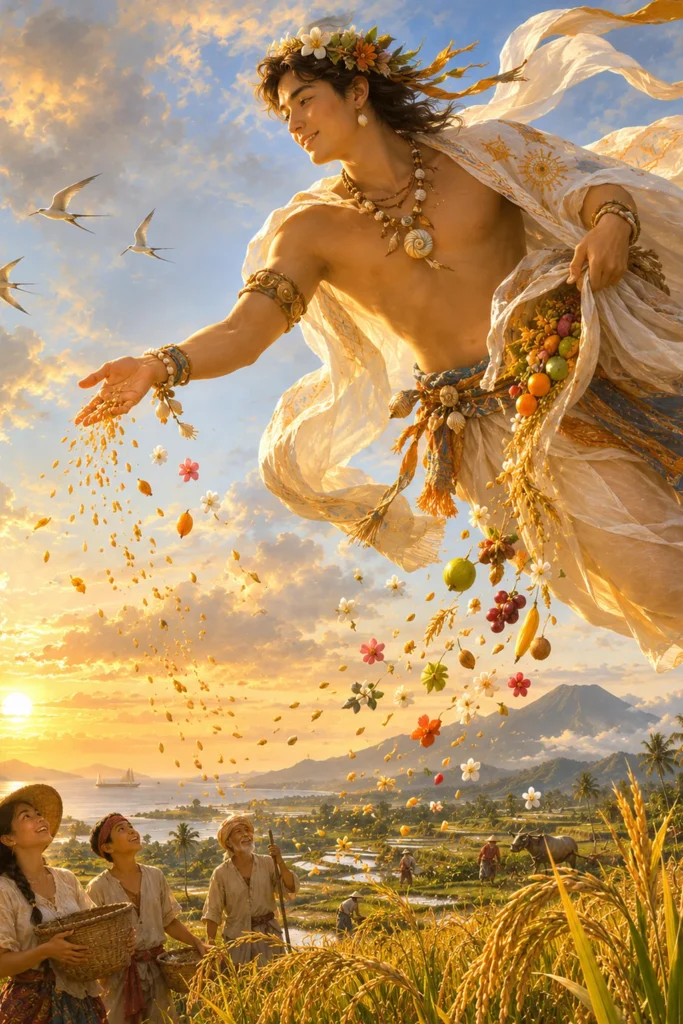
With Demeter, her sister and goddess of fertility, she shares the profile of the domestically oriented goddess; but while Demeter protects the fields and the grain, Hestia is confined to the hearth itself.
With Poseidon and Apollon she experienced the courtship relationship that ended with her oath of virginity. The calm fraternity toward both remains free of tension in the later tradition.
With Hekate, Hestia shares the hearth cult in some local traditions; at Delphi the eternal fire was expressly «Hestia-Hekateion», which preserves the archaic connection between hearth, transition, and the chthonic goddess of the threshold.
With Hermes as god of the road and protector of traffic, Hestia stands in a fine complementarity formulated by Jean-Pierre Vernant: Hestia is the inner and abiding, Hermes the outer and moving.
Reception
The Roman identification with Vesta yields the most powerful institutional form of the cult of all. Vesta was in Rome an independent Old Italic goddess whose temple on the Forum Romanum was regarded as the center of Roman state religion.
Six Vestal Virgins, chosen between the ages of six and ten, served the cult of Vesta for thirty years: ten as novices, ten as officiating priestesses, ten as teachers of the younger ones.
They maintained the eternal fire in the temple of Vesta, guarded the Palladium (the image of Athena rescued from Troy), watched over the oath of the magistrates, and enjoyed a legal standing equivalent to that of a free citizen sui iuris. If a Vestal violated her chastity, she was buried alive in the Campus Sceleratus.
The eternal fire of Vesta burned until the edict of Theodosius I in the year 394 of the Common Era, which had the temple closed. With this ended the oldest uninterrupted cult of the gods of the Roman world.
In the Middle Ages the memory of Vesta survived in the allegorical handbooks and in the notion of purity and fidelity. The Renaissance brought, with Camillo Mariani’s statue (late sixteenth century) and with numerous Vesta allegories in the great Italian palaces, a humanist reintegration of the figure.
In the nineteenth century Hestia-Vesta became a symbol of bourgeois domesticity and of female self-sacrifice in the household; this reading was critically deconstructed in the second half of the twentieth century by feminist mythological research.
Jean Shinoda Bolen («Goddesses in Everywoman», 1984) made Hestia the archetype of the introverted, contemplative woman. In the modern Olympic tradition (since 1936) the Olympic torch is symbolically lit at a «Hestia»-like bowl in Olympia, which is merely modeled on the ancient custom of the Hestia fire in the Prytaneion.
Religious-Studies Classification
The etymology of the name Hestia remains clear: it corresponds to the common Greek word for hearth (hestia) and is connected with the Latin «Vesta», the Old Indic «vāstu» (dwelling), and the Avestan «vāstryō» (householder).
The Indo-European root «*ues-» (to abide, to dwell) denotes the central function of abiding and dwelling. Hestia is thus one of the few Olympian gods whose Indo-European origin is securely attested.
In Indo-European comparison, Hestia corresponds to an old hearth deity that is also preserved in the Iranian religion (the Yazata «Ātar», fire) and in the Indian religion (Agni and the master of the house Vāstoṣpati).
The ritual practice of hearth veneration upon entry into a new family is similar in the Baltic, Slavic, Germanic, and Greek traditions, which points to a very old common layer.
Georges Dumézil, however, did not clearly assign Hestia to any of his three functions; rather, she is conceived as a «functional basis», that is, as the precondition of every function.
In «Greek Religion», Walter Burkert worked out the theological logic of Hestia: she is the goddess of the abiding, who through the perpetual fire secures the continuum of the polis and the family.
Her ritual omnipresence is the expression of a theology that does not play the constant off against the moving, but recognizes it as its precondition.
Robert Parker, in «Athenian Religion» (1996), systematically worked out the political profile of Hestia in the Prytaneion cult and showed how the semantics of honoring in Attic democracy crystallized around her. In more recent feminist mythological research (e.g. Christine Downing) Hestia gains new attention as a model of the non-activist, contemplative center.
Sources
Hesiod, «Theogony» 453 to 458. Homeric Hymn to Aphrodite, verses 21 to 32; Homeric Hymns 24 and 29 (to Hestia).
Pausanias, «Description of Greece» I, 18, 3 (Athenian Prytaneion), II, 35, 1 (Ermioni), V, 15, 8 to 9 (Olympia), X, 24, 4 (Delphi Prytaneion). Diodorus, «Bibliotheca historica» V, 68, 1. Ovid, «Fasti» VI, 249 to 460 (Vesta day).
Plutarch, «Numa» 9 to 11. Walter Burkert, «Greek Religion of the Archaic and Classical Period», Stuttgart 1977. Karl Kerényi, «The mythology of the Greeks», Zurich 1951. Robert Parker, «Athenian Religion. A History», Oxford 1996. Mary Beard, John North, Simon Price, «Religions of Rome», Cambridge 1998 (on the Vesta cult).