Supreme god of the Greek pantheon, Olympian Father, ruler of thunder, sky and order. Zeus stands at the centre of Greek mythology as the highest steward of the world.
He shares power with his brothers Poseidon and Hades, yet retains sovereignty over the upper world, the sky and the weather, and thereby the final authority over gods and mortals.
Zeus is the supreme thunder god of Greece and father of gods and men.
Type: supreme deity, god of sky and weather
Pantheon: Greece (Olympus)
Function: upholder of cosmic order, oaths and the law of hospitality, ruler and father figure
Principal attributes: thunderbolt, eagle, oak, aegis
Principal cult sites: Olympia, Dodona, Athens
Roman counterpart: Iuppiter (Jupiter)
The tradition concerning Zeus reaches from the Mycenaean Linear B tablets (c. 1400-1200 BCE) through Homer and Hesiod (c. 8th century BCE) into late antiquity.
In the Linear B texts his name already appears as di-we or di-wo. The literary form familiar to us today takes shape in the Iliad, the Odyssey and Hesiod’s Theogony.
Venerated across the entire Greek-speaking world: from the mainland (Olympia, Dodona, Athens, Thebes) and the islands (Crete with the Idaean Cave sanctuary) to Asia Minor and the Greek colonies of the Mediterranean. With the Roman reception as Iuppiter, the sphere of influence extends across the entire Empire.
The core consists of Homer’s Iliad and Odyssey together with Hesiod’s Theogony and Works and Days. To these are added the Hymns, lyric poetry (Pindar), the tragedies (above all Aeschylus’ Prometheus), cult inscriptions and archaeological finds from the major sanctuaries. Later sources, Pausanias and Apollodorus, gather the tradition in systematic form.
Greek: Ζεύς (Zeús), genitive Διός (Diós); the root points to Indo-European *dyeus, “sky, day”, placing it in a family with Latin dies, Sanskrit dyaus and Germanic Tiu/Tyr.
Epithets: Olympios (the Olympian), Xenios (protector of guests), Horkios (guardian of oaths), Soter (saviour), Keraunios (hurler of the thunderbolt), Pater (father). Mycenaean: di-we / di-wo in Linear B tablets from Pylos and Knossos. Roman counterpart: Iuppiter Optimus Maximus.
Appearance
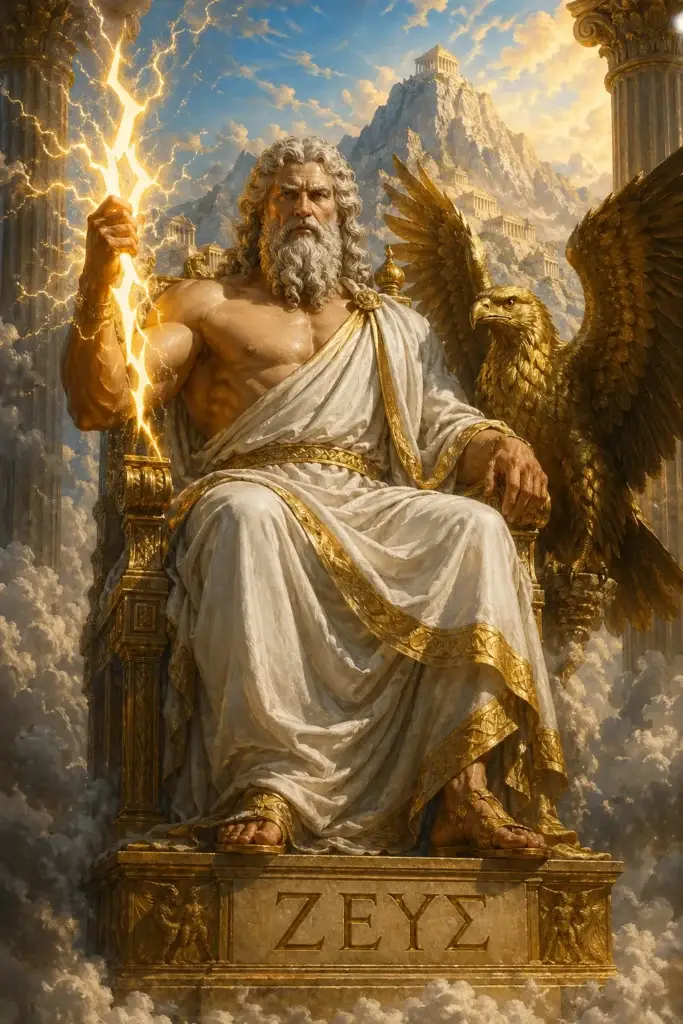
Zeus is depicted as a mature, powerfully built man with a thick beard and long hair. Archaic and classical visual art usually shows him enthroned, within or above the sea of clouds, holding the thunderbolt (keraunos) in his right hand and often a sceptre in his left.
The eagle, his sacred animal, perches on his shoulder or at his feet. The colossal seated statue by Phidias at Olympia (5th century BCE) was counted among the seven wonders of the ancient world.
Zeus is not the creator of the world but its orderer. After his victory over the Titans (Titanomachy) and the Giants (Gigantomachy) he establishes the Olympian order.
His conduct is ambivalent: he guarantees justice, the keeping of oaths and the law of hospitality, yet he is also an unpredictable lover whose many unions with goddesses and mortals people Olympus and the Greek tradition of heroes.
The most important aspects of Zeus at a glance. The table summarises origin, function, appearance, veneration, symbols and parallels.
Son of the Titan Kronos and of Rhea, youngest of the Olympian siblings. Raised in hiding on Crete, since Kronos threatened to devour his children. After the liberation of his siblings, victory over the Titans, with the world divided among Zeus, Poseidon (the sea) and Hades (the underworld).
Guardian of cosmic order and of fate. Protector of oaths, hospitality and suppliants. Father and ruler figure of the pantheon, the highest court of appeal in conflicts between gods.
A mature, bearded man, enthroned or striding forward. Thunderbolt in the right hand, sceptre in the left, eagle at his side. Often depicted within the sea of clouds, occasionally with the aegis (shield-mantle) or with a wreath of oak.
Principal cult sites: Olympia (the Olympic Games held in his honour), Dodona (oracle from the rustling of the sacred oak), the Idaean Cave on Crete, Athens (temple of Zeus Olympios), Nemea (the Nemean Games). Sacrifices: bull (the principal sacrificial animal), goat, and in the archaic period also hecatombs.
Thunderbolt (keraunos), eagle, oak, bull, aegis. The oak of Dodona was regarded as his voice; from the rustling of its foliage the priests interpreted his answers.
Iuppiter (Rome), Tinia (Etruscans), Indra and Dyaus Pita (Vedic India), Thor and Tyr (Germanic), Perun (Slavic), Marduk (Babylon), Baal (Levant), Teshub (Hittites). The Indo-European root *dyeus links a large portion of these figures etymologically.
Zeus was not a god of the mysteries or of personal salvation; he stood for the public, communal measure. In everyday life his veneration was expressed less at the private house altar than in public festivals, oath formulas and treaties.
Whoever swore an oath called upon Zeus Horkios; whoever offered protection to a stranger acted under the eye of Zeus Xenios (“protector of guests”).
At the level of household practice, the master of the house was occasionally regarded as the deputy of Zeus Herkeios (“god of the courtyard”), with a small altar in the inner court.
At important decisions in life, marriage, travel, contracts, offerings were customarily made to Zeus, often in conjunction with other deities (Hera as goddess of marriage, Hermes as protector of travel).
Roman tradition: Iuppiter Optimus Maximus, principal deity of the Capitoline Triad (with Iuno and Minerva). The Roman reception is seamless and leads to a syncretic fusion in the Hellenistic-Roman late antiquity.
Vedic and Hindu tradition: Dyaus Pita (“Father Sky”) as the original Indo-European supreme deity. In later Vedic religion Dyaus is displaced by Indra as weather god and leader. Indra shares with Zeus the thunderbolt (Vajra) and the role of leader in the battle of the gods.
Germanic tradition: Tyr (Tiu, Old High German Ziu) bears etymologically the same root. In functional terms the role of thunder god shifts to Thor, while Tyr becomes the god of oaths and law. Odin assumes the position of supreme deity.
Mesopotamian tradition: Anu (Sumerian An) as sky god and original head of the pantheon; later displaced in Babylon by Marduk, who carries the thunderbolt aspect more strongly.
In Greek mythology Zeus is the supreme god, ruler of sky and weather and king of the Olympian gods. He is the youngest son of the Titans Kronos and Rhea.
Since Kronos devoured his children to escape a prophecy, Rhea saved the newborn Zeus by a ruse. Once grown, Zeus overthrew his father, freed his siblings and led the gods to victory in the ten-year struggle against the Titans. His principal attribute is the thunderbolt.
Olympia in the Peloponnese was the most important sanctuary of Zeus. Inside its temple stood the roughly twelve-metre-high statue of the enthroned Zeus in gold and ivory, created by the sculptor Phidias in the fifth century BCE, which counted among the seven wonders of the ancient world.
In honour of Zeus the Olympic Games were held at Olympia, the beginnings of which are traditionally dated to 776 BCE. Another famous sanctuary of Zeus was the oracle at Dodona, the oldest oracle in Greece.
Against its influence, cross-cultural tradition names these protective means:
Compare in the Protection Compass →Recommended protective means
The simplest protective means in this collection: 41 layers of fine gold 999, platinum, silver and silicon, manufactured in Ruhla, Thuringia. It requires no activation, is bound to no person, and is effective within a radius of around 50 meters, even without being worn.
Related Beings

Yamuna, the sacred river goddess of Hinduism and sister of Yama. Origin, Krishna connection, icon...

Gugurang, the highest, benevolent god of the Bicol and guardian of fire. Origin, the Mayon volcan...

The Doppelsauger, the twice-sucking undead of Wendish-North German tradition. Origin, the consumi...

Dakuwaqa, the shark god and sea guardian of Fiji. Origin, the battle with the octopus and protect...

The written transmission about Mikail reaches back several centuries into the past, very probably...

Penghou, the Chinese tree spirit in the wood of ancient camphor trees. Origin in the classical te...