Hades, god of the Greek tradition
By Ralf Ittermann · last reviewed on
Hades is a god of the Greek tradition.
Ruler of the underworld, brother of Zeus and Poseidon, the unseen overseer of the realm of the dead. Hades reigns over the realm of the departed without laying claim to Olympus; after the victory over the Titans he divides the world with his brothers and deliberately retains the underworld for himself.
His name was so uncanny to the Greeks that they usually referred to him by paraphrases: Plouton, the wealthy one; Polydegmon, the receiver of many; Eubuleus, the good counsellor.
Hades is the best-known underworld god of Greece.
Hades
Quick Overview: Hades
Type: Major Greek deity, ruler of the underworld
Pantheon: Greece (one of the three brothers alongside Zeus and Poseidon)
Function: Ruler of the underworld, keeper of the dead, possessor of riches
Main attributes: Helm of invisibility (Helm of Aides), bidens (two-pronged staff), cypress wreath, Cerberus
Main cult sites: Eleusis, Hermione (Argolis), Pylos, Locri Epizephyrii
Roman counterpart: Pluto / Dis Pater
Historical Classification
Hades has been central to Greek mythology since Homer (8th century BCE). His name Aides (“the unseen one”) was taboo; in popular cult he was often called Plouton (“the wealthy one”), a euphemism used to avoid the name.
In Eleusis he is the consort of Persephone within the Mysteries. In the Hellenistic and Roman periods he was taken over as Pluto / Dis Pater, and in Christian late antiquity he was retained as Pluton-Hades, the personification of the underworld.
Dedicated temples of Hades are rare (his name being taboo). Main cult sites: Eleusis (venerated as Plouton within the Persephone Mysteries), Hermione (Argolis, where Pausanias mentions a distinctive Hades cult), Pylos, Locri Epizephyrii.
In Eleusis the Plutonion grotto (his reputed entrance to the underworld) can still be visited today. In the Roman world he was widespread in Pompeii and Rome (the Iseum complex).
Central sources: Hesiod (Theogony), Homer’s Iliad and Odyssey (Book XI, Odysseus’ Nekyia), the Homeric Hymn to Demeter (the abduction of Persephone), Apollodorus’ Bibliotheca, Virgil’s Aeneid Book VI, Pausanias’ Description of Greece. Secondary literature: Sourvinou-Inwood, “Reading” Greek Death; Garland, The Greek Way of Death; Burkert, Greek Religion.
Name and Variants
Greek: Ἅιδης (Háidēs), originally probably “the unseen one” (from *a-wid- “not to see”). In the classical period also Ἀΐδης (Aïdēs). Epithets: Plouton (the wealthy one, from Plutos “riches”), referring to the mineral wealth beneath the earth. Polydegmon (receiver of many), Eubuleus (good counsellor), Klymenos (the renowned one), Agesilaos (leader of the people of the dead).
Roman counterpart: Pluto (Latin Pluto, from Greek Plouton); also Dis Pater (“wealthy father”) as a distinctively Roman form. Etruscan: Aita. Important relatives: brother of Zeus and Poseidon, son of Kronos and Rhea, husband of Persephone (daughter of Demeter).
Characteristics
Appearance
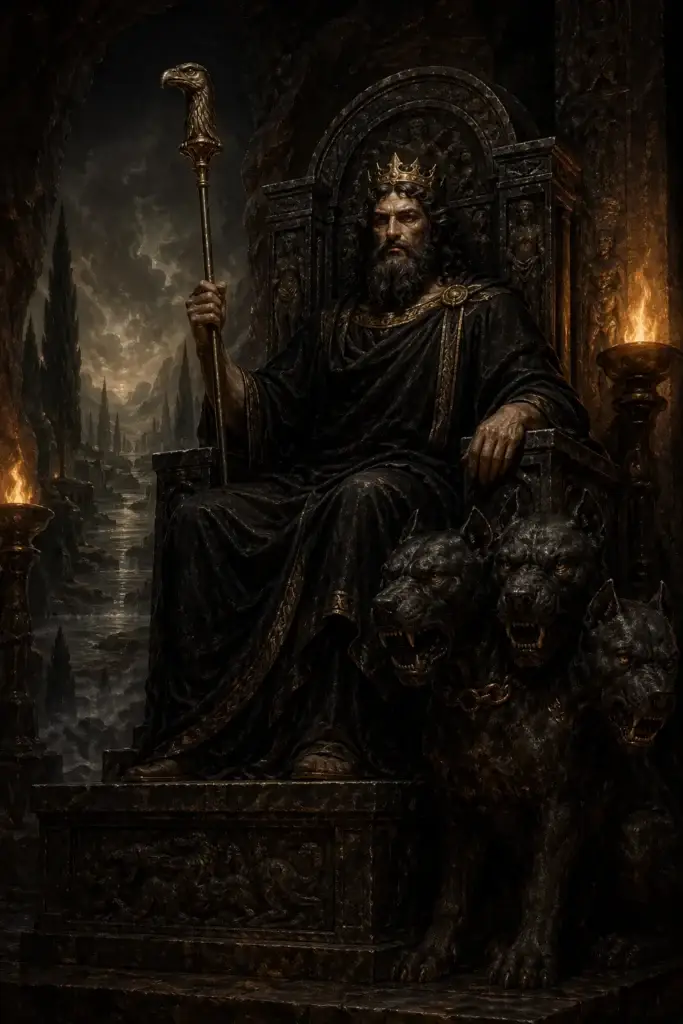
Hades is depicted as a mature, bearded man, similar in appearance to Zeus but usually with a darker, more sombre expression. In his hand he carries a sceptre topped with a bird’s head, or a two-pronged staff.
His Helm of invisibility, a gift from the Cyclopes, makes him invisible; he occasionally lends this helm to gods and heroes. His chariot is drawn by four black horses. At his side or at his feet lies the three-headed hound of the underworld, Kerberos.
Nature and Activity
Hades is not “death” itself, that is Thanatos. He is the keeper of the realm of the dead, just and incorruptible, but unyielding. Whoever has once entered his realm only returns in exceptional cases (Orpheus, Heracles, Odysseus’ Nekyia).
Unlike his Olympian siblings, Hades rarely interferes in mortal affairs; the only major exception is the abduction of Persephone, which gives rise to the cycle of the seasons and to the Eleusinian Mysteries.
Appearance and Symbolism
Hades is portrayed as a bearded, mature man, often carrying a sceptre. His colour is black or dark blue, the colour of the underworld. The two-pronged staff and the Helm of invisibility are his attributes.
Kerberos, the three-headed guardian of the realm of Hades, is his faithful companion. The poppy and the cypress were sacred to him. Unlike Zeus’ thunderbolt or Poseidon’s trident, the power of Hades is subtler, invisible, unavoidable. His realm, unlike the Christian hell, is not a place of punishment.
Profile: Hades
The most important aspects of Hades at a glance. The following fields summarise his origin, function, appearance, veneration, symbols, and parallels.
Hades is the son of Kronos and Rhea, elder brother of Poseidon and Zeus, younger brother of Hestia, Demeter, and Hera. In the division of the world following the victory over the Titans, Zeus receives the sky, Poseidon the sea, and Hades the underworld, by lot rather than by choice.
Husband of Persephone, whom he abducts from the upper world; this is the central Hades myth. Unlike his brothers, he has hardly any affairs or offspring: strictly confined to his domain.
Ruler of the underworld, not the judge of the dead (that role belongs to Minos, Rhadamanthys, and Aiakos), but the supreme lord of the realm. Keeper of the dead: no one returns from his realm except by special divine permission (Orpheus, Heracles, Persephone in part).
As Plouton he is also patron of riches, of mineral resources, of granary reserves, of the mineral wealth drawn from the earth. In the Eleusinian cult, the chthonic and fertility-bearing aspect predominates.
Mature, dignified male figure with thick curls and a full beard, similar to Zeus but sterner and more sombre. The Helm of Aides (helm of invisibility, forged by the Cyclopes) is his principal attribute and renders him unseen.
The bidens (two-pronged staff, comparable to Poseidon’s trident), a cypress wreath (a symbol of mourning), and in some representations a pomegranate (through Persephone’s binding) belong to his iconography.
He is accompanied by the three-headed hound Cerberus. On the Locri pinakes he is frequently shown enthroned with Persephone at his side. His skin tone is often darker than that of Zeus.
Veneration of Hades
Sphere of action: Hades was rarely invoked directly, as his name was considered taboo. More frequently invoked were Plouton (riches), Klymenos (“the renowned one”), or Eubouleus (“the good counsellor”). In Eleusis he was central under the name Plouton.
In personal cult, he was invoked for a safe passing (a merciful death). At burials, animal offerings were made (black lambs, pigs). In oaths he was rarely invoked under the name Hades, since this carried an element of wrath.
Symbols of Hades
Helm of Aides (helm of invisibility), bidens (two-pronged staff), cypress wreath, Cerberus (three-headed hound), pomegranate (through Persephone), chariot drawn by black horses, key (for the locking of the underworld). Plants: cypress, asphodel, poppy, narcissus (Persephone’s flower). Sacred animals: black sheep, Cerberus.
Pluto (Rome, an almost identical assimilation), Dis Pater (Rome, an earlier Roman form), Yamaraja (Hinduism, judge of the dead), Yama (Buddhism), Anubis/Osiris (Egypt, guide of the dead and king of the dead), Hel (Germanic, ruler of the underworld), Mictlantecuhtli (Aztec, lord of Mictlan), Yanluo (China, lord of Diyu), Ereshkigal (Mesopotamia, female queen of the underworld).
Veneration in Everyday Life
Hades was not a god of public festival culture; his name was avoided, temples were rare and usually set apart. In private life his presence was felt above all in two contexts: in burial rituals and in the mystery cults.
At burials the deceased was given a coin placed in the mouth (Charon’s obol) as fare for Charon, occasionally honey cakes for Kerberos.
Mourning ceremonies (Trita, Enata) on the third and ninth day after death followed fixed prayers to the chthonic gods. Family tombs were sites of continued care; funerary meals (Perideipnon) and periodic libations kept the bond with the departed alive.
The Eleusinian Mysteries, in which Hades and Persephone played central roles, promised initiates a better fate in the afterlife. The exact rites remained secret under the obligation of silence, yet Hades as Plouton appeared in the Mysteries as the just, less fearsome aspect of himself.
Hades, Parallels in Other Cultures
Roman tradition: Pluto (taken over from Greek Plouton) and Dis Pater (a distinctively Roman figure). The merging with the Greek Hades is seamless. The Lemuria and Parentalia served as the Roman equivalent of the Greek festivals of the dead.
Etruscan tradition: Aita (Hades) and his consort Phersipnai (Persephone), often depicted on Etruscan sarcophagi and wall paintings. The Etruscan conception of the underworld influenced the Roman one and continues to show through in late Greco-Roman pictorial works.
Mesopotamian tradition: Ereshkigal as mistress of the underworld (Kur, Irkalla), not male, but functionally comparable. Her consort Nergal corresponds more directly in some respects to the Hades aspect. The Inanna’s Descent motif has structural parallels to the Persephone story.
Egyptian tradition: The function is divided among Osiris (ruler of the realm of the dead as just judge), Anubis (guide of souls), and Hor-em-aha-bait (guardian of the dead). Greco-Roman late antiquity merged Osiris and Hades into the syncretism known as Sarapis.
Hindu tradition: Yamaraja as ruler over the kingdom of the dead (Yamaloka), the first mortal to find the path to the afterlife. Yamaraja shares with Hades the function of the just, incorruptible judge; unlike Hades, however, he does not reside permanently among the dead but visits their kingdom on a regular basis.
Germanic tradition: Hel as daughter of Loki, mistress of the eponymous realm of the dead, Helheim. Functionally similar to Hades, but with a different moral accent: Helheim was the place for those who had not fallen in battle, and thus not necessarily a place of punishment.
The Abduction of Persephone and the Origin of the Seasons
The best-known myth concerning Hades is the abduction of Persephone, recounted in detail in the Homeric Hymn to Demeter. Hades, lord of the underworld, desires Persephone, the daughter of Demeter and Zeus.
With Zeus’ tacit consent, the earth opens as the girl is picking flowers, and Hades carries her off in his chariot into the depths. Demeter, goddess of grain, searches desperately for her daughter and, in her grief, lets all growth on the earth cease, so that famine threatens.
Zeus must intervene and sends Hermes to bring Persephone back. Yet before parting, Hades gives her the seeds of a pomegranate to eat.
Whoever has taken food in the underworld remains bound to it. So a compromise is reached: Persephone spends part of the year with her husband in the underworld and part with her mother. During the separation Demeter lets nothing grow; on the daughter’s return the earth blossoms again.
The myth is a classic example of an aetiological myth, a narrative that explains an existing order, here the alternation between the season of growth and the barren season. At the same time it is the foundational myth of the Mysteries of Eleusis, the most important Greek mystery cult.
From the perspective of religious studies it is striking that Hades, in this narrative, is not a sinister villain but acts as a legitimate bridegroom upholding his share of the order. The harshness of the events lies less in his wickedness than in the inevitability of what he embodies.
The Geography of the Underworld
The realm of Hades held, in the Greek imagination, a remarkably concrete topography that became increasingly differentiated over the centuries. The dead arrive there by crossing one or more rivers.
The best known is the Styx, by which even the gods swear their inviolable oaths; alongside it are named the Acheron, the Kokytos (river of lamentation), the Pyriphlegethon (river of fire), and the Lethe (river of forgetting).
The ferryman Charon takes the dead across in exchange for an obol, a coin placed with the deceased.
The entrance is guarded by the many-headed hound Kerberos, who lets neither the living in nor the dead out. Within lie several regions. The Asphodel Meadows are the abode of the ordinary, shadowy dead.
Tartaros is the deepest abyss, a place of punishment for the great transgressors such as Tantalos, Sisyphos, and Tityos. The Elysian Fields or the Isles of the Blessed, by contrast, are a place of good fortune reserved for the especially favoured; this conception is developed mainly in later sources.
Over the fates of the dead preside judges, usually named Minos, Rhadamanthys, and Aiakos. This elaborated geography of the afterlife is not present from the beginning. In Homer the underworld is still a uniform, joyless place in which all the dead exist equally as powerless shades.
Only through Orphic, Pythagorean, and philosophical conceptions, visible for instance in Pindar and Plato, does the idea of reward and punishment after death enter the picture. Scholarship reads this development as a mirror of shifting conceptions of justice and individual responsibility.
The Name One Does Not Speak: Euphemisms and Cult
Hades occupies a peculiar position in the Greek pantheon. He is an Olympian god, one of the three sons of Kronos who divided the world among themselves after the overthrow of the Titans: Zeus the sky, Poseidon the sea, Hades the underworld.
Yet he is not venerated as the other Olympians are. The Greeks shrank from uttering his name directly, since the very act of naming was thought to bring misfortune.
Instead they used substitute names. The most frequent is Plouton, the wealthy one, which alludes to the riches beneath the earth, to the grain that grows out of the soil, and to mineral resources. From this epithet derives the Latin name Pluto.
Other paraphrases included Klymenos, the renowned one, or Eubouleus, the good counsellor. The name Hades itself was, in antiquity, often interpreted as “the unseen one”, an etymology that is not linguistically secure but captures the nature of the god well.
The god largely lacked dedicated temples and public festivals, in contrast to his brothers. Where he was venerated cultically, this often took place under the name Plouton, frequently together with Persephone and Demeter, for instance at Eleusis.
Offerings to Hades were chthonic, that is, directed toward the earth: one offered black animals, poured the blood into a pit, and turned the face away.
In terms of religious studies, this evidence shows that Hades was less a figure to whom one turned with petitions than the personification of a domain to which all the living inevitably fall, and which one sought to keep at a distance through avoidance of speech and ritual caution.
Those Who Entered Hades: Orpheus, Heracles, and the Boundary-Crossers
The realm of Hades was considered final, yet myth knows of a few figures who entered it alive and returned. These border-crossings, the katabasis or descent, belong to the most impressive narratives of the Greek tradition.
They show the underworld not from without but from within, and they probe what is possible, even in the face of death, and what is not.
Orpheus, the singer, descends to bring back his deceased wife Eurydice. His song moves the rulers of the underworld, and they permit her return under one condition: Orpheus must not look back at Eurydice on the way up. Shortly before the exit he looks back, and she is lost for ever.
Heracles, by contrast, succeeds in his task: as the last of his labours he is required to bring up the watchdog Kerberos, which he accomplishes with the permission of Hades and by sheer force.
Theseus and Peirithoos, too, descend in order to abduct Persephone, but they fail and are taken captive; Theseus is later freed by Heracles.
In the Odyssey, Odysseus travels to the edge of the underworld to consult the seer Teiresias and there speaks with the shades of the dead. These narratives are instructive from the perspective of religious studies because they enact the conceptions of the afterlife in literary form.
They consistently emphasise the non-negotiability of death: even the greatest heroes and the greatest singer can cross the boundary only as exceptions, only under conditions, and usually only incompletely. In these narratives Hades appears not as an arbitrary tyrant but as the guardian of an order that even the gods respect.
Further Links
Literature (Selection)
Frequently Asked Questions about Hades
Who was Hades in Greek mythology?
Hades (also Aïdes, the unseen one) is the eldest son of Kronos and Rhea and one of the three great brothers in the Olympian pantheon. After the victory over the Titans, Zeus, Poseidon, and Hades divided the realms: Zeus received the sky, Poseidon the sea, Hades the underworld.
Hades is not the god of death (that is Thanatos), but the ruler of the realm of the dead. He is stern but just; unlike the later Christian hell, his realm is not a place of punishment but the universal destination of all the dead.
What is the difference between Hades, Tartaros, and Elysium?
In the Hellenistic conception of the underworld there are three main regions. Hades (Erebos) is the neutral realm of the ordinary dead. Tartaros is the deepest abyss, a place of punishment for the gravest transgressors (Sisyphos, Tantalos, Ixion) and the prison of the defeated Titans.
Elysium (the Elysian Fields) is the abode of heroes and the virtuous. The Lethe (river of forgetting) lies at the entrance; whoever drinks from it forgets the life now past. Charon is the ferryman across the Styx (river of hatred).