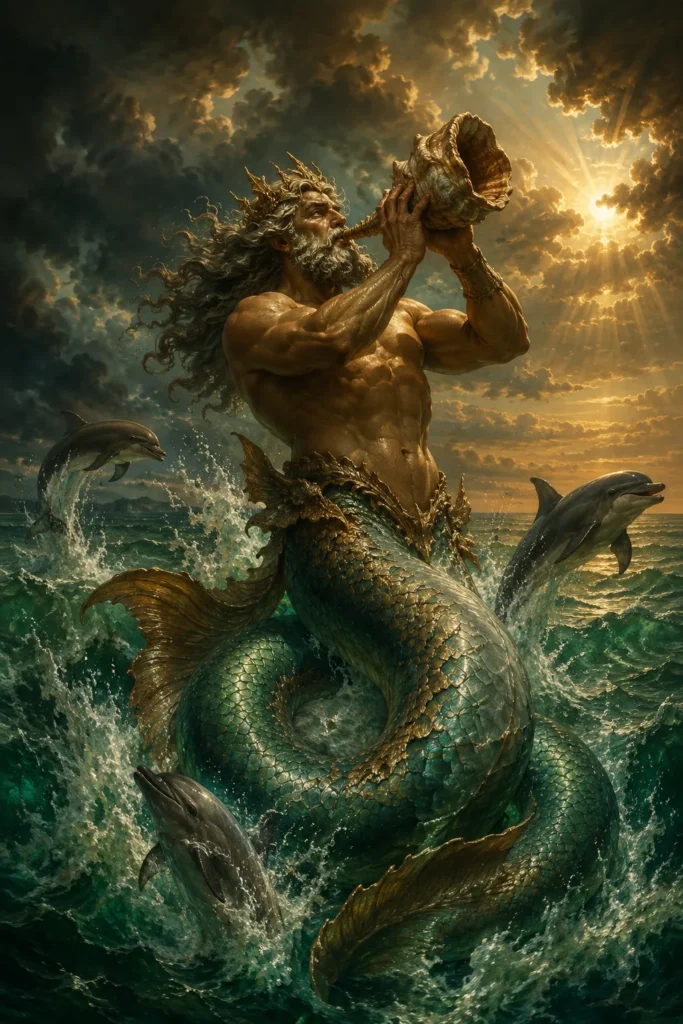
Triton, the herald with the conch horn
By Ralf Ittermann · last reviewed on
Triton is god of the Greek tradition.
Son of Poseidon, herald of the sea with the conch horn.
Triton, sea god and son of Poseidon and Amphitrite, acts as his father’s messenger. His attribute is the conch horn, with which he stirs up or calms the waves.
In Apollonius, he helps the stranded Argonauts out of the Libyan lagoon of Tritonis. From this early poetry grew a whole class of sea beings, the Tritons.
Type: Sea god, messenger and herald of Poseidon
Origin: son of Poseidon and Amphitrite
Texts: Hesiod, Apollonius, Pausanias
Period: 700 BC to the Roman imperial era
Appearance: human-fish hybrid being, conch horn
Textual history
Period of the Texts
From Hesiod around 700 BC to Ovid and Pausanias in Roman times.
Area of Diffusion
Greek Mediterranean region, local legends in Boeotia and Libya.
Sources
Well attested: Hesiod, Apollonius, Ovid, Virgil, Pausanias.
Name and variants
Greek: Hesiod calls him the far-mighty one; the name also attaches to Lake Tritonis.
Appearance and effect
Appearance
Hybrid being: human above, fish below; later art multiplies him into whole crowds of Tritons.
Effect
The horn’s blast orders the sea, whips up waves or ends floods; local legends know a predatory sea being of the same name.
Profile: Triton
Key facts about the sea god at a glance.
Earliest mention in Hesiod, later helper of the Argonauts.
Sailors whose course his horn signal guides.
Human with a fish tail, conch horn and trident.
Calms or stirs up the sea.
Hardly any cult of his own; prayers were directed at Poseidon’s house.
Son of Amphitrite, more active than the cosmological Okeanos.
Between herald and coastal terror
Hesiod’s Theogony names Triton first: he dwells with his father and mother in golden houses of the deep sea. In Apollonius, he receives the stranded Argo and shows it the way back.
Ovid describes how Triton blows his horn at Poseidon’s command and the waters recede; Virgil shows the other side: the trumpeter Misenus challenges the gods and is drowned.
From fountains to a moon of Neptune
Tritons became a recurring motif in European art, from mosaics to Bernini’s Triton fountain in Rome (1642/43); in 1846 Neptune’s moon was discovered, which was later named Triton after him.
In terms of the study of religion, Triton shows how a pantheon distributes tasks: Poseidon remains ruler, while his son takes on the role of messenger.
Wine jug and prayer: the Tanagra defence
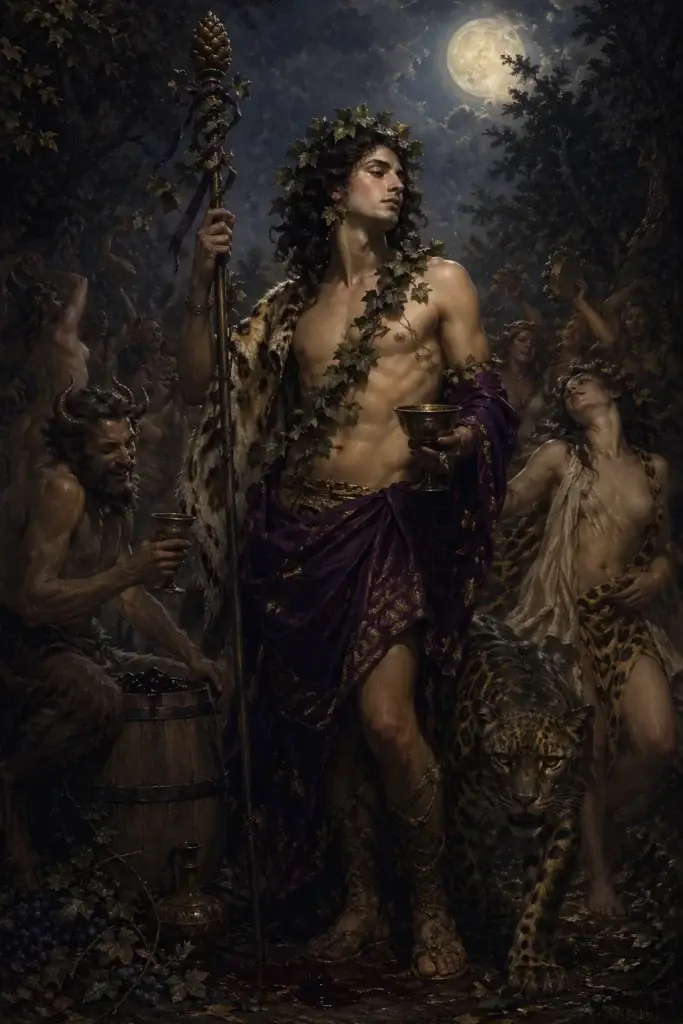
The Tanagra legend, recorded by Pausanias, preserves the pattern: a jug of wine lured the monster into sleep; in pious versions, prayer and Dionysus save the women. Fitting for this are amulet, salt and holy water as substitutes for the libation.
Messengers of the sea across cultures
Almost every coastal culture knows messenger and ruler gods of the sea, from the Japanese Ryūjin to the sea mistress Sedna. Triton stands alongside Amphitrite and Glaukos; unlike the cosmological Okeanos, he belongs to a younger layer.
Frequently asked questions about Triton
Is Triton a god or a monster?
Both: poetry portrays him as a god, while local legends such as Tanagra know a sea being of the same name.
What is the Triton horn?
A sea snail shell used as a trumpet, with which Triton calms or stirs up the sea.
Further links
Further reading:
Literature (selection)
Further standard works in the bibliography.
Those searching for Triton Greek mythology arrive at the conch horn: Triton conch horn identifies the son who, as his father’s herald, guides the floods.