Dionysus, God of the Greek Tradition
By Ralf Ittermann · last reviewed on
Dionysus is a god of the Greek tradition.
God of wine, ecstasy, theatre and transformation. Dionysus is the most widely travelled god of Olympus, a god of boundaries and transitions.
He breaks rules, transforms substances, and frees people from the constraints of everyday life. His festival, the *Dionysia*, gave birth to Greek drama. He is at once divine and mortal, male and feminine, civilised and wild.
Dionysus
At a Glance: Dionysus
Type: Major Greek deity, god of wine, ecstasy and theatre
Pantheon: Greece (admitted late into Olympus), Roman as Bacchus
Function: Wine and intoxication, theatre (especially tragedy and comedy), ecstatic religion (mysteries), the dying and resurrection of vegetation
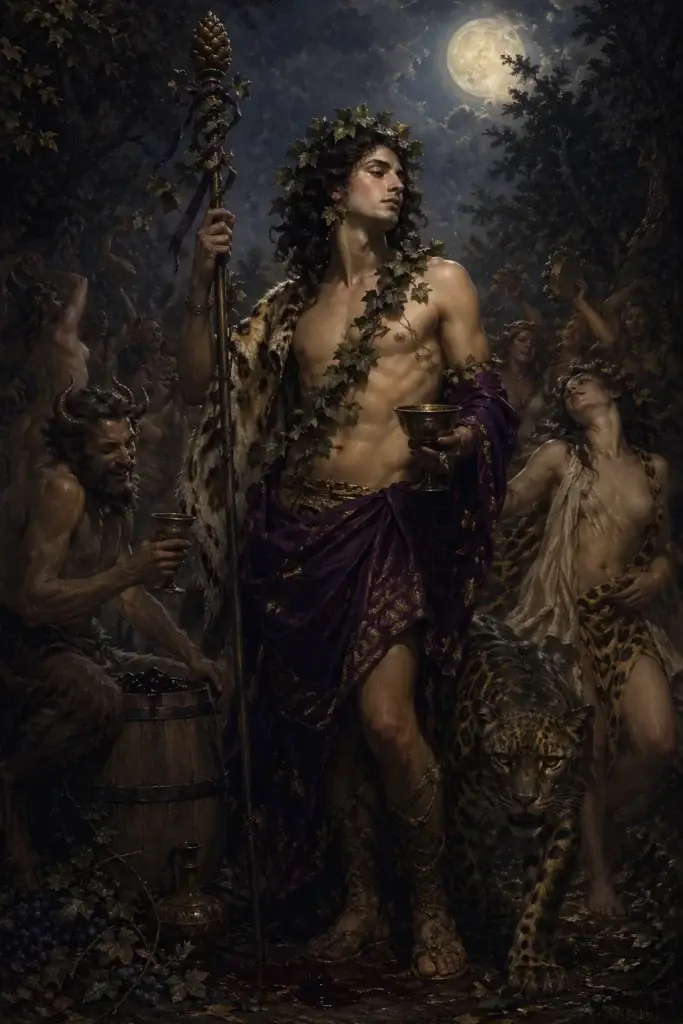
Principal attributes: Thyrsus staff (with pine cone), vine wreath, drinking vessel (kantharos), panther skin
Principal cult sites: Athens (Theatre of Dionysus), Thebes (mythical birthplace), Eleutherae, Naxos
Roman counterpart: Bacchus / Liber Pater
Historical Classification
Period of the Texts
Dionysus is already attested in Mycenaean Linear B (c. 1400–1200 BCE) as di-wo-nu-so-jo, making him one of the oldest Greek gods despite his seemingly „late“ character in the literary tradition.
Still peripheral in the Iliad, he is already more central in the Odyssey. The main flourishing of the Dionysia theatre tradition fell in the 6th–4th centuries BCE (Aeschylus, Sophocles, Euripides, Aristophanes: their plays were all written for the festival of Dionysus in Athens).
The Dionysian Mysteries were a significant mystery cult, parallel to Eleusis. In the Hellenistic and Roman period he spread further as Bacchus; the Roman Bacchanalia were restricted by decree of the Senate in 186 BCE.
In the late Roman Empire he became a symbol of an erotic and mystical piety, and in Christianity a rival figure (Christ-Sol versus Dionysus-Bacchus).
Area of Distribution
Principal cult sites: Athens (Theatre of Dionysus on the southern slope of the Acropolis, birthplace of Greek tragedy; the Great Dionysia held annually in March/April), Thebes (mythical birthplace, setting of Euripides’ Bacchae), Eleutherae (a border site between Attica and Boeotia, famed for its ancient Dionysus cult), Naxos (site of his marriage to Ariadne), Delphi (his winter aspect, parallel to Apollo in summer).
In Italy he was widely venerated, with the later Bacchanalian cult; the frescoes of the Villa dei Misteri in Pompeii depict scenes from the Dionysian Mysteries.
Source Material
Central sources: Hesiod (Theogony), Homer’s Odyssey (Book XI), the Homeric Hymn to Dionysus (Hymn 7, with the famous story of the Tyrrhenian pirates), Euripides’ Bacchae (the central tragedy on Dionysian theology), Apollodorus’ Library, Ovid’s Metamorphoses (several Dionysus episodes), Diodorus Siculus (Book IV), Plutarch (De Iside et Osiride, on Dionysus-Osiris syncretism).
Secondary literature: Burkert, Greek Religion and Antiquity Mysteries; Otto, Dionysus. Myth and Cult (a classic); Detienne, Dionysos à ciel ouvert; Henrichs, Greek Maenadism from Olympias to Messalina.
Name
Dionysus is depicted as a beautiful, androgynous-looking young man, sometimes with feminine features, sometimes bearded. His symbols are grapes and wine, the thyrsus staff (a staff topped with a pine cone), the theatre masks (tragic and comic), ivy, and panthers or leopards.
He is often surrounded by Maenads (wild, ecstatic women) and satyrs (half-human woodland beings). His appearance is changeable: he can appear older, younger, male or female.
Description
Dionysus is venerated through ecstatic rites, processions and theatrical performances. Wine is both his offering and his medium. In mystery cults (possibly connected with Demeter at Eleusis) he is understood as a figure of salvation: his torn body is reunited, just as the believer too can be made whole.
The Dionysia festivals gave rise to theatrical contests. His cult is inclusive: women, slaves and foreigners may take part, even where they are excluded from other cults. Dionysus liberates through ecstasy and transgression.
Appearance and Symbolism
Dionysus is portrayed as young, often of feminine beauty, with long curling hair and a beard, at times androgynous. He wears grapes, ivy and figs as wreaths.
The thyrsus (a staff with a pine cone and ivy) is his primary attribute. The panther or leopard is his sacred animal, as is the he-goat. The wine cup and the grape are his symbols.
Unlike other gods, his iconography is fluid: he can appear as an old man, as a youth, or as a woman. This underscores his nature as a god of transformation and masquerade. His element is the liquid and the flowing, wine, and at the same time blood, nectar and the uncontrollable flow of nature.
Profile: Dionysus
The most important aspects of Dionysus at a glance. The following fields summarise his origin, function, appearance, veneration, symbols and cultural parallels.
Dionysus is the son of Zeus and the mortal Semele, a daughter of Cadmus of Thebes. Hera, jealous of Zeus’ affair, persuaded the pregnant Semele to ask to see Zeus in his full divine form, which consumed her in flames.
Zeus rescued the unborn child and sewed it into his thigh, from which Dionysus was later born (twice-born, dimetor).
He grew up on Mount Nysa, often in the care of nymphs or his tutor Silenus. His marriage to Ariadne (abandoned by Theseus on Naxos) was one of the few genuinely happy unions in the Greek pantheon.
A multiple function is characteristic of Dionysus: as god of wine, he teaches people viticulture, drinking and conviviality; as god of ecstasy, his mysteries (the initiations of the mystai) promise the dissolution of individual boundaries into a divine sense of communal unity; as god of theatre, he is patron of tragedy and comedy at the Athenian Dionysia; as god of vegetation, his annual dying and rising mirrors the cycle of the vine; as liberator (Eleuthereus, Lyaios), he frees worshippers from social conventions, rank and gender in the ecstatic rites; as the foreign god, he is often portrayed as an Asian or Thracian intruder, although he is in fact Mycenaean and ancient.
Two principal forms, depending on the period:
Archaic (6th–5th century BCE): a bearded man of mature age in a long robe, often with a kantharos (drinking vessel) and a vine wreath. Graver and more dignified.
Classical and later (4th century BCE onwards): a youthfully beautiful, beardless man with long wavy hair, often unclothed or wearing a light fawn skin. Somewhat androgynous (thelydries, feminine and tender). With a vine or ivy wreath and the thyrsus staff (topped with a pine cone and wound with vines or ivy).
He is accompanied by the thiasos, a band of Maenads (women dancing in ecstasy), satyrs (horned, half-bestial companions of the wine), and Silenus (the old, stout tutor riding a donkey). His mount is the panther or leopard, or a chariot drawn by a panther team.
Sphere of effect: Dionysus had an exceptionally broad reach.
In public cult: the Great Dionysia in Athens (March/April) was the most important theatre festival of antiquity; Aeschylus, Sophocles, Euripides and Aristophanes wrote their plays for this festival, and the Theatre of Dionysus on the southern slope of the Acropolis is the mother of all Western theatre architecture.
Mysteries: Dionysian mystery initiation existed in numerous local traditions, with the promise of a happy afterlife. The Maenad tradition: every second winter, women went up into the mountains for ecstatic nights, portrayed canonically in Euripides’ Bacchae.
Domestic practice: each new wine was consecrated to Dionysus at the household altar. In the Roman Empire the Bacchanalia, whose excesses led in 186 BCE to their restriction by the Senatus consultum de Bacchanalibus.
Thyrsus staff (with a pine-cone tip, wound with vines or ivy), vine wreath, ivy wreath, kantharos (a two-handled drinking vessel), panther skin, fawn skin, theatre mask (comedy and tragedy), bull (a theriomorphic aspect: Dionysus as a bull in the Bacchae).
Plants: grapevine, ivy, pine, pomegranate, fig. Sacred animals: panther, leopard, bull, goat, snake (in the hands of the Maenads), donkey (the mount of Silenus). Companions: Maenads, satyrs, Silenus.
Bacchus / Liber Pater (Rome, an almost identical adoption), Sabazios (Phrygian, syncretised with Dionysus in the Hellenistic period), Osiris (Egypt, identified with Dionysus by Plutarch’s De Iside et Osiride through the motif of the dying and rising of vegetation), Tammuz/Dumuzi (Mesopotamia, a dying and rising vegetation god), Adonis (Phoenicia and Greece, a vegetation death), Shiva (Hinduism, a tantric and ecstatic aspect with dance and wine), Soma (the Vedic god of the draught, ecstatic).
Functionally, every ecstatic god of drink or plant shares aspects of Dionysus; the dying-and-rising motif links him to the mystery religions of the entire Mediterranean.
Protective Practice
Veneration in Everyday Life
Rituals and Invocations
The Great Dionysia was the theatre festival of Athens, alongside which stood the Anthesteria. The Maenadic rites (oreibasia) led into the mountains; the Dionysian Mysteries promised a particular hope of salvation.
Invocations and Conjurations
Textual Transmission and Formulae
The Homeric Hymn to Dionysus, Euripides’ tragedy „The Bacchae“, the Orphic gold tablets and texts of the Dionysian Mysteries transmit the myth and cult of the god.
Amulets and Protective Symbols
Material apotropaia and Archaeological Evidence
The thyrsus staff and ivy wreaths were among his signs. The mask of Dionysus held particular importance, serving an apotropaic function as both a theatrical and a protective mask; phallic processions are also attested.
Dionysus, Parallels in Other Cultures
Gods of wine and ecstasy are found everywhere: Osiris (Egypt, also rebirth), Soma (India, an intoxicating juice), Bacchus (Rome, a later name).
Dionysus’ androgyny and transformation connect him with figures of transformation such as Hermes or Hecate. His role as god of theatre is unique in mythology. The ecstasy of the Maenads resembles shamanistic trances in other cultures.
The Bacchae of Euripides: The God as Tragedy
No ancient text shaped the image of Dionysus as strongly as the Bacchae of Euripides, performed shortly after 406 BCE. The play recounts the arrival of the god in Thebes, the city of his mother Semele.
Pentheus, the young king, refuses to acknowledge Dionysus as a god and tries to suppress the new cult. The god, who appears in human form, drives Pentheus into madness through a series of humiliations.
The climax is cruel. Pentheus, dressed by Dionysus in women’s clothing and curious about the raving women, is taken for a wild beast by the Maenads on Mount Cithaeron.
At their head, his own mother Agave tears him apart in the delusion of Dionysian frenzy. She returns to Thebes with his head, believing she has slain a lion, and only then realises what she has done.
From the perspective of religious studies, the play is a central source because it presents the double face of Dionysus. The god is a giver of joy, wine and liberation, but whoever rejects him experiences his destructive side.
Scholars such as E. R. Dodds, whose commentary on the Bacchae (1944) remains authoritative to this day, have shown that the drama is neither a simple defence nor an indictment of the cult, but makes the unavailable, dangerous nature of the divine itself its theme.
The Bacchae are at the same time a reflection on tragedy as an institution, for the theatre in Athens stood under the patronage of Dionysus.
The Theatre of Dionysus and the Dramatic Festivals
Greek tragedy and comedy are institutionally bound up with Dionysus. In Athens the most important dramatic performances took place at his festivals, above all at the Dionysia in spring and the Lenaia in winter.
The stone theatre on the southern side of the Acropolis bore his name, the Theatre of Dionysus, and at its centre stood an altar of the god; a priest of Dionysus held a place of honour in the front row.
The Great Dionysia was a state festival lasting several days. A procession brought the cult image of the god solemnly into the theatre, followed by offerings, choral contests of boys and men with dithyrambs, and the competitive performance of tetralogies of tragedy and comedy.
The poets, among them Aeschylus, Sophocles and Euripides, competed against one another, and a jury awarded prizes. The festival was thus at once a religious celebration, a political self-presentation of the polis and an artistic contest.
Why it was precisely Dionysus who became the patron of drama has been much discussed in scholarship. The older theory derived tragedy from the dithyramb, a choral song to Dionysus, an assumption that goes back to Aristotle and is judged more cautiously today.
What is certain is that the theatre created a space in which transformation, mask, ecstasy and the crossing of one’s own identity were permitted and ordered, all elements that belong to the nature of Dionysus.
The mask, with which an actor assumed another form, points directly to the god, who was himself often venerated as a god of masks.
Twice-Born: Birth, Death and the Orphic Interpretation
Dionysus bears the epithet of the twice-born. The best-known myth tells of Semele, a king’s daughter of Thebes, who is pregnant by Zeus. At the instigation of the jealous Hera, she asks Zeus to show himself to her in his true form; the lightning radiance of the god consumes her.
Zeus rescues the unborn child and sews it into his own thigh, from which Dionysus is finally born. Hence the two births, from the mother and from the father.
Another, older and darker narrative tradition belongs to the Orphic milieu. Here Dionysus, often called Zagreus, is a child of Zeus and Persephone. The Titans lure the child, tear it apart and devour it. Zeus destroys the Titans with the thunderbolt, and from their ashes human beings come into being.
The heart of Dionysus is saved, and the god is born anew. From this narrative Orphic theology derived an anthropology: the human being carries within himself both a Titanic and a Dionysian part.
Scholarship has long disputed the age and scope of this Orphic tradition. The so-called Orphic gold tablets, thin inscribed gold leaves from graves in southern Italy, Crete and Thessaly, give indications of afterlife conceptions connected with Dionysus. They promise the initiate a better lot after death.
Here Dionysus is not only a god of wine and ecstasy, but a figure to whom hope for a particular destiny beyond the grave was attached. The precise connection between the Zagreus myth, the gold tablets and the mysteries that can be grasped in literature remains one of the difficult open questions of research.
The Mysteries and the Maenads between Myth and Cult Reality
The image of Dionysus includes the Maenads or Bacchae, the raving women who dance in the mountains, tear animals apart and withdraw from the ordinary order. It was long debated whether a real cult practice lay behind these literary images.
Today scholarship assumes that there were indeed ritual women’s festivals, the trieteria, celebrated every two years at fixed locations, for example on Parnassus at Delphi. Inscriptions attest organised Bacchic associations with female leaders.
These real rites were considerably more ordered than the mythical frenzy. They took place at fixed times, had office-holders and were embedded in the festival calendar of the cities.
The mountain journey, the nocturnal dancing and the carrying of the thyrsus, the staff adorned with ivy and a pine cone, were part of the procedure. The myth exaggerated this practice into the dangerous and boundless, probably also in order to mark the social significance of the festival as a temporary, ordered exception.
In addition there were mystery cults of Dionysus into which both men and women could be initiated. The wall frieze of the Villa of the Mysteries in Pompeii is the most famous pictorial testimony, even though its interpretation remains contested.
Scholars of religion such as Walter Burkert and Albert Henrichs have stressed that the Dionysian Mysteries did not form a unified system but were organised very differently from place to place.
What they had in common was the experience of crossing over, the temporary absorption into another order under the protection of a god who himself repeatedly crossed the boundary between human and animal, man and woman, life and death.
Dionysus between the Orient and Linear B
The ancient Greeks themselves often regarded Dionysus as a god who came from outside, a newcomer from Thrace, Phrygia or Lydia. This idea is reflected in the Bacchae, in which the god comes to Thebes as a stranger.
For a long time scholarship too followed this interpretation and saw in Dionysus a comparatively late immigrant cult. This picture had to be corrected.
Decisive were the Mycenaean Linear B tablets, administrative texts written in a syllabic script of the second millennium BCE. On tablets from Pylos and the mainland the name di-wo-nu-so appears, which is convincingly read as Dionysus.
This makes it certain that the god was already known in the Bronze Age, that is, long before the Greeks stylised him in literature as a newcomer. The notion of the foreign god is thus not a historical finding but a religious motif.
From the standpoint of religious studies, this shifts the question. The riddle is no longer the origin from outside, but why the Greeks so persistently portrayed an old, indigenous god as foreign, as late and as transgressive.
A common explanation is that Dionysus had the function of embodying the Other, the dissolving, the extraordinary within their own religion.
He was the god who threatened the fixed order not from outside but showed it from within to be temporarily suspendable. The name on the clay tablets from Pylos is thus at once proof of his great age and an occasion to read anew the self-image of Greek religion.
Further Links
Literature (Selection)
Frequently Asked Questions about Dionysus
Who is Dionysus in Greek mythology?
Dionysus is the Greek god of wine, ecstasy, theatre and religious transformation, the twelfth and youngest of the Olympian gods. His Roman counterpart is Bacchus (also Liber). His mother was the Theban princess Semele, his father Zeus.
When Semele was consumed too soon by Zeus’ apparition, Zeus sewed the embryo into his thigh, from which Dionysus was fully born, hence the epithet Twice-Born (Dimetor). Dionysus is the god of the dissolution of ordinary boundaries, through wine, dance, music and sexuality.
What were the Dionysian Mysteries?
The Dionysian Mysteries, alongside the Eleusinian Mysteries, were among the most important mystery cults of the ancient world. At their centre stood the experience of ecstasy (being beside oneself), through wine, ecstatic dance (Maenads, Bacchantes) and sometimes the raw consumption of an animal (omophagy).
Theologically, the dying and rising god stood at the centre: Dionysus was torn apart by the Titans and reborn from the heart by Athena. The mysteries promised a happier afterlife existence for the initiates. The famous wall paintings of the Villa dei Misteri in Pompeii show scenes of initiation.