The term “shamanism” derives from the Tungusic word šaman, the religious specialist who, through trance, mediates between the human world and the spirit world.
From Siberia (Tungus, Buryats, Yakuts, Evenki, Chukchi) this religious form spreads across the Mongolian and Turkic steppe as far as Korea and Japan, and into indigenous American traditions. Tengrism is the monotheistically oriented form of the steppe peoples, with Tengri as the supreme sky god.
With his standard work Shamanism (1951), Mircea Eliade coined the term as a category in religious studies: shamanism is a religious technique of ecstasy, not an independent religion with a fixed doctrine.
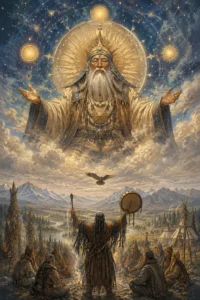
The shaman (male or female) enters into contact with spirit worlds through trance, induced by drum, dance, breathing technique or plant medicine, in order to heal, to search for what has been lost or to read the future.
Constitutive elements are spirit helpers, the soul journey, and ascent and descent along a world axis (world tree, world mountain).
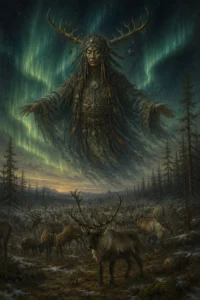
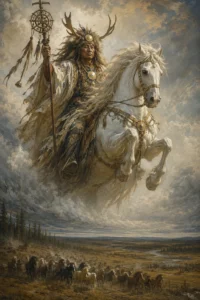
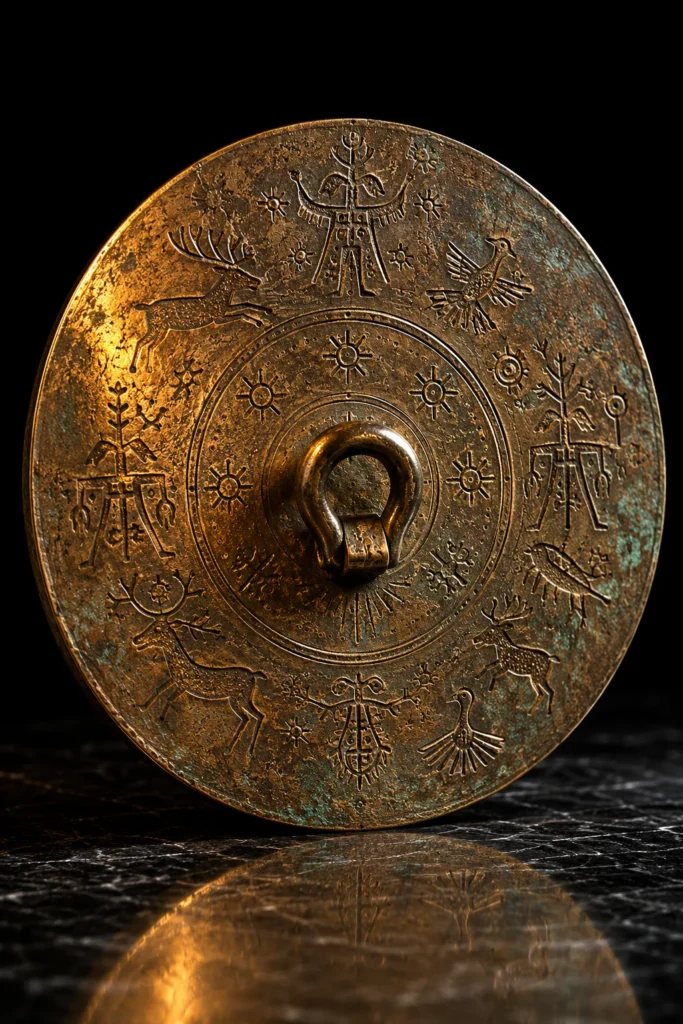
The Tungusic and Evenki shamans of Siberia are regarded as the prototype. Their trance practice uses a characteristic drum (with cosmological depictions), a shaman’s coat with metal pendants (a bone-frame symbol), an antler crown and an iron tongue (a tongue-shaped pendant).
The Buryats at Lake Baikal know both female and male shamans with initiation by ancestral spirits. Among the Yakuts there is a distinction between white shamans (healing) and black shamans (offensive).
Tengri (Mongolian: Tngri, Turkic: Tanrı) denotes both the sky and the sky god, one of the oldest Central Asian religious concepts, attested since the Xiongnu (3rd century BCE) and continuously among the Huns, Turks, Mongols and Khitan.
The Mongolian empire-founder Genghis Khan invoked a mandate from Tengri. The Tengri religion is quasi-monotheistic, with Tengri standing above all other spirits and natural forces. Present-day Neo-Tengrism is an identity movement in Mongolia, Kazakhstan and Kyrgyzstan.
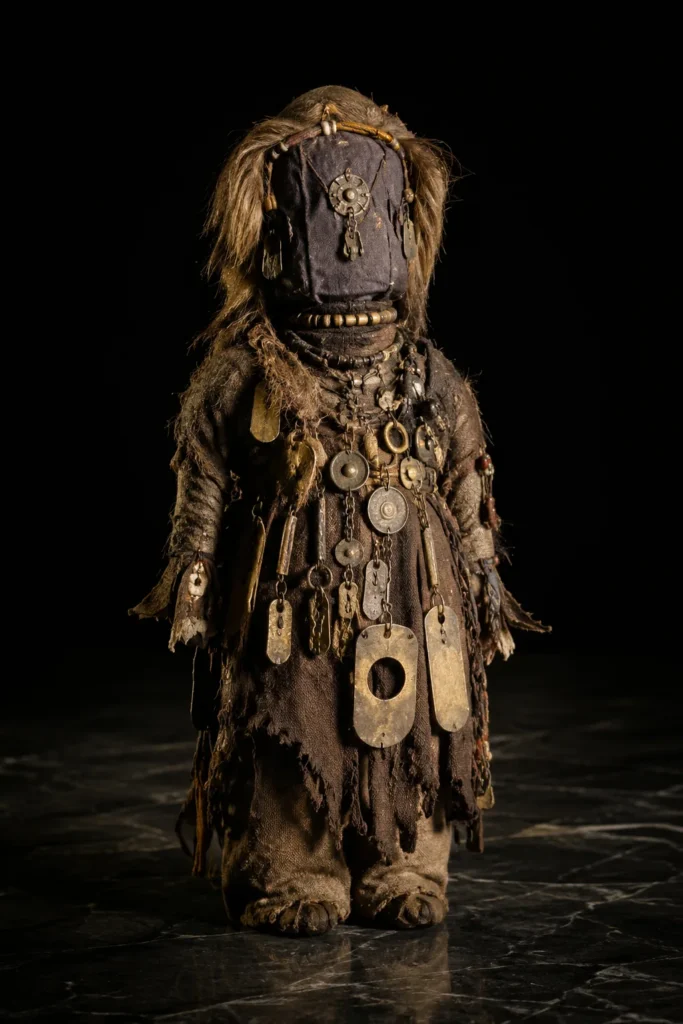
Ongon (Mongolian) or Ongor (Buryat) are spirit containers, small figurines or pendants made of felt, wood or metal in which the shaman’s helping spirit or the house spirit takes up residence. They are hung in the yurt or worn on the body.
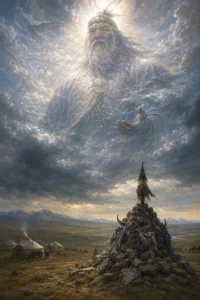
Shaman’s mirrors (Mongolian: toli) made of bronze hang in rows on the coat and protect through reflection. Ovoo (Mongolian) are stone pyramids at mountain passes where travelers leave stones, khadak cloths or banknotes. Protective khadaks of blue silk are ubiquitous.
Siberian shamans use trance aids that differ by region: in western Siberia the fly agaric (Amanita muscaria, presumably corresponding to the Indo-Iranian soma), in central Siberia tobacco extracts and juniper smoke.
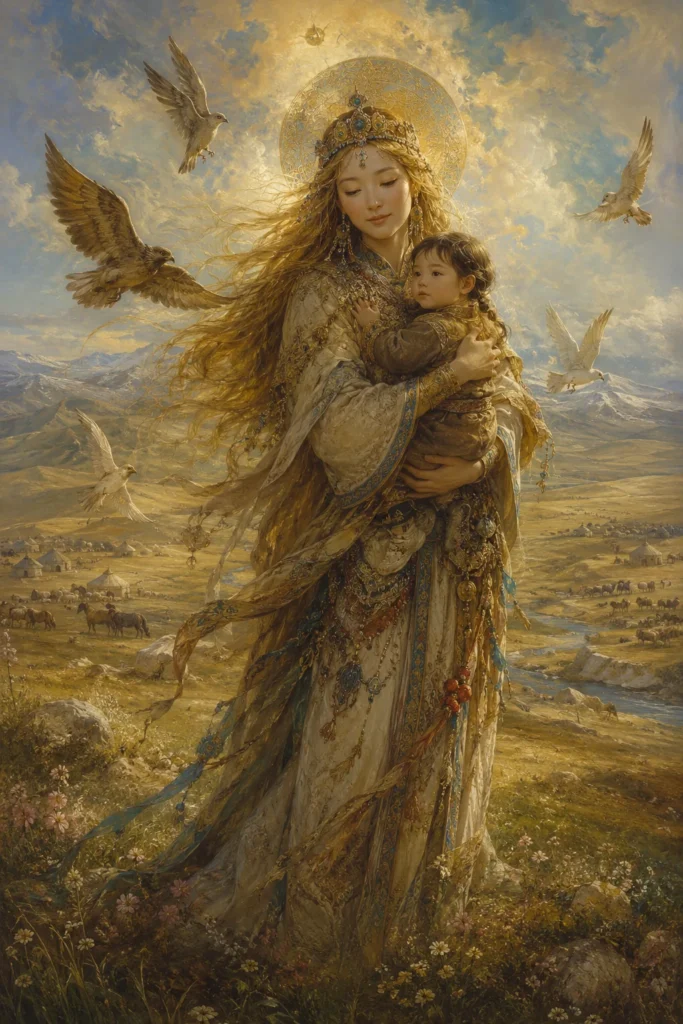
Animal-spirit allies are constitutive of the culture: bear (especially among the Ainu of Japan, whose religious tradition is connected with the Siberian one), wolf, eagle, deer, reindeer. The shaman’s coat often bears antler or feather elements that represent the animal-spirit connection.
In the twentieth century shamans were heavily persecuted in the Soviet Union as “enemies of the people” and “functionaries of superstition.” Many were shot in the 1930s or sent to camps, their drums destroyed, their coats taken to museums.
With the end of the Soviet Union in 1991, a shamanic renaissance set in across Buryatia, Mongolia and Tuva, with its own associations, teachers and renewed visibility. Mongolia today has several hundred practicing shamans.
Important works: Mircea Eliade, Le Chamanisme et les techniques archaïques de l’extase (1951), Vladimir Basilov, Nikolai Šokorov, Caroline Humphrey, Roberte Hamayon. For Tengrism: Jean-Paul Roux, La religion des Turcs et des Mongols.
The Central Asian Secret History of the Mongols (13th century) is also a source. Shamanism as a global comparative category is discussed in contributions by Michael Harner and the Foundation for Shamanic Studies.
The term Tengrism is a modern coinage and describes no uniform, historically clearly defined religion. It derives from the word Tengri, which in numerous Turkic and Mongolian languages denotes the sky and at the same time a heavenly power.
In the oldest testimonies, the Old Turkic runic inscriptions of the Orkhon Valley from the eighth century, Tengri appears as the authority that grants the ruler his power and gives the people order.
The present-day use of the word Tengrism is, however, strongly shaped by later developments. In the nineteenth and twentieth centuries, researchers and later also national movements in Central Asia coined the term in order to describe a supposedly common, pre-Islamic and pre-Buddhist religion of the steppe peoples.
Religious studies urges caution here. What is gathered under Tengrism encompasses very different traditions across a wide space and a long period of time.
It is established that the veneration of the sky, an earth deity and a multitude of spirits played a central role among many steppe peoples. Whether a coherent body of doctrine can be reconstructed from this is disputed.
Serious accounts therefore prefer to speak of sky belief or of the religion of the early Turks and Mongols, and treat Tengrism as a modern collective concept rather than as a historical unity.
Alongside the sky belief of the steppe stands the shamanism of the Siberian forest zone, which likewise is not a uniform religion but a bundle of related practices.
They are found among the Evenki, Yakuts, Buryats, Nganasan, Khanty and many other peoples who speak partly Turkic, partly Tungusic and partly Uralic languages. The word shaman itself comes from Tungusic and was carried into the European languages by Russian travelers.
Common to these traditions is the idea that certain people possess the ability to enter into contact with the spirit world in order to heal, to bring back lost souls, to secure the hunt or to guide the dead. Here, however, the regional differences matter.
Among some peoples the shaman is called by the spirits and goes through a crisis of illness; among others the office is rather hereditary. The equipment of drum, costume and crown differs considerably from people to people, and the cosmology also varies.
Widespread is the idea of a world divided into several levels, often as upper world, middle world and lower world, connected by a world tree or a central pole. Older research, such as that of Mircea Eliade, tended to merge all of this into a universal shamanism.
More recent ethnology, among others the work of Roberte Hamayon, criticizes this homogenization and emphasizes that the individual traditions must be understood from within their concrete social and ecological contexts.

The written tradition concerning the religions of Siberia and the steppe is shaped from the outside. From the early period there are the Old Turkic and Old Mongolian inscriptions as well as Chinese reports about the northern neighbors.
These texts are terse and mostly written from the perspective of rule and diplomacy, not out of religious interest.
A second layer is formed by the travel accounts of the Middle Ages and the early modern period. European envoys and later Russian research travelers described shamanic sessions, though often with bewilderment, mockery or the aim of marking the foreign as superstition.
With the Russian expansion into Siberia there also arose an extensive missionary and administrative literature in which the indigenous religions were combated but also documented.
The most scientifically usable layer stems from the ethnographic fieldwork of the late nineteenth and the twentieth centuries. Researchers such as Vladimir Bogoras and Lev Shternberg, some of them themselves political exiles, collected extensive material.
In the Soviet era shamanism was then suppressed by the state, shamans were persecuted, and many traditions broke off or were passed on only in secret.
As a result of this history, present-day sources show gaps, and later revivals had in part to rely on ethnographic books. A critical reading must always keep this filter of the observers and of the suppression in mind.
After the end of the Soviet Union, several regions of Siberia and the neighboring states saw a revival of the pre-Christian and pre-Buddhist religions.
In the republics of Buryatia, Tuva and Sakha, shamanic associations arose that in part reorganized the office, offered training and carried out public rituals. These movements are closely tied to the desire for cultural self-assertion in the face of decades of Russification.
The assessment of this revitalization in religious studies is sober. On the one hand, today’s practices connect to real traditions that were often preserved in hiding.
On the other hand, breaks are unmistakable, and some elements are newly assembled from the ethnographic literature or from exchange with international currents. Researchers therefore speak of a neo-shamanism in which reconstruction and innovation flow together.
In the Mongolian world, shamanism is moreover linked with Tibetan Buddhism, which has been present for centuries. The two systems stand alongside each other, partly in competition, partly in a practical division of labor.
The modern political Tengrism, which in some Central Asian countries is discussed as an element of national identity, also belongs to this picture.
It is less a lived folk religion than an intellectual and political project that appeals to the steppe past. For a serious account, the rule is: today’s situation is diverse, very different from region to region, and should be described neither as an unbroken continuation of an age-old religion nor as a mere invention.


In Siberian Tengrism, protective practice forms a fixed part of the shaman’s ritual, in which drum, smoke and offerings are meant to shield the family and the herd against spirits of illness and of the road.
Related key terms: shaman Tengri Buryats Tungus Yakuts Mongols yurts ongon onggor ovoo Khan Tengri Asbuiga.
The Siberian-Tengrist tradition knows ongon figurines as spirit containers, shaman’s mirrors (toli) made of bronze, khadak silk cloths and ovoo stone pyramids at mountain passes as portable and stationary means of protection.
iWell Guard fits into this culturally historical line of portable means of protection, in a contemporary material architecture, made in Germany. 41 layers, solid gold, platinum, silver. 30-day right of return.
Personal experiences may vary. Not a medical device. No promise of healing.