Ongon: the material dwelling of a protective spirit in Siberia and Mongolia
By Ralf Ittermann · last reviewed on
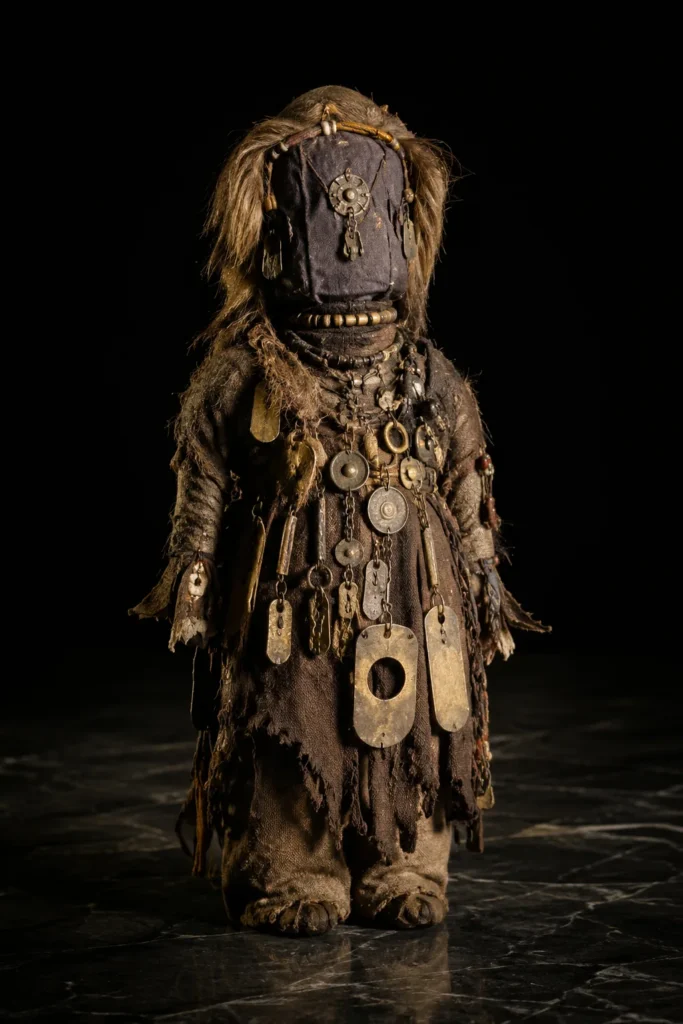
Ongon is a term used among Mongolian and neighbouring peoples of Siberia for an object regarded as the dwelling or the visible embodiment of a protective spirit.
Such objects could be small figures made of felt, wood, metal or cloth, in which a spirit resided that protected the family, the livestock or a particular sphere of life.
From the perspective of religious studies, the Ongon is less an amulet in the usual sense than a dwelling place of a spirit that was kept favourable through offerings and care. This text describes its origin, form and meaning from an outside perspective and without claims of effect.
Classification of the Ongon
The Ongon is an object regarded among Mongolian and neighbouring peoples of Siberia as the dwelling or the visible embodiment of a spirit. The word ongon comes from Mongolian languages and is connected with notions of the sacred and of the spiritual.
Across the various languages and peoples, further terms and notions are found. The Ongon is widespread over a vast area, which leads to a diversity of forms and names.
Unlike an amulet, which is regarded as powerful in itself, the Ongon is first of all a place. It is the dwelling of a spirit that resides in it or becomes present through it. The meaning lies in the spirit, not in the object alone.
The spirits associated with an Ongon are often regarded as protective spirits. They are meant to protect a family, the livestock, the house or a particular sphere of life and to secure its well-being.
In terms of religious studies, the Ongon belongs to the broader context of protective symbols. Among these it is a special case, because it represents not a powerful object but the dwelling place of a protective spirit.
The Ongon thus differs from an amulet, whose effect is attributed to the object itself. With the Ongon, the meaning lies in the spirit that resides in it and in the care it receives.
Important for a factual account is that the Ongon is not a uniform object. Its shape, the spirit associated with it and the notions about its care differed from people to people and from family to family.
Origin and History
The religious notions to which the Ongon belongs are ancient in Mongolia and in parts of Siberia. They were shaped by the idea of a world animated by spirits and by the veneration of ancestors.
Many Ongon are connected with ancestors or with significant deceased persons. The spirit of an ancestor could become a protective spirit of the family, for whom an Ongon was set up as a dwelling.
In addition, spirits of natural forces, of places or of animals could also be associated with an Ongon. The diversity of spirits reflects the diversity of spheres of life that were regarded as worthy of protection.
Written reports about the Ongon begin with the records of travellers, missionaries and scholars who wrote about Mongolia and Siberia from the 17th and especially during the 19th century.
With the spread of Buddhism in Mongolia, the older religion entered into a relationship with Buddhist teachings. Some notions merged, others were pushed back. The handling of the Ongon was shaped in part by this encounter.
The encounter between the older religion and Buddhism did not proceed uniformly. In some regions Ongon were rejected and removed by Buddhist clergy, while in others they continued to exist alongside Buddhist objects. Scholarship describes this process as a long coexistence in which notions merged, shifted and in part also displaced one another.
In the 20th century, religion was persecuted in Mongolia and in the Soviet Union. Ongon and other religious objects were destroyed or confiscated, and the open practice of the tradition was interrupted.
Form, Material and Manufacture
An Ongon can be designed in very different ways. Often it is a small figure depicting a person, an animal or another form. Flat, pictorial representations also occur.
Felt, cloth, wood, leather and metal served as materials. Felt figures and figures made from cloth are widespread among Mongolian peoples. The choice of material depended on the region and on the kind of spirit.
Some Ongon show human features, at times a face, eyes or suggested limbs. Others are rather abstract. The shape was meant to make the spirit recognisable and to offer it a suitable dwelling place.
An Ongon could occur singly or as a group. In some households several Ongon were present, which housed different spirits and concerned different spheres of life.
In the ethnographic reports there are descriptions of Ongon that occurred in pairs or depicted a family of spirits. The precise shape of an Ongon depended on which spirit was associated with it and what task was attributed to it. There was no uniform form.
The making of an Ongon was bound to notions about the right occasion and the right procedure. Often a religious specialist was involved, who invited the spirit into the object or established the connection.
This text gives no instructions for making an Ongon. The object was part of a religion with its own notions. A reproduction without this context would remain an appropriation of the outer form.
Religious and Mythological Background
The religion to which the Ongon belongs was shaped by the idea of a world animated by spirits. Spirits could be present in nature, in places, in animals and in the ancestors, and could take part in the life of people.
In this conception the Ongon is a dwelling place for a spirit. By receiving a visible dwelling, a spirit becomes tangible and can enter into an ordered relationship with people through offerings and care.
Ongon are often associated with protective spirits. Such a spirit was meant to protect the family, the house, the livestock or a particular sphere of life and to provide for its flourishing.
The connection to the ancestors is characteristic of many Ongon. According to the transmitted notions, a significant deceased person could become a spirit who continued to accompany the descendants. The Ongon gave this spirit a fixed place in the house and kept present the relationship between the living and the ancestors.
The relationship between human and spirit rested on reciprocity. The spirit granted protection, and the people cared for the Ongon, presented offerings to it and observed the rules associated with it.
In terms of religious studies, the Ongon can be understood as an example of how a spirit becomes located and approachable through an object. The object is a mediator between the world of people and the world of spirits.
It is important that the Ongon did not act of itself. Its meaning rested on the spirit that resided in it and on the care it received. Without this relationship, the Ongon remains a mere figure.
Ritual Use and Bearers
The Ongon was as a rule not worn on the body but kept in the house or in the tent at a particular place. There it had a fixed location corresponding to its significance.
The care of the Ongon was part of religious everyday life. Keeping the spirit favourable required regular offerings, for instance of food, fat or drink, as well as observance of the rules associated with it.
On certain occasions, for example at festivals, in case of illness or before important undertakings, the Ongon received special attention. Then offerings could be presented and the spirit asked for assistance.
The bearers of the tradition were primarily the families themselves who had an Ongon in the house. The care of the Ongon belonged to the religious duties of the household and was not bound to specialists alone.
In the making of an Ongon and on special occasions, however, a religious specialist could be involved. He established the connection to the spirit or led the necessary actions.
With the persecution of religion in the 20th century, the open handling of the Ongon was pushed back. Some Ongon were hidden, others destroyed. The tradition was weakened without dying out entirely.
Regional Variants and Related Objects
The Ongon is attested among various Mongolian and Siberian peoples, for instance among the Mongols and the Buryats. With each people and in each region, the form, name and notions associated with the Ongon differed.
The kind of spirits associated with an Ongon could vary. Ancestor spirits, nature spirits and spirits of particular places or animals could all receive a dwelling in an Ongon.
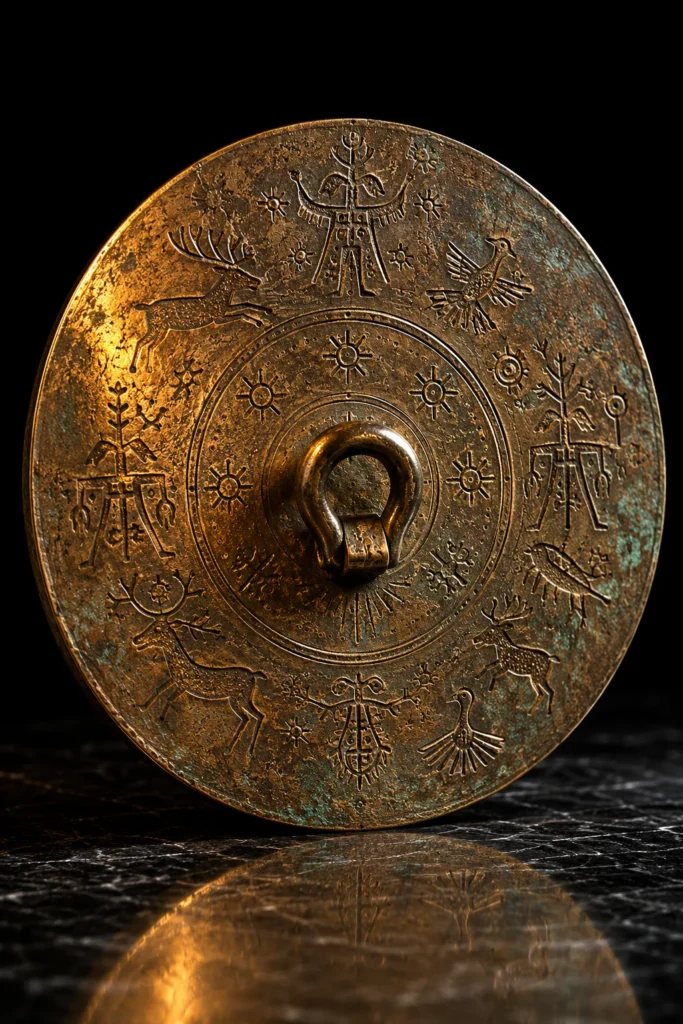
Related to the Ongon is the toli, the bronze shaman‘s mirror, which is treated in a separate article. Both belong to the religion of the peoples of Siberia and Mongolia, but fulfil different functions.
Other ritual objects of Northern Eurasia, for instance the shaman’s drum, also belong to the broader context. They show how various peoples of the north equipped their religion with their own objects.
In terms of religious studies, the Ongon can be compared with notions of other cultures in which a spirit or a protective being receives a material dwelling place. Such comparisons must not, however, blur the distinctiveness of the tradition.
Among the Buryat groups, Ongon made of felt and cloth are particularly well documented, while in other areas figures of wood or metal predominate. The number of Ongon in a household and the manner of their placement also differed. This regional diversity is one reason why scholarship refrains from a uniform description of the Ongon.
Within the field of protective symbols, the Ongon is a special case. The article on amulet and talisman explains how it differs from an ordinary amulet.
Significance as a Protective Object
The Ongon was regarded as protective because a protective spirit resided in it or became present through it. The protection was often directed at the family, the house, the livestock or a particular sphere of life.
The protection rested not on the object itself but on the spirit and on the relationship between it and the people. The Ongon was the place where this relationship could be cultivated.
The protection was bound to reciprocity. The spirit granted assistance, provided the people cared for the Ongon, presented offerings to it and observed the rules. Neglect was regarded as dangerous, since it disturbed the relationship.
In terms of religious studies, the protective function can be described as part of a coping with uncertainty. The concern for family, house and livestock found in the Ongon a fixed point of reference and an ordered action.
This text makes no statements about actual protective effects. It describes only what significance the religion of Mongolia and Siberia attributed to the Ongon. Healing promises and claims of effect are expressly excluded.
It remains to be noted that the protective significance of the Ongon was bound to the religion of its cultures of origin. Outside this context, the Ongon is a historical object, not a self-acting protective object.
History of Research, Ethical Questions and Cultural Appropriation
The study of the Ongon is connected with the ethnology of Mongolia and Siberia. Travellers and scholars of the 19th and 20th centuries documented the notions associated with the Ongon and collected numerous specimens.
Later research examined the diversity of Ongon, their connection to the ancestors and their role in religion. It became clear that a uniform description does not do justice to the diversity of the traditions.
A grave chapter is the persecution of religion in the 20th century. In Mongolia and in the Soviet Union, religious objects were destroyed and specialists persecuted. Many Ongon were lost during this period.
For the present-day peoples of Mongolia and Siberia, the Ongon is part of their suppressed religious history. The handling of transmitted objects in museums is increasingly considered together with the communities of origin.
The cultural appropriation of the Ongon by modern esotericism is a separate problem. The notion of a spirit dwelling is at times detached from its context and used for commercial offerings.
A serious account describes the Ongon from an outside perspective, names the history of persecution and refrains from any instruction for making or for ritual use.
Present-Day Reception
After the end of the persecution, the older religion experienced a renewal in parts of Mongolia and Siberia. In this context, notions about the Ongon are also being taken up again.
Museums in Mongolia, in Russia and in other countries preserve Ongon and other religious objects. Some institutions work together with representatives of the cultures of origin in order to classify the objects factually.
The ethnographic literature of the 19th and 20th centuries has described a great number of Ongon and transferred them into collections. These holdings are today an important source of research, but at the same time they are reconsidered in the light of their often problematic provenance.
The renewal of the older religion is manifold. It ranges from the revival of local family traditions to new forms. The Ongon appears in this in varying contexts.
In international esotericism, the notion of a spirit dwelling is at times taken up and marketed. In terms of religious studies, this is a distinct form of reception that is to be distinguished from the traditions of the cultures of origin.
In art and craft, creators from Mongolia and Siberia take up the Ongon in order to connect with their religious history. The Ongon thus becomes a sign of cultural origin.
For interested readers, a conscious approach is advisable. To acquire knowledge about the Ongon is legitimate, but to imitate its religious practice is not. Further protective objects are presented in the section protective symbols.
Literature (Selection)
Related key terms: Ongon protective spirit Mongolia Siberia spirit dwelling ancestor cult Buryats felt figure shamanism indigenous religion house spirit Northern Eurasia.
iWell Guard and Protective Traditions
iWell Guard stands in the cultural-historical line of portable protective objects to which the Ongon also belongs. A modern companion for people who live with protective symbols: made in Germany, 41 layers of real gold, platinum and silver, with a 30-day right of return.
Personal experiences may vary. Not a medical device. No healing promise.