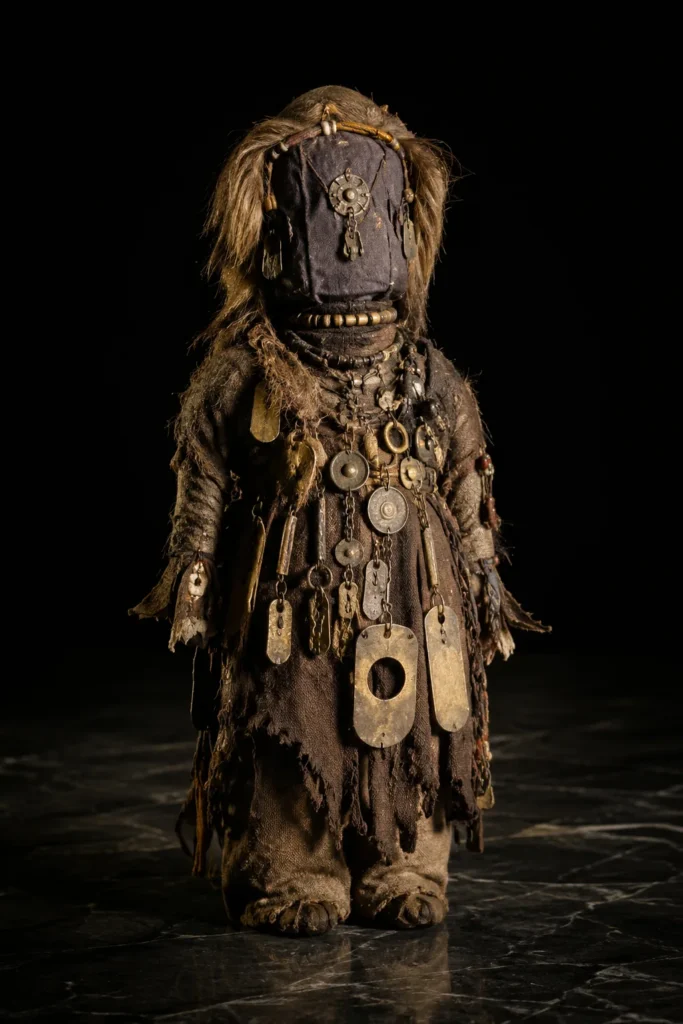
Toli: the bronze shaman's mirror as an apotropaic object of the peoples of Siberia
By Ralf Ittermann · last reviewed on
Toli is a term used among several peoples of Siberia and Mongolia for a round metal mirror that belongs to the equipment of shamanic specialists. The usually bronze, often disc-shaped object was worn on the clothing, held in the hand or attached to the ritual garment.
It was credited with the task of warding off harmful influences, making spiritual powers visible and protecting the bearer.
From the perspective of religious studies, the toli is an example of a ritual object with a pronounced protective function. This text describes its origin, form and meaning from an outside perspective and without any claims of efficacy.
The toli is a bronze shaman‘s mirror of the Siberian shamans. The Toli is introduced as Siberia’s bronze shaman’s mirror, an object whose use and meaning the sections below describe.
Classification of the Toli
The toli is a round metal mirror that belongs to the ritual equipment of shamanic specialists among various peoples of Siberia and Mongolia. The word toli comes from Mongolian and neighbouring languages and generally denotes a mirror.
In the various languages of Siberia and Mongolia there are further terms for the shaman’s mirror. The object is spread over a wide area, which leads to a variety of names and forms.
Unlike an everyday mirror, the toli did not serve primarily for viewing one’s own image. It was credited with a religious meaning connected with warding off, with making spirits visible and with protection.
The toli was worn in various ways. It could be attached to the ritual garment, hung on a cord around the neck or held in the hand during ritual acts.
In terms of religious studies, the toli belongs to the broader context of protective symbols and of shamanic ritual objects. Among these objects it is an example with a particularly pronounced protective function.
The toli is thus an example of how an object that is in itself widespread, the metal mirror, can take on a meaning of its own within a particular religion. Only the shamanic context turned the polished disc into a ritual device.
Important for a factual account is that the toli is not a uniform object. Form, use and meaning differed considerably from people to people and from specialist to specialist.
Despite this diversity, most toli share a common feature. They are round, shining metal discs whose reflective surface was linked with the idea of warding off. This basic feature connects the regionally very different forms of the object.
Origin and History
The shamanic traditions of Siberia and Mongolia are old and varied. They were shaped by the idea of a world divided into several levels and by mediation between humans and spirits.
Metal mirrors were known in large parts of Asia from an early date. In China, bronze mirrors were made from antiquity onwards. Through trade and cultural exchange, mirrors and the art of making them also reached the north and Inner Asia.
Some of the toli used in Siberia demonstrably originate from Chinese or Inner Asian manufacture. Such mirrors were acquired along trade routes and taken into shamanic use.
Alongside this, mirrors were also made in Siberia and Mongolia themselves. The production of bronze objects was widespread in several regions. Old and new, imported and local mirrors could exist side by side.
Written reports on the shamanic use of the toli begin with the records of travellers, researchers and officials who wrote about the peoples of Siberia from the 18th century and especially in the 19th century.
Some of the mirrors used in Siberia are several centuries old and were passed down over generations. An imported Chinese mirror could thus, over the course of time, turn from a trade good into an inherited ritual device. Researchers have shown on individual toli the traces of long use and repeated reworking.
In the Soviet era, shamanism in Siberia and Mongolia was persecuted and suppressed. Many ritual objects, among them toli, were confiscated or ended up in museums. The open practice of the tradition was interrupted.
Form, Material and Manufacture
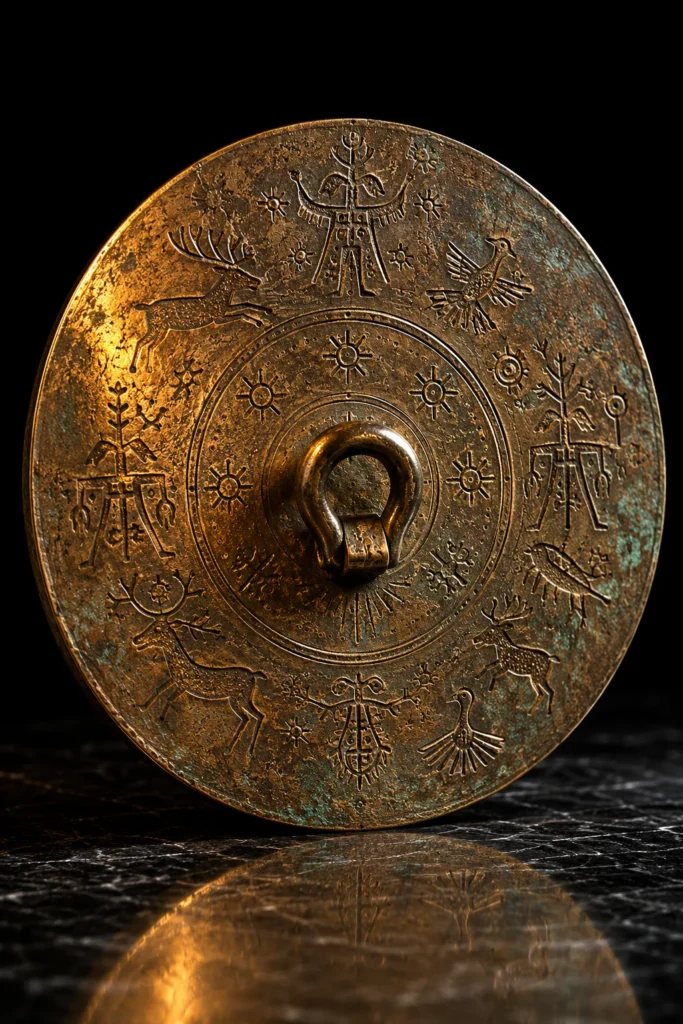
The toli is usually a round, flat metal disc. Its diameter ranges from a few centimetres to larger discs. The form is mostly perfectly circular, which is associated with its meaning.
The material is usually bronze, an alloy of copper and tin. Other copper alloys also occur. The surface could be polished, so that the mirror shone and reflected light.
Many toli bear a relief image or a decoration on one side. On imported mirrors of Chinese origin these may be zodiac signs, characters or other motifs. Locally made mirrors show their own patterns.
On the back or at the rim, toli often have an eyelet or a perforation. This allowed them to be attached to the clothing, to a band or to the ritual garment.
The size and the number of toli that a specialist possessed could vary. Some shamanic garments were equipped with several mirrors, and a larger mirror could be worn on the chest.
This text gives no instruction for making or using a ritual toli. The mirror was a device of a shamanic tradition. Copying it without this context would remain an appropriation of its outer form.
Religious and Mythological Background
In the shamanic traditions of Siberia and Mongolia, the world was regarded as animated by spirits and powers that could help or harm humans. The shaman was the specialist who mediated between humans and these powers.
In this context, the toli was credited with the ability to ward off harmful influences. The shining surface of the mirror was meant to reflect back attacking spirits or harmful forces and thus protect the bearer.
At the same time, the mirror was regarded as a means of making spiritual powers visible. In some conceptions, the shaman could recognise spirits in the toli or perceive what was hidden. The mirror was thus also a tool of perception.
The round form of the toli was associated with the sun and with light. Light and radiance were regarded in many shamanic traditions as opposed to what was harmful. The shining mirror stood on the side of what protected.
In some traditions the toli was also credited with a connection to water or to ice, since its smooth surface recalled a reflective surface. Such interpretations differed from people to people. They show that the meaning of the mirror was not fixed but took on its own features in each tradition.
In terms of religious studies, the toli can be placed in the broader context of the shamanic ritual objects of Northern Eurasia. It stands alongside the drum and other devices with which the shaman carried out his tasks.
It is important that the toli did not act on its own. Its meaning emerged from the skill of the shaman, from the songs and from the established acts. Without this context it remains a metal object.
Ritual Use and Bearers
The bearer of the toli was the shamanic specialist. He used the mirror as part of his ritual equipment, which, depending on the people, also included a drum, a special garment and further devices.
During ritual acts, the toli could be attached to the garment, held in the hand or moved. Its shine and its movement were part of the proceedings that connected the shaman with the spiritual powers.
An important task of the toli was the protection of the shaman himself. Since the specialist engaged with dangerous powers in his work, the mirror was meant to preserve him from their attacks.
Besides this, the toli was used for the protection and help of the community. In healing rituals, in the search for the causes of misfortune and in other matters, the mirror belonged to the shaman’s equipment.
The handling of the toli was bound to ideas about correct use. As with other ritual devices, there were rules about who might touch the mirror and how it was to be kept.
Among some peoples, the toli was regarded as so closely bound to its bearer that it was not simply passed on after his death.
The mirror could be buried with the deceased shaman or laid down at a special place. Such ideas underline that the toli was regarded not as an arbitrary device but as part of a person.
With the suppression of shamanism in the Soviet era, the open ritual use of the toli was pushed back. Some mirrors were hidden, others confiscated. The tradition was weakened without being entirely extinguished.
Regional Variants and Related Objects
The toli is spread over a wide area that includes parts of Siberia and Mongolia. Among the various peoples, for instance the Buryats, the Evenks and the Mongols, the form, name and use of the mirror differ.
An important distinction concerns the origin of the mirrors. Imported mirrors of Chinese manufacture and locally made mirrors could be used side by side. Both were taken into shamanic use.
Related to the toli is the shaman’s drum, which is treated in a separate article on the Sami drum. Drum and mirror belonged together in many traditions of Northern Eurasia to the equipment of the shaman.
Other ritual objects of Siberia too, such as physical dwellings of spirits, belong to the broader context. They show how various peoples of the north equipped their religion with objects of their own.
In terms of religious studies, caution is advised in making comparisons. The shamanic traditions of Northern Eurasia share basic features but are each independent. A sweeping equation would not do justice to their diversity.
Among the various peoples, the toli was integrated to differing degrees into the shaman’s equipment. Among some groups it belonged firmly to the ritual garment, among others it was used only on certain occasions.
These differences show that the mirror was not a uniformly fixed device but was fitted into each local tradition in its own way.
Within the field of protective symbols, the toli is an example of an object meant to ward off harm by reflecting it back. The article on amulet and talisman classifies such apotropaic objects in conceptual terms.
Meaning as a Protective Object
The toli was regarded above all as an apotropaic object. It was credited with the task of reflecting back harmful influences and attacking spirits. In this protective function lies its prominent meaning as a protective object.
The idea of warding off ties in with the reflective surface. Just as a mirror reflects light, the toli was meant to reflect back what was harmful. This connection of form and meaning is important for understanding.
The protection was directed first of all at the shaman himself, who exposed himself to dangers in his work. Beyond this, the toli could also serve the protection of the community for which the shaman worked.
In terms of religious studies, the protective function can be described as part of a coping with uncertainty. In a world shaped by illness, misfortune and concern for the herds, the toli offered the image of effective protection.
This text makes no statements about actual protective effects. It describes only what meaning the shamanic traditions attributed to the toli. Healing promises and claims of efficacy are expressly excluded.
It should be noted that the protective meaning of the toli was bound to the shamanic traditions of Siberia and Mongolia. Outside this context, the toli is a historical object, not a self-acting protective item.
History of Research, Ethical Questions and Cultural Appropriation
The study of the toli is connected with the ethnology of Siberia and Mongolia. Travellers and researchers of the 19th and 20th centuries documented the shamanic use of the mirror and collected numerous specimens.
Later research investigated the origin of the mirrors, their distribution and their meaning. It became clear that imported Chinese mirrors and locally made pieces must be distinguished.
A grave chapter is the persecution of shamanism in the Soviet era. Shamans were suppressed, ritual objects confiscated. Many toli ended up in museums and collections during this time.
For the present-day peoples of Siberia and Mongolia, the ritual objects are part of their suppressed religious history. The handling of museum holdings and the question of possible returns are increasingly discussed.
The cultural appropriation of the toli by modern esotericism is a problem of its own. Replica mirrors and courses that invoke Siberian models detach the object from its meaning and are viewed critically.
A serious account describes the toli from an outside perspective, names the history of persecution and collection, and refrains from any instruction for replication or shamanic use.
Present-Day Reception
After the end of Soviet persecution, shamanism experienced a renewal in parts of Siberia and in Mongolia. In this context the toli is again used openly.
Museums in Russia, Mongolia and other countries preserve toli and other shamanic objects. Some institutions work together with representatives of the peoples of origin in order to classify the objects factually.
The ethnographic research of the 19th and early 20th centuries brought numerous toli into European and Russian collections. These holdings are now being looked at anew, and individual institutions examine the provenance of their objects together with representatives of the Siberian peoples.
The renewal of shamanism is varied. It ranges from the revival of local traditions to new, urban forms. The toli appears in this connection in different contexts.
In international esotericism, mirrors are marketed with reference to Siberian or generally shamanic models. In terms of religious studies, this is a reception form of its own that must be distinguished from the traditions of Siberia.
In art and craft, creators from Siberia and Mongolia take up the toli in order to connect with their religious history. The mirror thus becomes a sign of cultural origin.
For interested readers, a mindful approach is advisable. Acquiring knowledge about the toli is legitimate, but imitating its ritual practice is not. The section on protective symbols presents further protective objects.
Literature (Selection)
Related key terms: Toli shaman’s mirror Siberia Mongolia bronze mirror shamanism Buryats apotropaic object ritual device spirits indigenous religion Northern Eurasia.
iWell Guard and Protective Traditions
iWell Guard stands in the cultural-historical line of portable protective objects to which the toli also belongs. A modern companion for people who live with protective symbols: made in Germany, 41 layers of solid gold, platinum and silver, with a 30-day right of return.
Personal experiences may vary. Not a medical device. No healing promise.