Tahquitz, the meteor on a soul hunt
By Ralf Ittermann · last reviewed on
Tahquitz is a spirit of the tradition of the Cahuilla in North America.
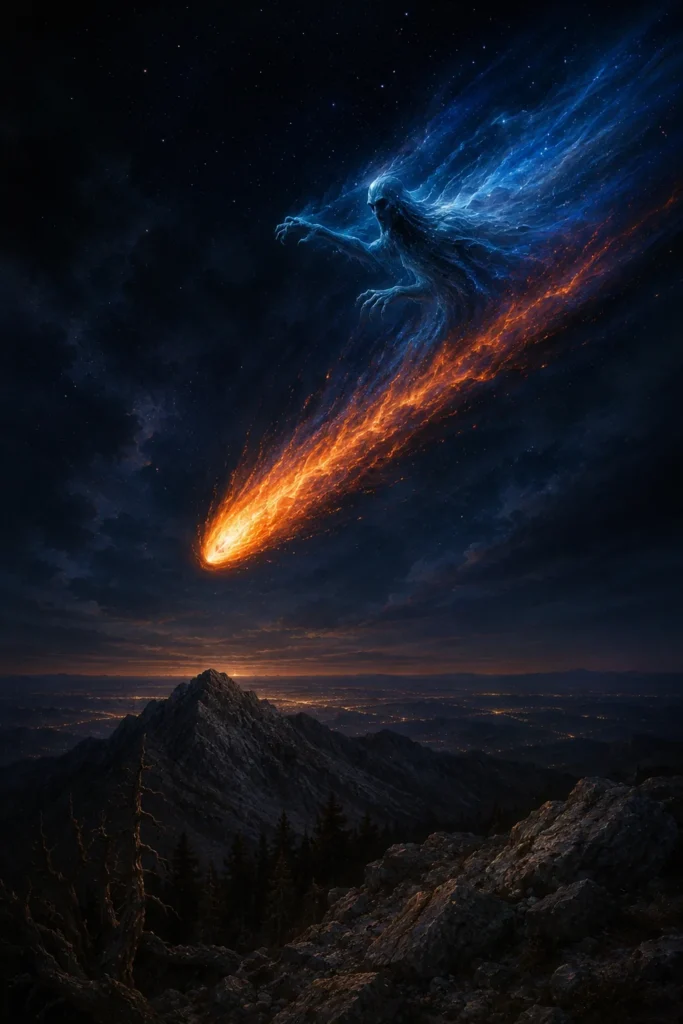
The soul-stealer that streaks across the night sky as a meteor.
Tahquitz, also known as Takwish, is a powerful evil spirit of the Cahuilla at Mount San Jacinto in Southern California. He is regarded as a soul thief who travels across the night sky as a meteor, carrying stolen souls into his rocks and devouring them there.
At the same time, he is ambivalent: he can be a protective and power spirit of the shamans, not purely demonic but a dangerous source of power. Ethnographically, the figure has been solidly documented since DuBois 1908 and Hooper 1920.
Type: Evil soul-thieving spirit, also an ambivalent source of power for shamans
Origin: Cahuilla tradition, related among the Luiseño and Kumeyaay
Texts: ethnographic documentation from 1908 onward, DuBois, Hooper and Bean
Period: Cahuilla tradition, ethnographically documented from 1908
Appearance: meteor, ball of fire, or human-like figure
Source context
Period of the Texts
The core tradition is Cahuilla and was already ethnographically documented in 1908 by C. G. DuBois and in 1920 by Lucile Hooper; Lowell John Bean deepened the documentation.
Area of Diffusion
Mount San Jacinto and Tahquitz Canyon in Southern California; related traditions are found among the Luiseño and Kumeyaay.
Sources
Well documented: Hooper 1920 and Bean, along with research on Californian shamanism. Not an internet construct, but solid ethnography.
Name and variants
Cahuilla and Luiseño: The name exists in many spellings; the form Tahquitz commonly used today was only standardised through the US land survey of 1897. In Luiseño, Takwish is associated with the meaning electric ball of fire or meteor.
Appearance
Appearance
Tahquitz appears as a meteor, ball of fire, or ball lightning in the night sky; according to Bean, as a meteor or in a human-like form emitting blue sparks. Rumbling, thunder, earthquakes, and rockfalls in the mountains are also attributed to him.
Effect
Tahquitz is an evil, death-bringing spirit and soul thief; the meteor is regarded as Tahquitz on a soul hunt. He carries stolen souls into his rocks on Mount San Jacinto and devours them there. At the same time, he can be a protective and power spirit of the shamans, a dangerous source of power, not purely demonic.
Profile: Tahquitz
The key aspects of the soul thief at a glance.
Cahuilla tradition at Mount San Jacinto, related among the Luiseño and Kumeyaay; ethnographically documented since 1908.
People whose souls he steals, and shamans, for whom he can serve as a dangerous source of power.
Meteor, ball of fire, or ball lightning in the night sky; according to Bean, also human-like, emitting blue sparks.
Soul theft and death, along with rumbling, thunder, earthquakes, and rockfalls in the mountains, regarded as his doing.
Avoidance of Tahquitz Canyon; during earthquakes, people danced, and only qualified shamans made contact with him.
Whirlwind spirits from the same narrative corpus, who likewise steal souls, and Chaup, the Luiseño and Diegueño meteor being.
From the mountain of the Cahuilla to the map of California
The core tradition of Tahquitz is Cahuilla, related among the Luiseño and Kumeyaay, and is located at Mount San Jacinto and in Tahquitz Canyon. It was already recorded ethnographically in 1908 by C. G. DuBois and in 1920 by Lucile Hooper; Lowell John Bean later described the figure as part of his Cahuilla research. The name exists in many spellings, and the form used today was only standardised through the US land survey of 1897.
In Luiseño, Takwish is associated with the meaning electric ball of fire or meteor; the tradition carries this very celestial sign to this day. Whoever saw a meteor over San Jacinto saw Tahquitz on a soul hunt, and whoever heard the rumbling of the mountain heard his doing.
Place names, literature, and classification
Tahquitz gives his name to Tahquitz Peak, Tahquitz Rock, Canyon, and Falls as well as a road in Palm Springs, and appears in literature in the work of Louis L’Amour; the canyon is now overseen by the Agua Caliente Band of Cahuilla Indians.
In religious studies, Tahquitz is an evil soul thief and ambivalent source of power. Important clarifications: he is solidly attested ethnographically, not an internet construct. Popular sources reduce him to a mere cannibal meteor and overlook his shamanic embedding. And the tidy narrative of the first shaman who turned evil and was banished stems mainly from modern tourist presentations.
Avoidance, dance, and shamanic contact
Tahquitz Canyon was avoided; during earthquakes, regarded as his doing, people danced, and only qualified shamans made contact with Tahquitz. No specific protective amulet is attested. Dealing with this spirit was thus not a matter for the individual but for specialists: those who were not shamans kept their distance.
Soul thieves in the night sky: parallels
Within the same narrative corpus are whirlwind spirits that steal souls like Tahquitz; the closest regional parallel is Chaup, the Luiseño and Diegueño meteor being. Typologically, Tahquitz is the soul-stealing night and sky spirit: a figure who equates celestial phenomena with mortal danger.
Frequently asked questions about Tahquitz
Who is Tahquitz?
A powerful evil spirit of the Cahuilla at Mount San Jacinto in Southern California, a soul thief.
What is his sign?
Meteors and balls of fire in the night sky, understood as Tahquitz on a soul hunt; rumbling, earthquakes, and rockfalls are also regarded as his doing.
Is he only evil?
No, he is ambivalent and can also be a protective and power spirit of the shamans, a dangerous source of power.
Further links
Further reading:
- Chindi – the spirit of the dead of the Diné
- Yee Naaldlooshii – the skin-walker of Diné witchcraft
- Amulet, Salt, Smoke cleansing – traditional protective means
- Protection Compass – protective means at a glance
Literature (selection)
Further standard works in the bibliography.
As a Cahuilla spirit of Mount San Jacinto, Tahquitz combines celestial spectacle and terror: the soul thief within the meteor remained at the same time a source of power for shamans, and it is precisely this dual role that sets him apart from a mere monster.