Gaoh, Lord over Bear, Panther, Moose and Fawn
By Ralf Ittermann · last reviewed on
Gaoh is a spirit of Iroquois tradition.
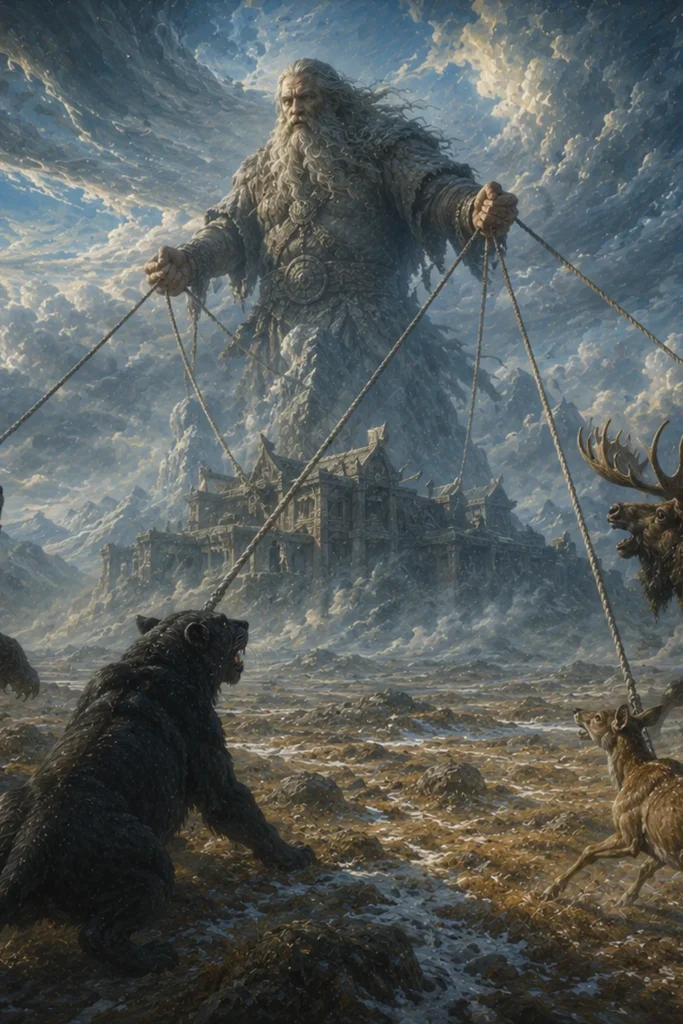
The Wind Lord who tames the four animal winds on leashes. Gaoh is named Wind Lord over Bear, Panther, Moose and Fawn, the four animal winds on his leashes.
Gaoh, also written Ga-oh, is the Lord of the Winds in the tradition of the Iroquois and Seneca. He is regarded as the instrumentality through which the Great Spirit moves the elements, and he holds four animal winds in check on leashes, ordering their powers.
He is depicted as a giant, at times as a bound giant at the far northern sky, dwelling in a house of the winds. The figure is solidly attested by Harriet Maxwell Converse, an adopted Seneca, whose collection was published by Arthur C. Parker in 1908.
Type: Wind Lord, tamer of the four animal winds
Origin: tradition of the Iroquois and Seneca, north-eastern USA
Texts: Converse, Myths and Legends of the New York State Iroquois (1908)
Period: Seneca tradition, ethnographically documented in 1908
Appearance: a giant who holds four animal winds on leashes
Origin and sources
Period of the Texts
Seneca tradition, ethnographically recorded by Harriet Maxwell Converse; her collection was published in 1908, edited by Arthur C. Parker.
Area of Diffusion
The territory of the Iroquois and Seneca in the north-eastern USA; there, Gaoh is established as a narrative figure of wind order.
Sources
Solidly attested: Converse’s 1908 ethnography. Popular sites at times render the animal-wind scheme in a distorted way; the authoritative source remains the specialist text.
Name and variants
Seneca: Gaoh, also written Ga-oh, the proper name of the wind giant of the Seneca. The sources do not give a secured literal etymology.
Appearance and behaviour
Appearance
Gaoh is a giant, at times depicted as a bound giant at the far northern sky, dwelling in a house of the winds. He embodies the ordering mastery of the wind forces.
Effect
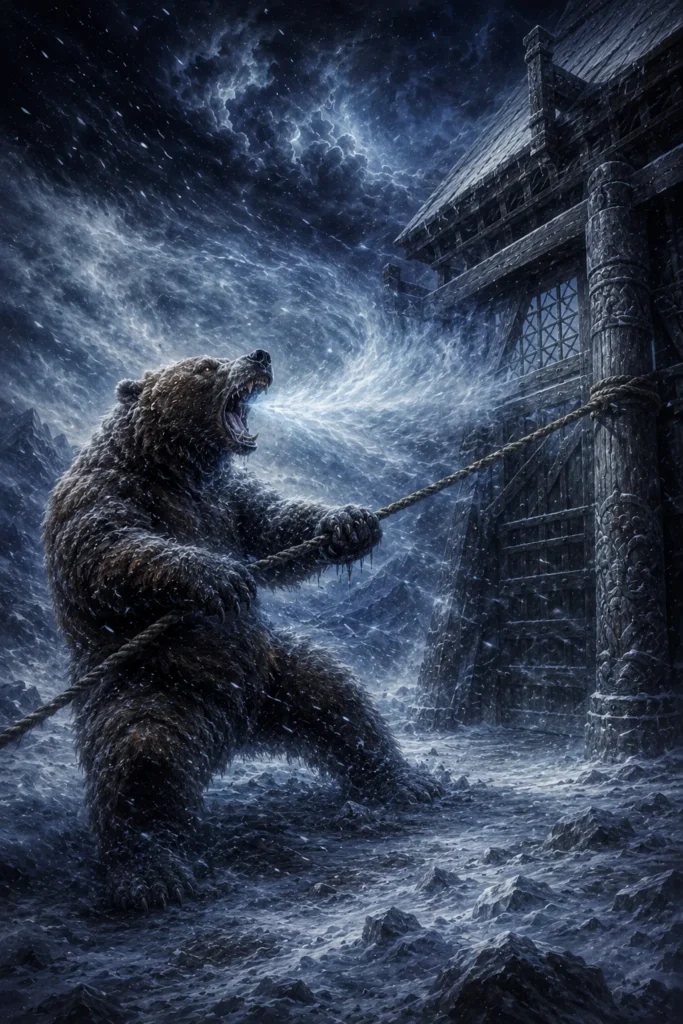
Gaoh holds four animal winds in check on leashes. The confirmed scheme is: Ya-o-gah, the bear, is the north wind; Da-jo-ji, the panther and fiercest of the four, is the west wind; O-yan-do-ne, the moose, is the east wind; Ne-o-gah, the fawn, is the south wind. In this way Gaoh prevents the destructive winds from laying waste to the world.
Profile: Gaoh
The key aspects of the Wind Lord at a glance.
Wind Lord of the Iroquois and Seneca, subordinate to the Great Spirit: the instrumentality through which he moves the elements.
The four directional winds: Gaoh orders their powers and prevents the destructive winds from laying waste to the world.
A giant, at times thought bound at the far northern sky, who dwells in a house of the winds and holds the four leashes of the animal winds.
Taming of the four animal winds: bear in the north, panther in the west, moose in the east, fawn in the south. In this way, Gaoh secures the order of the world.
An actual cult is not reliably attested; Gaoh is a narrative and explanatory figure. This gap in the evidence is honestly noted here.
The House of the Winds in Harriet Maxwell Converse
Gaoh is the proper name of the wind giant of the Seneca; the sources do not give a firmly established literal etymology. He is solidly attested in Harriet Maxwell Converse, an adopted Seneca, in Myths and Legends of the New York State Iroquois, edited by Arthur C. Parker in 1908.
The centre of the narrative is the House of the Winds: there Gaoh holds the four animal winds on leashes and lets them act as needed. He does not act by his own sovereign power, but as a tool of the Great Spirit, to whom he is subordinate. The best known of the four animal winds is Ya-o-gah, the bear of the north wind, whose icy breath could destroy the world without Gaoh’s leash; a dedicated page covers him.
Reception and classification
Gaoh is anchored in specialist literature by Converse and Parker and widely received in popular encyclopedias. It should be noted that popular sites sometimes render the animal-wind scheme incorrectly; the specialist source is authoritative.
From a religious-studies perspective, Gaoh shows the motif of the lord of winds who tames the dangerous directional winds and thereby secures the order of the world. The animal winds must not be confused: bear equals north, panther equals west, elk equals east, fawn equals south. As a tool of the Great Spirit, he remains subordinate to him.
Forms of worship: an honest gap in the record
An actual cult for Gaoh is not reliably attested; in tradition he is a narrative and explanatory figure who makes it understandable why the winds change and why the destructive ones among them do not devastate the world. This gap in the record should be honestly noted rather than inventing a rite; the detached, dossier framing applies here in particular, since this concerns an indigenous tradition.
Lords of the winds in comparison
Gaoh is a lord of winds with four directional winds, which places him typologically close to the Greek Aeolus and the Anemoi, without any historical connection. Unlike a sovereign weather god, he is subordinate to the Great Spirit. Within North America, Hotoru, the wind spirit of the Pawnee, stands alongside him as a likewise subordinate wind power; his own north wind is Ya-o-gah, the bear on the leash.
Frequently asked questions about Gaoh
Who is Gaoh?
The lord of the winds of the Iroquois and Seneca, who keeps the four animal winds in check. He is attested in the ethnography of Harriet Maxwell Converse from 1908.
Which animals are the four winds?
Bear in the north, panther in the west, elk in the east and fawn in the south. This scheme must not be reversed; popular sites sometimes render it incorrectly.
Is Gaoh the supreme god?
No. He is subordinate to the Great Spirit and is his tool for the winds.
Further links
Further reading:
- Ya-o-gah – the bear of the north wind on Gaoh’s leash
- Hotoru – the wind spirit of the Pawnee
- Aeolus – the Greek keeper of the winds as a typological parallel
- Amulet, Sage, Protective candle – traditional protective means
- Protection Compass – protective means at a glance
Literature (selection)
Further standard works in the bibliography.
As the Iroquois lord of winds and master of the four animal winds, Gaoh stands for tamed natural force: bear, panther, elk and fawn pull at their leashes, yet the order of the world remains preserved.