Sage: A Smudging Plant for Purification
By Ralf Ittermann · last reviewed on
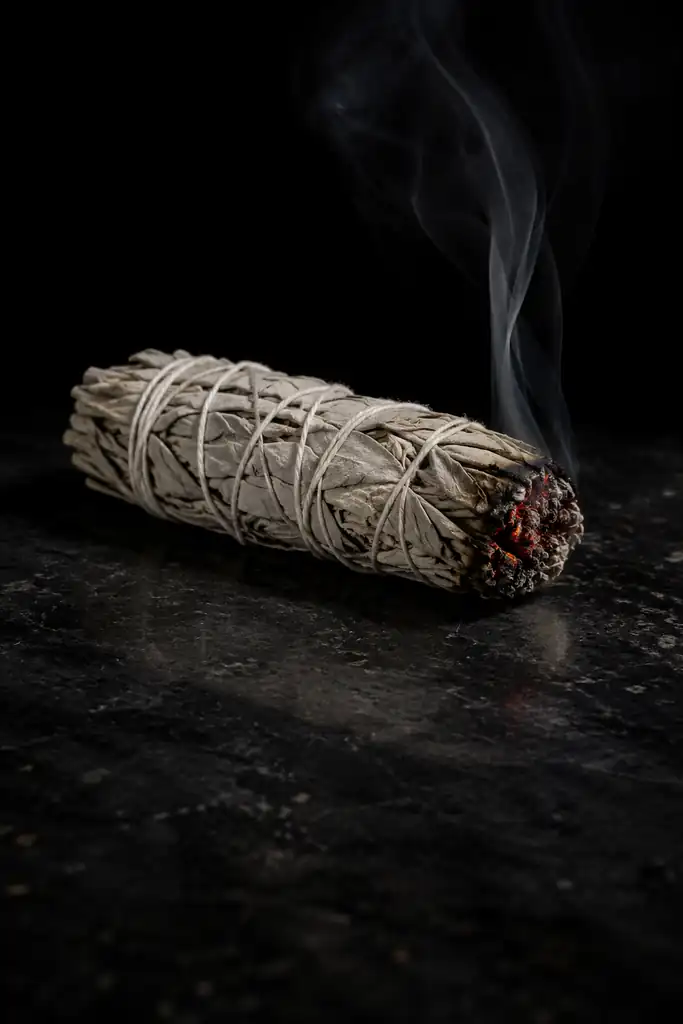
Sage is the incense that, over the past few decades, has crossed over worldwide from North American shamanism into general purification practices. Yet its ritual use reaches back centuries: indigenous peoples of various cultures of the American West and Southwest used bundles of white sage (Salvia apiana) to cleanse people, spaces, and ceremonial objects.
The smoking bundle, called a “smudge stick” in English, is the tool of one of the oldest documented purification rituals in North America. Like all incense substances on the overview page on smudging and purification, sage too follows the basic pattern: smoke purifies, protects, and sets boundaries.
Sage is a smudging plant that is burned for purification and for protection.
Quick Overview
White sage (Salvia apiana) grows mainly in Baja California and the neighboring US states. In the tradition of indigenous peoples, its smoke is considered especially effective at loosening and carrying away negative or disruptive influences from a space or a person.
The bundled and lit herb is moved through the room or over the person to be cleansed using the hand or a feather; the smoke is meant to take the harmful element with it. In other traditions, including European ones, common garden sage (Salvia officinalis) is also known as a protective plant.
Origin and Tradition
The smudging ritual is attested in various forms among numerous indigenous peoples of North America, including the Lakota, the Navajo, and many other cultures of the Great Plains and the Southwest.
The practice is not uniform; each group developed its own rituals, times, and intentions for smudging with sage. What unites them is the view that certain conditions, places, or periods of time require purification before sacred acts can take place, and that sage is a particularly suitable means for this.
Beyond the indigenous context, sage also has a history of protection in European folk tradition.
Garden sage was highly valued as a medicinal plant in antiquity; the medieval folk saying “Cur moriatur homo, cui salvia crescit in horto?” (Why should a person die who has sage growing in their garden?) points to its comprehensive protective effect in tradition.
Sage in doorframes and window niches was, in some regions, meant to keep witches and evil influences away.
The present-day spread of white sage as a purifying agent outside North America began in the 1970s and 1980s, when New Age movements took up elements of indigenous practices.
This transfer out of its original cultural context is not without controversy; some indigenous communities regard the mass commercialization of white sage as problematic, because it strains the stock of protected white sage and tears the ritual meaning out of context.
Mode of Action According to Tradition
In the indigenous tradition of the peoples who practiced smudging, the smoke of sage has a binding and removing function. It is meant to bind negative influences or disruptive spirits to itself and lead them out of the space.
The intention of the practitioner is important here: according to this view, the ritual does not work mechanically but presupposes a conscious attitude. The prayer or inner orientation of the person smudging is part of the act, not its background music.
In European folk tradition, sage works rather as a boundary substance: its strong, penetrating smell marks an area that harmful things avoid. The plant itself, not only its smoke, was considered protective; for this reason it was placed at thresholds, entrances, and in sleeping quarters.
Cross-Cultural Distribution
Besides North America and Europe, sage also appears as a ritually significant plant in the Mediterranean region. In antiquity, Salvia officinalis was a cult plant cultivated in gardens beside temples.
In the Arab world, related sage was part of medical and ritual practice. The boundary between medicinal and ritual use is fluid here: what protects and heals the body counts, in many traditions, at the same time as a means against supernatural influence.
In parts of Latin America, the use of sage is bound up with the local herbal medicine (Curanderismo), which mixes indigenous and European elements. There, sage belongs to a group of protective plants used in the Limpias ritual, a cleansing of the body.
Anyone interested in related incense substances will find further traditions of purifying smoke from other cultural spheres on the pages on juniper and palo santo.
What It Is Used Against
Tradition uses sage above all against categories of influences described as clinging, disruptive, or adhering: spirits bound to a place, remnants of former occupants, energies from distressing events, or the harmful effect of envy and the evil eye.
In the indigenous tradition, it is not always individualized beings that stand in the foreground, but conditions that impair the well-being of a person or a community.
In European folk belief, sage appears as a means against witchcraft and against the influence of women to whom a supernatural capacity for harm was ascribed. The specific profile of the beings warded off by sage differs from that of frankincense, which is more strongly directed against demons in the theological sense.
The Protection Compass assigns sage to the types of beings for which it is documented as a countermeasure in various traditions.
Application and Limits
Sage smudging traditionally begins by lighting the bundle and smothering the flame so that it smolders evenly.
The smoke is then guided systematically through the room, beginning at the door and including all corners; or it is guided over the person to be cleansed with a feather. A vessel, traditionally an abalone shell, catches the ash.
The traditions themselves name an important limit: the ritual presupposes knowledge and respect. Use without intention, without an understanding of its origin, and without respect for the source tradition is regarded in indigenous tradition as ineffective or counterproductive.
Beyond this, it should be noted that white sage is a plant increasingly under pressure in its natural habitat; sustainably cultivated sage or native garden sage is a defensible alternative for those who wish to apply the practice outside its context of origin.
As with all incense substances, the rule holds: a single means of protection does not replace a comprehensive protection concept. The Protection Compass shows which combinations the traditions recommend for particular situations.
Literature (Selection)
Related key terms: burning sage white sage smudging purification.
iWell Guard and Protective Traditions
The smudging ritual follows the basic idea that purification is a conscious act that involves time, place, and person. The iWell Guard translates this idea into a permanent companion: whoever wears the pendant carries the awareness of protection with them, without being bound to the place or the moment of a ritual.
Both approaches, the old smudging ritual and the modern protective sign, assume that protection requires an inner attitude supported by an outward sign or an outward act.
Personal experiences may vary. Not a medical device. No promise of healing.