Protective Deities: Guardians and Keepers
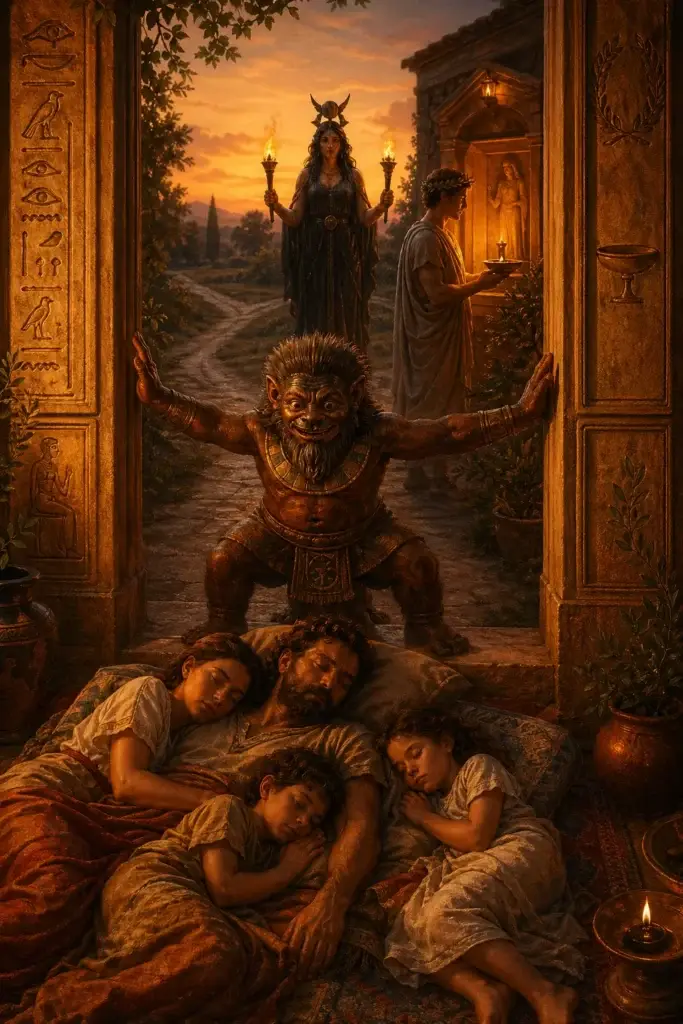
Deities that protect people, houses, paths or communities. Bes, Hecate, Lar, guardians of everyday life across cultures.
Protective deities appear as guardians of sacred spaces and keepers of the cosmic order.
Table of Contents
Quick Overview (Definition List)
Type: God / Goddess Class: Protective deities Distribution: All pantheons, with regionalised variants Main characteristics: Specialised protective domain, personal veneration, often female or “hybrid”, closeness to people Related sub-categories: High deities, deities of the dead, local protective spirits
Concept and Distinction
Protective deities differ from mere house spirits in that they are part of the established pantheon: they have names, cults, temples. They differ from high deities in that they are specialised and personally accessible.
A mortal can pray to Bes and hope for direct intervention; with Zeus this is less personal. Protective deities are also not neutral like deities of the dead: they have explicit loyalties and preferences. Some are older (primordial), some arose from mortal veneration.
The Depth of Protective Deities in the History of Religion
In terms of the history of religion, the class of protective deities is one of the oldest fields of functionally specific divine veneration. The oldest evidence is found in the early Mesopotamian tradition: Ninurta as protective god of the city of Nippur, Marduk as protective god of Babylon, Ashur as protective god of Assyria.
This configuration of the urban protective god (poliuchos in the later Greek tradition) runs through all advanced civilisations with organised urban culture, from Athena as protective goddess of Athens to Quirinus, Mars and Jupiter as protective gods of Rome, through to Inari as protective god of the Japanese rice harvest and household.
From a phenomenological perspective, protective deities differ from high deities through their functional specificity: they are not responsible for the creation of the world or the cosmic balance, but for a concrete sphere that is to be protected.
This sphere may be a city, a profession, a stage of life, a group of people or a particular activity. Scholarship (Walter Burkert, Griechische Religion, 1977; Hans-Peter Hasenfratz, Die Religion der Germanen, 1992) has systematically worked out the functional logic of protective deities in the various pantheons.
Cultural-Historical Examples
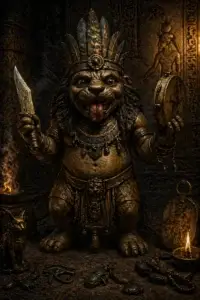
The Egyptian Bes is a dwarf-like, lion-like god with a red face and feather crown, a protector of children, women in labour, and households. Bes amulets were extremely popular; households prayed to Bes daily.
The Egyptian Taweret (also Tauret) is a hippopotamus goddess, protector of pregnant women and newborns, a maternal figure with enormous cult influence. The Greek Hecate is goddess of magic, boundaries, crossroads and witchcraft; she is venerated at boundaries and crossroads, not in temples.
The Scottish Cailleach is an ancient goddess or spirit figure (ambiguity is characteristic) who watches over herds, winter and mountain landscapes; she is fearsome but necessary.
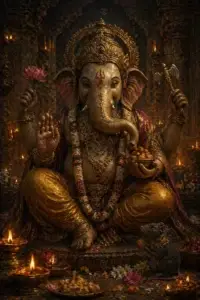
The Roman Vesta protects the hearth fire and public order; the Vestals were her priestesses. The Hindu Ganesha is protector of beginnings and obstacles; every significant undertaking begins with the veneration of Ganesha.
Examples from Further Cultures
The Jewish tradition has no elaborated concept of a protective god in the polytheistic sense, but functionally analogous are the guardian angels (malakhe ha-sharet), assigned to individual persons, places or tasks.
In Christianity this function is taken over by the tradition of patron saints, with more than 10,000 saints and their specific areas of responsibility.
In Islam the function is distributed partly among the angels (Mala’ika) and partly among the Awliyya (saints). In the Hindu tradition every family knows its Kuldevta (family protective deity), every profession its assigned deity, every region its protective gods with their own temples.
Sources
Protective deities are documented in Egyptian texts and amulets, in Greek votive offerings and inscriptions, in Roman household cults, in Hindu Puranas and in European folklore.
Archaeological finds show massive veneration of these deities; more Bes figures than Zeus statues have been found in Egyptian houses. Religious literature often treats protective deities as “insignificant” compared to high deities; popular veneration tells a different story.
Sources
Standard works on comparative religious scholarship include Walter Burkert, Griechische Religion der archaischen und klassischen Epoche (Kohlhammer, Stuttgart 1977; English Greek Religion, 1985), Jean Bottéro, La religion babylonienne (PUF, Paris 1952), Erik Hornung, Der Eine und die Vielen. Altägyptische Götterwelt (Wissenschaftliche Buchgesellschaft, Darmstadt 1971; English Conceptions of God in Ancient Egypt, 1982).
For comparative functional analysis, Georges Dumézil, Mitra-Varuna (1940) and his Mythe et épopée (3 vols. 1968, 1973) are standard references. For the Jewish-Christian-Islamic tradition, Susanne Bickel, Bes (in Lexikon der ägyptischen Götter und Götterbezeichnungen, Otto Harrassowitz, Wiesbaden 2002), Annemarie Schimmel, Mystische Dimensionen des Islam (1985).
Present-Day Significance / Related Beings
In the history of religion, protective deities take on a central function wherever life is particularly endangered: at the transition between worlds, at the entrance of houses and temples, at births and deathbeds, on journeys and in war.
In the earliest transmitted pantheons they are usually understood not in abstract-theological but in situational-pragmatic terms; they are invoked for precisely the situation in which they are needed.
Mesopotamia knows personal protective deities (Sumerian lamma, Akkadian lamassu) that accompany every person and may abandon them in illness or danger; accordingly central was the ritual of their re-invocation.
Ancient Rome institutionalised this idea in the form of the Lares and Penates, whose domestic cult is documented into the 4th century CE (Walter Burkert: Antike Mysterien, Munich 1990; Mary Beard, John North, Simon Price: Religions of Rome, Cambridge 1998).
Further standard works in the literature index.
Protective Deities of Various Cultures