Mazu, Goddess of the Chinese Tradition
By Ralf Ittermann · last reviewed on
Goddess of seafarers, protectress of travelers, beacons of hope. Mazu is one of the most popular Chinese deities in South China, especially in coastal regions and among sailors. She is the southern counterpart to Guanyin (the Buddhist bodhisattva of compassion), but specific to the sea and to ships.
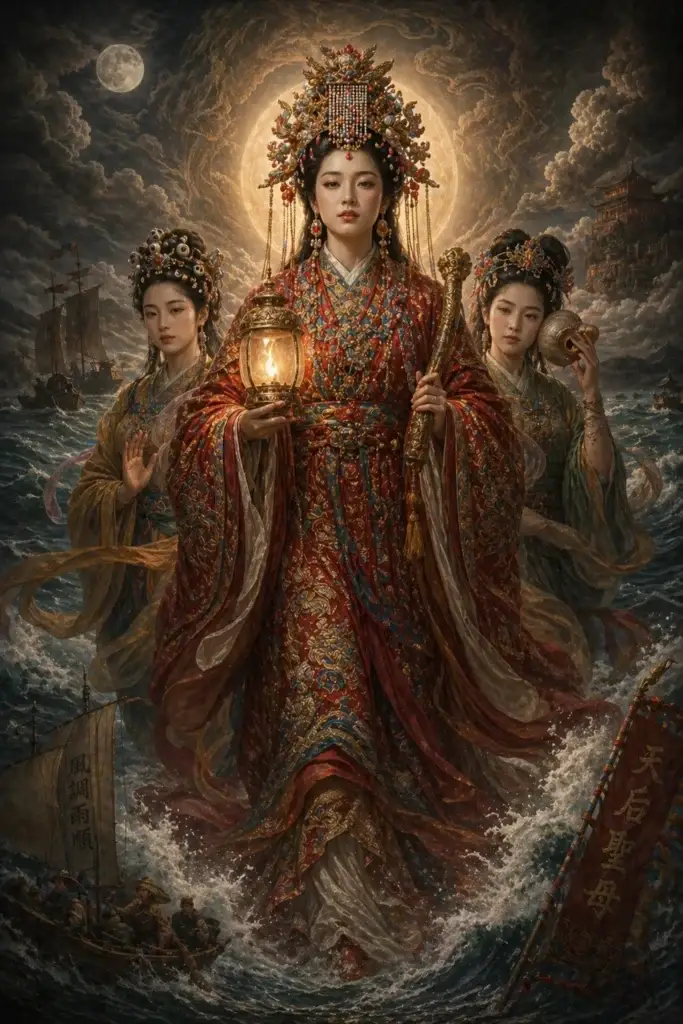
She is depicted in red robes, with a gentle face and an aureole, gazing out over stormy waves to rescue lost ships.
Her legend holds that she was an earthly saint who revealed herself through meditation, met needs at sea, and ascended to heaven in a whirlwind. Ever since, millions of fishermen and merchants have kept Mazu shrines on their boats.
Mazu is China’s protective goddess of seafarers and the sea.
Mazu is the goddess of the Chinese tradition and the patroness of seafarers.
Type: Chinese folk deity, patroness of mariners and coasts
Pantheon: Daoism, Chinese folk religion, Taiwanese syncretism
Function: protection at sea, safety of fishermen and travelers, maternal care
Main attributes: red brocade mantle, court-lady crown, lamp or chart
Main cult sites: Meizhou Island (Fujian, birthplace), over 1500 Mazu temples worldwide
Buddhist syncretism: Tianshang Shengmu (Holy Heavenly Mother)
Classification
Mazu (Chinese Māzǔ, literally „mother ancestor“) is historically traced back to Lin Moniang, a young woman born in the 10th century (Song period) on the island of Meizhou near Fujian, who gained fame through miraculous rescues of mariners and was venerated as a cult figure after her early death (probably 987).
Deification in the 12th and 13th centuries under the Song and Yuan emperors. Today she is one of the most popular Chinese folk deities, especially in Taiwan and the Chinese diaspora.
Main cult site: Meizhou Island (Fujian), her birthplace and the largest Mazu temple complex worldwide. Taiwan: the country with the most Mazu temples (hundreds). International distribution: Hong Kong, Macau, Singapore, Malaysia, Vietnam, Indonesia, U.S. Chinatowns, the Philippines. UNESCO added the veneration of Mazu to the list of intangible world heritage in 2009.
Sources
Central sources: the local chronicles of Meizhou (12th century onward), the imperial conferral edicts (Song and Yuan periods), the Tianhou Shengmu Shengji (Holy Records of the Heavenly Mother, Qing period). Secondary literature: Boltz, In Hommage to Tianfei; Watson, Standardizing the Gods; Sangren, History and Magical Power in a Chinese Community.
Name
Mazu is depicted as a young to middle-aged woman in red or golden silk robes, often with a gentle, compassionate face. A radiant aureole or halo surrounds her head, not wrath like Zhong Kui, but kindness. She is frequently shown gazing out over the waves, with a lantern or a lighthouse signal in her hand.
At times two red figures flank her (Er Ma, the two mother-helper spirits), or the moon shines above her. Artistically she is often central on temple altars, with worshippers before her, often old fishermen and their families.
The red motif is central: a red lantern for ship safety, red robes for the blessing of life. Boats carry Mazu symbols to ensure safety.
Characteristics
Mazu is a more direct, more personal goddess than administrative ones such as Yanluo or imperial ones such as Yuhuang. Fishermen pray to her for a safe voyage, full nets, and protection from typhoons.
Merchants traveling by sea swear oaths to Mazu. In Meizhou (her birthplace) the Mazu temple is a pilgrim attraction; millions visit, especially for the birth festival of the third moon.
In Taiwan and the diaspora, Mazu processions are legendary: bearers carry heavy, ornamental altars through the streets while believers play music and set off fireworks. In contrast to male war gods (Guan Yu) or administrators (Yuhuang), Mazu is close, compassionate, almost motherly. She is not instruction, but consolation.
Appearance and Symbolism
Mazu is depicted as a beautiful woman in red or golden robes, often with a crown or tiara. She sometimes carries a scepter or a seal.
Her companions are two spirit guides: one with red cheeks (the Far-Seeing One) and a paler one (the Keen-Hearing One). She stands on clouds or is surrounded by the waves of the sea.
The most important aspects of Mazu at a glance. The following fields summarize origin, function, appearance, veneration, symbols, and parallels.
Mazu is historically traced back to Lin Moniang: born in the year 960 (Song period) on Meizhou as the daughter of a fishing family, she rescued several mariners of her family from storms.
By the age of 16 she was known as a swimmer and a seer; at the age of 28 she is said to have climbed the sacred mountain of her island and never returned. Later, mariners and fishermen saw her countenance in storms, which preceded rescues.
Protectress of mariners, fishermen, and sea travelers. In situations of distress at sea she is called upon and appears as a red-robed figure on the horizon or at the mast.
In the extended cult she is also protectress of mothers, of pregnant women, and of the family in general. In Taiwan she is a central goddess of identification: many pilgrims travel each year along the 350 km Dajia Mazu Raojing pilgrimage route.
A young woman in a red or red-and-gold brocade mantle, with the court-lady crown of the Song court ladies (with hanging strings of pearls). In her hand a lamp or a chart (a guide).
Frequently seated on a dragon throne or standing with outspread hands. Accompanied by two guardian figures: Qianliyan („Thousand-Mile Eye“) and Shunfeng’er („Wind-Hearing Ear“), who report to her from afar about situations of distress.
Sphere of effect: Before every ship voyage and before every fisherman’s departure, incense is offered at harbor Mazu shrines. In Taiwan the annual Dajia Mazu pilgrimage festival (March/April) is observed by over two million participants.
Visitors to the temple bring incense, food, and gold-paper offerings. In the personal cult, she is invoked for family protection, healing, and safe journeys.
Red brocade mantle, court-lady crown (with strings of pearls), lamp, chart, dragon throne, lotus. Attendants: Qianliyan and Shunfeng’er (two guardian companions). Sacred animals: dragon, phoenix. Sacred plants: lotus, jasmine. Sacred colors: red and gold. Sacred number: 28 (the age at her death).
Tianhou (imperial title: „Queen of Heaven“), Guanyin (Buddhism, a related goddess of compassion), Avalokiteshvara (Buddhism). Global parallels among protectresses of mariners: Stella Maris/Mary (Christianity), Aphrodite Pelagia (Greece, Aphrodite of the Sea), Yemaya (Yoruba/Santeria), Ran (Germanic, sea goddess with nets). Functionally also: Anahita (Persian), Sedna (Inuit).
Warding Off in Everyday Life
Rituals of Veneration
The veneration of Mazu is central to the seafaring culture of the South China seas (Fujian, Guangdong, Taiwan). Main festival: Mazu Dajie (Mazu’s birthday, the 23rd day of the 3rd lunar month) with processions and offerings (fish, fruit, incense sticks, paper money).
The Mazu temple in Putian (Fujian) has been the historical pilgrimage site since the 10th century. Daily veneration at house altars by seafaring families, with incense sticks in the morning, for protection from storms.
Spells and Invocations
Chinese nianfo/mantra: „南無媽祖娘娘” (Namo Mazu Niangniang, homage to the goddess). Invocations before sea voyages and during storms. Daoist magic: talisman writings (Fu) that invoke Mazu’s protection are sold by Daoist priests. Historical texts: songs and hymns in the Mazu temple canon (17th-century compilations).
Amulets and Protective Symbols
Mazu talismans (protective images) in fishing boats and in the houses of sailors. Daoist paper amulets (Fu characters) with an invocation of Mazu Niangniang.
Archaeological evidence: Mazu temple inscription stones from the 12th century in Fujian, ceramic statues from the Ming period in museums in Taiwan and China. Wood carvings in modern temples show Mazu with dragon-throne iconography.
Mazu, Parallels in Other Cultures
Mazu resembles the European Stella Maris (the Virgin Mary, patroness of sailors), the Greek Amphitrite (sea goddess), and the Hawaiian Namaka (ocean goddess). In contrast to Amphitrite (primarily mythological) or Stella Maris (theologically imposed), Mazu became established organically and from the people. With the Buddhist bodhisattva Guanyin (compassion) she shares the feminine, compassionate principle.
With Inari (Japanese) Mazu shares veneration through millions of lay altars in private spaces. With Guan Yu she shares the historical-legendary hybridity. What is unique is her specificity: she is not a general goddess but specialized in the sea, illustrating the need for contextual deities in practical cultures.
The Historical Lin Moniang: From Woman to Goddess
Unlike most deities of Chinese folk belief, Mazu goes back to a figure who, according to tradition, is historically tangible.
She is said to have lived as Lin Moniang in the 10th century on the island of Meizhou off the coast of Fujian Province, traditionally dated to around 960 to 987. The accounts describe her as the daughter of a fishing family, silent (hence the name Moniang, “the silent girl”), pious, and gifted with special abilities.
The best-known episode tells how, in a trance or in a dream, she rescued her father and her brothers who had been caught in a storm at sea.
When her mother woke her, she let go of one of the brothers whom she had held fast in spirit, and he drowned. Another tradition has her die young by climbing a mountain and being taken up into heaven.
From this local figure, over the centuries, an empire-wide venerated goddess emerged. The process of apotheosis, of deification, can be traced through the sources. At first she was a patroness of the sailors of Fujian.
Then emperors began to confer titles on her, which sanctioned and broadened her veneration. Religious studies sees in Mazu a model example of how, within the Chinese religious system, a person could rise to the rank of a deity through the combination of popular veneration, local tradition, and state recognition.
Imperial Titles and the Rise to Empress of Heaven
State promotion was decisive for Mazu’s career. From the Song dynasty onward, the emperors conferred ever higher titles on her in a long series of honors.
According to tradition, she received her first official rank in the early 12th century. Under the following dynasties she rose from a “lady” (furen) to a “consort of heaven” (tianfei).
The highest title was conferred on her by the emperor of the Qing dynasty in the 17th century: Tianhou, “Empress of Heaven” or “Queen of Heaven.” Under this name she is known to this day in many temples, whose designation Tianhou temple derives from it. Each elevation of title was often linked to a concrete occasion, such as alleged help in a naval battle, an embassy voyage, or the securing of grain transport by sea.
This process says much about the Chinese relationship between state and religion. The imperial court conducted a kind of administration of the supernatural. Local deities could be incorporated into an empire-wide “civil service” of the beyond, with ranks and titles modeled on those of the earthly officialdom.
Mazu was especially suited to this policy because seafaring was of high importance to the empire, for trade, tax transport, and coastal defense. Her veneration was therefore not only the pious practice of fishermen but also an instrument of imperial integration.
Temple Network and Spread Beyond the South China Sea
The veneration of Mazu followed the routes of South Chinese emigration and sea trade. Wherever people from Fujian and Guangdong settled, they founded Mazu temples.
In this way a dense network of sanctuaries arose along the Chinese coast, on Taiwan, where Mazu became one of the most important deities of all, as well as in Hong Kong, Macau, Vietnam, Malaysia, Singapore, and in Chinese communities worldwide.
The ancestral temple on Meizhou is regarded as the place of origin from which many temples derive their cult statues.
This connection is maintained through the practice of fenxiang, the “sharing of the incense”: a new temple takes ash or embers from the censer of an older temple and thereby establishes a ritual line of descent.
The annual pilgrimages, in which Mazu statues are carried through the landscape in great processions, are today among the largest religious mass events in the Chinese-speaking world.
In 2009 the belief in Mazu was added by UNESCO to the list of the intangible cultural heritage of humanity.
This recognition marks a further shift in the long history of the veneration: from local fishermen’s piety, through imperial state-cult policy, to the cultural-political upgrading in the present, in which Mazu also functions as a symbol of shared identity across political borders.
Religious studies observes here how a deity takes on new social functions again and again, without losing its core: protection on the dangerous water.
Further Links
Literature (Selection)
Frequently Asked Questions about Mazu
Who is Mazu in Chinese religion?
Mazu (Chinese, roughly “mother ancestor”) is the Chinese goddess of the sea and patroness of seafarers, fishermen, and travelers. Unlike most deities, she goes back to a historical person: Lin Moniang, a girl from a fishing family on the island of Meizhou in Fujian Province who lived in the 10th century.
According to tradition, she had supernatural abilities and rescued sailors from storms. After her early death she was venerated as a goddess.
How widespread is the Mazu cult today?
The Mazu cult is one of the most vibrant folk cults of the Chinese cultural sphere, with several hundred million devotees. It is particularly strong in Fujian, Taiwan, and the Chinese communities of Southeast Asia.
In Taiwan the annual Mazu pilgrimage procession is among the largest religious events, in which statues are carried over hundreds of kilometers. In 2009 UNESCO added the belief in Mazu and its customs to the list of the intangible cultural heritage of humanity.