He Bo, bridegroom and destroyer of the Yellow River
By Ralf Ittermann · last reviewed on
He Bo is a god of Chinese tradition.
Lord over blessing and flood, once appeased with human sacrifices. The entry casts him both as bridegroom and destroyer, his moods shaping the river’s fate.
He Bo is the god of the Yellow River and the personification of both its power and its destruction: the river was one of China’s greatest resources and, at the same time, one of its greatest sources of suffering. The oracle bones of the Shang dynasty already attest to a sacrificial cult for him, and he becomes literarily traceable in the Warring States period in the Zhuangzi and in the Chuci anthology.
Notorious are the historical human sacrifices: young women were sent out as brides of He Bo on a raft and drowned, until the official Ximen Bao ended the practice in the fifth to fourth century BC. This episode is recorded in the Shiji of Sima Qian and is still regarded in China today as an example against superstition.
Type: Ambivalent river god of the Yellow River
Origin: Old Chinese tradition, sacrificial cult since the Shang dynasty
Texts: Zhuangzi, Chuci anthology, Shiji of Sima Qian, Shang-dynasty oracle bones
Period: Shang dynasty to the Warring States period, still received today
Appearance: human face with a fish body, or a white dragon, on a chariot drawn by dragons

Area of origin and sources
Period of the Texts
Shang dynasty to Warring States period: the sacrificial cult is already attested in the Shang-dynasty oracle bones; He Bo becomes literarily traceable in the Warring States period in the Zhuangzi and in the Chuci.
Area of Diffusion
Northern China, along the Yellow River, whose water level and floods He Bo governed.
Sources
Good: the Shang-dynasty oracle bones, the Zhuangzi, the Chuci anthology and the Shiji of Sima Qian document both cult and myth alike.
Name and variants
Name: He Bo means Lord of the River: the name identifies him directly as the personification of the Yellow River and its devastating floods.
Form and effect
Appearance
He Bo is an ambivalent water god in whom blessing and curse coincide in a single figure: the irrigation and fertility of the fields, and the deadly floods. Iconographically he appears as a human-fish hybrid being with a white face, or as a white dragon, often on a chariot drawn by two dragons. In the Nine Songs he is the bridegroom of a ritual wedding voyage.
Effect
He Bo is the lord over the floods of the Yellow River. As the personification of a river that both gives and destroys life, he embodies the duality of blessing, the harvest and the water, and curse, drowning and catastrophe. His unpredictable, greedy character explained, in tradition, the need to appease him through offerings, up to and including the bride sacrifices, which were abolished only late.
Profile: He Bo
The key aspects of the river god at a glance.
Old Chinese river god with a sacrificial cult since the Shang dynasty, literarily attested in the Zhuangzi and in the Chuci anthology.
Water level and floods of the Yellow River, historically the recipient of human and animal sacrifices in the imperial cult.
Human, white face with a fish body, or a white dragon, often on a chariot drawn by two dragons.
The blessing of irrigation and harvest on the one hand, deadly floods and drowning on the other.
Human and animal sacrifices, including drowned brides, until Ximen Bao abolished the practice; afterwards, containment of the river and an orderly cult.
The Dragon King, who later superimposed himself on the Chinese water and dragon god complex, and the Korean Imugi as a related East Asian water power.
Myth, sacrificial cult and the end of the brides
He Bo, the Lord of the River, is the personification of the Yellow River and its devastating floods. Shang-dynasty oracle bones already attest to a sacrificial cult; he becomes literarily traceable in the Warring States period in the Zhuangzi and in the Chuci anthology. In the Zhuangzi, He Bo boasts of his greatness during a flood, travels downstream to the North Sea and is humbly instructed there by the sea god. In the Chuci, the archer Hou Yi shot He Bo in the left eye and took his wife from him.
The darkest chapter is the human sacrifices: until the Warring States period, animals and humans were drowned in the river, including young women sent out as brides of He Bo on a raft. The official Ximen Bao ended the practice by declaring the offered bride unsuitable and having the shamanesses and elders thrown into the river as messengers; since none returned, the ritual was abandoned in horror. This episode is recorded in the Shiji of Sima Qian.
Echoes from the Nine Songs to the video game
Of the deities of the Nine Songs, He Bo is the one with the greatest cultural afterlife. In modern popular culture he appears as a playable character in video games. The Ximen Bao episode is still cited in China today, in schools and moral discourse, as an example against superstition.
In religious studies, He Bo is a classic river and weather god, the personification of a natural phenomenon. Characteristic of him are his ambivalent nature of blessing and destruction and the cultic logic of appeasement through offerings, up to and including human sacrifice. The Ximen Bao tradition marks an early documented transition from sacrificial cult to a rationalising rejection by the official elite. Later he was absorbed into the complex of the Dragon Kings.
From human sacrifice to an orderly river cult
The recorded forms of the cult range from human sacrifices, brides drowned in the river, through animal sacrifices to the sinking of valuables: horses were drowned and jade thrown into the river. The imperial cult and shamanic rituals sorted the sacrificial animals according to purity criteria. The abolition of human sacrifice by Ximen Bao is still regarded in China today as a classic example of rationalist enlightenment against superstition.
The real protection later lay in the containment of the river and an orderly cult in place of blood sacrifices. Holy water, as consecrated water, links to this orderly, bloodless cult against the danger of the river; a worn amulet was considered a protective sign for travel and life along the great river, and the sound of bells in the temple served as a protective sign within the river cult.
Dragon Gods of East Asia
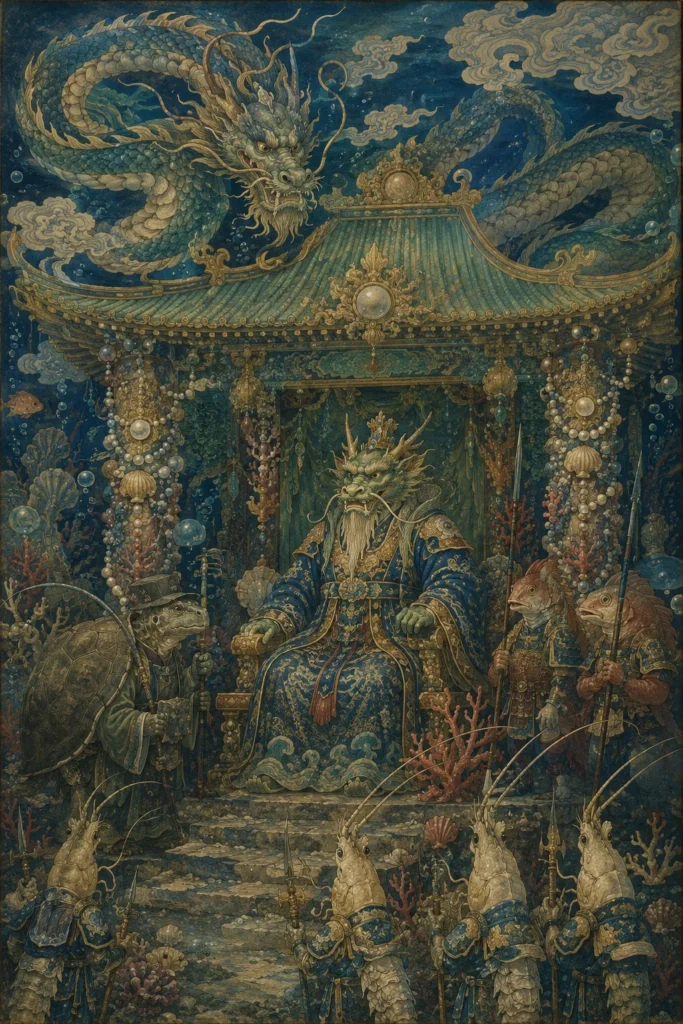
He Bo belongs to the Chinese complex of water and dragon gods, which was later overshadowed by the Dragon Kings: the Dragon King took his place as the central authority of the Chinese river cult. Closely related to him are the Japanese Ryūjin and the Korean Yong-wang, while the Korean river god Habaek is considered directly derived from He Bo. As a related East Asian water power, the Korean Imugi is also close to him. Within China, He Bo also touches on the circle of deities around Caishen and the cultural hero Fuxi.
Frequently asked questions about He Bo
Were brides really thrown into the river for He Bo?
Yes, this is well documented. Young women were set adrift on a raft and drowned as brides. The practice is attested for the Warring States period, locally into the Qin era.
Who ended the human sacrifices?
The official Ximen Bao under Marquis Wen of Wei in the fifth to fourth century BC. The episode appears in Sima Qian’s Shiji.
What did He Bo look like?
Depictions vary: either as a human, white face with a fish body, or as a white dragon, often riding a chariot drawn by two dragons.
Further links
Further reading:
- China – all beings of the Chinese tradition
- Dragon King – the later central authority of the Chinese river cult
- Imugi – the Korean water dragon as an East Asian parallel
- Holy Water, Amulet, Bells – traditional protective means
- Protection Compass – protective means at a glance
Literature (selection)
Further standard works in the bibliography.
Anyone searching today for He Bo, god of the Yellow River, finds a figure in whom harvest and drowning, blessing and human sacrifice are inseparably linked: a river god whose bloody worship was ended only by the official Ximen Bao.