Yuhuang, god of the Chinese tradition
By Ralf Ittermann · last reviewed on
Yuhuang is a god of the Chinese tradition.
The Jade Emperor, lord of heaven and earth, cosmic administrator.
In Daoism, Yuhuang Shangdi is the Jade Emperor and supreme deity.
Yuhuang
Type: Chinese principal deity, supreme lord of heaven (Daoism, folk religion)
Pantheon: Daoism, Chinese folk religion
Function: supreme ruler of heaven, highest official of the heavenly court, administrator of fate
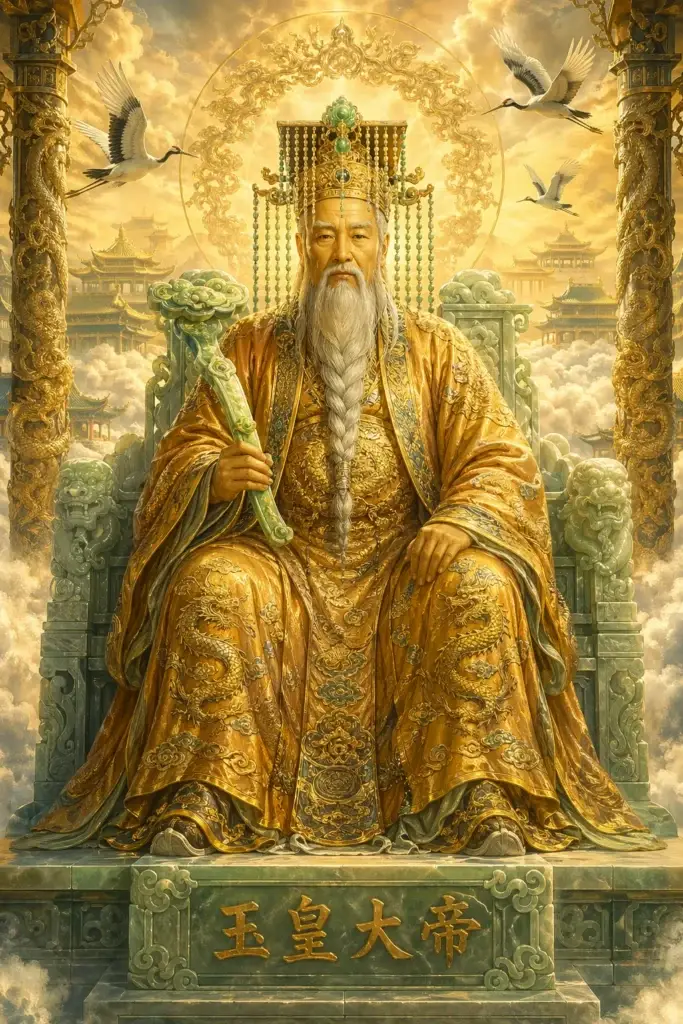
Main attributes: Mian crown with strings of jade pearls, yellow dragon robe, jade sceptre
Main cult sites: in every Chinese Daoism temple, Yuhuang Ge in Pingyao, Temple of Heaven in Beijing
Synonym: Jade Emperor (see separate page jade-kaiser)
Historical context
Yuhuang (Chinese Yù Huáng Dàdì, “Jade Emperor Grand Ruler”) develops during the Tang dynasty (7th to 10th century CE) and receives his canonical status under Emperor Zhenzong of the Song dynasty (early 11th century).
The Yuhuang cult is a theological consolidation of the Chinese pantheon: all other deities are subordinate to him as heavenly officials.
The main flourishing period of Yuhuang veneration runs from the Song to the Qing dynasty. Today he remains central in every Daoism temple and in Chinese folk religion; his birthday festival on the 9th day of the Chinese New Year is one of the largest Daoist festivals.
Main cult sites: present in every larger Daoist temple. Special sanctuaries: Yuhuang Ge in Pingyao (Shanxi), Yuhuang Miao on Mount Tai (one of the five sacred mountains of China), Yuhuang temples in Beijing, Shanghai, Hong Kong, Singapore.
In imperial China the Temple of Heaven in Beijing (built in 1420) was the highest cult site; only the emperor was permitted to sacrifice there to the highest heaven. Internationally present in every Chinese diaspora community with a Daoist temple.
Central sources: Yù Huáng Běnyì Jīng (sutra of the Jade Emperor, canonical text), the Daozang collection (the Daoist canon), imperial edicts of the Song dynasty. Secondary literature: Werner, Myths and Legends of China; Kohn, Daoism Handbook; Schipper, The Taoist Body; Bokenkamp, Early Daoist Scriptures.
Designation and spellings
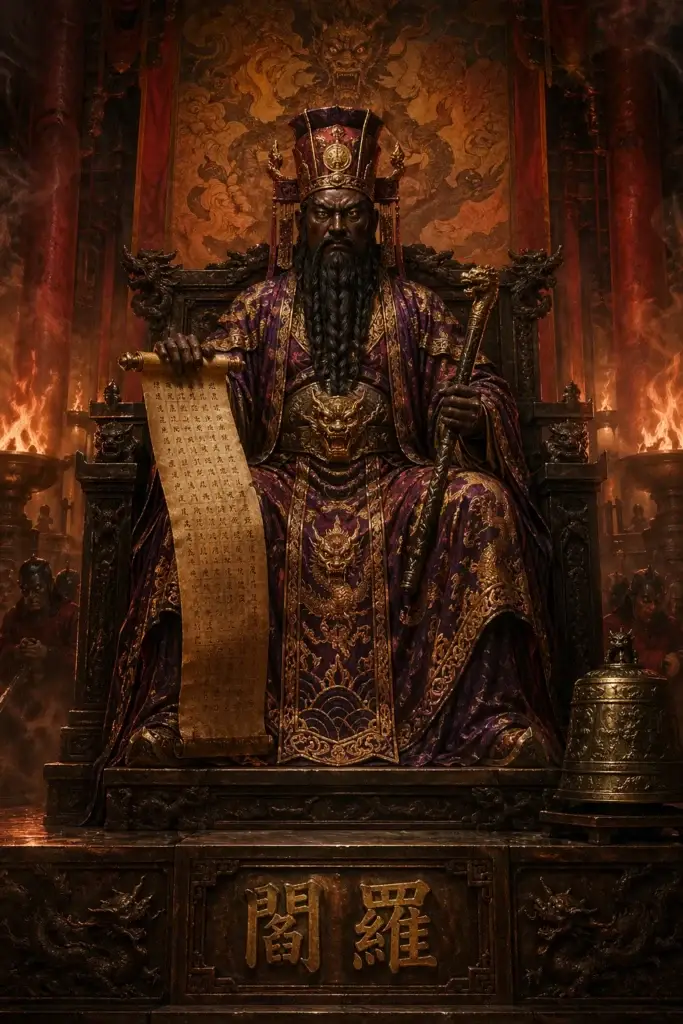
Yuhuang Shangdi is depicted as a dignified, middle-aged to elderly man, clothed in imperial red or golden silk robes, with a pearl crown and sceptre. His face is just, not angry but authoritative.
He sits on a throne in his heavenly office, surrounded by scrolls and instruments of administration, not weapons or works of art, but ledger-like documents concerning karma and fate.
The jade symbol refers to a metaphysical quality: in China, jade is a symbol of life, purity and indestructibility. His emblems are the imperial dragon, the Persian pattern and heavenly insignia. In art he is often shown with an entourage of government, subordinate gods, secretaries and scribes.
Characteristics
Yuhuang Shangdi rules over all deities, spirits and administrative heavens. Beneath him are specialised gods, a god of moisture, a god of the forest, a god of every village.
The earthly emperor rules through his mandate (Tianming). People may pray to the Jade Emperor for a change of fate, blessing for harvests or for the family, but not as to other gods, not intimately but formally.
The Jade Emperor birthday festival on the ninth day of the first lunar month is one of the largest folk festivals of China: fireworks, processions, altars with red paper money.
The Jade Emperor is treated with respect, much as one is humble before an earthly emperor. His decisions are the most central for human life: when you are reborn, with which karma, under which constellation.
Profile: Yuhuang
The most important aspects of Yuhuang at a glance. The following fields summarise origin, function, appearance, veneration, symbols and cultural parallels.
Yuhuang arises in the Tang dynasty as a theological consolidation of the Chinese pantheon.
In the mythological tradition: son of the realm’s tutelary spirit and of Bao Yue Guang Wang Mu (mother of creation); he incarnated in an early dynasty as Prince Yu, gave up his kingdom to become an ascetic, and after millions of years of meditation attained the highest heavenly status.
Consort: Wang Mu Niang Niang (Queen Mother of the West). Uncle of Yang Jian (son of his sister) and father of many demigods.
Supreme ruler of heaven and highest administrator of the cosmic apparatus of officials. All gods and demons are subordinate to him. He grants and withdraws divine offices, convenes assemblies and observes the human world through his officials.
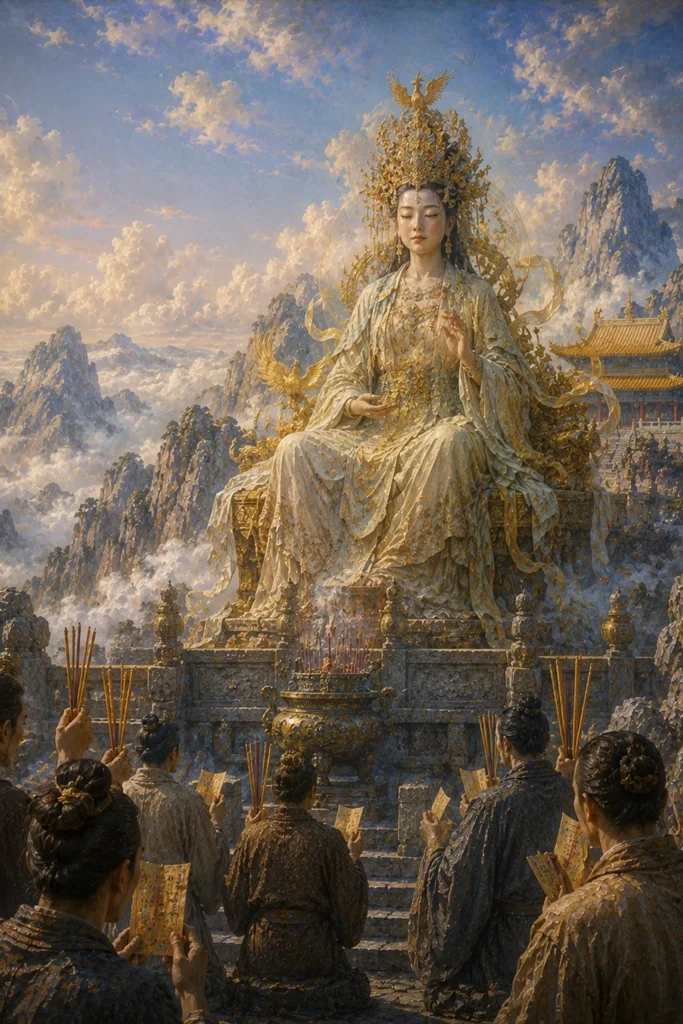
In the folk cult he is the recipient of petitions of all kinds, but typically through lower local gods (for example the city god, the earth god) as intermediaries. In personal household worship he is also invoked at New Year and on his birthday.
Yuhuang as an imperial court ruler in ancient Chinese dress: Mian crown (a high rectangular crown with hanging strings of jade pearls), a yellow or golden-yellow dragon robe (imperial symbol), a jade sceptre (gui), a beard, mild yet stern features.
He is enthroned on a magnificent dragon throne in the hall of the highest heaven, surrounded by official gods. In pictorial temple depictions he is often monumental in the central cella.
Sphere of influence: Yuhuang is venerated in every Chinese Daoism temple. His birthday on the 9th day of the Chinese New Year (mid to late January/February) is one of the largest Daoist festivals, with dramatic petition processions and offerings.
In personal household worship, invocation is typical at New Year and on his birthday. Kings of the traditional Chinese world (also in Korea and Vietnam) saw themselves as his representative on earth, a theology that found political expression in the Mandate of Heaven (Tianming).
Mian crown with strings of jade pearls, yellow dragon robe, jade sceptre (gui), dragon throne, beard, imperial insignia. Sacred animals: dragon (especially the yellow dragon), phoenix. Sacred plants: peach (the peach of immortality of his consort), peony. Sacred number: 9 (the imperial number).
Jade Emperor (Chinese, separate page), Tian / Shangdi (an earlier Chinese supreme-god concept), Brahman (Hinduism, highest being), Anu (Mesopotamia, sky god), Ouranos (Greece, primordial sky), Tian-Hou (Mazu, “Queen of Heaven”), Mahabrahma (Buddhism, highest official of the worlds).
Functionally: every supreme god who leads a cosmic hierarchy of officials shares Yuhuang aspects. The imperial theology makes Yuhuang unique, he is the heavenly mirror of the Chinese imperial system.
Warding off in everyday life
Rituals for warding off
In Chinese folk religion, the Jade Emperor is not regarded as a figure to be warded off but as the supreme guarantor of the heavenly order. Dealings with him therefore follow the logic of veneration: on the ninth day of the first lunar month, temples and households celebrate his birthday with incense, offerings, and prayers. Those who respect his authority thereby also seek protection from lesser spirits, which are subject to his heavenly administration.
Invocations
In everyday life, people encounter the Jade Emperor mainly through household altars and temple visits, where incense sticks are lit and fruit or tea is offered. In parts of southern China and in the Hokkien tradition of Taiwan and Southeast Asia, his birthday festival, the Bai Tian Gong, counts among the most important dates of the ritual year. Such rites serve less to ward off the god himself than to maintain an orderly relationship with Heaven.
Amulets and protective symbols
An expanded text with further source material will follow in a later update.
Yuhuang, parallels in other cultures
Yuhuang Shangdi resembles the Western God (cosmic administrative authority), the Ptolemaic cosmos-ordering Zeus and the Indian Brahma (creator-administrator, not the highest). In contrast to God or Brahma, Yuhuang is not the absolute final instance but stands beneath the Sanqing. With the Japanese Amaterasu, Yuhuang shares the imperial role of legitimation and centrality.
With the Roman Jupiter, the rule of heaven. What is unique is the administrative character: he is not primarily a god of thunder or of love but a god of cosmic bureaucracy. This is typically Daoist: spirituality through order, not mysticism.
The rise to Jade Emperor: a late career in the pantheon
The Jade Emperor (Yuhuang Dadi, “Exalted Jade Emperor”), despite his present pre-eminence, belongs to the comparatively young figures of the Chinese heaven of gods.
He is still absent from the classical texts of the Han period; the older layer of the Daoist supreme gods is formed by figures such as Yuanshi Tianzun (“the Heavenly Venerable of the Primordial Beginning”) and the trinity of the Sanqing.
The Jade Emperor emerges clearly only in the Tang and above all in the Song period.
Imperial patronage was decisive. Emperor Zhenzong of the Song dynasty conferred official titles on the Jade Emperor in 1012 and again in 1015, thereby binding him into the state cult. Emperor Huizong continued this policy.
Scholarship sees in this a process whereby the earthly imperial court created a heavenly mirror image of its own order: the Jade Emperor governs the cosmos as the Son of Heaven is meant to govern the realm, with an apparatus of officials, audiences and petitions.
This fusion of folk religion, Daoist theology and state cult explains the dual nature of the figure. For the Daoist schools, the Jade Emperor remained subordinate to the highest Sanqing, an exalted but not primordial god.
In popular piety, by contrast, he became the actual ruler of heaven, earth and the underworld, to whom all other deities owe account. This tension between learned and popular classification persists into the present and is one reason why descriptions of his standing differ considerably from source to source.
The heavenly bureaucratic state: cosmology and administrative model
The world of ideas surrounding the Jade Emperor is permeated by the bureaucratic order of the Chinese empire. Heaven appears not as an abstract place but as an administration with ministries, registers and careers. The Jade Emperor sits at the top, surrounded by court officials, and receives at fixed times the reports of subordinate deities.
Particularly close is the connection to the kitchen god (Zaojun), who resides in every household and once a year, shortly before the New Year festival, ascends to the Jade Emperor to report on the conduct of the family.
The city god (Chenghuang) and the earth deities (Tudigong) are also bound into this hierarchy: they function like local officials who report upward and receive directives from above.
The lifespan and fate of human beings are recorded in heavenly registers. Deities such as the Southern and the Northern Star Lord administer birth and death.
According to some texts, whoever acquires merit can rise within the apparatus of the beyond; deified human beings receive offices. This model of the religious career mirrors the social reality of the official examinations.
From the perspective of religious studies, this complex, termed the “celestial bureaucracy”, has been much examined, among others in the works of C. K. Yang and later Stephan Feuchtwang.
The central insight: the Chinese heaven of gods is not an arbitrary pantheon but a system ordered by responsibilities, in which the Jade Emperor takes the role of supreme sovereign without intervening in every detail.
Temples, images and the festival on the ninth day
In iconography, the Jade Emperor is almost always depicted as an enthroned ruler in imperial dress. He wears the mianfu, the ceremonial robe, and on his head the mianguan, the flat crown with hanging strings of pearls, as it was reserved for the Chinese emperor.
In his hands he often holds an audience tablet (hu). This depiction visually underscores his identification with the earthly sovereign.
Temples consecrated to the Jade Emperor often bear names such as Yuhuang Gong or Tiangong (“Heavenly Palace”). Well-known sites are found in Taiwan, for example the Tiangong temple in Tainan, and on the Chinese mainland.
In addition, the Jade Emperor possesses in many larger temple complexes his own shrine or his own hall, even when the temple is dedicated to other deities.
The most important festival day is the ninth day of the first lunar month, which is regarded as the birthday of the Jade Emperor. In Hokkien communities, especially in Taiwan and Southeast Asia, it is observed as Pai Ti Kong.
Veneration begins on the preceding night: families erect altars, offer sugar cane, which in a legend once gave the Hokkien protection from their pursuers, and present tea, fruit and incense. Since the Jade Emperor is considered too exalted to be honoured directly with animal flesh, vegetarian offerings and symbolic paper offerings predominate.
The straw mats on which one kneels and the ritual order of the bows are codified differently from region to region. Ethnographic studies of these festivals, for example from Singapore and Penang, show how strongly the cult is bound to concrete histories of migration.
The Jade Emperor in novel, opera and modern entertainment
Beyond religious practice, the Jade Emperor is a fixed literary figure. In the novel Journey to the West (Xiyou ji, 16th century) he appears as the supreme ruler of heaven, whose court is thrown into uproar by the Monkey King Sun Wukong.
It is notable that the novel does not portray the Jade Emperor as omnipotent: he must call upon the Buddha for help to subdue the monkey. This half-satirical portrayal shapes the popular image to this day.
In classical Chinese theatre and in Beijing opera, the Jade Emperor regularly appears in plays that dramatise episodes from Xiyou ji or from the Investiture of the Gods (Fengshen yanyi). His stage role is that of the dignified, somewhat distant sovereign.
In the modern era this tradition has continued. The Jade Emperor appears in animated films, television series, comics and computer games, in the People’s Republic of China as well as in Western popular culture that draws on the Journey to the West.
In doing so, the figure is often reduced to the powerless bureaucrat who stands in the way of the rebellious hero.
For religious studies this finding is instructive: the literary transmission and the living cult run alongside each other.
Whoever sacrifices to the Heavenly Palace on the ninth day of the first month venerates an exalted sovereign; whoever reads the novel encounters an ironically broken figure. Both images belong to the history of reception and should not be played off against each other.
Source situation: where our knowledge comes from
Anyone who wishes to grasp the Jade Emperor historically must distinguish between several layers of text. The oldest evidence for an exalted ruler of heaven of this name comes from Daoist writings of the Tang period.
The decisive impetus comes from the Song-period court documents that record the conferrals of titles by Emperor Zhenzong; these are transmitted in the dynastic historical works.
Alongside this stands the Daoist body of writings collected in the Daozang, the Daoist canon. Here are found liturgies, invocations and theological classifications that fit the Jade Emperor into the system of the supreme gods. These texts are often difficult to date and presuppose specialised liturgical knowledge.
A third layer is formed by the narrative literature of the Ming period, above all Xiyou ji and Fengshen yanyi, which strongly shaped the popular image but are not theological sources in the narrower sense. Finally, modern ethnography, for example the fieldwork on Taiwanese and Southeast Asian folk Daoism, provides material on lived practice.
Scholarship urges caution: much of what is presented in popular accounts as ancient mythology, for example detailed birth legends of the Jade Emperor, is literarily late or regionally limited.
The sober statement is that the Jade Emperor is a figure consolidated over the course of the Middle Ages, whose profile results from the interplay of state cult, Daoist scholarship and popular piety. Where older myths are asserted, the source basis must be critically examined.
Further links
Literature (selection)
Further standard works in the literature index.