Zhong Kui, God of the Chinese Tradition
By Ralf Ittermann · last reviewed on
Zhong Kui is a god of the Chinese tradition.
The demon hunter, terror of evil spirits, protector of the night. Zhong Kui is one of the most popular protective deities of China, not by imperial commission, but through popular recognition of his power against evil spirits (*yao* and *gui*).
With a grotesque and wild appearance, blue skin, hair standing on end, a sharp-toothed laugh, he is frightening, but only to evil.
The legend says: a gifted scholar, unjustly denied his rank, took his own life, returned as a spirit and took it upon himself to hunt down all demons and damned souls.
Ever since, millions of Chinese have hung his portrait on their doors, as an effective deterrent and for prayer.
Zhong Kui is China’s legendary demon hunter and popular protective god.
Type: Deified human of Chinese folk religion, demon hunter and apotropaic protective god
Pantheon: Daoism, Chinese folk religion
Function: driving away demons, protection at the New Year, patron of examination candidates
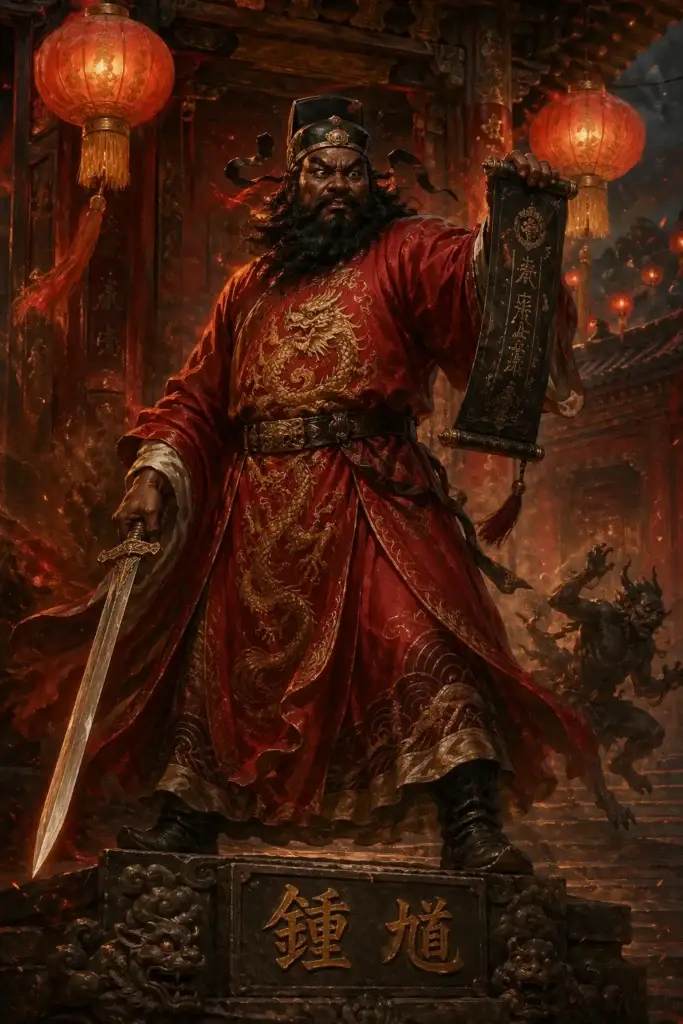
Principal attributes: black full beard, red official’s robe, sword, captured demon’s head
Principal cult sites: Zhong Kui temples in Anhui, in every Chinese house entrance as a door image
Tradition: centrally invoked at the Dragon Boat Festival (Duanwu Jie)
Context
Zhong Kui (Chinese Zhōng Kuí) first appears in the Tang dynasty (7th to 10th century AD).
Main legend: an examination candidate who, despite outstanding performance, is not admitted to the imperial civil service because of his ugly appearance, takes his own life out of honour, and is appointed king of the demon hunters in the afterlife.
Main flourishing period: Tang to Ming dynasty. Today still widespread in every Chinese house entrance as a door image, especially at the Chinese New Year and at the Dragon Boat Festival (Duanwu Jie). In modern Chinese popular culture (films, games, anime) extremely widespread.
Principal cult sites: Zhong Kui temples in Anhui (his supposed birthplace), Zhong Kui temples in Pingyao (Shanxi). More frequent than dedicated temples: the door-image tradition. Images of Zhong Kui are hung at house entrances to ward off demons.
At the Dragon Boat Festival (Duanwu Jie, 5th day of the 5th month) he is especially invoked, because this day is regarded as dangerous for demonic intruders. In the Taiwanese cult he is venerated under the designation “Lord of Demons” (Da Wang).
Central sources: Tang sources (anecdotes at the court of Emperor Xuanzong, who saw Zhong Kui in a dream and had him painted), Zhong Kui legend collections from the Song dynasty onward.
Pictorial tradition: Wu Daozi’s Zhong Kui image (Tang period, lost), numerous later painters. Secondary literature: Werner, Myths and Legends of China; Bordahl, The Eternal Storyteller; Cahill, Chinese Painting.
Name and Variants
Zhong Kui is terrifying and fearsome: blue or black skin, a red, distorted face with a large, wrathful laugh. His hair stands on end as though electrified.
He is often shown with a broad sword or whip, which he uses against demons. Especially characteristic: in his arms or at his feet are captured demons, often shamed or made small.
His portrait is widely found on doors and walls, not as a delicate work of art, but as an effective magical threat to evil. While other deities are majestic, Zhong Kui is deliberately ugly and wild; his power lies in ferocity, not in dignity. Swords, capturing tools and captured demons surround him.
Description
Zhong Kui is a purely practical protective god, with no theological role in heaven or hell, but rather the defender of the house against supernatural intruders.
His portrait on the door is a warning signal: the demon hunter is watching, you are not welcome. At the New Year festival, Zhong Kui portraits are hung up anew, a ritual renewal of his mandate.
In southern China, Zhong Kui processions take place, in which performers embody the role and simulate demon traps. Buddhist temples and Daoist sanctuaries acknowledge Zhong Kui, but not hierarchically; he is an agent against evil, not a central deity.
Popular veneration is not devout, but practical: people trust Zhong Kui not out of love, but out of conviction in his effectiveness.
The most important aspects of Zhong Kui at a glance. The following fields summarise origin, function, appearance, veneration, symbols and cultural parallels.
According to legend, Zhong Kui was a Tang-period scholar from Shaanxi (or Anhui) who passed the imperial examinations with the highest performance, but was not appointed by the emperor because of his ugly appearance (too dark, too powerfully built, too wild). Out of honour and despair he dashed his head against the palace pillar.
In the afterlife his spirit was appointed king of the demon hunters by the Yuhuang (Jade Emperor); he is to catch and destroy all evil spirits.
In some versions he appears to Emperor Xuanzong (8th century AD) in a dream and drives away a demon that is troubling the emperor, whereupon the emperor has his image hung at the house entrances as protection.
Patron of the driving away of demons. Protection against illness (especially in early summer), evil spirits, intruders. In the personal household cult, hung up as a door image at the New Year and at the Duanwu Jie.
Patron of examination candidates (he himself was a candidate unjustly rejected); young students pray to him before examinations. In modern Chinese folk belief he remains popular as a door image.
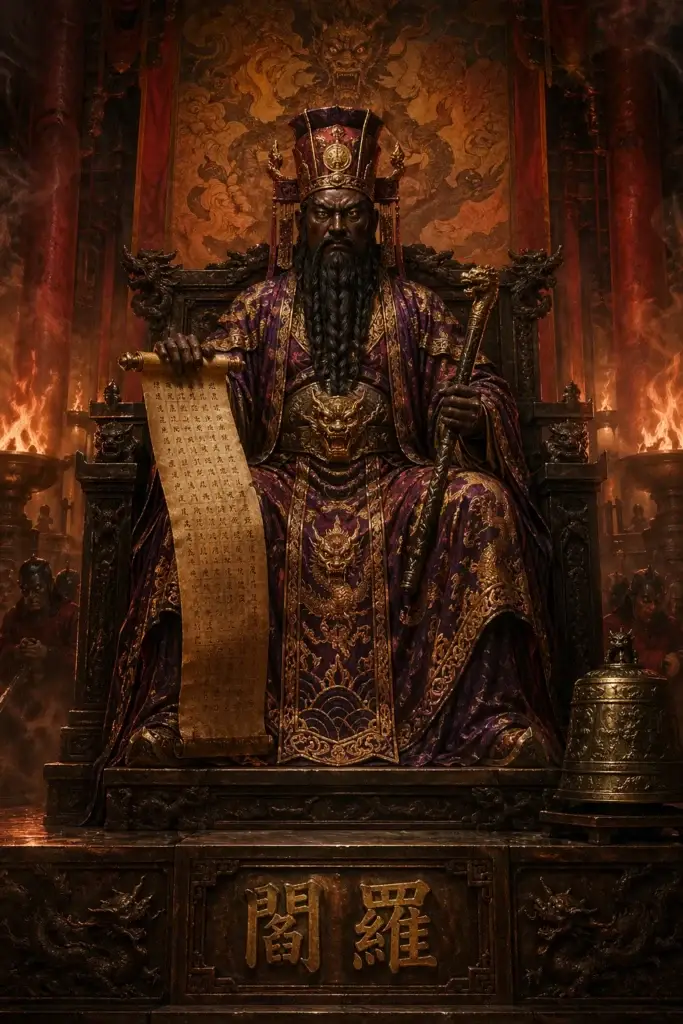
Characteristically depicted as a powerful, bearded male figure with a black full beard, dark hair, and a wild facial expression (eyes opened wide, sometimes one of them enlarged). He wears a red official’s robe with dragon embroidery (a symbol of his posthumous appointment) and an official’s hat.
In the right hand a demon hunter’s sword, in the left often a severed demon’s head or a captured demon. He is frequently shown riding a tiger or accompanied by small demons that serve him.
Sphere of effect: Zhong Kui is venerated in every Chinese house entrance as a door image, one of the most popular door-image traditions of China. At the Chinese New Year and at the Dragon Boat Festival (Duanwu Jie) his image is renewed or hung up anew.
Examination candidates pray to him before examinations. In the personal illness cult there is invocation for protection against demonic causers of illness. In modern popular culture (films, anime) very frequent; his image is one of the most iconic of East Asian mythology.
Black full beard, red official’s robe, demon hunter’s sword, severed demon’s head, official’s hat, small demon servant. Sacred animals: tiger (mount), bats (a symbol of good fortune). Sacred plants: sweet flag (calamus, hung on the door at the Duanwu Jie). Sacred colours: red and black. Sacred number: 5 (5th day of the 5th month).
Zhōng Kuí (Japanese Shōki, an adaptation of its own with a festival-eve protector function in Japan), Pazuzu (Mesopotamia, apotropaic protective demon), Bes (Egypt, ugly household-protection god), Gorgoneion (Greece, terrifying face as protection), Vajrapâni (Buddhism, wrathful protection), St. Michael (Christian, demon-fighting archangel), Bhairava (Hinduism).
Functionally, all apotropaic threshold protectors with a dangerous appearance share aspects with Zhong Kui.
Protective Practice
Rituals for Defence
The Zhong Kui defensive ritual is strongly widespread in Chinese households; Zhong Kui images at house entrances serve to ward off demons, especially in southern China (Guangdong, Fujian).
Daoist priests perform Zhong Kui exorcism ceremonies (Zhong Kui Qu E) to drive malevolent spirits out of houses. Historically attested: Tang dynasty (8th century), Emperor Ming documented a Zhong Kui conjuration against pestilence.
Conjurations and Invocations
Daoist exorcism mantra: “鍾馗捉鬼” (Zhong Kui Zhua Gui, Zhong Kui, catch the spirits). Description from Tang literary texts: commands to evil spirits to fear Zhong Kui. A talisman with red ink and a Zhong Kui portrait, which is ritually activated by a Daoist priest.
Amulets and Protective Symbols
Zhong Kui prints (lithographed portraits) at the house entrance, especially during the Duan Wu festival (5th day of the 5th lunar month). Zhong Kui statues in shrine niches.
Archaeologically attested: Tang paintings in the British Museum (Zhong Kui with a demon), Ming-period wood carvings in Suzhou museums. Modern practices: Zhong Kui amulet papers (Fu) available at Daoist priest shops.
Zhong Kui, Parallels in Other Cultures
The Legend of the Failed Scholar
The best-known narrative about the origin of Zhong Kui connects him with the Tang emperor Xuanzong, who reigned in the eighth century.
According to this legend, the emperor fell ill with a fever and saw in a dream a small demon stealing objects from him. A large, grim-looking man appeared, seized the demon and devoured it. When the emperor asked, the figure introduced himself as Zhong Kui.
In his account, Zhong Kui relates that in life he had been a scholar who had passed the imperial examination, but who had been denied his deserved rank because of his repellent appearance. Out of shame he had taken his own life.
In the afterlife, however, he had been granted an honourable burial, and out of gratitude he had vowed to rid the empire of evil spirits.
When the emperor awoke, his fever had vanished. He had the court painter Wu Daozi capture the dream image, and thus, it is said, the first portrait of Zhong Kui came into being.
Scholarship regards this legend as an aetiological narrative, that is, as a subsequent explanation for an already existing custom. Sinological work has pointed out that the name Zhong Kui linguistically echoes an old word for a mallet or club made of peach wood, a traditional implement for warding off spirits.
It is therefore quite possible that a personified protective figure gradually emerged from a ritual object, and that the legend of the failed scholar was added only later, in order to provide this figure with a life story.
Zhong Kui in Painting and in the New Year Custom
Zhong Kui is among the most frequently depicted protective figures of Chinese art. His image almost always shows a massive man with a thick beard, a furrowed face and a wrathful gaze, often in the attire of an official and with a sword.
He is frequently surrounded by small demons whom he subdues or who have become subservient to him. This iconography can be traced back to the Tang period and remained remarkably stable through the Song, Ming and Qing periods up to the present.
In the course of the year, Zhong Kui was originally associated with the New Year festival. Images of him were hung on doors and walls in order to keep the coming year free of harmful influences.
Over time, his principal veneration shifted to the Dragon Boat Festival in the fifth lunar month, a time associated in the Chinese calendar with illness and misfortune. During this period his images were regarded as a particularly effective protection against epidemics and evil spirits.
The genre of Zhong Kui painting developed its own subtypes over the centuries. There are stern, defensive depictions, but also humorous images, such as Zhong Kui travelling, at the wedding of his sister, or at play with the subjugated demons.
Important painters of the Ming and Qing periods took up the theme, and folk prints, which were affordable for broad classes, also spread his image. This range from learned ink painting to the simple woodcut shows how deeply Zhong Kui was rooted in all classes of Chinese culture.
Zhong Kui in Opera, Theatre and Modern Reception
Beyond painting, Zhong Kui found a firm place on the stage. In Chinese opera and in puppet theatre he is a popular figure, who usually appears with an elaborate, fear-inspiring mask or face painting.
Plays in which Zhong Kui subdues demons served not only for entertainment, but often had a ritual function of their own: a performance was regarded as a means of purifying a place.
Especially widespread is the scene of Zhong Kui marrying off his sister, accompanied by a retinue of subjugated demons.
This episode combines the dreadful with the comic and shows a characteristic peculiarity of the Zhong Kui tradition: the figure of terror is at the same time a character met with a certain sympathy and even cheerfulness. The ugly scholar, disadvantaged in life, becomes in death a powerful, yet also popularly approachable, protector.
In the present day, Zhong Kui lives on in film, television and comics, both in the People’s Republic of China and in Taiwan and in Chinese-speaking communities worldwide.
Modern film adaptations take up the legend and place him as a demon hunter at the centre of adventure narratives. In doing so, the emphasis shifts from the ritual protective function toward action and the heroic image.
From the standpoint of religious studies, however, it remains remarkable that the basic structure, the person wrongly rejected who becomes a benefactor after death, has been preserved through all the transformations of media. It connects today’s entertainment with the old notion of the just dead who intercede for the living.
Position in Chinese Folk Religion
Within Chinese folk religion, Zhong Kui occupies a distinctive position. He is not a high god of the heavenly bureaucracy, as religious Daoism knows it, nor a nature god.
He belongs to the broad class of deified human beings, that is, of historical or legendary persons who are venerated after their death as effective protective powers. His sphere of duties is clearly defined: the driving away of illness demons and harmful spirits.
Zhong Kui is frequently imagined as the leader of a host of spirit beings whom he once subdued and placed in his service.
This notion of the demon subduer who himself employs the subjugated powers for protection is attested several times in the religious history of East Asia. It allows the threatening not to be denied, but to be placed under an ordered supervision.
In comparison with protective figures of other cultures, a parallel emerges with figures such as the Buddhist gate guardian or the deified generals who likewise keep watch at thresholds and entrances. What distinguishes Zhong Kui is the close binding to the biography of a human being with a concrete injustice in his life story.
This injustice, the denial of the deserved rank because of his appearance, gives him a moral background: he is not only powerful, but also an emblem of the fact that outward ugliness says nothing about the worth of a human being.
This message contributed substantially to his lasting popularity in all classes of the population. Those interested in related protective figures will find further examples in the field of the Chinese tradition.
Further Links
Sources and Literature
Further standard works in the literature index.
Frequently Asked Questions about Zhong Kui
Who is Zhong Kui in Chinese mythology?
In Chinese mythology, Zhong Kui is the subduer of demons and spirits. According to legend, he was a highly gifted scholar who was denied the top rank in the imperial civil-service examination because of his repulsive appearance.
In despair he took his own life. In the afterlife he was appointed king of the spirits and entrusted with the task of hunting and subduing evil demons. He is depicted with a wild beard, a menacing gaze, a scholar’s robe and a sword.
How is Zhong Kui used in folk custom?
Zhong Kui is one of the most popular protective figures of Chinese folk religion. Images of him are placed on doors and walls in order to guard the house against evil spirits and misfortune.
His image is especially widespread at the time of the Dragon Boat Festival in the fifth lunar month, traditionally regarded as a dangerous time during which harmful influences must be warded off. Zhong Kui is moreover a frequent motif of Chinese painting, often depicted humorously, for instance at the wedding of his sister.