Dongyue Dadi, judge of the dead of the Eastern Peak
By Ralf Ittermann · last reviewed on
Dongyue Dadi is a god of the Chinese tradition.
Lord over life and death and presiding authority of the tribunal of the dead.
Dongyue Dadi, the Great Emperor of the Eastern Peak, is the highest Daoist personification of the sacred mountain Tai Shan. He is the supreme lord over life and death, presiding over a tribunal of the dead and an otherworldly bureaucracy of officials.
The deity is rooted in ancient Chinese belief that Tai Shan was the gathering place of the souls of the dead. From the mountain god thus emerged the judge of the deceased, who keeps the register of life and death; he was repeatedly elevated with imperial titles, finally becoming emperor in the Song period.
Type: Highest Daoist mountain deity of Tai Shan, lord of the tribunal of the dead
Origin: ancient Chinese belief in Tai Shan as the gathering place of the souls of the dead
Texts: Daoist liturgy, temple tradition
Period: from ancient Chinese belief to present-day Daoist liturgy
Appearance: imperially enthroned ruler with an apparatus of officials
Textual history
Period of the Texts
The roots lie in ancient Chinese belief in Tai Shan as the gathering place of the souls of the dead; the veneration extends into the Daoist liturgy of the present day.
Area of Diffusion
Tai Shan in Shandong and Dongyue temples throughout China; the Dongyue Temple in Beijing is well known.
Sources
Well documented: in the West, the cult is chiefly accessible through Susan Naquin’s research on Tai Shan and the monograph by Édouard Chavannes.
Name and variants
Chinese: Dōngyuè Dàdì, Great Emperor of the Eastern Sacred Mountain. The Eastern Peak is Tai Shan among the Five Sacred Mountains.
Nature and effect
Appearance
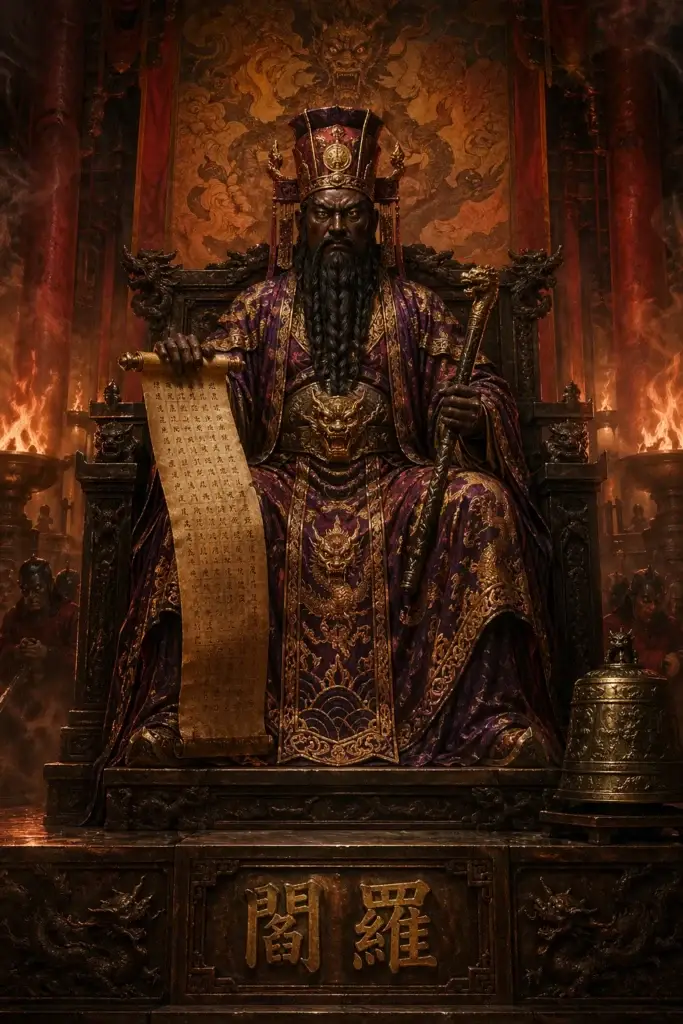
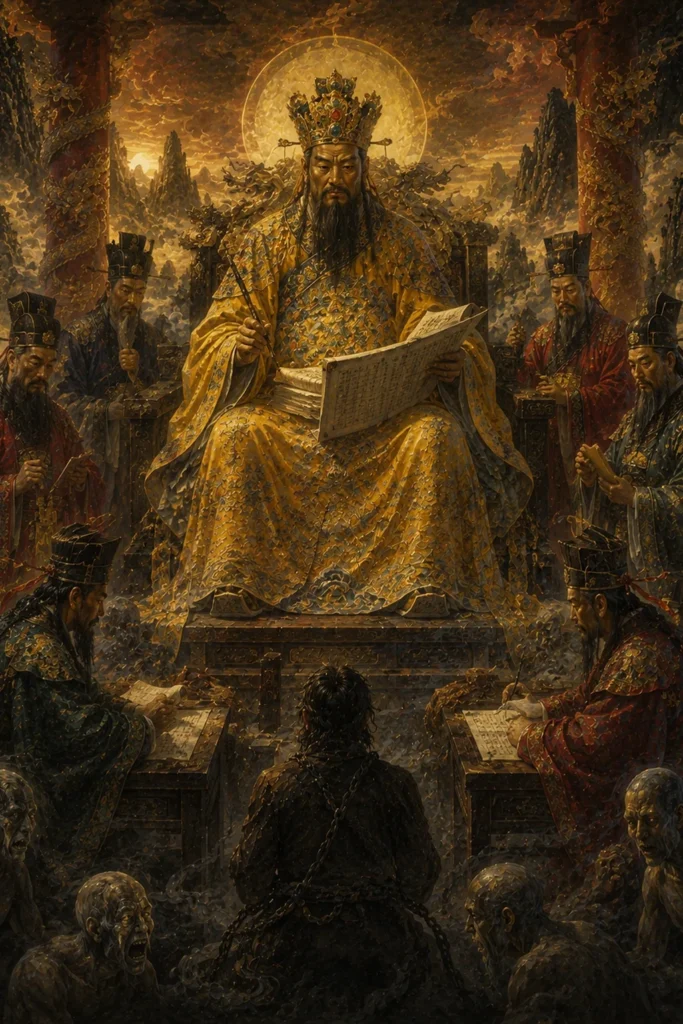
Dongyue Dadi appears as an imperially enthroned ruler in official robes with a crown and tablet of office, surrounded by an apparatus of officials made up of judges, scribes and messengers of hell.
Effect
He is lord of the tribunal of the dead and of an otherworldly bureaucracy: he keeps the register of life and death, determines the lifespan, summons the souls and assigns reward and punishment. In some sources he commands numerous subordinate deities; circulating exact figures should be treated as source-dependent.
Profile: Dongyue Dadi
The most important aspects of the mountain god at a glance.
The highest Daoist personification of Tai Shan, grown out of the ancient Chinese belief in the mountain as the gathering place of the souls of the dead.
Life and death: the register of lifespans, the summoning of souls and the assignment of reward and punishment in the tribunal of the afterlife.
An imperially enthroned ruler in official robes with a crown and tablet of office, surrounded by judges, scribes and messengers of hell.
Presiding authority of the tribunal of the dead and of an otherworldly bureaucracy of officials; in the pantheon he ranks below the Jade Emperor.
Dongyue temples in many Chinese cities, with the departments of the tribunal of the afterlife as chapels; offerings and prayer visits for the deceased and for longevity.
The Buddhist-influenced hell tribunal around Yanluo Wang and Diyu is a separate strand; on the mountain he is opposed by Bixia Yuanjun as lady of Tai Shan.
From soul mountain to emperor of the afterlife
Dōngyuè Dàdì means Great Emperor of the Eastern Sacred Mountain; the Eastern Peak is Tai Shan among the Five Sacred Mountains. The deity is rooted in ancient Chinese belief that Tai Shan was the gathering place of the souls of the dead; from this notion the mountain god became the supreme lord over life and death.
The imperial honours followed in stages: the god was repeatedly elevated with titles, finally becoming emperor in the Song period. His rank in the pantheon thus mirrors the earthly order: a ruler with a tablet of office, an apparatus of officials and clearly defined responsibilities.
Reception and classification
Dongyue Dadi is a firm part of folk religion and Daoist liturgy; in the West he is chiefly accessible through Susan Naquin’s research on Tai Shan.
In religious studies, Dongyue Dadi is not malevolent, but an uncannily strict judge of the dead; the danger lies in inescapable reckoning, not in an attack. One important clarification: equating him with the Buddhist king of hell Yama is imprecise. He is the Daoist authority above the hell tribunal, while the Diyu and Yanluo conception is a separate, Buddhist-influenced strand that historically merged with the Tai Shan cult.
Temples, offerings and prayer visits
Well documented are the Dongyue temples found in many cities, most notably the Dongyue Temple in Beijing, with the departments of the court of the afterlife serving as chapels. Offerings and pilgrimages are made for the deceased and for longevity. Dealing with the strict judge is thus not an act of warding off, but of reverence: whoever wishes to win the favour of the lord of the register does so through intercession, not through banishing means.
Court of the underworld, city god and Jade Emperor
Functionally, Dongyue Dadi is interlinked with the Buddhist-influenced court of the underworld around Yanluo Wang and Diyu, as well as with the city god Chenghuang as a local official of the afterlife; within the pantheon he ranks below the Jade Emperor. On the mountain itself he is paired with Bixia Yuanjun, the lady of Tai Shan, who is responsible for birth and life, while he judges the dead.
Frequently asked questions about Dongyue Dadi
Who is Dongyue Dadi?
The highest Daoist mountain deity of Tai Shan and the supreme lord over life and death, head of a court of the dead and an otherworldly bureaucracy of officials.
What is his main role?
He presides over the court of the dead, keeps the register of life and death, determines lifespan and assigns reward and punishment.
Is he the same as the underworld king Yama?
No. He is the Daoist authority above the Buddhist-influenced court of the underworld, Diyu; the two strands only merged historically.
Further links
Further reading:
- China – all beings of the Chinese cultural sphere
- Bixia Yuanjun – the lady of Tai Shan and goddess of birth
- Incense burning, Amulet, Protective candle – traditional protective means
- Protection Compass – protective means at a glance
Literature (selection)
Further standard works in the bibliography.
As god of Tai Shan and emperor of the Eastern Peak, Dongyue Dadi represents a conception of the afterlife run like an office: with a register, deadlines and an accountability no one can evade.