Chang-e is a goddess of the Chinese tradition.
Goddess of the moon, immortal recluse, the moon-hare tale. Chang-e is one of the oldest names in Chinese mythology: the moon goddess, keeper of the elixir of immortality, condemned to solitude on the moon. The legendary version: she was the wife of the archer Yi, who shot down the ten suns and became immortal.
Yet instead of sharing immortality, the Jade Rabbit of Yi (or hare) took the elixir and flew to the moon, where she has lived ever since, lonely, young and radiant in the lunar distance.
In the underlying moon myth there is a jade rabbit or moon hare that lives with her and pounds the elixir, the reason the moon has craters.
Type: Chinese principal deity, moon goddess and heroine of immortality
Pantheon: Daoism, Chinese folk religion
Function: moon, immortality, love and separation, Moon Festival
Main attributes: lunar disc, hare (Yutu, the Jade Hare), pill of immortality
Main cult sites: Moon Festival celebrations in every Chinese household, Moon Temple in Beijing
Consort: Hou Yi (the archer who shot down nine suns)
Chang-e (Chinese Cháng’é) has been attested in literature since the Han dynasty (2nd century BCE onward).
Main myth: her consort Hou Yi receives the pill of immortality from the Queen Mother of the West; Chang-e swallows it secretly (in some versions out of fear of a thief, in others out of willfulness), floats up to the moon and becomes the moon goddess there.
She lives alone in the Moon Palace with the Jade Hare (Yutu), who pounds the pill of immortality. The principal flowering of her folk tradition: Tang to Qing dynasty. Today she is known worldwide through the Chinese Moon Festival (Zhongqiu Jie); in 2007 the first Chinese lunar probe was named after her (Chang’e-1).
Chang-e has no special temples, but she is present in every Chinese household during the Moon Festival. Moon Temple (Yuè Tán) in Beijing: one of the four imperial sacrificial temples, consecrated to the moon (today a park).
In Hong Kong, Singapore, Malaysia, Vietnam, Korea and Japan her Moon Festival is celebrated internationally. In the modern Chinese spaceflight tradition she is central, the Chinese lunar programme bears her name.
Central sources: Huainanzi (2nd century BCE, one of the oldest versions of the Chang-e myth), Shanhaijing (Classic of Mountains and Seas), Tang poetry (Li Bai, Li Shangyin), Yuan and Ming narratives.
Secondary literature: Werner, Myths and Legends of China; Kohn, Daoism Handbook; Birrell, Chinese Mythology. An Introduction; Yang/An, Handbook of Chinese Mythology.
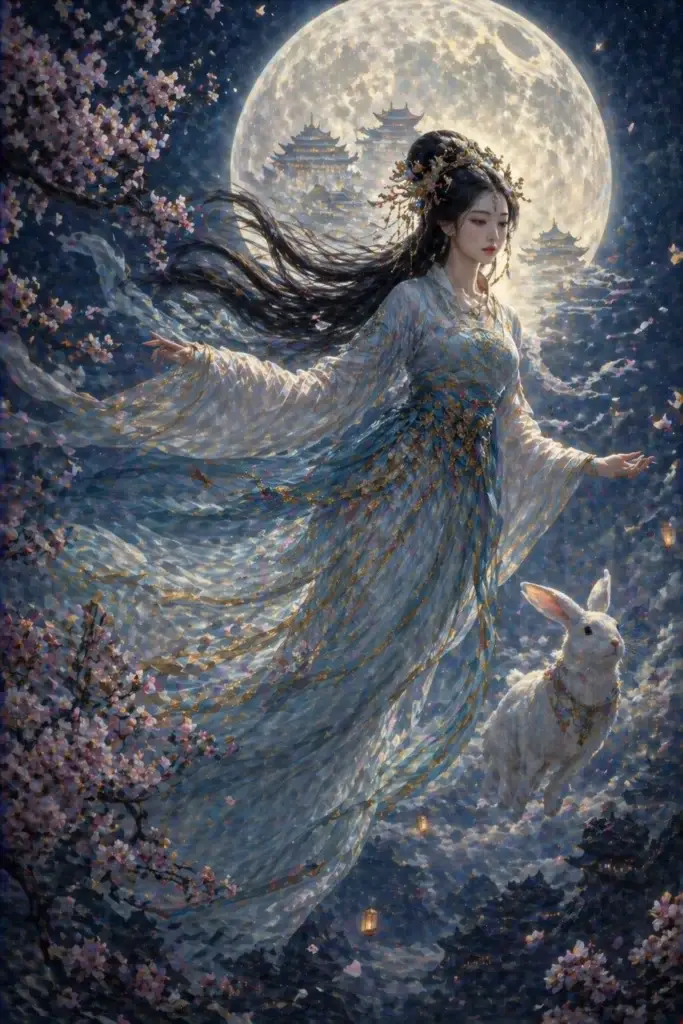
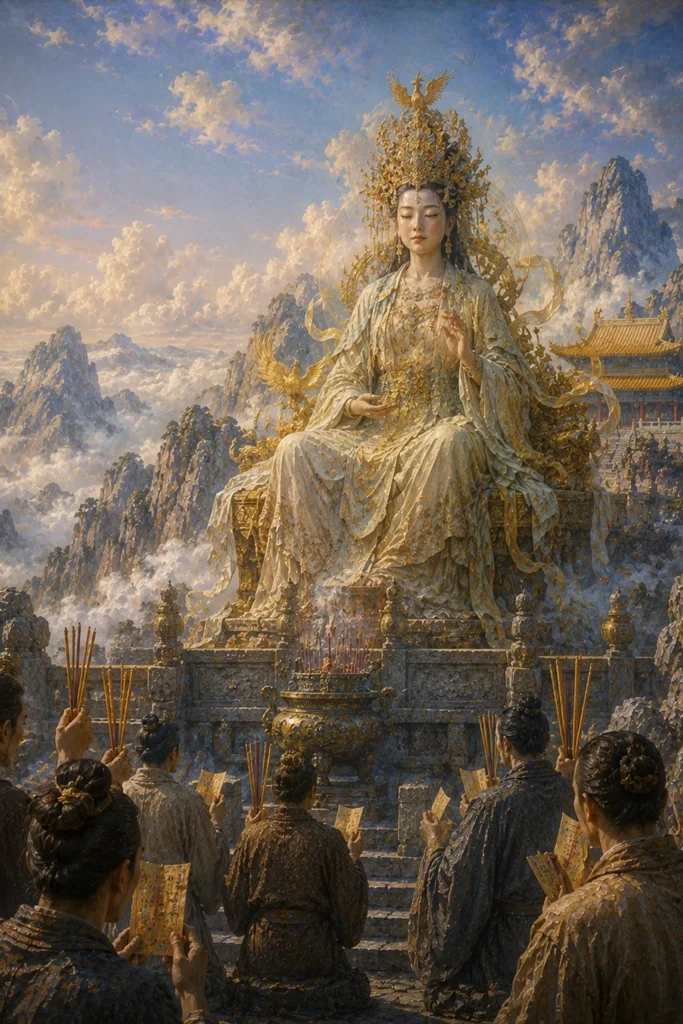
Chang-e is depicted as a wondrously beautiful maiden in white or silver silk robes, surrounded by moonlight. Her face is sorrowfully beautiful, neither wrathful like Raijin nor delicate like Guanyin, but melancholy and even-featured. She is often shown with a moon mirror or with the moon itself behind her.
Beside her is the Jade Rabbit (yutu), a sweet white creature with long ears that pounds the elixir of immortality in a mortar. Sometimes Chang-e is shown gazing down from the moon to the earth with a nostalgic look.
The white colours are central: the moon is white, the silk is white, the rabbit is white. Artistically Chang-e is often romanticised, not sacred like Yuhuang or wild like Zhong Kui, but poetic.
Chang-e is not an administrator like Yanluo or Yuhuang, but a symbol, the goddess of longing, of solitude, of immortal beauty. She is invoked less for practical aid than for sympathy; poets and lovers invoke her.
The Moon Festival (the fifteenth day of the eighth lunar month) is China’s festival comparable to Thanksgiving, at which Chang-e is venerated. Families gather, eat mooncakes (yuebings, sweet cakes with an egg-yolk moon symbol), and contemplate the moon.
The act is less religious than nostalgic and sentimental: Chang-e on the moon, lonely like people who are far from family. Unlike other deities (who are prayed to for blessing), people pray to Chang-e for understanding of longing.
In modern times Chang-e is a cultural icon: the Chinese lunar probe was called Chang-e, and design firms use her name. She is primarily literary and emotional, not religiously functional.
Chang-e is depicted as a beautiful woman with pale skin, often dressed in a white or silver robe. She is shown on the moon with a rabbit (or a toad, depending on the version). Sometimes she holds a moon comb or a moon mirror. Her colour is silver or white, the colours of the moon.
The most important aspects of Chang-e at a glance. The following fields summarise origin, function, appearance, veneration, symbols and cultural parallels.
Chang-e is the consort of the heroic archer Hou Yi, who shot down nine of the ten suns that were scorching the land. As a reward, Hou Yi receives the pill of immortality from the Queen Mother of the West (Xiwangmu).
Chang-e swallows the pill secretly (the myth versions vary in the motivation: fear of a thief, willfulness, an attempt by both lovers at immortality); she floats up to the moon and cannot return.
Since then she has lived alone in the Moon Palace (Yuè Gông), accompanied by the Jade Hare Yutu and, in one tradition, by the woodcutter Wu Gang (cursed to fell a moon tree that grows back each time).
Moon goddess and patroness of lunar lovers. She is centrally invoked at the Moon Festival (Zhongqiu Jie, the 15th day of the 8th month of the Chinese calendar, September/October); families gather, eat mooncakes (Yuebing) and pray to the moon.
In traditional love poetry she is a symbol of love in separation (Chang-e and Hou Yi never see each other again). Patron of women’s longing. In modern Chinese spaceflight a symbolic banner.
A beautiful young woman in a flowing light-blue or white court robe, with long black hair and a melancholy expression. Frequently floating up to the moon among clouds, or enthroned in the Moon Palace.
Accompanied by the Jade Hare (Yutu), who pounds the pill of immortality. In some depictions with the moon tree or the woodcutter Wu Gang in the background. A favoured subject of traditional Chinese painting in Moon Festival imagery.
Sphere of effect: Chang-e is universally venerated at the Moon Festival, one of the greatest Chinese folk festivals. Families eat mooncakes, pray to the moon and hang up lanterns. In personal folk belief she is the patroness of separated lovers, with invocation in times of love-distress.
In modern China she is a central figure of identification (also as a feminist symbol, a woman who ascended to the moon alone). The Chinese lunar probe Chang’e-1 (2007), Chang’e-3 (lunar lander 2013) and Chang’e-4 (far-side lunar lander 2019) bear her name.
Lunar disc, Jade Hare (Yutu), pill of immortality, Moon Palace, moon tree, light-blue court robe. Sacred plants: moon tree (mythical), cassia tree. Sacred animals: Jade Hare, toad (in some versions). Sacred food: mooncakes (Yuebing).
Selene (Greece, female moon goddess), Luna (Rome), Artemis (Greece, lunar aspect later), Tsukuyomi (Japan, moon god, male, unlike Chang-e), Chandra (Hinduism, male), Khons (Egypt, male).
The Chinese tradition reflects a remarkable diversity in the gender of moon deities worldwide. Chang-e is one of the few female moon goddesses of East Asia (Japan and the Hindu world have male moon gods).
Invocations
A further article with additional sources is being prepared here.
Amulets and protective symbols
Chang-e, the goddess carried away to the moon, is closely linked with the Moon Festival, at which round mooncakes symbolise completeness and family unity. Moon-shaped pendants and jade jewellery were traditionally worn as signs of purity and constancy; jade was regarded in China as a life-preserving stone.
The Jade Hare, Chang-e’s companion who pounds the elixir, appears on amulets and New Year pictures as a sign of good fortune and fertility.
Since Chang-e is connected with the elixir of immortality, her figure also stood for the longing for long life, a motif that continues to resonate in folk jewellery and pictorial art to this day.
Chang-e is the goddess of the Moon Festival (Zhongqiu Jie), one of the most important Chinese festivals. Women venerate her especially for fertility and family. Incense sticks and sweet mooncakes are brought to her as an offering. The Moon Festival is a folk festival celebrated across Confucian and Daoist boundaries alike.
Chang-e resembles the Greek Selene (moon goddess), the Roman Luna, the Japanese Tsukuyomi (moon god) and the Babylonian Sin. Unlike Selene (primarily astronomical) or Tsukuyomi (cosmic and absent), Chang-e is emotional and narrative; her tragic story is central. With the European Lady of Shalott she shares isolation and melancholy beauty.
With the Hindu myth of Soma (lunar nectar) she shares aspects of immortality. With Persephone (abducted by Hades) she shares spatial separation, but Chang-e herself chose flight.
Unique is the literary romanticisation: she became popular not through ritual cult, but through poems and stories. The moon hare is a sweet distinguishing feature; hardly any other moon goddess has an animal companion.
The tale of Chang-e, the woman who ascended to the moon, has been transmitted in several, in part strongly diverging versions.
Common to them all is the core: Chang-e takes an elixir of immortality and floats up to the moon, where she dwells from then on. In the details and in the moral interpretation, however, the versions diverge widely.
In an old version that resonates in early texts such as the Huainanzi from the second century BCE, Chang-e steals the elixir that her husband, the archer Hou Yi, had received, and flees with it to the moon.
Here she appears in a rather negative light, as the one who takes the common possession for herself alone. One version even reports that as punishment she was transformed into a toad on the moon, a motif that explains the connection of the moon with the toad in early Chinese thought.
Later versions soften this image or reverse it. In one widespread version Chang-e takes the elixir in order to prevent a greedy disciple or intruder from stealing it from Hou Yi; her ascent is then a sacrifice, not a betrayal. In yet other tales the ascent happens unintentionally or as a tragic misunderstanding.
Scholarship sees in this diversity a long process of reinterpretation, in which an ambivalent or guilty figure gradually became a sympathetic, wistful one. Which version is the original cannot be said with certainty, but the negative variant is regarded as the older layer.
Chang-e is inseparably bound up with one of the most important festivals of the Chinese calendar, the Moon Festival or Mid-Autumn Festival, which is held on the fifteenth day of the eighth lunar month, when the full moon is considered especially round and bright.
On this evening families gather, contemplate the moon and eat the round mooncakes whose shape recalls the lunar disc.
Chang-e is regarded as the dweller of the moon, to which this festival pays special attention. In some regions offerings were brought to her, above all by women who asked for beauty, for happiness in marriage or for offspring.
The connection of moon, femininity and fertility is old in the Chinese world of ideas and gives Chang-e, within the framework of the festival, a cultic function that goes beyond the mere narrative figure.
Connected with Chang-e are further lunar dwellers who belong to the fixed stock of the tradition: the Jade Hare, who pounds an elixir or healing herbs under a tree, and in some versions the woodcutter Wu Gang, who is condemned to fell a tree forever that always closes up again.
The Moon Festival makes these tales present anew each year. It is an example of how a myth is transmitted not only as text but kept alive through an annual custom. The combination of sky-watching, family gathering and storytelling secures Chang-e a firm place in lived Chinese culture.
In the visual arts Chang-e usually appears as a graceful woman in flowing robes, often floating, with fluttering ribbons, before the disc of the full moon. She is frequently accompanied by the Jade Hare.
This depiction developed over the centuries and is widespread on hanging scrolls, fans, porcelain and in woodcuts. The figure stands for a particular aesthetic idea: a cool, lonely beauty, distant and unattainable like the moon itself.
In classical Chinese poetry Chang-e is a recurring motif. Poets of the Tang period, among them Li Shangyin, took up her figure to express solitude, regret and unquenchable longing.
In a famous poem it is said in substance that Chang-e must regret the long allure of her decision, now that she keeps watch night after night, alone, over the nocturnal sea and the empty sky.
Poetry thus shifted the emphasis from outward action to inner experience and made of Chang-e an emblem for the shadow side of a fulfilled wish.
This literary tradition shaped the image of Chang-e lastingly. From the thief of the early texts and the festival goddess of folk religion, learned culture made an elegiac figure whose immortality is at the same time her punishment.
The ambiguity that results from this is one reason for the enduring artistic appeal of the subject. Chang-e can be read as a figure of good fortune, as an admonition and as a tragic heroine, and Chinese art has drawn on all these readings at different times.

The connection of Chang-e with the moon has given her an unusual topicality in the present. The Chinese lunar programme officially bears her name.
The series of unmanned lunar probes launched since 2007 is called Chang-e, and the lunar rover of one of these missions was likewise named after the Jade Hare, the mythical companion of the moon’s dweller. Thus an old myth has become the namesake of a highly technical research undertaking.
This choice of name is instructive for the history of religion. It shows that a mythological subject does not necessarily come into conflict with modern science, but can be carried forward as a cultural symbol.
The myth supplies the images, and science fills them with new content. For a broad Chinese public the name links lunar research with a familiar tale and makes an abstract technical enterprise culturally accessible.
In present-day film, animation and literature, too, Chang-e is present, both in China and in the Chinese diaspora worldwide. Modern tales take up the ambiguity of the subject and interpret Chang-e, as needed, as a romantic heroine, as an emblem of separation from family, or as a figure torn between duty and her own wish.
From the standpoint of religious studies it remains to be noted that Chang-e is a rare example of how a figure has remained continuously alive, from the ancient Chinese text through folk religion and classical poetry into the spaceflight and popular culture of the twenty-first century.
Anyone seeking related celestial and lunar figures will find further points of connection in the field of Chinese mythology.
Further standard works in the literature index.
Chang-e is the goddess of the moon in Chinese mythology. The best-known myth relates that her husband, the archer Houyi, received an elixir of immortality after he had shot nine of ten suns from the sky.
Chang-e took the elixir, for varying reasons according to the tradition, and ascended to the moon, where she has dwelt ever since. There she is accompanied by a Jade Hare who pounds an elixir.
Chang-e stands at the centre of the Moon Festival (Mid-Autumn Festival), one of the most important festivals of the Chinese calendar, celebrated on the 15th day of the eighth lunar month.
On this evening, when the full moon shines brightest, families commemorate the moon goddess, eat round mooncakes and bring offerings. The round form of the moon and the mooncakes symbolises the reunion of the family. The Chinese lunar exploration programme was named in honour of the goddess Chang-e.
Against its influence, cross-cultural tradition names these protective means:
Compare in the Protection Compass →Recommended protective means
The simplest protective means in this collection: 41 layers of fine gold 999, platinum, silver and silicon, manufactured in Ruhla, Thuringia. It requires no activation, is bound to no person, and is effective within a radius of around 50 meters, even without being worn.
Related Beings

Ereshkigal, mistress of the Mesopotamian underworld. Sister of Ishtar, wife of Nergal: ruler over...

The Nisse, the Norwegian-Danish farm and barn spirit. Origin, the julegrøt tradition and its clas...

Achelous, the greatest river god of Greece. Origin, the wrestling match with Heracles, the cornuc...

The Nörgel, the small mountain and earth spirit of South Tyrol. Origin, its ambivalent nature and...

Cherufe, the man-eating lava demon of the Mapuche in Chile. Origin, its volcanic associations and...

Chalchiuhtlicue, the Aztec goddess of lakes, rivers and birth. Origin, iconography, the fourth wo...