Hei Bai Wuchang are the black-and-white spirit pair of Chinese folk religion, tasked with tracking down the souls of the deceased and escorting them to the underworld Diyu.
As subordinates of the City God, they embody the inevitability of death and at the same time its moral order. This article situates the two figures within religious studies and presents their mythology, cult, and scholarly research.
Hei Bai Wuchang designates, in Chinese folk religion, a pair of death spirits whose task is to locate the souls of the dying and escort them to the realm of the underworld.
The name combines the color terms hei (black) and bai (white) with the word wuchang (impermanence, transience). The two figures appear almost always together and are considered an inseparable pair that makes visible the inevitable mutability of all earthly things.
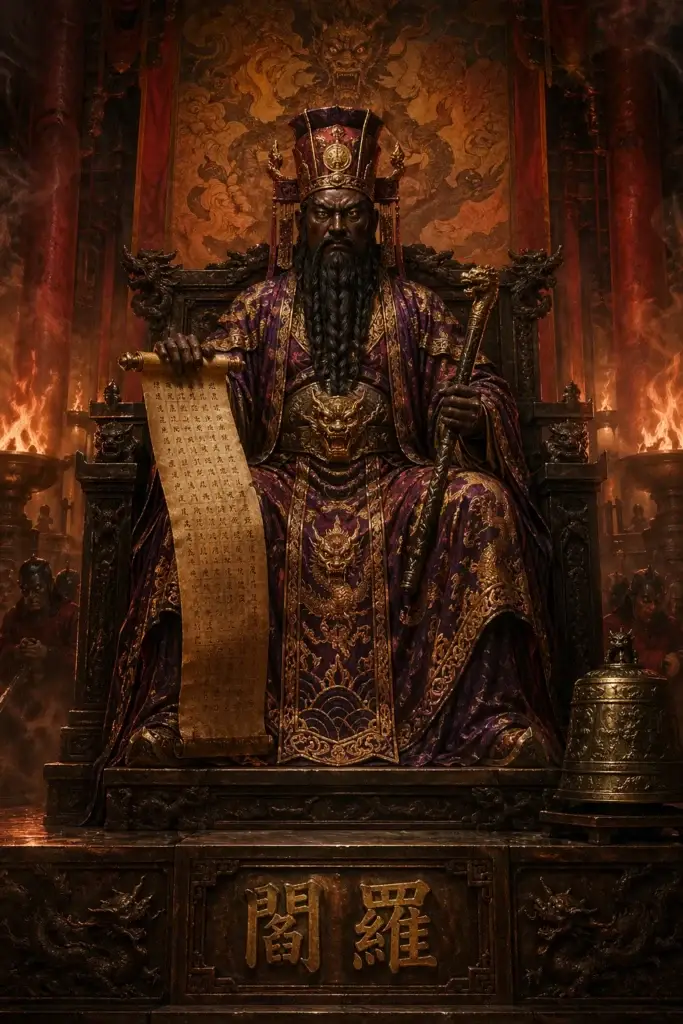
In terms of religious history, Hei Bai Wuchang belong to the context of Chinese conceptions of Diyu, the subterranean administration of the afterlife, which from the Tang and Song dynasties onward was conceived as a bureaucratically structured governmental apparatus. Within this system the two spirits are not independent rulers but assistants.
They are subordinate to the Chenghuang, the City God, and in a broader sense to the ten kings of hell who judge the fate of the dead. They thus occupy a middle rank in the otherworldly hierarchy, comparable to court officers or constables of a secular bureau.
Veneration of the pair is widespread throughout the Chinese cultural world, but particularly pronounced in the south, in Fujian, in Taiwan, and among the Southeast Asian diaspora communities. In temple processions and in folk theater, Hei Bai Wuchang rank among the most striking figures of all.
Their significance extends beyond the pure function of messengers of death, for they embody a moral message: death comes for everyone, and the way one has lived determines how the encounter with it turns out.
Anyone who wishes to understand the religious landscape of China cannot overlook this spirit pair, because it bundles the interplay of folk belief, temple cult, and ethical instruction in a particularly vivid form.
It should be noted that the tradition varies considerably by region. In some places the two spirits are conceived as brothers, in others as friends, and occasionally in a familial or service relationship with each other.
Their names also vary. This diversity is not a sign of inconsistency but an expression of a living oral tradition that never solidified into a uniform canon.
The collective term Hei Bai Wuchang can be rendered literally as “black and white impermanence.” The word wuchang originates in Buddhist usage and translates the Sanskrit term anitya, that is, the teaching of the impermanence of all things.
In folk religion this abstract concept was personified and condensed into a concrete figure embodying death as an event. A philosophical insight was thus transformed into an acting character.
The two spirits each bear their own name. The white spirit is most commonly called Xie Bi’an, the black one Fan Wujiu. These names are widely attested in temple inscriptions, theatrical texts, and folk narratives, though regional variants exist.
The white spirit is also frequently addressed as Bai Wuchang, the black one as Hei Wuchang. In some regions the white spirit bears an honorific title identifying him as the bringer of prosperity, while the black one appears as a stern, punishing figure.
The color symbolism is central to the interpretation. White is traditionally the color of mourning and death in China, worn at funerals. Black stands for the dark, the hidden, and the nocturnal sphere in which spirits operate.
The pairing of both colors expresses completeness: death has a welcoming side and a repelling side, a bright aspect and a dark one. Some traditions invert the assignment or distribute the attributes differently, yet the basic structure of the contrasting pair is preserved.
There is also a range of epithets and honorifics that emphasize their official status. They are described as messengers, constables, or envoys of the City God.
On their hats or inscribed banners there are often phrases summarizing their function, such as the announcement that their appearance heralds wealth, or that one will encounter them immediately. These inscriptions are part of the iconography and are treated more closely in the following section.
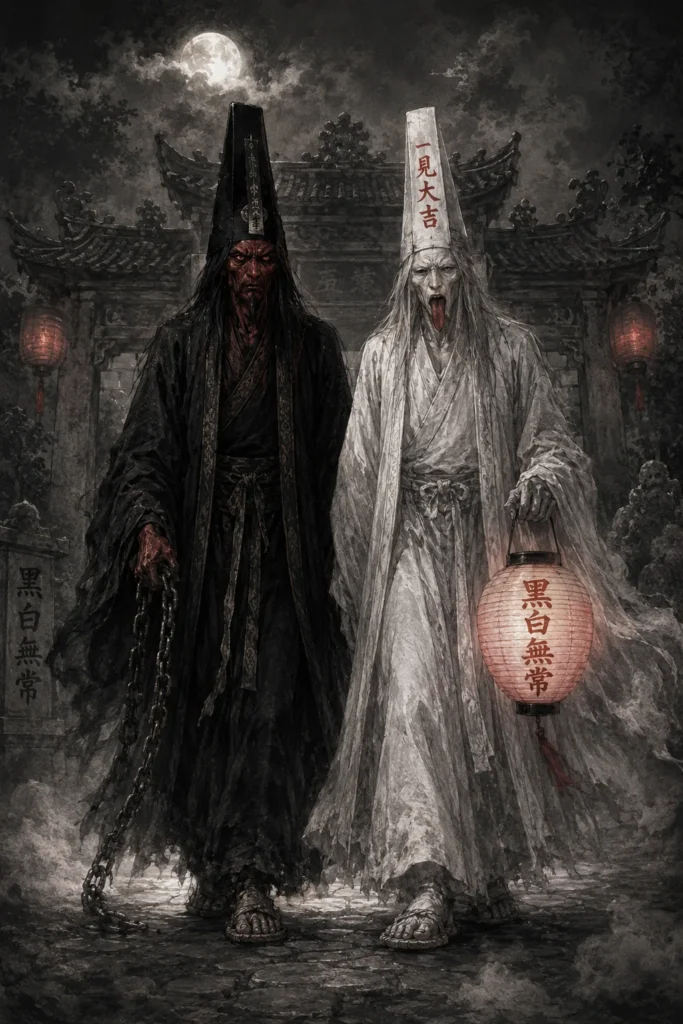
Hei Bai Wuchang are among the most visually distinctive figures in Chinese folk religion. Their depiction follows a fixed schema that recurs in temple statues, processional masks, paper figures, and in theater.
The white spirit is strikingly tall and slender, often dressed in a long white robe and wearing a tall, pointed hat. The black spirit, by contrast, appears shorter and stocky, dressed in dark clothing, with a round face.
The most distinctive feature of the white spirit is the protruding, elongated tongue. This refers to the notion that he died by hanging, an explanation anchored in one of the widely known mythological versions. On his tall hat he often bears an inscription associating his appearance with good fortune or wealth.
In his hands he typically holds a fan and a chain or fetter with which he binds and leads away souls. The black spirit, by contrast, has a fierce face, sometimes with wide-open eyes, and in his hand there is often a tablet or an instrument of punishment.
Both spirits carry inscribed banners, insignia of office, and occasionally chains of coins or paper money. These attributes mark them as officials of the otherworldly bureau.
Their appearance is deliberately grotesque and exaggerated so as to inspire awe and a certain shudder, while at the same time carrying a folk-like, almost caricature-like quality. In processions they are portrayed by performers on tall stilts, which makes the white spirit appear especially larger than life and uncanny.
The iconography is not rigid. In Taiwan and Fujian, distinctive regional styles have developed, with elaborately painted masks and richly decorated robes. In more northern regions the depictions are often simpler.
Common to all variants is the clear contrast between light and dark, between tall and short, which makes the nature of the pair as a unity of opposites visible. The design serves not only to instill fear but also to instruct, since it renders abstract ideas of death and judgment tangible for a broad audience.
The best-known narrative about the origin of Hei Bai Wuchang tells of two close friends or officials who in life were bound by a fateful promise. In a widely circulated version, the two arrange to meet each other at a specific place.
When a sudden downpour sets in and the river swells, one of them, the white one, keeps faithful watch at the agreed spot even as the water rises.
He perishes in the flood or hangs himself rather than break his word. The other, the black one, arrives late, finds his friend dead, and dies of grief by taking his own life.
This story explains several iconographic features at the same time. The protruding tongue of the white spirit refers to death by hanging, his light robe to faithfulness and integrity. The dark face of the black spirit is associated with drowning or with grief.
Because of the righteousness and loyalty they demonstrated in life, the narrative relates, the two were appointed as officials of the underworld by the powers of that realm after death and entrusted with the task of collecting the souls of the deceased.
Other traditions associate the two spirits with specific historical or local figures, furnishing them with family names and life histories. In some versions they were guardians of a City God temple; in others, upright citizens who died by misfortune.
Common to all variants is the idea that the two acted with moral exemplariness in life and therefore received an honorable task in death. In this way the myth conveys a clear ethical message: loyalty, reliability, and integrity are rewarded even beyond death.
In narratives depicting the everyday activities of the spirits, they appear as constables equipped with a warrant from the underworld, arriving to collect a person’s soul at the appointed time.
Folk tales describe encounters of the living with the spirits, attempts to bribe or deceive them, and the impossibility of escaping the appointed hour of death.
Occasionally they also appear as incorruptible minor judges who track down wrongdoers. These stories portray the spirits as simultaneously uncanny and just, as executors of an order that cannot be circumvented.

Hei Bai Wuchang are venerated primarily within the context of the Chenghuang cult, that is, in connection with the temples of the City Gods. In many of these temples, figures of the spirit pair stand as companions and servants of the principal deity.
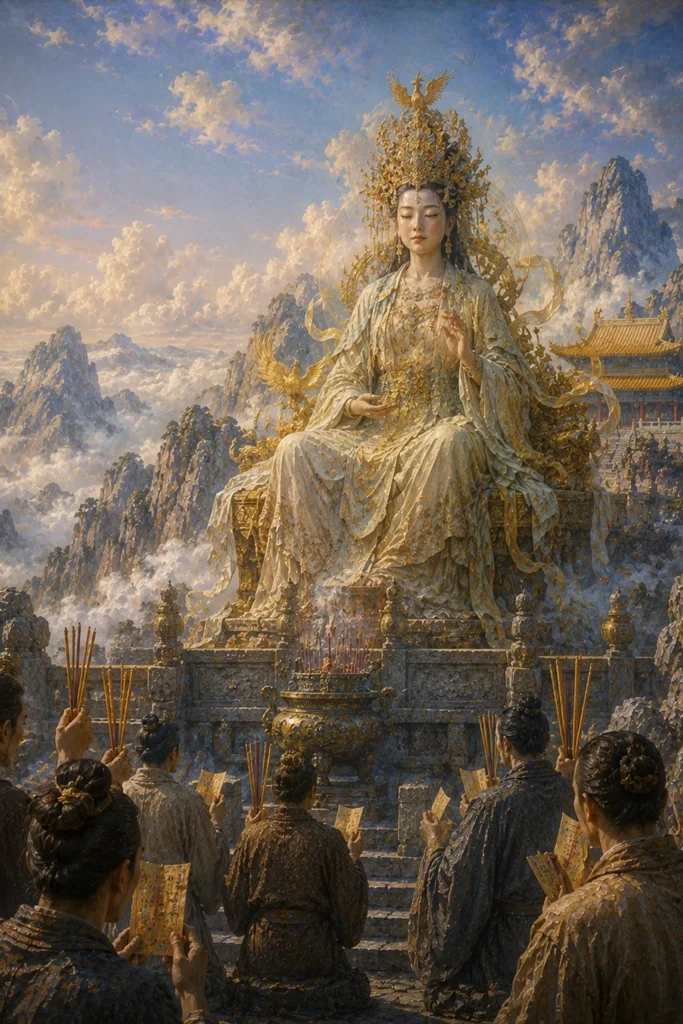
Devotees offer them incense, food offerings, and paper money, often accompanied by requests for protection against untimely death, for the recovery of the sick, or for the rectification of injustices.
A particularly visible form of veneration consists in the temple processions in which performers dressed in the costumes of Hei Bai Wuchang take part. In Taiwan and Fujian they belong to the fixed components of major parades, for instance at festivals honoring the City God or at ghost festivals.
The performers do not merely portray the spirits but are considered temporarily possessed by them, which is why special respect is shown to them during the procession. It is common to offer the spirits small gifts in this form, such as sweets or cigarettes, in the hope of their goodwill.
During the Ghost Festival of the seventh lunar month, when according to folk belief the gates of the underworld are opened and souls visit the world of the living, the two spirits likewise play a role as marshals and overseers of the wandering dead.
At funerals their image may also play a part, for instance in the form of paper figures burned to ensure safe passage for the deceased into the underworld.
The cult is closely connected to the need for justice. Because the spirits are regarded as incorruptible constables who collect everyone at the right time and spare no one, people turn to them when they feel let down by secular courts.
In this function they resemble other figures of the otherworldly judicial apparatus. Veneration is therefore not simply fear of death but also trust in a balancing order that outlasts earthly injustice.
In dealing with Hei Bai Wuchang, a range of ideas plays a role that concern the protection of the living and the orderly transition of the dead. It should be emphasized that these are historically and ethnographically describable practices, not effective procedures in the sense of a promise.
A central notion is that one should approach the spirits with respect so as not to provoke their displeasure. In processions it is considered unwise to block the path of their performers or to mock them. Conversely, a respectful encounter is hoped to bring goodwill.
The inscription on the hat of the white spirit, associating the sight of him with wealth, has led some devotees to interpret an encounter with him as a favorable omen, for instance in connection with lotteries or business success.
Apotropaic practice includes the offering of sacrifices to put the spirits in a favorable mood, as well as the burning of paper money and paper figures, which is intended to ensure a smooth passage for the deceased into the underworld.
For the dying and the dead, rites are observed to prevent the soul from angering the constables or remaining as a restless spirit. These include providing offerings in good time and observing the mourning periods.
In temples the figures of the spirits themselves serve a protective function. As guardians of the City God they are meant to ward off evil influences and secure the order of the district. Amulets and pictorial tablets bearing their image were occasionally affixed to houses.
Behind all of these practices there ultimately lies the conviction that while death is inevitable, the transition can be made orderly and dignified through proper conduct. This attitude combines fear with the willingness to integrate oneself into a cosmic order perceived as just.
The idea of messengers of death who collect the souls of the deceased and escort them to the afterlife is widespread far beyond China. Hei Bai Wuchang can be placed within a broader religio-historical group of psychopomps, that is, figures whose task is the guidance of souls.
In Greek mythology, Hermes in his role as Hermes Psychopompos escorts the dead to the entrance of the underworld, while the ferryman Charon brings them across the river. In the Roman tradition this conception continues. In the Germanic sphere, the Valkyries in one of their aspects are understood as collectors of the fallen.
Jewish and Islamic tradition knows the angel of death, who takes the soul at the appointed time. These parallels show that the image of an officially commissioned messenger who does not determine the hour of death on his own initiative but only carries out the sentence is encountered in many cultures.
Particularly striking is the connection with a bureaucratic conception of the afterlife. The Chinese Diyu is conceived as an administration with courts, files, and constables, and Hei Bai Wuchang are the court officers of this apparatus.
A comparable conception of an otherworldly administration with weighing and judgment is found in the ancient Egyptian judgment of the dead, where the heart of the deceased is weighed, and in medieval Christian ideas of the judgment of the soul.
Within the Chinese cultural sphere itself, the two spirits stand alongside further figures of the realm of the dead, such as the ox-head and horse-face guardians, who likewise appear as constables and wardens.
The dual structure of a light and a dark spirit also recalls the overarching principle of polarity that is expressed in Chinese cosmology as Yin and Yang. The comparison makes clear that Hei Bai Wuchang are not an isolated curiosity but a culturally specific expression of a religious motif found worldwide.
Hei Bai Wuchang remain living figures of Chinese folk belief up to the present day. In Taiwan, Fujian, Hong Kong, and in Chinese communities throughout Southeast Asia they continue to belong to the established repertoire of temple culture and religious processions.
The performers who portray them on stilts are often organized in their own associations, and their costumes are crafted with great artisanal care.
Beyond the religious sphere, the two spirits have found their way into popular culture. They appear in films, television series, comics, and video games dealing with the Chinese underworld.
There they are portrayed at times as uncanny, at times as humorous or even sympathetic figures. This reception has secured their recognition among a younger audience less familiar with traditional temple cult.
In religious studies and ethnological research, Hei Bai Wuchang are treated within the framework of studies on Chinese folk religion, the Chenghuang cult, and afterlife conceptions.
Older standard works on Chinese mythology by authors such as Henri Maspero and Edward T. C. Werner have documented and described the figures. More recent works, including collected volumes on Chinese mythology, situate them in the broader context of Diyu conceptions and examine their regional diversity.
Research emphasizes that the tradition was never fixed in a canonical form, and that the diversity of names, origin stories, and modes of representation is a characteristic of living folk religion.
The social functions of the cult are also examined, such as its contribution to coping with dying and grief, and to the idea of a balancing justice.
Hei Bai Wuchang thus constitute a rewarding example of how an abstract religious idea, here impermanence, takes shape in folk belief and continues to exert cultural influence over centuries.
Related key terms: Hei Bai Wuchang Diyu underworld messengers of death Chenghuang City God folk religion psychopomp.
iWell Guard draws on the cultural-historical tradition of wearable protective objects, in the tradition of China and many other cultures worldwide. 41 levels, real gold, platinum, silver, crafted in Germany. 30-day return policy.
Individual experiences may vary. Not a medical device. No healing promises.