Yanluo, god of the Chinese tradition
By Ralf Ittermann · last reviewed on
King of hell, ruler of Diyu, judge without pity. Yanluo Wang is one of the ten kings and judges of the Chinese underworld *Diyu*, a cacophonous hell with ten levels, each with its own torments.
Unlike the Indian Yama (his original ancestor), Yanluo Wang is not primarily a god of death but a judge-administrator: precise, dispassionate, working through karmic ledgers without mercy.
The name means King Yanluo; Yanluo itself is a Sanskritization of Yama. With dark robes, an imperial mandate and administrative papers, he sits on his throne in the fifth hall of hell and adjudicates every soul that appears before him.
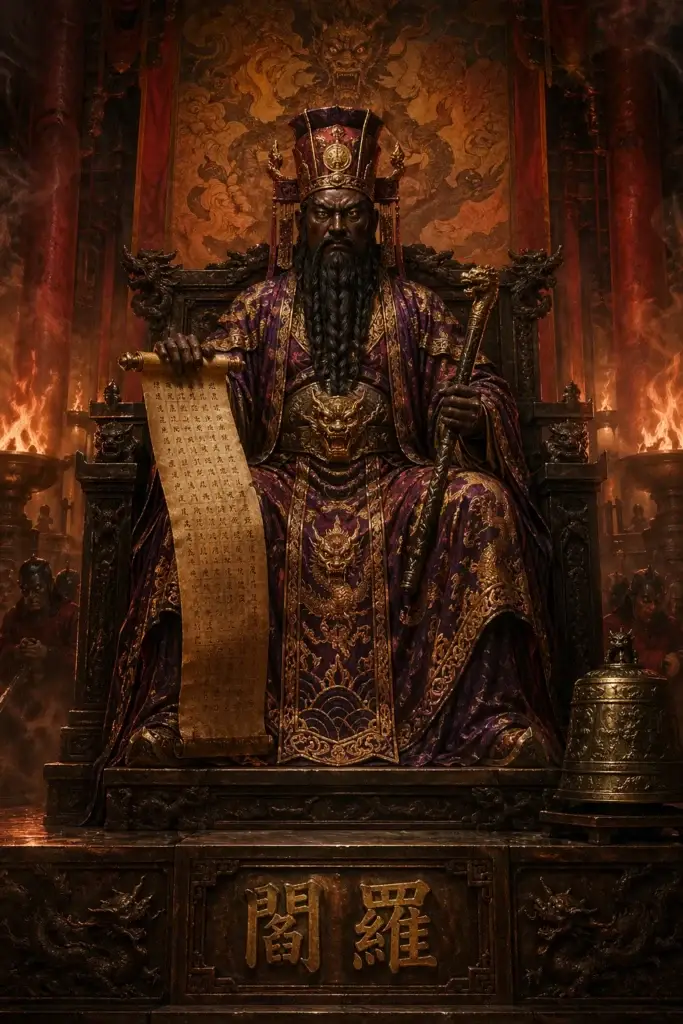
Yanluo
Type: Chinese principal deity, judge of the dead and fifth of the ten kings of hell (Diyu)
Pantheon: Daoism, Chinese Buddhism, Chinese folk religion
Function: Judge of the dead in the hell realm Diyu, administrator of rebirth
Principal attributes: judge’s robe, brush and book of the dead, writing tablet with brush
Principal cult sites: Dongyue temples (Mount Tai), temples of the dead in every larger Chinese city
Buddhist identification: Yamaraja (Sanskrit), Yāma (Buddhism)
Context
Yanluo (Chin. Yán Luó Wáng) is a synthesis of the Indo-Buddhist Yamaraja and the Chinese folk concept of the judge of the dead. The syncretization begins with the arrival of Buddhism in China (1st to 2nd cent. CE) and becomes canonical in the Tang dynasty (7th to 10th cent.).
In the Chinese system Yanluo is not the only king of the dead but the fifth of the Ten Kings of Hell (Shí Diàn Yánluó), each of whom presides over one of the ten chambers of hell.
The main flourishing of Yanluo theology runs from the Tang to the Ming dynasty. It remains central today in every Chinese ritual for the dead.
Principal cult sites: Dongyue temple on Mount Tai in Shandong (one of the most important Chinese sanctuaries of the dead), Yanluo temples in many Chinese cities (typically connected with the local city-god temple).
Present in Hong Kong, Singapore, Malaysia and Taiwan in every larger Chinese diaspora temple complex. In Taiwanese folk belief he is centrally invoked above all during the Yulan Pen festival (Ghost Month).
Central sources: Sutra of the Ten Kings (Chinese Buddhist text, 9th/10th cent.), Yulan Pen Sutra, Daoist and Buddhist liturgies for the dead. Secondary literature: Teiser, The Scripture on the Ten Kings and the Making of Purgatory in Medieval Chinese Buddhism; Werner, Myths and Legends of China; Kohn, Daoism Handbook.
Designation and spellings
Yanluo Wang is depicted as a somber, imposing male figure in imperial, dark robes, often green or black. His features are stern, not evil but inflexible.
He wears the crown and insignia of power, not gold but the authority of judgment. His table is covered with ledgers and papers that document the karma of every soul.
The other kings sit beside him, magistrates beside or below him. His symbols are the ten chambers of hell, each with its typical torments (lakes of blood, sawing saws, boiling cauldrons, forests of thorns). The river Sanzu (or Naihe, the river of repudiation) separates life and death.
Characteristics
Yanluo Wang belongs to a purely functional pantheon: there is no individual devotion to him but rather respect born of fear. The folk tradition emphasizes that he has no discretion. Every life’s work is assessed, and the punishment follows automatically. In Daoism meditation practitioners may confront him in order to ascend.
In Buddhism his judgment is the enactment of karma: not morally absolute but descriptive. Direct altars to Yanluo Wang are rare; instead he is mentioned in temples, shown in artworks depicting hell, and invoked in folk-belief rituals for protection against damnation.
Priests can negotiate with Yanluo Wang through rituals in order to save living or deceased relatives, but his decision remains functional: karma is not negotiable.
Profile: Yanluo
The most important aspects of Yanluo at a glance. The following fields summarize origin, function, appearance, veneration, symbols and cultural parallels.
Yanluo develops from the Indian Yamaraja, who comes to China with Buddhism. In the Chinese system he is merged with the folk concept of the judge of the dead.
In later folk tales he is often identified with a historical person (various candidates depending on the region: a just Sui official, a Tang minister). As the fifth of the Ten Kings of Hell, the other nine serve alongside him, each administering a specific chamber of hell (one for each category of sin).
Judge of the dead. When a person dies, their soul first passes through four other courts and then comes before Yanluo.
He reads from the book of the dead, in which all deeds are recorded, and decides upon: (1) immediate good rebirth (rare) or (2) a term of punishment in one of the ten hells before rebirth.
The ten hells are organized by categories of sin (a hell of ice for the loveless, a hell of fire for the wrathful, and so on). In personal cult Yanluo is not invoked but feared; yet in rituals for the deceased he is asked for lenient treatment.
A stern male official in a Chinese judge’s robe (imperial blue or black, with dragon embroidery), a black beard, a high official’s cap (the Mian or “Seven Stars” hat), brush and writing tablet in hand, the book of the dead on his desk.
He is enthroned on a high judge’s seat in the fifth hall of hell. He is accompanied by two guardian demons: Niu Tou (Ox Head) and Ma Mian (Horse Face), who drag the dead to judgment.
Sphere of effect: Yanluo is invoked in every Chinese ritual for the dead, with petitions for a lenient judgment. In personal cult he is hardly venerated directly: he is feared, not loved.
During the Yulan Pen festival (Ghost Month, July/August of the Chinese lunar calendar), food and paper-money offerings for the deceased are brought before Yanluo’s court. In folk theater (Peking opera) the scene of Yanluo’s court is a classic subject.
Judge’s robe, brush, writing tablet, book of the dead, Mian crown or official’s hat, black beard, judge’s seat, the seal of divine authority. Companions: Niu Tou (Ox Head demon) and Ma Mian (Horse Face demon). Sacred plants: none specific.
Yamaraja / Yama-Dharmaraja (Hinduism / Tibet, direct predecessor), Yama (Buddhism, shared Indian root), Enma-O (Japan, an adaptation shaped by China), Yeomra (Korea, shaped by China), Hades (Greece, lord of the underworld), Pluto (Rome), Anubis/Osiris (Egypt, guide of the dead and judge of the dead), Hel (Germanic), Mictlantecuhtli (Aztec).
Yanluo is the East Asian, Chinese-shaped version of the Indian Yamaraja, with the characteristic official hierarchy of the ten kings of hell.
Protective practice
Apotropaic rituals
Yanluo Wang (Chin. 閻羅王) is the king of the ten hells (Shidian Yanjun) in Chinese folk belief, a synthesis of the Indian Yama with Confucian conceptions of official bureaucracy. Established since the Tang period (7th-9th cent.).
Veneration takes place above all within the framework of the Zhongyuan festival (15th day of the 7th lunar month, the “Ghost Festival”), when spirit money (jīnzhǐ) and food are presented for the dead.
Temple images show Yanluo at the tribunal with the scribe Cui Jue and the messengers (Niu-Tou, Ma-Mian), cf. Teiser, The Ghost Festival in Medieval China.
Invocations
The Yulan-pen-jing (Ullambana Sutra, ca. 6th cent.) is the central liturgical text for the deliverance of the dead from Yanluo’s ten hells. Mulian tales (Mulian rescues his mother) are performed during the Ghost Festival. Daoist liturgies such as the Yujing ritual integrate Yanluo into the Daoist pantheon.
Amulets and protective symbols
Gate-guardian images (Mengshen) at Chinese house entrances, Qin Shubao and Yuchi Gong, generals of the Tang period who were deified, are meant to protect against Yanluo’s messengers.
Black ink talismans bearing the Yanluo seal are carried during visits to graveyards. The hell inscriptions at the entrance of Chinese temples list Yanluo’s ten hells in an apotropaic manner.
Yanluo, parallels in other cultures
The ten kings of hell and Yanluo's place among them
In Chinese folk belief Yanluo, in full often Yanluo Wang, is not a sole ruler over the realm of the dead but part of a bureaucratic body.
The fully developed conception knows ten kings of hell, the Shi Dian Yanluo or ten kings of the underworld, each of whom presides over one of ten courts of hell. In the common ordering Yanluo is regarded as the fifth of these kings.
This order is tangible in a concrete text, the Shiwang jing, the Sutra of the Ten Kings, which arose in the Tang period and is well attested by finds in the caves of Dunhuang.
The text describes the journey of the soul through the ten courts, which are passed through in a fixed temporal rhythm, on particular days after death and on anniversaries. At each court a part of the life’s balance is examined.
That Yanluo, despite this integration, often stands in common usage for the entire underworld has historical reasons. He is the oldest and best known of the kings, having emerged from the Indian Yama, and his name was in circulation before the system of the ten kings became fixed.
Religious studies, for instance in the works of Stephen Teiser on the Shiwang jing, sees in the tenfold structure a specifically Chinese achievement: it transfers the model of the earthly hierarchy of officials onto the afterlife.
From the Indian Yama to the Chinese official
Yanluo is the result of a long process of translation and adaptation. The name itself is a Chinese rendering of the Sanskrit Yama, transcribed in the early Buddhist translations mostly as Yanmoluo or, in shortened form, Yanluo.
With Buddhism, the conception of a judge of the dead and of differentiated hells reached China from the first centuries after the turn of the era (see Yama).
The Indian Yama was thereby profoundly reshaped. From the lord of the ancestors and administrator of the Dharma he became an official within an administrative hierarchy, who is himself subordinate to a higher heaven and can even be dismissed or transferred.
A story widespread in folk tales reports that Yanluo was demoted by a higher court for excessive leniency. These tales show how completely the figure was transferred into the Chinese thinking about office, promotion and discipline.
At the same time Yanluo became connected with native Daoist and folk conceptions of the realm of the dead, such as Mount Taishan as the gathering place of souls and the subterranean realm Diyu.
The result is a hybrid form in which Buddhist karmic teaching, Daoist geography of the afterlife and Confucian-shaped administrative ethics flow together. Yanluo is thus a model example of how a deity in the transition between cultures is not simply taken over but reassembled anew.
Bao Zheng: the just judge as king of hell
A peculiarity of the Chinese Yanluo belief is that the office was not thought to be permanently bound to a single mythical person. In the popular tradition, outstandingly just people could become Yanluo after their death.
The most famous such identification concerns Bao Zheng, a historical official of the Song period in the eleventh century, who entered folk memory as the epitome of the incorruptible judge.
In countless tales, plays and later novels, Bao Zheng appears by day as an earthly judge and by night judges in the underworld as Yanluo. This conception joins this world and the afterlife into a single, continuous legal system.
Whoever escapes punishment on earth is called to account among the dead by the same incorruptible judge. The message is clearly moral: no one can escape justice in the long run.
From the perspective of religious studies, several things about this are interesting. First, it shows the close interweaving of religion and judicial culture in traditional China. Second, it makes Yanluo a function, an office that can have various holders, much like an earthly official post.
Third, the Bao Zheng tradition served as a popular corrective against corruption and arbitrariness, a kind of otherworldly guarantee for the validity of the law. The king of hell is here not primarily a figure of terror but the embodiment of a hope for compensating justice.
Diyu in temple and popular piety
The conception of Yanluo and the ten kings of hell is materially present in China and in the Chinese diaspora to this day. Numerous temples contain their own halls or side chapels in which the ten courts of the underworld are depicted as sculptural scenes.
Such depictions of hell are especially well known in temple complexes in Singapore, Taiwan and southern China, where the individual punishments for particular offenses are rendered vividly and drastically.
These depictions had and have an educational function. They show the visitor what consequences lying, deceit, murder or a lack of filial piety toward one’s parents entail. They are often accompanied by texts and pictorial scrolls that explain the journey of the soul through the ten courts.
In the ritual for the dead, paper money, paper documents and so-called hell banknotes are burned so that the deceased has means at their disposal on the way through Diyu, which also reflects the bureaucratic logic of the afterlife in practical terms.
Important is the temporal limitation of these hells. Unlike in some Western conceptions, the punishments in Diyu are not eternal. They are stations, at the end of which stands rebirth.
At the tenth court a decision is made about the nature of the next existence, and there is the conception of a draught of forgetting from the old woman Meng Po, which erases the memory of the former life.
Yanluo and his fellow kings are thus part of a cycle, not guardians of a final end state.
Further links
Literature (selection)
Further standard works in the literature index.
Frequently asked questions about Yanluo
Who is Yanluo in Chinese mythology?
Yanluo (also Yanluo Wang, King Yanluo) is, in Chinese mythology, one of the ten kings and judges of the underworld Diyu. His name goes back to the Indian god of death Yama, whose conception reached China with Buddhism and there merged with native conceptions of the afterlife.
Yanluo decides the fate of the deceased: he examines the good and bad deeds they committed in life and determines into what form they are reborn.
How is the Chinese underworld under Yanluo structured?
In the Chinese conception the underworld Diyu is organized like a celestial administration, a mirror image of the earthly bureaucracy. Yanluo is traditionally regarded as one of the ten kings who preside over the courts or tribunals of the underworld, through which each soul is led one after another.
Each court examines particular offenses and imposes corresponding punishments. This conception combines Buddhist teachings of karma and rebirth with Confucian thinking about order and justice. Yanluo is here not an arbitrary ruler but an incorruptible judge.