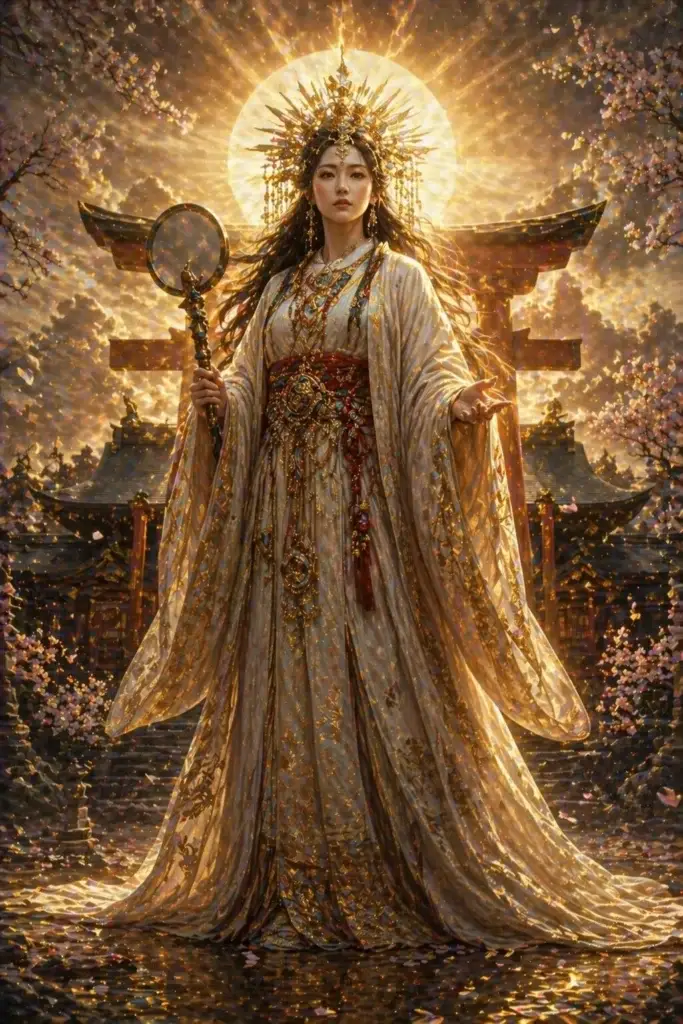
Enma O is a god of the Japanese tradition.
Judge of the damned, ruler of the Buddhist hell.
Enma-ō is the East Asian form of the Indian Yama, who came to the Tendai school by way of the Chinese Yánluó-Wáng. Documented in East Asian Buddhism since roughly the 8th century, he was spread in particular by the Tendai and Shingon schools.
As the presiding figure among the ten judges of hell (Jūō), he decides the fate of the soul on the seventh day after death.
The oldest surviving Japanese sources on Enma-ō date from the late 8th and early 9th century, embedded in the transmission of Buddhist hell cosmologies from China. The Nihon Ryōiki (ca. 822) contains early narratives in which Enma-ō questions the deceased.
In the 12th century the system of the ten judges of hell, with Enma-ō as the presiding figure, becomes firmly established; the standard iconographic repertoire (crown, dark skin, mirror, writing tablet) emerges in the Kamakura period.
The worship of Enma-ō was widespread across the Buddhist world of East Asia, from the great temple cities of Kyōto and Nara to rural pilgrimage sites.
Especially formative was his image in the Buddhist temple halls, where statues of the judge of hell were meant to prompt the living to ethical self-examination. Folk theatre took up the motif from the 14th century onward; Enma-ō appears regularly in Nō and Kabuki plays as a figure of incorruptible judgment.
Research in religious history on Enma-ō draws on a broad source base: canonical Buddhist sūtras in Chinese translation, Tendai Buddhist setsuwa collections, iconographic image tablets (Jūō-zu), and popular otogi-zōshi tales.
The central standard works come from regional religious ethnology and from international Buddhist studies; a curated bibliography for each being is continually added to within the lexicon.
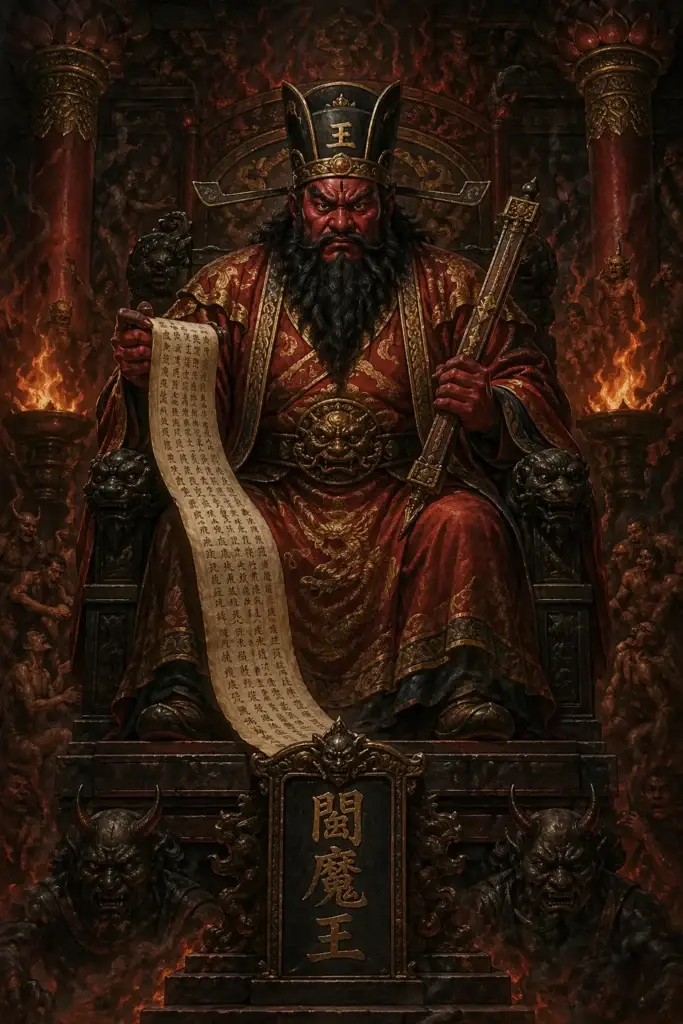
Enma-ō is depicted as a huge, muscular figure with deep-red or blue-black skin. His hair stands up in flames, and his eyes glow like burning coals. He wears a brocade-adorned robe and sits on a raised throne.
In his hands he holds a judge’s sword (kensaku) and often a large ledger or scroll recording the karmic balance of each soul. His symbols are the guardians of hell (oni), the river of the damned, and the various levels of hell beneath his realm.
Enma-ō receives every soul immediately after death. In the judgment of the dead, lay clerics or one’s own evil deeds sit as accusers, while the ledger does not lie. Enma-ō does not negotiate, he carries out. His decision determines the next rebirth within the six realms of existence (Rokudō).
His realm is not simply punishment but karmic balancing: a stony path, boiling oil, or return as a hungry spirit. In the Tendai school, small shrines to Enma-ō are maintained in local temples, often with Jizō statues nearby that symbolize aid for damned children.
In Japanese Buddhism, Enma-O is the judge of the dead who passes judgment on the deceased according to their deeds. He is usually depicted as a wrathful dignitary in Chinese official dress with a judge’s cap and a tablet of office. His figure combines Indian, Chinese, and Japanese layers of tradition into a distinct presence in folk belief and temple art.
Enma-O is the Japanese Buddhist adaptation of the Chinese Yanluo, whose root lies in the Indian Yama, the Vedic god of the dead and first mortal (Rigveda 10.14).
With the spread of Mahayana Buddhism across Central Asia, Yama’s concept reached China in the 6th to 8th century and was developed there into Yanluo Wang, the king of the ten hells.
In the 9th to 10th century Japanese Buddhism adopted this system with the Jūō (ten kings). Enma-O stands at the highest rank in this series. In religious history, the Indian doctrine of karma, the Chinese concept of an official bureaucracy, and Japanese ideas of the dead merged together.
A further article with additional sources is being prepared and will appear shortly.
In iconography Enma-O is depicted as a fearsome old man with a long black beard, dark skin, and burning eyes. He wears the robe of a Chinese official of the Tang dynasty with an imperial crown (raikan).
In his hands he holds the Golden Book of Life (jōfuzu), in which all karmic deeds are recorded, and a scepter or writing brush.
Before his tribunal stand the messengers Niū-Tō (ox-head) and Ba-Mien (horse-face), as well as the recording secretary. The temple paintings (jigoku-zōshi of the Edo period) show him surrounded by scenes of hell.
Sphere of influence: Enma-O is the universal judge of all the deceased; on the seventh of the 49 days of the dead (the 49th day after death) the central reckoning of karma takes place before his tribunal. He decides on rebirth in one of the six worlds (gods, demigods, humans, animals, hungry spirits, hells).
His judgment is not arbitrary but strictly in accordance with karma (dharmic). The living also worship him to mitigate the karma of the deceased. In the farming regions of Japan he is regarded as a protective god against unexpected death and as a helper in difficult births.
Symbols: the Golden Book of Life (jōfuzu), writing brush, sword, the mirror of truth (jōhari no kagami); before this mirror all the deeds of one’s life become visible as images.
His apotropaic feature: konjac dishes are offered to him as his favorite food (Edo tradition); Enma-Omamori in red silk protect against unexpected death and karmic illnesses.
Scholarship in the history of religion describes Enma-O as the Japanese form of a judge figure that traveled by way of India and China. In the Vedic texts, Yama is the first mortal and lord of the realm of the dead; in Chinese Buddhism he becomes the fifth of the Ten Kings of Hell. Japan adopted this judicial model together with the notion of intermediate states after death, in which the bereaved can intercede for the deceased through memorial rites.
Apotropaic and devotional rituals
Enma-O (Japanese 閻魔大王) is the Japanese Buddhist adaptation of the Chinese Yanluo / Indian Yama. He is worshipped in numerous Enma temples in Japan (Genkaku-ji in Tokyo, Inn-ji in Kyoto, Ennō-ji in Kamakura).
The main day of practice is the 16th day of the 1st and 7th month (Enmasai), regarded as a gateway to the world of hell.
Pilgrims offer konjac dishes (Enma’s favorite food according to Edo tradition), prayers for deceased relatives, and petitions for the mitigation of karma (cf. Sekiguchi, The Cult of King Yama in Medieval Japan).
Sutras and invocations
The Jūō-kyō (sutra of the ten kings) is the main liturgy. Buddhist monks recite the Heart Sutra with special bows to Enma. The Edo period (17th to 19th century) saw the worship of Enma become popular within folk Buddhism through picture books (jigoku-zōshi, hell scrolls).
Amulets and protective symbols
Enma-Omamori (protective amulets bearing an image of Enma) from the Enma temples, usually red fabric with golden embroidery. The Goōhōin (symbol of the healing of the Yakushi Buddha) is worn against karmic illnesses.
The iconographic tablet of the ten kings of hell (Jūō-zu) is hung at Buddhist household altars as a preparation for death.
Enma-O goes back to the Indian god of the dead, Yama, who reached China with Buddhism and was incorporated there as Yanluo Wang into the system of the Ten Kings of Hell. This Chinese form came to Japan with the Buddhist schools and there became Enma-O. Comparable judge figures of the afterlife are known in other cultures as well, such as the Egyptian Osiris at the judgment of the dead or the Korean Yeomra, who stems from the same Buddhist tradition.
Enma-o, the ruler of the underworld and judge of the dead in Japanese Buddhism, is the final link in a long migration. His origin lies in Vedic India, where Yama was regarded as the first mortal and thus as king of the dead.
Through Buddhism the figure reached China, where it was incorporated as Yanluo into the system of underworld courts, and from there it passed by way of Korea to Japan. The Japanese name Enma is the phonetic adaptation of the Sanskrit Yama; the addition o means king.
At each stage the figure changed. The Indian Yama was at first more a ruler over a realm of the dead than a stern judge.
In China he merged with the bureaucratic idea of an otherworldly administration that examines the life of each deceased person, settles the account, and decides on their rebirth. This Chinese imprint, which portrays the afterlife as an apparatus of officials with files, scribes, and courts, was largely taken over by Japanese Buddhism.
In Japan, Enma-o was firmly embedded in popular Buddhist piety. He appears in sermons, in temple painting, and in teaching texts as the authority before which every person must give account after death. Unlike an abstract notion of karmic retribution, he gave this teaching a face, a concrete, addressable, and terrifying form.
The significance of this migration for religious studies lies in the fact that Enma-o makes it possible to read how a religious idea is carried across linguistic and cultural boundaries and is recolored anew in each case.
The Japanese judge of the dead carries within himself the layers of three cultures: his Indian origin, the Chinese bureaucratization, and the Japanese folk-religious elaboration.

In the Chinese-influenced Buddhism that came to Japan, Enma-o is not the sole ruler of the afterlife but part of a collegium.
The system of the ten kings of the underworld, which was elaborated in the Chinese Middle Ages and reached Japan through picture scrolls and texts, assigns each king a court and a particular point in time after death.
The deceased passes through these courts in a fixed temporal sequence, on certain days after death and on anniversaries.
Enma-o holds a prominent position within this system. He is usually the fifth of the ten kings, his court is passed through on the thirty-fifth day after death, and he is regarded as the most important and most powerful among them. Before his tribunal the deeds of the deceased are examined with particular thoroughness.
Fixed iconographic elements belong to the equipment of his court. Enma-o keeps registers in which every good and bad deed is recorded.
At his side stand assistants; Japanese tradition knows, for instance, a figure carrying human-like heads on staffs, one with an angry expression and one with a calm one, which indicate the nature of the deceased.
A famous prop is the mirror of souls, in which the dead person sees his life and his transgressions reflected without disguise, so that lying becomes impossible.
This court system had a clear pastoral function. It provided the basis for the practice of commemorating the dead, observed at fixed intervals after death.
Through rites and the transfer of merit, the bereaved could favorably influence the course of the deceased through the ten courts. Enma-o was thus not merely a figure of terror but the pivot of an entire ritual economy between the living and the dead.
The pictorial representation of Enma-o follows a fixed convention derived from the Chinese model. He appears as a king or high official, often in the official garb of a Chinese dignitary with a characteristic crown or headdress on which the character for king frequently stands out.
His face is usually flushed with anger, with wide-open eyes and a grim expression, an image of incorruptible severity.
Such images are found in numerous Japanese temples, often as a sculpture in a hall of their own, the Enma hall. Famous examples are the Enma figures in temples in and around Kyoto and Kamakura.
Often Enma-o is surrounded by the other nine kings or embedded in a larger depiction of hell. The Japanese pictorial tradition of the jigoku-e, the images of hell, portrays the punishments of the underworld in drastic scenes and places Enma-o as the judging authority at their beginning.
An iconographically significant tradition connects Enma-o with the Bodhisattva Jizo. In Japanese piety, Jizo is regarded as the compassionate savior who stands by the beings in hell.
Some texts and images even interpret Enma-o and Jizo as two aspects of the same reality, the stern and the merciful side, which work together to lead the deceased toward improvement and a favorable rebirth. This pairing softens the terrible character of the judge and binds him into a salvation-oriented theology.
The temple images had an educational task. Preaching monks used them to bring home to lay people the consequences of bad conduct. The flushed, angry Enma-o was thus a teaching aid that translated the abstract doctrine of karma into a memorable, terrifying image.
Beyond the monasteries, Enma-o became a fixed figure of Japanese folk belief. His name entered fixed sayings and admonitions for children. Parents warned children who told lies that Enma-o would tear out their tongues, a threat known in many regions of Japan.
The judge of the dead thus became an authority of everyday moral education, long before a child ever set foot in a temple.
On certain days of the year, traditionally in spring and late summer, special devotions were held before the Enma figures in some regions, on which the temple halls were opened and the faithful could view the images that were otherwise kept closed.
Such customs show that Enma-o was not merely a literary or doctrinal figure but an object of lived worship and fear.
In modern Japanese culture Enma-o has remained extraordinarily present. He appears in manga, anime, video games, and films, sometimes as a terrifying antagonist, sometimes in a comic register as an overwhelmed bureaucrat of the underworld.
This popular-cultural treatment gladly takes up precisely the bureaucratic side of the figure, the king who runs a vast otherworldly administrative apparatus with files, stamps, and subordinates.
This persistence is instructive for religious studies. Enma-o has accomplished the transition from religious teaching figure to general cultural figure without losing his core. Even in humorous treatment he remains the one who decides on the right and wrong of a life that has been lived.
The figure shows how deeply the Buddhist notion of a judgment of the dead has seeped into Japanese culture, and how it can be retold again and again, from the temple hall to the children’s book.
Against its influence, cross-cultural tradition names these protective means:
Compare in the Protection Compass →Recommended protective means
The simplest protective means in this collection: 41 layers of fine gold 999, platinum, silver and silicon, manufactured in Ruhla, Thuringia. It requires no activation, is bound to no person, and is effective within a radius of around 50 meters, even without being worn.
Related Beings

Yamauba, Japan's ambivalent mountain witch. Origin, her dual nature between man-eater and nurturi...

Basajaun, the hairy lord of the forest of the Basques, warns shepherds of storms and wolves. Orig...

Willy-Willy, the whirlwind of the Australian outback. Origin, the Aboriginal interpretation as a ...

Ningyo, Japan's fish-human: Nihon shoki account of 619, the Yao Bikuni legend, omen function, tem...

Zephyros, the mild Greek west wind. Origin, the death of Hyakinthos, the altar at Lakiadai and th...

Pricolici, the wolf-shaped werewolf-undead of Romania. Origin, the spirit of the evil dead and th...