iWell Guard

Fujin, God of the Japanese Tradition

Fujin is a god of the Japanese tradition.

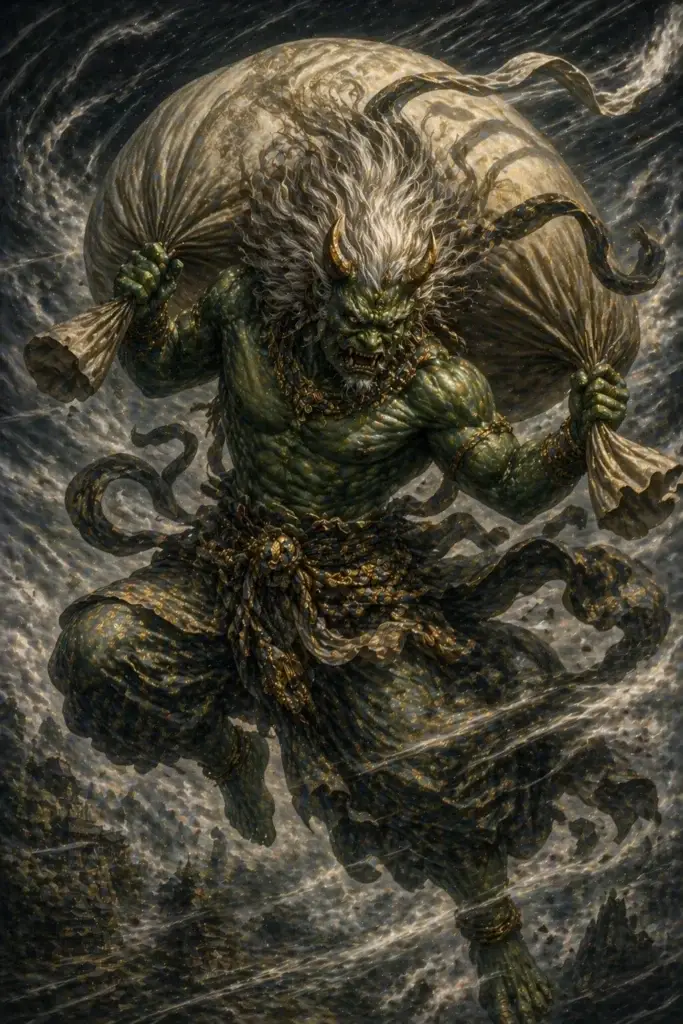
Wind god, wild bag of the air, guide of the clouds. Fujin is Japan’s wind god, rarely worshipped yet iconographically unmistakable. Depicted as a muscular, red or green figure with wild hair, he carries an enormous bag or pouch full of winds on his back.

With both hands he opens or closes the pouch to release or restrain the winds. In artworks he often rides alongside Raijin (the thunder god), an inseparable partnership: Fujin blows the clouds together, Raijin beats them into thunder. Together they produce the dreaded typhoons of the Pacific.

Table of Contents

Fujin - gods from the Japanese tradition, historical and illustrative

Fujin

At a Glance: Fujin

Type: Japanese principal deity (Shinto), wind god
Pantheon: Shinto and folk-Buddhist tradition
Function: wind, companion of storms, bearer of the world’s winds
Main attributes: wind bag on the shoulders, green demonic features, wild hair
Main cult sites: Sanjusangendo (Kyoto, together with Raijin), Senso-ji (Tokyo, Thunder Gate)
Companion deity: Raijin (thunder god)

Classification

Period of the Texts

Fujin is attested in literature from the 8th century in the Kojiki and Nihon shoki. The main flowering of the iconographic tradition falls in the Heian and Kamakura periods. The famous Tawaraya Sotatsu painting pair of Raijin and Fujin (17th century, Kennin-ji) is the most popular depiction.

The Fujin statue in Sanjusangendo is among the outstanding works of Japanese sacred art. In the 13th century, Fujin played a special role in the mythological interpretation of the Kamikaze (“Divine Wind”), which sank the Mongol fleets in 1274 and 1281.

Area of Distribution

Main cult sites: Sanjusangendo in Kyoto (with the statues of Raijin and Fujin in the entrance hall), Senso-ji in Tokyo (Kaminari-mon, Thunder Gate, with Raijin on one side and Fujin on the other), Kennin-ji in Kyoto (Sotatsu painting).

Beyond these, in every temple or shrine that guarantees weather protection. In rural folk belief he is invoked especially by seafarers and farmers.

State of the Sources

Central sources: Kojiki (Book I), Nihon shoki (storm myths), Sotatsu’s pictorial works (Kennin-ji, 17th century), the Sanjusangendo temple records. Secondary literature: Kasahara, A History of Japanese Religion; Aston, Shinto. The Way of the Gods; Kanda, Shinto in History; Bocking, A Popular Dictionary of Shinto.

Designation and Spellings

Fujin is a strongly physical deity, a muscular figure, often colored red or green, with chaotic hair that resembles swirling wind. The central icon is his enormous bag or pouch (kaze-no-fukuro, wind bag), which he carries behind him or holds in his hands.

With one hand he opens the pouch and lets winds stream out; with the other he draws it closed or seals it. His body appears fragmented by wind eddies. Fujin is rarely shown alone, usually beside Raijin, in a symmetrical composition with dynamic, diagonal lines. Their pairing symbolizes the interplay of wind and thunder.

Characteristics

Fujin is the typhoon god, but also the giver of the northern wind in autumn that carries the harvest. His function is as ambivalent as Raijin’s: without Fujin there are no fertilizing winds, but typhoons kill harvests and people. The folk cult is minimal and formal; there are few Fujin shrines dedicated exclusively to him.

Instead, Fujin is worshipped in Raijin contexts, as an integral component of the storm religion. Amulets against typhoons show both gods together. In Buddhist temples, images of Raijin and Fujin are stylized as pairs, often on door panels or wall paintings (ema = votive pictures). The trust placed in him is functional and magical.

Appearance and Symbolism

Fujin is depicted as a wild, muscular being with a reddish or dark blue body. He wears a leopard or tiger skin and carries a large bag of wind on his back.

His face is often grim or laughing. Clouds or air swirl around him. He is sometimes shown together with Raijin (red) on a cloud.

Profile: Fujin

The most important aspects of Fujin at a glance. The following fields summarize origin, function, appearance, worship, symbols, and cultural parallels.

Cultural Context

Fujin (Japanese Fujin, “wind god”) is the son of the creator goddess Izanami, arising from her decaying breath in Yomi (the underworld) parallel to the thunder aspects.

In later traditions he is connected with the thunder god Raijin as brother and companion; the wind-and-thunder pair is a central iconographic motif of Japanese art. In folk tradition he is related to Susano-o (storm god).

Fujin's Target Audience

Patron of the wind, both feared (typhoon, storm) and entreated (travel wind for seafarers, harvest wind). He is central in the agricultural tradition, since an abundant harvest requires favorable wind.

In the Mongol war (1274, 1281) the wind was interpreted as the “Divine Wind” (Kamikaze) that sank the Mongol invasion fleet, a myth that was politically and ideologically revived as late as the 20th century. In modern times he offers protection against typhoons.

Form

A green, muscular male body with demonic features (horns, sharp teeth, wild hair). Characteristic: a wind bag carried on the shoulders, from which the winds of all directions escape. He wears only a loincloth or tiger pelt.

In the classic paintings (Sotatsu) he floats on a cloud, together with Raijin (red, with a ring of drums). At the Senso-ji Thunder Gate he appears as a massive figure with a gaping mouth.

Fujin's Effect

Sphere of effect: Fujin is invoked in coastal regions and in island communities for protection against typhoons. Seafarers pray to him before every voyage for favorable wind.

In the agricultural tradition there is an invocation for timely wind during the flowering season. At Senso-ji, visitors touch the Thunder Gate lantern as a good-luck ritual. In modern folk belief he remains present through anime and pop culture.

Fujin's Defense

Wind bag on the shoulders, horns, sharp teeth, wild hair, tiger-pelt loincloth, green (sometimes blue-green) skin color, cloud pedestal. Sacred animals: tiger (pelt), deer (in some traditions). Sacred plants: bamboo.

Counterparts

Aeolus (Greece, wind king, who keeps the winds in a bag, a notable parallel to the Fujin wind bag), Vayu (Hinduism, wind god), Stribog (Slavic, wind god), Njord (Germanic, god of wind and sea), Shu (Egypt, god of air and wind), Enlil (Mesopotamia, storm god), Adad/Hadad (Mesopotamia, weather god), Feng Bo (China, the Chinese variant of the wind god).

The Aeolus parallel is especially notable because of the wind-bag motif.

Practice of Protection

Rituals of Worship

Fujin (Japanese 風神, “wind god”) is a weather god of Shinto and Buddhism, iconographically complementary to Raijin (thunder god).

Main depictions: the monumental Fujin-Raijin statues in the Sanjusangen-do (Kyoto, 1164) and Sotatsu’s famous folding-screen pair in Kennin-ji (17th century), a key work of the Rinpa school. In farming regions, special wind shrines were erected for him, often on hilltops.

Invocations

Norito prayers to Fujin emphasize the request to calm storms. The Buddhist companion name Vayu (Sanskrit wind god) connects him with the Indian pantheon. In the Edo period (17th to 19th century), Fujin appeared in numerous genre paintings as an ambivalent natural force, helper and threat at once.

Amulets and Protective Symbols

Fujin carries a large wind bag (kazebukuro) on his shoulders, from which the winds of the four cardinal directions stream out. Green skin, horns, designed similarly to Raijin; the two form an iconographic pair.

Protective amulets from the wind shrines are made for seafarers and travelers. Wind chimes (furin) on houses serve as a symbolic homage to Fujin and a summer apotropaion.

Fujin, Parallels in Other Cultures

Fujin resembles the Greek Aeolus (master of the winds), the Norse Njord (wind and sea), and the Indian Vayu (the air element). Unlike Aeolus, who keeps wind in bags (the Odyssey), Fujin’s bag is active: he releases wind or holds it back, dynamically.

With the Mexican Quetzalcoatl (wind god), Fujin shares creator aspects (wind generates life). What is unique is the inseparable partnership with Raijin: they are not hierarchical but symbiotic. Wind without thunder is useless; thunder without wind is fragmentary. Fujin and Raijin are Japanese examples of forces that make sense only together.

Fujin and Raijin: the Divine Pair of Wind and Thunder

Fujin (風神, “wind god”) appears in Japanese tradition almost always together with Raijin (雷神), the thunder god. The two form a fixed iconographic pair that embodies the untamed forces of the sky.

In temples their statues often stand as guardian figures on either side of a gate, Fujin usually to the right and Raijin to the left of the person entering.

The connection of the two deities has a meteorological core: storm and thunderstorm occur together, and both the destructive and the fertilizing sides of the weather are distributed between them. Fujin carries his characteristic wind bag across his shoulders, from which he releases the winds.

Raijin beats with sticks on a ring of drums. In the pictorial tradition, Fujin is frequently depicted green-skinned and Raijin red-skinned, both with demon-like features that mark their origin in the sphere of the fearsome rather than the gentle deities.

This ambivalence is central to understanding him. Fujin is not a benevolent guardian spirit but a power that brings the typhoon just as much as the beneficial breeze. Japanese religiosity did not categorize such deities morally but treated them as natural forces that had to be favorably disposed through worship and ritual.

The Mongol storm of 1281, which destroyed the invasion fleet of Kublai Khan, was later interpreted as kamikaze, “divine wind,” and indirectly linked with the working of such wind deities, even though the contemporary sources document no direct invocation of Fujin.

The Wind and Thunder Image of Tawaraya Sotatsu

The most famous artistic embodiment of Fujin is the two-part folding screen Fujin Raijin-zu, which Tawaraya Sotatsu created in the early 17th century. The work belongs today to the temple Kennin-ji in Kyoto and is classified as a National Treasure of Japan.

Sotatsu placed the two gods on a gold ground, without landscape, without a narrative frame, with only their banks of cloud. Fujin springs into the picture from the right, the bulging wind bag stretched over his head.

The composition became a key work of the so-called Rinpa school. Ogata Korin copied it almost exactly around 1700, and Sakai Hoitsu created a further version in the early 19th century.

This chain of re-creations is not mere copying but, in the Japanese art tradition, a recognized form of engagement with a canonical model. Each version shifts details of the coloring and the rendering of the clouds.

From an art-historical perspective, it is notable that no single older model showing exactly this arrangement can be attributed to Sotatsu for the pictorial idea. He presumably drew on older depictions of the two gods from Buddhist pictorial programs, for example from the attendant figures of the thousand-armed Kannon.

A religious pictorial element thus became an autonomous work of art. The screen exemplifies how closely religious iconography and secular high art remained interwoven in Japan, and how a deity can unfold its own line of influence through art history, partly independent of temple piety.

Origins and the Influence of the Silk Road

Scholarship has long debated whether Fujin’s characteristic wind bag is a native Japanese creation or has a long journey of migration behind it. A widespread thesis connects the motif with the Greek wind god Boreas, who in Hellenistic art was likewise depicted with a cloth or cloak stretched over his head.

By way of the Greek-influenced art of Gandhara in present-day Pakistan and Afghanistan, then through Central Asia and China, the pictorial scheme could have reached Japan along the trade routes.

Evidence for this path is provided by wall paintings in the caves of Dunhuang in western China, where wind-bringing figures appear with a similar attribute. The thesis is plausible but remains uncertain in its details, because the chain of transmission is full of gaps and the motif of a billowing cloth can also arise independently.

Within Japan, the figure merged with native conceptions. Shinto has its own wind deities in Shinatsuhiko and Shinatobe, who are named in the early chronicles Kojiki and Nihon shoki and were worshipped in shrines such as Tatsuta-Taisha.

Fujin in his familiar demon-like pictorial form, by contrast, belongs more strongly to the Buddhist-influenced visual cosmos. In lived religion, both strands ran side by side without being systematically unified. This layering is typical of Japanese religious history, in which imported and native elements overlay one another rather than displacing each other.

Literature (Selection)

  • Aston, William G.: Shinto. The Way of the Gods. London 1905.
  • Kasahara, Kazuo (ed.): A History of Japanese Religion. Tokyo 2001.
  • Walde, Christine (ed.): Der Neue Pauly (entry “Fujin”).

Further standard works in the literature index.

Classification & Protection

IILEVEL
The Protection Compass assigns this being to influence level II, Noticeable influence.

Against its influence, cross-cultural tradition names these protective means:

Compare in the Protection Compass →

Recommended protective means

iWell Guard

The simplest protective means in this collection: 41 layers of fine gold 999, platinum, silver and silicon, manufactured in Ruhla, Thuringia. It requires no activation, is bound to no person, and is effective within a radius of around 50 meters, even without being worn.

All protective means at a glance →