iWell Guard

Yama-no-Kami, Mistress of the Japanese Mountains

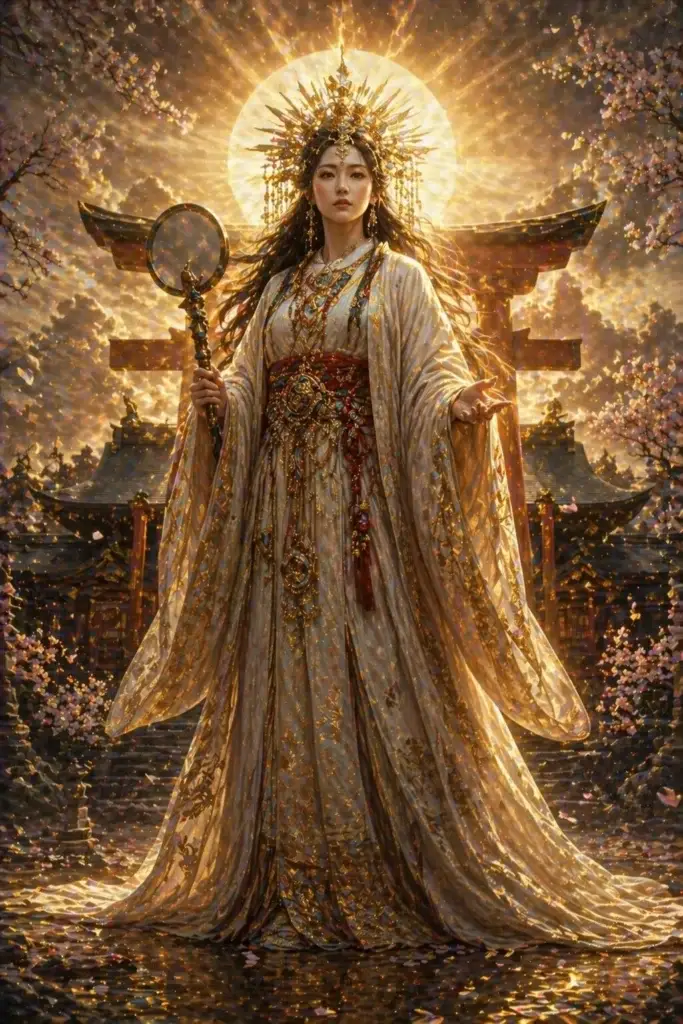
Yama-no-Kami is a goddess of Japanese tradition.

Mistress of the mountains and of wild game, in spring a field deity.

GoddessJapan

Table of Contents

Yama-no-Kami, the mountain kami of Shinto
Yama-no-Kami

Yama-no-Kami is the mountain kami or mountain deity of Shinto and folk belief, a functional and collective term for mountain deities. In much of rural Japan she is thought of as female, often jealous, and presides over hunters, woodcutters and farmers.

A core aspect is the seasonal exchange with the field deity Ta-no-kami: in spring the mountain kami descends and watches over the rice fields, returning to the mountains after the autumn harvest. In this way she links the mountain world with the agrarian world.

Overview: Yama-no-Kami

Type: mountain kami, functional and collective term for mountain deities
Origin: Shinto and folk belief, documented through folklore studies
Texts: folkloric research, among others by Yanagita Kunio
Period: folk belief up to the present day
Appearance: usually a mountain kami regarded as female and jealous

Region of origin and sources

Period of the Texts

Yama-no-Kami belongs to Shinto and folk belief; the complex has been documented mainly through folklore studies, above all by Yanagita Kunio.

Area of Diffusion

Japan, especially the rural mountain regions; the basic pattern is widespread, though its forms vary regionally.

Sources

Well documented in its basic pattern, regionally variable: folklore research, above all Yanagita Kunio’s Yama no jinsei, along with Blacker’s study of Japanese shamanism.

Name and variants

Japanese: Yama-no-Kami literally means kami of the mountain; it is not a proper name but a functional designation. In mythology, Ōyamatsumi from the Kojiki is regarded as lord of the mountains; in folk belief, however, Yama-no-Kami is primarily a local, often nameless mountain deity and not identical to the classical mythological kami.

Nature and effect

Appearance

In much of rural Japan, Yama-no-Kami is female, often imagined as a jealous goddess considered ugly. Several customs and taboos derive from this connotation.

Effect

Yama-no-Kami is mistress of the mountain game; hunting success is regarded as her gift. In spring she descends from the mountains and becomes Ta-no-kami, the field deity who watches over the growth of the rice fields; after the autumn harvest she returns to the mountains and becomes Yama-no-Kami again.

Profile: Yama-no-Kami

The key aspects of the mountain kami at a glance.

Cultural Context

Shinto and rural folk belief: a complex of local, often nameless mountain deities, documented through folklore studies by Yanagita Kunio.

Relates To

Hunters, woodcutters, charcoal burners and farmers: the mountain kami presides over them, and her favour decides the outcome of the hunt and the harvest.

Depiction

Usually thought of as a female goddess regarded as jealous and ugly; often worshipped only at a stone, a tree or a small hokora.

Function

Mistress of the mountains and of the game; in seasonal exchange with Ta-no-kami she is also the field deity over the growth of the rice.

Dealing with it

Local shrines and simple mountain sanctuaries, the okoze offering of the Matagi hunters, as well as mountain and women’s taboos, the breaking of which is considered dangerous.

Comparables

Within Japan, the Yamauba and the Tengu; typologically, the master-of-animals deities of other hunter cultures, such as the Georgian Dali.

From mythological kami to a mountain deity of hunters

Yama-no-Kami literally means kami of the mountain and is not a proper name but a functional designation. In mythology, Ōyamatsumi from the Kojiki is regarded as lord of the mountains; in folk belief, documented mainly by Yanagita Kunio, Yama-no-Kami is instead primarily a local, often nameless mountain deity of hunters, woodcutters and charcoal burners, and not identical to the classical mythological kami.

Central to the complex is the seasonal exchange: in spring Yama-no-Kami descends from the mountains and becomes Ta-no-kami, the field deity who watches over the growth of the rice fields; after the autumn harvest she returns to the mountains and becomes Yama-no-Kami once more. This pattern links the mountain world of the hunters with the agrarian world of the farmers.

Living customs and classification

Yama-no-Kami is a fixed subject of Japanese folklore studies, notably in the work of Yanagita Kunio, and remains alive today in rural regions through customs such as the okoze offering and mountain closure days. In popular culture she is less firmly established than the Tengu or the Yamauba.

In the study of religion, Yama-no-Kami is fundamentally protective and giving with regard to hunting, harvest and forest, yet sensitive to broken taboos; the danger lies in violating a taboo, not in mere malice. Three clarifications: Yama-no-Kami is not a single god but a complex of local mountain deities. The female connotation and the okoze and women’s taboos belong to the folk layer of tradition. And the exchange with Ta-no-kami is a regionally widespread pattern, not a nationwide dogma.

Okoze offering, mountain closure and taboos

Numerous local Yama-no-Kami shrines and simple mountain sanctuaries exist, often no more than a stone, a tree or a small hokora. The Matagi, the professional hunters of the Tōhoku region, offer the goddess the particularly ugly stonefish Okoze, so that the sight of an even uglier creature might please her. In many places the hunting and mountain area was considered taboo for women, and on her feast day the mountain must not be entered, because the deity is then counting her trees.

Mountain kami, mountain yōkai and mistresses of the game

Within Japan, Yama-no-Kami merges at the edges with mountain yōkai such as the Yamauba and the Tengu. Typologically comparable are master-of-animals deities of other hunter cultures, whose favour decides hunting success, such as the Georgian Dali.

Frequently asked questions about Yama-no-Kami

Is Yama-no-Kami a single god?

No. It is a complex of local mountain deities, not a single god; the name is a functional designation.

Why is the stonefish Okoze offered to her?

Because she is regarded as jealous and concerned about her appearance; the sight of an even uglier creature is meant to please her.

What is the exchange with Ta-no-kami?

In spring the mountain kami becomes the field deity over the rice fields and returns to the mountains after the autumn harvest.

Further links

Recommended internal links:

  • Japan – all beings of the Japanese world of belief
  • Yamauba – the mountain demoness with whom the mountain kami merges at the edges
  • Dali – the Georgian mistress of the game as a typological counterpart
  • Amulet, Smoke cleansing, Salt – traditional protective means
  • Protection Compass – protective means at a glance

Literature (selection)

A selection of key sources and studies:
  • Blacker, Carmen: The Catalpa Bow. A Study of Shamanistic Practices in Japan. London 1975.
  • Foster, Michael Dylan: The Book of Yōkai. Berkeley 2015.
  • Yanagita Kunio: Yama no jinsei. Tokyo 1926.

Further standard works in the bibliography.

As a Japanese mountain kami and goddess of hunters and fields, Yama-no-Kami links two worlds: the wild mountain region, whose game she grants, and the rice fields over which she watches in summer as Ta-no-kami.

Classification & Protection

IILEVEL
The Protection Compass assigns this being to influence level II, Noticeable influence.

Against its influence, cross-cultural tradition names these protective means:

Compare in the Protection Compass →

Recommended protective means

iWell Guard

The simplest protective means in this collection: 41 layers of fine gold 999, platinum, silver and silicon, manufactured in Ruhla, Thuringia. It requires no activation, is bound to no person, and is effective within a radius of around 50 meters, even without being worn.

All protective means at a glance →