Yamauba, the old mountain woman between terror and blessing
By Ralf Ittermann · last reviewed on
Yamauba is a demoness of Japanese tradition.
Man-eater of the mountains and nurturing mother of Kintarō. Yamauba’s story moves between terror and blessing, man-eater and nurturing mother by turns.
Yamauba, also known as Yamamba or Yamanba, is Japan’s mountain witch or mountain woman, an old woman of the mountains. She is ambivalent: as a man-eater she attacks travellers, while as a nurturing figure she brings fertility and prosperity.
In the Kintarō legend of Mount Ashigara, she is regarded in several versions as the supernatural mother of Kintarō, the later warrior Sakata no Kintoki. Her central literary attestation is the Nō play Yamamba, which portrays her as a wise, cosmically wandering mountain spirit.
Type: mountain witch, ambivalent mountain demoness
Origin: medieval to early modern narrative, Nō and Kabuki tradition
Texts: Nō play Yamamba, folk tales, Kabuki, Ukiyo-e
Period: Middle Ages to early modern era, afterlife to the present
Appearance: old woman with wild white hair, sometimes with a second mouth

Historical Classification
Period of the Texts
Yamauba originates from medieval to early modern folk and narrative tradition, from fairy tales, Nō, Kabuki and Ukiyo-e, with no connection to the Kojiki.
Area of Diffusion
Japan, especially the mountain regions of the narrative tradition; the Kintarō legend is linked to Mount Ashigara.
Sources
Well documented: the Nō play Yamamba, traditionally attributed to Zeami, along with folk tales, Kabuki and Ukiyo-e, as well as modern research from Reider to Copeland and Ehrlich.
Name and variants
Japanese: yama means mountain, uba old woman or nursemaid, so mountain crone or mountain woman; Yamamba and Yamanba are assimilated forms. The name denotes exactly what the legends tell: an old woman who dwells in the mountains.
Appearance and effect
Appearance
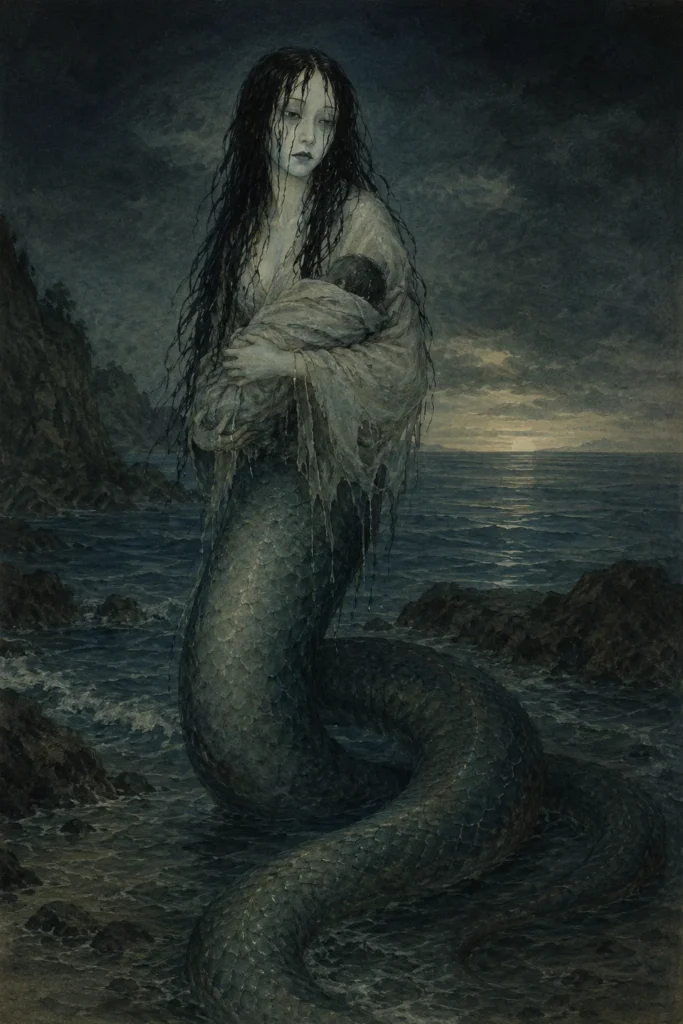
Yamauba is usually an old woman with wild, long, often white hair and a tattered kimono. A widespread horror motif is a hidden second mouth on the crown of her head, beneath the hair. Depending on the tale, she is either monstrously man-eating or dignified and superhuman.
Effect
As a man-eater, Yamauba lures and attacks travellers in the mountains. At the same time, she is a bearer of fertility and prosperity: she raises the superhumanly strong child Kintarō, and in some places her visit brings wealth or a good harvest.
Profile: Yamauba
The key aspects of the mountain witch at a glance.
Japanese narrative and stage tradition: fairy tales, Nō, Kabuki and Ukiyo-e; no connection to the Kojiki.
Travellers in the mountain regions, whom she threatens as a man-eater; also villages, to whom her visit brings wealth or a good harvest.
Old woman with wild white hair and a tattered kimono; as a horror motif, a hidden second mouth on the crown of her head.
Man-eating on mountain paths, yet also fertility and prosperity; in the Kintarō legend she is the nurturing foster mother of the hero child.
No uniform sacrificial cult; regionally there are places and stones linked to Yamauba, as well as the veneration of Kintarō in the Ashigara area.
Related to the female Oni and mountain demonesses; typologically close to Baba Yaga and Frau Holle, but distinctly Japanese in character.
From the mountain crone to the Nō play Yamamba
The name is made up of yama, mountain, and uba, old woman or nursemaid, so mountain crone or mountain woman; Yamamba and Yamanba are assimilated forms. The figure originates from medieval to early modern folk and narrative tradition, from fairy tales, Nō, Kabuki and Ukiyo-e, with no connection to the Kojiki.
The central literary reference is the Nō play Yamamba, traditionally attributed to Zeami, in which she appears as a wise, cosmically wandering mountain spirit. Alongside this stands the Kintarō legend of Mount Ashigara: in several versions, Yamauba is regarded as the supernatural mother of Kintarō, the later warrior Sakata no Kintoki, raising the superhumanly strong child.
From a figure of terror to a screen for projection
Yamauba appears in Nō, in Kabuki and in numerous Ukiyo-e, often together with the child Kintarō. In the modern era, she has changed from a figure of terror into a screen for projections of femininity and ambivalence; the term Yamanba was also borrowed for a Japanese fashion style.
From a religious-studies perspective, Yamauba, in her man-eating form, is very dangerous, yet highly context-dependent. Three clarifications: she is not unambiguously evil, and the ambivalence between devouring and fertility is her essential nature. The Nō play depicts her as a sublime mountain spirit, not as a monster. And the mother-of-Kintarō variant is only one among several.
Places, stones and the veneration of Kintarō
A widespread, formal shrine and festival cult is only partly documented for Yamauba. Regionally, there are locations and stones associated with her, as well as her close association with the veneration of Kintarō in the Ashigara area. Overall, she is more a figure of narrative and stage than the object of a uniform sacrificial cult; protection from her dangerous side belongs to the world of fairy tales, not to liturgy.
Mountain witches and forest women compared
Within Japan, Yamauba is related to the female Oni and mountain demonesses; at the margins, she merges with the mountain kami Yama-no-Kami. Typologically, she is comparable to ambivalent European witches and forest women such as Baba Yaga or Frau Holle, who are likewise both threatening and giving figures.
Frequently asked questions about Yamauba
Who is Yamauba?
The mountain witch or mountain woman of Japan, an old woman of the mountains with an ambivalent nature between danger and gift.
Is she evil?
Not unambiguously. Her essential nature is the ambivalence between man-eating danger and nurturing fertility.
What does she have to do with Kintarō?
In several versions of the legend of Mount Ashigara, she is regarded as the supernatural mother of Kintarō, whom she raises.
Further links
Further reading:
- Japan – all beings of the Japanese belief world
- Oni – the demon beings whose females Yamauba is related to
- Yama-no-Kami, Sōjōbō – other figures of the Japanese mountain world
- Salt, Amulet, Iron – traditional protective means
- Protection Compass – protective means at a glance
Literature (selection)
Further standard works in the bibliography.
As Japan’s mountain witch and mountain woman of legend, Yamauba deliberately remains two-faced: the same old woman who becomes a terror on the mountain path raises little Kintarō as a nurturing mother.