Beings from the Germanic tradition on iWell Guard. The pre-Christian world of gods and spirits of Northern and Central Europe. Main sources: the Prose Edda, the Poetic Edda, skaldic poetry, archaeological finds.
This page documents Germanic religion from the Iron Age pantheon to the age of the Eddas.
Germanic religion is a difficult tradition from the standpoint of source criticism. What we know stems almost entirely from late Christian Icelandic transmission: the Poetic Edda and the Prose Edda were compiled in the 13th century, long after Norse paganism had ceased to be a living religion.
Pre-Christian inscriptions, runes and place names supplement this picture, but do not replace it.
At the centre stand two families of gods: the warlike Aesir around Odin, Thor, Tyr and Frigg, and the fertility-related Vanir around Freyr, Freyja and Njord. Mythologically the system is dynamic: it ends in Ragnarok, the doom of the gods, and thereby gains an eschatological depth that other polytheistic systems do not possess.
The popular religion revolved around protective spirits: house spirits (Hausvaettr), land spirits (Landvaettir), fylgjur (personal spirits of fate) and disir (female ancestral spirits). In the history of religion this layer is often deeper and older than the Aesir mythology, and it survived in Scandinavian folk customs into the 19th century.
Period: the Bronze Age (1500 BC) to Christianisation (10th-12th century). Texts: the Prose Edda (1220), the Poetic Edda.
Distribution: Scandinavia, mainland Germania, the British Isles. Viking Age expansion as far as Russia and North America.
Sources: the Prose Edda, the Poetic Edda, skaldic poetry, Saxo Grammaticus, Tacitus’ Germania, runic inscriptions.
Pantheon and classes of beings: Aesir (Odin, Thor, Frigg), Vanir (Freyr, Freyja), giants, dwarves, elves, Norns.
Germanic religion before Christianisation is known only through archaeological evidence, late written transmission (the Eddas) and classical sources (Tacitus).
The reconstructed pantheon divides into two cosmic dynasties: the Aesir (gods of order and war, led by Odin and Thor) and the Vanir (gods of fertility and magic). Mythologically this is codified as a former war between the dynasties.
The cosmic final state of Ragnarok describes the cyclical destruction and rebirth of the world. Important figures are Odin (wisdom, war, magic), Thor (thunder, order), Freyja (love, war, magic) and Loki (chaos, transgression). The written sources stem from authors of the Christian era and are therefore ideologically coloured. The original rites are lost.
The practices that can be reconstructed include sacrificial rituals (blót), runic divination and ritual acts for the harvest and for war. Sacred groves and springs were cult centres. Skalds and priests administered the mythological knowledge. Protective rituals and runic writing served spiritual defence.
Christianisation from the 8th to the 12th century displaced these practices; yet they endured in folk traditions (Walpurgis Night, May festivals) and in regional beliefs about spirits. Spirit beings such as alfar (elves) and disir (protective spirits) remained present in folk tradition. Shamans and seers (völvas) were specialised experts on the spirit world.
Germanic religion no longer exists as a living, organic tradition. Archaeological and literary reconstruction is academically rigorous, but speculative. The modern Asatru movement has attempted a revival since the 20th century, but is ideologically heterogeneous and has been co-opted by right-wing extremist groups.
Popular culture (Tolkien, Marvel’s Thor, video games) has aestheticised Norse mythology and made it available to mass culture. The myths serve as metaphors for psychological and existential themes, not as a living system of belief.
The Norse pantheon comprises two families of gods: the Aesir, with roughly 13 principal gods (Odin, Thor, Tyr, Heimdall, Baldur, Bragi, Forseti, Hodur, Vidar, Vali, Ull and others), and the Vanir, with Njord, Freyr and Freyja as central figures.
Added to these are the goddesses (Frigg, Idun, Sif, Skadi, Saga) and countless nature beings, giants, dwarves, elves and valkyries. In all, the Edda names roughly 50 to 60 gods and goddesses by name.
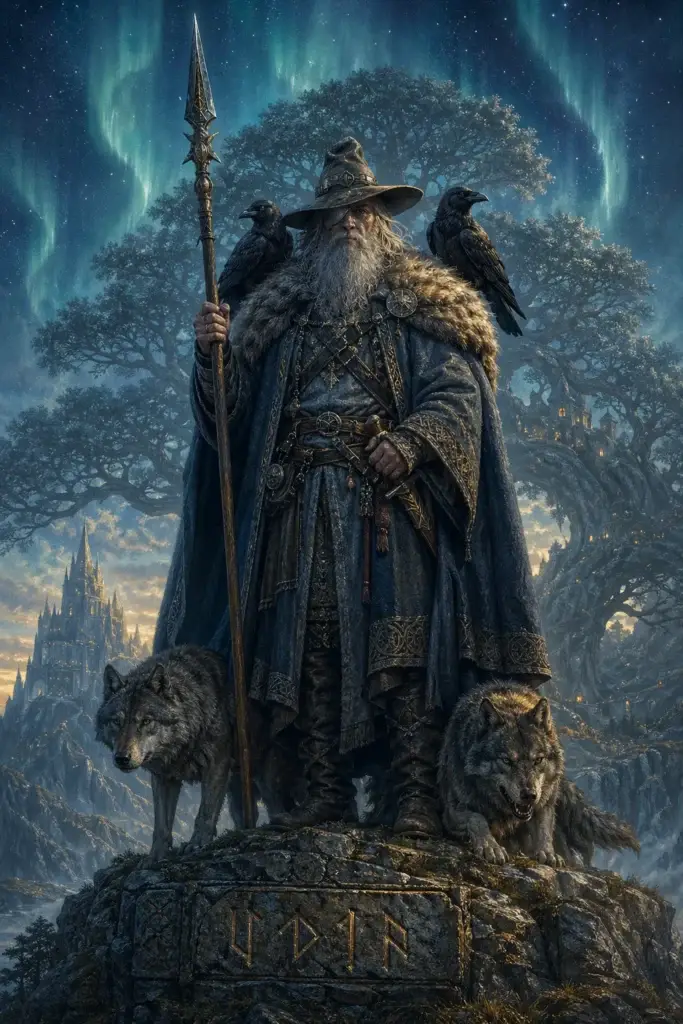
Odin (also Wodan, Woden) is the chief god of the Aesir pantheon, god of wisdom, of poetry, of magic, of war and of the dead.
He gave his eye for a draught from Mimir’s well and hung for nine days on the world tree Yggdrasil to win the runes. Thor is his son and, in popular belief, especially among farmers and seafarers, more beloved; yet Odin holds cosmic pre-eminence.
The Aesir and Vanir are two families of gods. The Aesir (Odin, Thor, Tyr, Heimdall, Baldur) stand for war, law, kingship and fate. The Vanir (Njord, Freyr, Freyja) are gods of fertility, peace and wealth.
After the war of the Vanir, both families exchanged hostages: Njord, Freyr and Freyja came to the Aesir. In the study of religion, the division is regarded as a memory of the merging of two pre-Germanic layers of religion.
Ragnarok is the twilight of the gods, the end of the present world order. Its omens are three winters without summer (the Fimbulwinter), war between brothers and the collapse of the moral order.
At Ragnarok, Loki breaks free of his bonds, the wolf Fenrir devours Odin, Thor kills the Midgard serpent and dies of its venom, and Freyr falls against Surt. Heimdall blows the Gjallarhorn. After the catastrophe, a new, purified world rises with the return of Baldur.
Yggdrasil is the world tree, an evergreen ash that bears the universe. Three roots reach into Asgard (to the gods), Jotunheim (to the giants) and Niflheim (to the underworld of Hel).
At the roots lie three wells: Urd (fate), Mimir (wisdom) and Hvergelmir (the primal spring). The trunk connects the nine worlds. The squirrel Ratatoskr runs between the eagle in the crown and the dragon Nidhogg at the root, carrying insults back and forth.
The Germanic days of the week mirror the pantheon: Tuesday (English) and Dienstag (German) belong to Tyr (Tiwaz, Tiu). Wednesday belongs to Odin/Wodan, visible directly in the English as Woden’s day.
Thursday is Thor’s day, the English name making it immediately recognisable, while the German shows Donar, an older form of Thor. Friday belongs to Freyja (or Frigg, on which scholarship is divided). This naming replaced the Roman planetary week in the Germanic region.

Germanic religion is considerably more poorly transmitted to us than the Greek or Mesopotamian. The most important sources, Snorri Sturluson‘s Prose Edda and the anonymous Poetic Edda, were written down in the 13th century in Iceland, that is, centuries after Christianisation.
Added to these are Tacitus’ Germania, the Icelandic sagas and archaeological finds. The Continental Germanic tradition is known almost exclusively at second hand.
The Germanic pantheon knows two families of gods: the Aesir (Odin, Thor, Tyr, Frigg, Loki) and the older, fertility-related Vanir (Njord, Freyr, Freyja).
The two families waged a war that ended with an exchange of hostages, a mythologem for the historical merging of two cultic layers. Alongside them stand the giants (Jotunn) as primal cosmic powers.
Unlike most ancient mythologies, the Germanic tradition knows a clear end point: Ragnarok, the fate of the gods. The Voluspa describes the final battle in detail: Thor dies fighting the Midgard serpent, Odin in the jaws of the wolf Fenrir. Yet afterwards a new earth rises from the sea, and some of the gods return.
The runes, the elder Futhark, the younger and the Anglo-Saxon, were more than a writing system. Inscriptions on weapons, amulets and gravestones show their ritual use.
Odin’s self-sacrifice on the world tree Yggdrasil is regarded as the mythological foundation of rune magic. The sources also know galdr (sung sorcery) and seidr, a shamanic trance practice.
Germanic religion is methodologically delicate to research, because a large part of the sources, the Prose Edda, the Gylfaginning, was edited only in the 13th century in an already Christianised Iceland.
Standard works are Hilda Ellis Davidson’s “Gods and Myths of Northern Europe” (1964), Rudolf Simek’s “Lexikon der germanischen Mythologie” (1995) and Anders Hultgard in several contributions to the history of Indo-European religion.
In the Germanic-Norse tradition, Thor’s hammer pendants (Mjölnir) and runestones were the most common portable protective signs.
iWell Guard places itself within this cultural-historical line of portable objects of protection, in a contemporary material architecture, manufactured in Germany. 41 layers, solid gold, platinum, silver. 30-day right of return.
Personal experiences may vary. Not a medical device. No promise of healing.
The lexicon of protective symbols treats several signs and objects from the Germanic world on their own pages: bracteate, protective runes, Thor’s hammer, troll cross, valknut, Vegvísir and Ægishjálmur. The page on protective symbols offers a cross-cultural overview.