Freyja, Goddess of the Germanic Tradition
By Ralf Ittermann · last reviewed on
Freyja is one of the central goddesses of Germanic mythology, presiding over love, fertility, war and prosperity. She belongs to the lineage of the Vanir and embodies sensuality, female power and magical knowledge in Norse sources such as the Prose Edda.
Freyja is depicted with gold, cats, falcons and the neck ornament Brisingamen. She chooses half of those fallen in battle (alongside Odin) and leads them to her hall Folkvangr. She is venerated in fertility cults, in marriage vows and in female craft practices.
Type: Principal Germanic goddess, Vanir, goddess of love, war and magic
Pantheon: Germanic / Norse (Vanir lineage)
Function: love, beauty, sex, war, seidr (Norse ritual magic), half of the fallen warriors
Main attributes: Brisingamen necklace, falcon-feather cloak, cat-drawn chariot, tears of gold
Main cult sites: no dedicated temples documented; popular cult in Scandinavia and northern Germany
Siblings: Freyr (brother, principal Van)
Historical Context
Freyja has been central since the earliest Scandinavian sources. Principal sources: Snorri Sturluson Snorra-Edda (1220) and the Poetic Edda (13th century, containing older poems).
She is the foremost of the Vanir goddesses (the older, pre-Aesir divine lineage), received as a hostage in Asgard with her father Njord and brother Freyr after the war between Aesir and Vanir.
The main flowering of her cult: pre-Christian Scandinavia (Viking Age, 8th, 11th centuries). The Christianisation of Scandinavia (10th, 12th centuries) interrupted the cult, but folk customs (Friday gatherings of women, veneration of cats in some regions) persisted.
In the 19th and 20th centuries there was a Romantic revival; she is again central in the modern Asatru tradition.
Tacitus mentions in his Germania (98 AD) a goddess Nerthus who was venerated by several Germanic tribes and whose name is linguistically related to Njord. Scholarship regards Nerthus as a figure belonging to the Vanir and thus as a possible early parallel or precursor to the Freyja tradition, even though a direct equation is not possible.
Geographical Distribution
Dedicated Freyja temples are not clearly documented; several Scandinavian place names (for example Frejskult sites in Sweden) point to old cult places of Freyr. In the 11th century Adam of Bremen mentions the temple of Uppsala with statues of Odin, Thor and Freyr (not explicitly Freyja, though implicitly in the Vanir context).
In modern Asatru (active in Scandinavia, the USA, the UK and Germany) she is venerated again; in Iceland Asatru has been a state-recognised religion since 1973, with Freyja as principal goddess in some lineages.
Place-name research has recorded in Sweden, Norway, and Denmark a number of Frö- and Freys-names pointing to cult sites or cult areas, which, however, go back to Freyr and therefore do not count as evidence of a Freyja cult. This field of research is considered an important supplement to the literary tradition, as it provides evidence for the geographical spread and local rootedness of the Freyr cult that cannot be obtained from the Eddic texts alone.
Central sources: Snorri Sturluson, Snorra-Edda (Gylfaginning, Skaldskaparmal); Poetic Edda (Hyndluljod, with the principal myth concerning Freyja and Ottar; Thrymskvida, on Freyja’s Brisingamen).
Secondary literature: Simek, Dictionary of Northern Mythology; de Vries, Altgermanische Religionsgeschichte; Nasstrom, Freyja. The Great Goddess of the North (standard work); Lindow, Norse Mythology; Davidson, Roles of the Northern Goddess.
Among the archaeological evidence are gold bracteates from the Migration Period, on which female figures wearing necklaces are depicted; they are occasionally interpreted in scholarship as representations of Freyja, although a secure identification remains difficult. In addition, place-name research in Scandinavia documents numerous Frö- and Freys-names, which, however, go back to Freyr and therefore do not count as evidence of a Freyja cult.
Name and Variants
Freyja is depicted in the various sources and artistic traditions with certain recurring iconographic elements that remain relatively constant across decades and across different geographical regions. These elements are not merely decorative or chosen at random, but are deeply symbolically encoded and carry great significance.
They convey central functions, sources of power, areas of responsibility and the cosmic role of the being.
The overall system resembles a sacred script or an encoded image; it allows initiates or the culturally educated to grasp and rightly understand the essential deeper meaning. Colours, sacred objects or weapons, bodily attributes and specific accessories, all are significant and traditionally transmitted.
Characteristics
Freyja was central to religious practice, everyday ritual and the daily understanding of the Germanic peoples. In critical or specific life situations, or at particular ritual times of the year, people turned to this entity with structured, often elaborate rituals, prayers or offerings.
The seidr magic associated with Freyja was a regulated art with its own specialists: the völva, an itinerant seeress with a staff and a fixed ritual procedure, practiced it, and according to the Edda it was Freyja herself who introduced this practice among the Aesir. Whoever performed seidr followed learned procedures, chants, and role conventions, not free improvisation.
The continuity of these practices across many generations clearly shows that the practice was regarded as effective and necessary. Functions were varied: some were preventive (averting potential misfortune), some healing (alleviation of illness or suffering), some transformative (accompaniment through transitions between stages of life).
Appearance and Symbolism
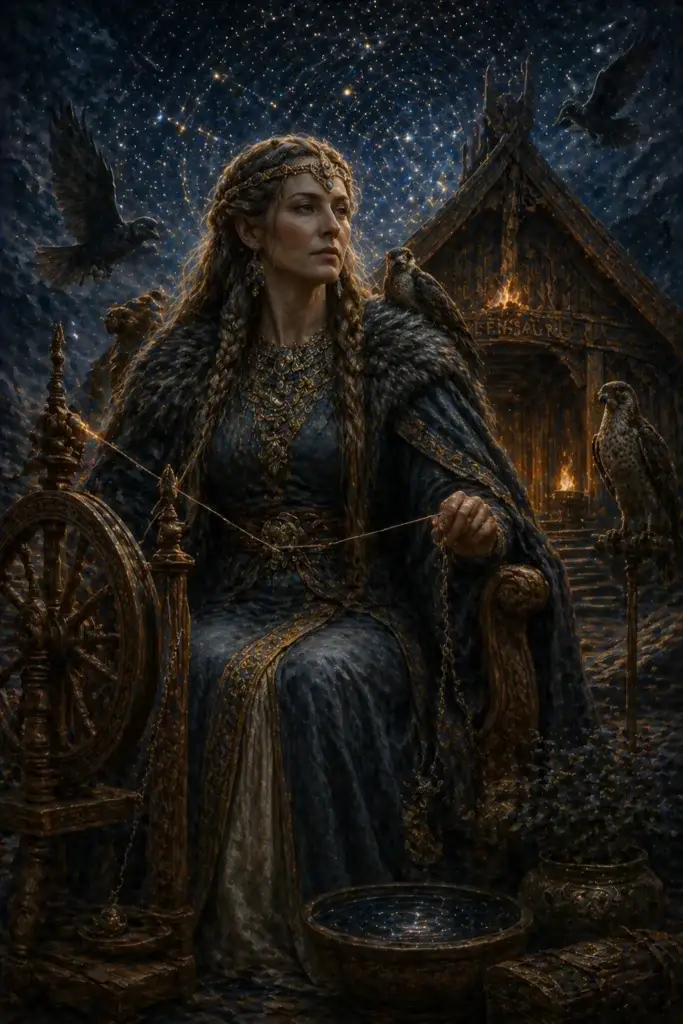
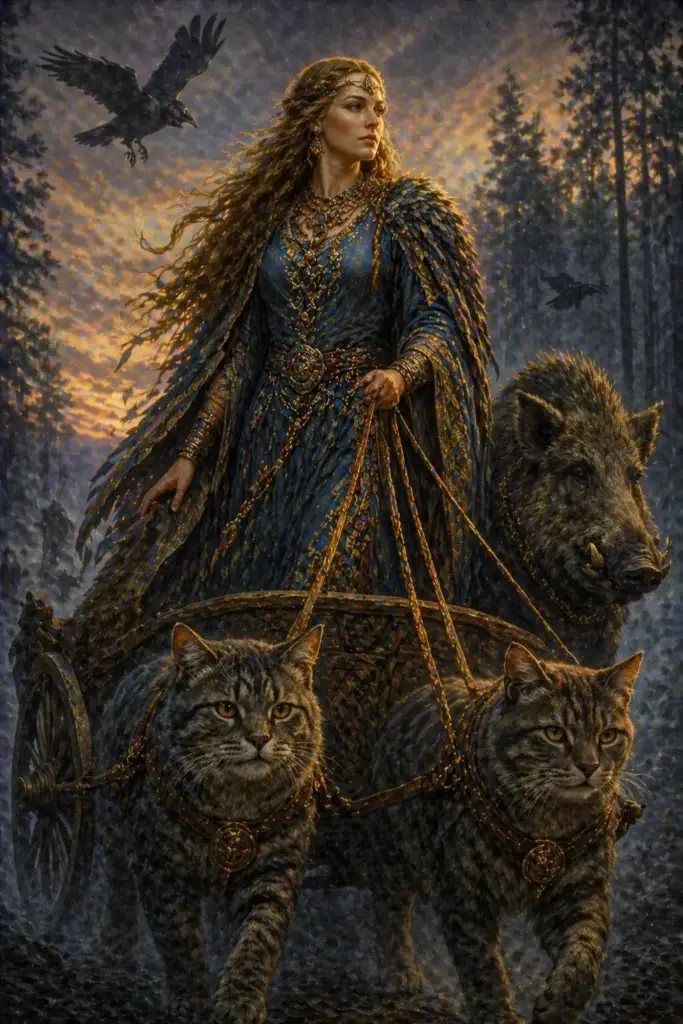
Freyja is depicted with the golden necklace Brisingamen. She rides in a chariot drawn by cats. Her falcon cloak allows her to fly in falcon form. The rose, the spring and the warrior woman embody her many-sidedness. The sea belongs to her sphere.
The most important aspects of Freyja at a glance. The following fields summarise origin, function, appearance, veneration, symbols and cultural parallels.
Tradition
Freyja is the daughter of Njord (sea god). Sister of Freyr, with whom she forms the Vanir sibling pair.
Spouse of Od/Odur (identified with Odin in some sources); her husband disappears on endless travels, and Freyja seeks him weeping, her tears turning to gold. Mother of the daughters Hnoss (“jewel”) and Gersemi (“precious thing”). In the Hyndluljod, she has a relationship with the mortal Ottar.
Sphere of Action
Goddess of love, beauty, sexuality and fertility. She also has a double function as a war goddess: according to Snorri she chooses half of the fallen warriors for her retinue in Folkvangr (the other half goes to Odin in Valhalla), a remarkable hierarchy that places Freyja on equal footing with Odin.
Patroness of seidr magic (shamanistic, oracular deep magic, which she taught to the Aesir). In personal cult, she is invoked in matters of love, in needs of fertility, and in warlike and seidr practice. In modern Asatru she is a central female initiation goddess.
Depiction
A beautiful young woman, often portrayed as youthfully erotic, distinctly different from the matronly Frigg. Golden hair, multi-layered court dress, often with armour beneath it (double function).
The Brisingamen necklace serves as her principal attribute, an elaborate gold necklace which she obtained from four dwarves (through intercourse with each), one of the most famous stories of Germanic mythology.
The falcon-feather cloak (Falken-fjadrhamr) is also lent to Loki. She rides in a chariot drawn by two large cats (the most famous and most distinctive Freyja symbol). She is also frequently shown with a sword or a boar helmet.
Freyja's Influence
Sphere of influence: In the old Germanic folk cult, Freyja was invoked in matters of love and concerns of fertility. Seidr practitioners (later volva, prophetic women) were regarded as her followers. In Scandinavian folk tradition, cats are her sacred animals, hence the taboo against harming a cat.
In the modern Asatru tradition she is the principal goddess of the women’s blot gatherings (especially in the Vanatru branches, which focus on the Vanir). Sacred weekday: Friday (in some traditions shared with Frigg; some scholars hold Frigg and Freyja to have originally been identical).
Forms of Defence
Brisingamen necklace (main attribute, elaborate gold chain), falcon-feather cloak, cat-drawn chariot (two large cats), sword, boar helmet, tears of gold (symbol of her search for Od).
Sacred animals: cat (especially the Norse forest cat), boar (she also rides the gold-bristled Hildiswin), falcon. Sacred plants: strawberry, elder, daisy (“Freyja plants” in folk belief), ragged robin. Sacred weekday: Friday.
Counterparts
Frigg (Germanic, a closely related or perhaps originally identical goddess), Aphrodite (Greece, goddess of love), Venus (Rome), Inanna/Ishtar (Mesopotamia, love and war united in one figure, remarkably similar to Freyja), Astarte (Phoenicia), Hathor (Egypt), Lakshmi (Hinduism), Erzulie Freda (Vodou).
In functional terms, all double goddesses of love and war share aspects of Freyja. In the Germanic pantheon she is, after Odin, the most important deity of all.
No direct equivalent of Freyja is attested in the Anglo-Saxon tradition, yet the weekday Friday (Old English frīgedæg) is traced back to a goddess named Frige. Scholarship debates whether Frige, Frigg, and Freyja go back to a common older divine figure or were always distinct figures. Britt-Mari Näsström has argued for an original identity of all three figures; this view is nonetheless considered controversial and is rejected by other scholars.
Freyja, Parallels in Other Cultures
Freyja shares characteristics with Inanna, Aphrodite and the Devi-Shakti tradition, a multiple function comprising love, war and magic that is uniquely condensed in the Germanic-Norse pantheon. Unlike pure love goddesses of other cultures, Freyja commands her own army and possesses, in seidr, her own magical tradition.
Jewish tradition: Lilith and other demonic or magical female figures share with Freyja features of sexual autonomy, magical competence and independence from the patriarchal pantheon, contrasting in cultural history but structurally similar in their subversion.
Greco-Roman world: Aphrodite and Venus correspond to Freyja in love and sensuality, while Athena corresponds to her warlike side. No Greek goddess unites both dimensions as Freyja does.
Slavic tradition: Freyja and Slavic love goddesses such as Mokosch or Stentatsia show parallels in fertility, household and female magic. Both traditions preserve the Indo-European goddess duality (housewife and warrior).
Hinduism: Lakshmi and Durga similarly embody prosperity and sensuality on the one hand and warlike power on the other, with Durga as Shakti converging especially with Freyja’s combative role.
In comparative Indo-European religious research, Georges Dumézil interpreted Freyja as an example of the third of the three Indo-European basic functions, the function of fertility, material wealth, and reproduction. The Vanir as a whole are regarded within this interpretive framework as gods of this third function, while the Aesir embody primarily the first (sovereignty) and second (warrior) functions.
The Sources: Snorri, the Poetic Edda and the Problem of Late Transmission
What we know about Freyja stems almost exclusively from texts that were written down in Christian Iceland in the 13th century, that is, centuries after the Christianisation of Scandinavia.
The most important sources are the Poetic Edda, a collection of mythological and heroic poems, and the Prose Edda of Snorri Sturluson, a handbook of poetic art that systematically presents the mythological material.
Snorri assigns Freyja to the Vanir, that divine lineage distinguished from the Aesir and joined with them after the mythical war between the two groups.
He calls her the most distinguished of the goddesses and ascribes to her the dwelling of Folkvangr, on which the hall Sessrumnir stands. A frequently quoted stanza states that Freyja receives half of those fallen on the battlefield, while the other half goes to Odin in Valhalla.
This source situation demands methodological caution. Snorri was an educated Christian who sought to order the old knowledge and preserve it for poetic art, but who also viewed it through the lens of his own time. Where the Poetic Edda and Snorri mutually support each other, the tradition is relatively firm.
Where Snorri stands alone, it is open whether he renders older knowledge or supplements it systematically. The research of recent decades, for instance the work of Britt-Mari Nasstrom specifically on Freyja, has therefore emphasised that every statement about the goddess must be tied back to its source.
In some source passages Sessrúmnir also appears as the name of a ship, which has led to speculation about a connection between Freyja, ships, and the cult of the dead. Hilda Ellis Davidson argued in Gods and Myths of Northern Europe (1964) that Freyja’s relationship to death and fate was older and more comprehensive than the later literary tradition suggests, and that the division of the slain with Odin goes back to a synthesis of Vanir and Aesir ideas.
The Brisingamen and the Dispute over the Cats
Among Freyja’s firm attributes is the necklace or neck ornament Brisingamen. Snorri mentions it, and the Anglo-Saxon epic Beowulf knows a related piece, the Brosinga mene, which points to a familiarity with the conception that reached beyond Scandinavia.
A detailed narrative about the acquisition of the Brisingamen is, however, preserved only in a late source, the Sorla thattr, a tale from the 14th century whose value for pre-Christian religion is disputed.
In the poem Thrymskvida of the Poetic Edda the Brisingamen plays a role when Thor is to disguise himself as Freyja in order to recover his stolen hammer, and in doing so puts on the goddess’s necklace as well.
The episode is comically conceived, and at the same time shows how closely the Brisingamen was thought to be bound up with Freyja’s identity.
A further well-known attribute is her team of cats, which draws her chariot. This detail too rests essentially on Snorri’s authority. Scholarship has discussed which animals were originally meant, since the Old Norse word is not unambiguous in every case, and larger felines or other animals have also been proposed.
Such debates make clear that even apparently firm “facts” about Freyja often rest on the interpretation of single words. According to Snorri she also possesses a falcon-feather cloak with which one can fly, and the boar Hildisvini.
In the Þrymskviða of the Poetic Edda, the giant Þrymr demands Freyja as a bride price for the return of Thor’s hammer. Freyja refuses indignantly, whereupon Thor himself is sent to Þrymr in disguise, dressed in women’s clothing and wearing the Brísingamen as a bride. The episode attests how closely the Brísingamen was conceived as bound to Freyja’s identity and dignity, and shows at the same time that the goddess was not regarded as negotiable goods but as an autonomous figure within the divine order.
Freyja and Seidr: Magic at the Boundary of Gender Roles
A particularly illuminating tradition in the history of religion connects Freyja with seidr, a form of ritual magic. Snorri reports in the Ynglinga saga that Freyja mastered this art and taught it to the Aesir, in particular to Odin.
According to the sources, seidr served, among other things, for divination, for influencing fortune and fate, and for harmful magic.
It is noteworthy that seidr in the sources appears burdened with a problem of gender. Several texts indicate that the practice of seidr was regarded as unmanly for men, as ergi.
When Odin practises seidr, this is reproached as shameful by Loki in the Lokasenna. That the art derived from a goddess and was practised above all by women fits this picture.
Freyja stands at an interface. She joins the spheres of love and fertility, which are usually ascribed to her, with the power over hidden knowledge and over fate.
This connection is not a contradiction but corresponds to a pattern that is also encountered with other Vanir deities: fertility and the power over fate belong together because both concern becoming and passing away.
Scholarship discusses whether behind Freyja stands an older, more wide-reaching goddess of fate and vegetation, whose profile is only partially visible in the transmitted mythology.
A certain answer is not allowed by the sources, but the connection of seidr, war, love and death makes Freyja one of the most multi-layered figures of the Norse pantheon.
The Eiríks saga rauða provides one of the most vivid descriptions of Seiðr practice in Old Icelandic saga literature: a seeress sits elevated on a scaffold, is brought into a trance through song, and dispenses prophetic answers. This description reveals the ritual framework within which Seiðr was performed and attests the close connection between trance, song, and divination. Neil Price, in his studies of Seiðr and Norse war ideology, has identified this practice as a central, long-underestimated component of Old Norse religion, emphasizing Freyja’s role as the original teacher of this art.
Further Reading and Links
Scholarly Literature
Frequently Asked Questions about Freyja
Who is Freyja?
Freyja (Old Norse Freyja, “Lady”) is the most important female deity of Norse mythology. She belongs to the lineage of the Vanir and is regarded as patroness of love, of fertility, of the knowledge of fate and of seidr magic. In her, erotic, magical and warlike aspects are joined, which makes her one of the most multi-layered figures of Germanic tradition.
What role does Freyja play among the Vanir?
Freyja stems from the lineage of the Vanir, the older divine family, which was received into the circle of the Aesir after the war of the Vanir. She is the daughter of Njord and the sister of Freyr, and is regarded as the foremost Vanir goddess. In the Gylfaginning Snorri describes her, alongside Frigg, as the most important female deity of the Norse pantheon.
What does Freyja have to do with the war dead?
According to the Grimnismal and Snorri’s Gylfaginning, Freyja receives in her hall Folkvang the one half of those fallen in battle, while the other half falls to Odin in Valhalla. Hilda Ellis Davidson has argued that Freyja’s relation to death and fate was older and more comprehensive than the later literary tradition suggests. She thus joins responsibilities that otherwise appear distributed among several deities.
How is the source situation for Freyja?
The central written testimonies stem from the 13th century, among them the Snorra-Edda, the Poetic Edda and the late-transmitted Sorla thattr. The texts reflect the pre-Christian religion not in unbroken form, but in a Christianised record. The archaeological tradition is sparser than for Odin or Thor, which is why many statements about Freyja remain a subject of scholarly discussion.