iWell Guard

Wayland the Smith, master of forge and revenge

Wayland the Smith is god of Germanic tradition.

The master smith who forges himself wings to freedom.

Table of Contents

Wieland the Smith, master smith of legend
Wayland the Smith

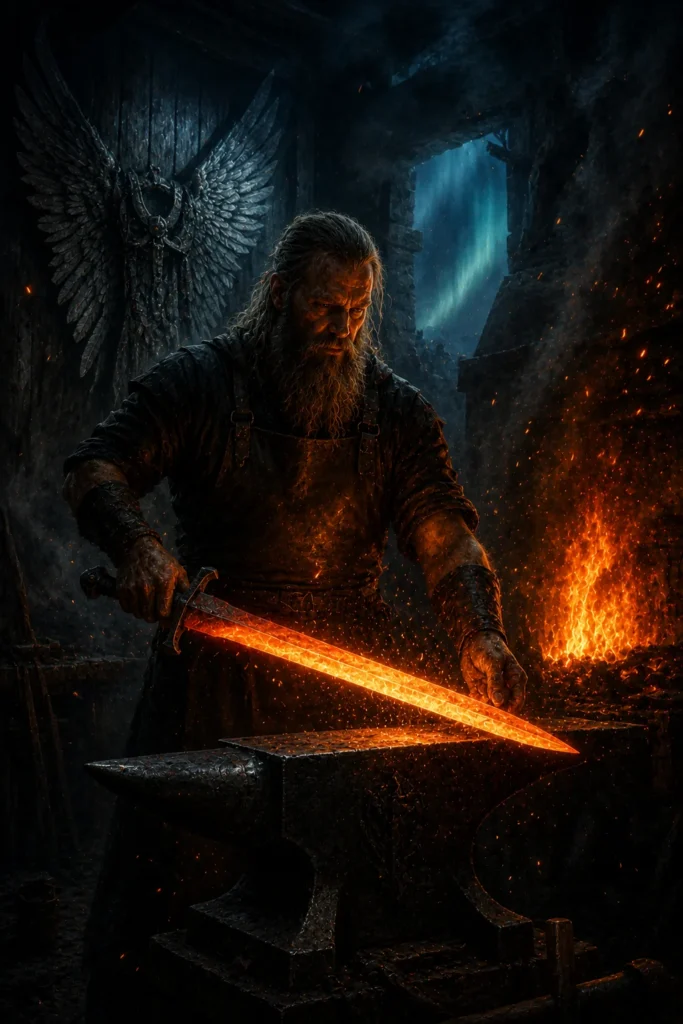
Wieland the Smith, Old Norse Völundr, is the most famous master smith of Germanic legend. His skill at the forge fire is superhuman; the legend tells of his captivity, his cruel revenge and his escape on wings he forged himself.

Wieland is not a fully developed cult god, but a mythical smith who, in some interpretations, is counted among the mythical demigods. His name still stands proverbially for the highest smithing skill today.

Overview: Wieland the Smith

Type: Mythical master smith of heroic legend tradition
Origin: Northern and Western Germanic regions: Scandinavia, England, Germany
Texts: Völundarkviða (Poetic Edda), Thidrekssaga
Period: Migration Period to the High Middle Ages
Appearance: human-superhuman smith, often depicted as lamed

Source Context

Period of the Texts

The material spans from the Migration Period to the High Middle Ages; it is documented in writing in the Poetic Edda and in the Thidrekssaga.

Area of Diffusion

The Northern and Western Germanic regions: Scandinavia, England and Germany all know the legend, in England under the name Wayland.

Sources

Well attested: the Völundarkviða of the Poetic Edda and the Old Norse Thidrekssaga, along with pictorial evidence such as the Anglo-Saxon Franks Casket.

Name and variants

Name forms: German Wieland, Old Norse Völundr, English Wayland. The name still clings to places such as the burial chamber Wayland’s Smithy in England and remains proverbial for the highest smithing skill.

Form and Activity

Appearance

Wieland is depicted as an outstanding master smith, whose fire and anvil produce wondrous weapons and elaborate jewellery. In the legend he is lamed to prevent his escape; his symbol is the transforming, yet also dangerous, power of the forge fire.

Effect

Wieland forges swords and rings of legendary quality. Captured by King Nidhad and lamed in the tendons of his feet to force him to work, he carries out an elaborate revenge and finally escapes through the air with a winged garment he made himself.

Profile: Wieland the Smith

The key aspects of the master smith at a glance.

Tradition

Heroic legend tradition of the Germanic region; not a temple god, but in some interpretations counted among the mythical demigods.

Responsible for

The craft of smithing in its highest form: swords, rings and jewellery of legendary quality emerge at his forge.

Depiction

Human-superhuman smith, often depicted as lamed; the Anglo-Saxon Franks Casket shows scenes from his story.

Function

Embodiment of the transforming, yet dangerous, power of the forge fire: brilliant and creative, yet capable of cruel revenge in the legend.

Handling

No formal cult; in folk belief around Wayland’s Smithy, an invisible smith shoes horses in exchange for a coin.

Parallels

Hephaistos, Vulcanus and Goibniu: divine smiths, often associated with physical impairment.

Captivity, revenge and flight: the legend of Wieland

Wieland is a mythical smith, not a fully developed cult god, but in some interpretations he is counted among the mythical demigods. The main sources are the Völundarkviða of the Poetic Edda and the Old Norse Thidrekssaga; pictorial evidence such as the Anglo-Saxon Franks Casket depicts his story. In some versions, his father is a giant or a sea being.

The core of the legend is his captivity: King Nidhad has Wieland’s foot tendons lamed to keep him captive and force him to forge for him. The captive responds with an elaborate, cruel revenge and finally escapes through the air with a winged garment he made himself, perhaps the strongest image in the legend for the transforming power of his craft.

From Wayland to fantasy

Wieland is firmly established in Germanic heroic legend and continued to have an effect, for instance as Wayland in England and in modern adaptations in literature and fantasy. His name remains proverbial for the highest smithing skill.

From a religious-studies perspective, Wieland is a prime example of the mythical smith, whose fire is both creative and dangerous. One clarification: he is a legendary figure, not a temple god with a formal cult. The motif of the lamed yet unsurpassed smith links him across cultures to Hephaistos and points to an old notion of the ambivalence of the smithing craft.

Folk belief rather than temple cult

Wieland has no formal cult; he is a legendary figure, not a temple god. However, his name clings to places and monuments, such as the burial chamber Wayland’s Smithy in England, around which folk belief grew that an invisible smith shoes horses there in exchange for a coin. Such legends show the popular veneration of the master smith as a supernatural helper.

Smith gods compared

Wieland corresponds to the Greek Hephaistos, who likewise limps and creates wondrous works as a divine smith, as well as to the Irish smith god Goibniu and the Roman Vulcanus. All embody the creative forge fire, often linked with physical impairment.

Frequently asked questions about Wieland the Smith

Who was Wieland?

The most famous master smith of Germanic legend, Old Norse Völundr, known in England as Wayland.

Why was he lamed?

King Nidhad had his foot tendons lamed to keep him captive and force him to forge for him.

How did he escape?

He forged himself a winged garment and fled through the air, after carrying out an elaborate revenge.

Further links

Recommended internal links:

Literature (selection)

A selection of key sources and studies:
  • Völundarkviða. In: Lieder-Edda. Old Norse.
  • Thidrekssaga. 13th century.
  • Simek, Rudolf: Lexikon der germanischen Mythologie. Stuttgart 2006.

Further standard works in the bibliography.

As the Germanic master smith, Wieland unites the fire and craft of legend in a single figure: captive, lamed and yet unconquerable, since his skill in the end even grants him wings.

Classification & Protection

IIILEVEL
The Protection Compass assigns this being to influence level III, Burdensome influence.

Against its influence, cross-cultural tradition names these protective means:

Compare in the Protection Compass →

Recommended protective means

iWell Guard

The simplest protective means in this collection: 41 layers of fine gold 999, platinum, silver and silicon, manufactured in Ruhla, Thuringia. It requires no activation, is bound to no person, and is effective within a radius of around 50 meters, even without being worn.

All protective means at a glance →