Frau Holle, figure of the Rauhnächte and winter weather
By Ralf Ittermann · last reviewed on
Holla is a goddess of the Germanic tradition.
Known as Mother Holle, a figure presiding over weather and diligence, widely interpreted as a mother goddess. This profile examines Mother Holle as mistress of winter weather, whose shaking of feather beds brings the snow.
Holla, popularly known mostly as Frau Holle or also Hulda, is widely interpreted as an old earth and mother goddess of the Germanic-speaking world; whether she continues a pre-Christian goddess or arose only in the Middle Ages is open. She watches over weather, the seasons and fertility, rules over an ambiguous otherworld and is at the same time revered as protector of house and hearth.
She became known above all through the Grimm fairy tale Frau Holle (KHM 24), which still shapes her strict, just character to this day. The earliest clear written trace goes back to the year 1010, in the Corrector sive Medicus of Bishop Burchard of Worms.
Type: figure of weather, fertility and the otherworld, widely interpreted as an earth and mother goddess
Origin: Germanic-speaking world, earliest trace around 1010 (Burchard of Worms)
Texts: medieval church penitentials, Grimm’s Children’s and Household Tales (1812/1857), 19th-century folklore collections
Period: especially the Rauhnächte and winter, still alive today in custom and place names
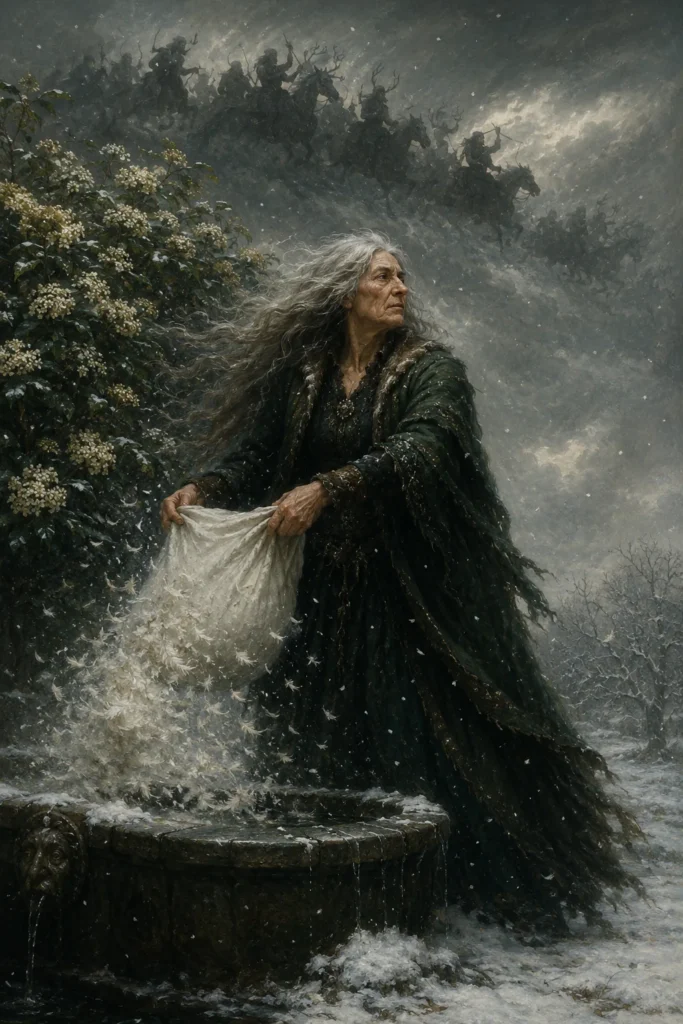
Appearance: old woman with flowing hair, motherly or frightening depending on context
Region of origin and sources
Period of the Texts
Earliest written trace around 1010 in Burchard of Worms, established in literature through Grimm’s Children’s and Household Tales in 1812 and in the final version of 1857.
Area of Diffusion
The entire German-speaking region, with a focus on Hesse and Thuringia, plus outliers in alpine areas.
Sources
Medieval church penitentials, 19th-century folklore collections and customs and place names that remain alive to this day form the basis of the sources.
Name and variants
Old High German: Linguistically, the name is usually derived from hold, meaning gracious, favourably disposed, giving Holda as ‘the gracious one’. Alongside this, tradition also shows a folk-etymological link to the elder shrub, dialectally Holler; whether this connection is linguistically original or arose later is considered unresolved.
Being and effect
Appearance
Holla usually appears as an old woman with long, often flowing or matted hair, bearing both frightening and motherly traits at once. She rules over a well or pond that is regarded as an entrance to her otherworld, and over the clouds, from which she lets snow fall when shaking out her bedding.
Effect
As teacher of spinning and weaving she watched over diligence and order in the household; spindles left lying about provoked her wrath in the legends. As leader of the Wild Hunt and the Rauhnächte, she also embodies the dark, death-adjacent side of winter.
Profile: Frau Holle
The most important aspects of Frau Holle at a glance.
Widely interpreted as a Germanic earth and mother goddess, with early church attestation around 1010 and a fairy-tale tradition through the Brothers Grimm that remains alive to this day.
Weather, fertility and spinning work, as well as unborn and prematurely deceased children’s souls, which according to legend she shelters in her pond.
Old woman with flowing hair, motherly or frightening depending on context; as a figure of speech, she shakes out her bedding when it snows.
Rewarding diligence with a shower of gold, punishing laziness; as leader of the Wild Hunt, also mistress over snowfall and storm.
Prayers and incense during the Rauhnächte, carried talismans and protective stones, and respectful treatment of the elder shrub.
From Burchard of Worms to the Brothers Grimm fairy tale
The earliest clear written trace of the figure appears around the year 1010 in the Corrector sive Medicus of Bishop Burchard of Worms, who asked women whether they believed there was a Holda with whom one rides at night. One manuscript of the text even calls her strigam Holdam, the witch Holda, placing her in the context of the so-called Canon Episcopi on the nocturnal ride with Diana. A 13th-century text reports that on Christmas Night people set the table for the queen of heaven, whom the people call Frau Holda, so that she might help.
In the Middle Ages, church sources equated Holda with Diana, Herodias, Berta and Abundia, thereby placing her close to the witch persecutions. She acquired her best-known form today through the fairy tale Frau Holle by the Brothers Grimm (KHM 24), first printed in 1812 and revised into its final version in 1857.
Frau-Holle-Land and modern rediscovery
Through the Grimm fairy tale KHM 24, Frau Holle became one of the best-known German fairy-tale figures of all, still shaping children’s books, plays and the tourism marketing of the Hesse region, which promotes itself as Frau-Holle-Land. The colloquial exclamation Holla, die Waldfee is commonly associated with the legendary figure, although its exact origin has not been conclusively established linguistically.
From a religious studies perspective, Holla is an example of how pre-Christian vegetation and mother deities transitioned into Christian-shaped legendary figures. Church sources from the 11th century onwards show how the clergy branded belief in nocturnal processions with Holda as superstitious and demonic, without actually extinguishing popular belief. It is debated whether Holla continues an independent, pre-Christian goddess or whether she only took shape in the Middle Ages from various local ideas and church polemics against witchcraft; the sparse and late source material does not allow a firm conclusion here.
Prayer, incense and the elder shrub
Tradition surrounding Holla is defined above all by rules of conduct and pious practices. Widespread were prayers to Holla or for her protection, complemented by incense, which was meant to purify and protect house and farm when burned during the Rauhnächte. Worn talismans and protective stones, as well as a spoken banishing spell, were meant to keep evil influences away during her nocturnal processions, while magical protective signs were placed on doors and windows. Speaking charms over illness and misfortune, along with the use of protective herbs, also belonged to the traditional repertoire of defence. A special custom concerned the elder bush: anyone wishing to prune or fell it was to greet it and ask permission first, since it was believed to be the dwelling place of Holla or of good spirits.
Goddesses of Winter and the Wild Hunt
Within Germanic mythology, Holla stands in close structural proximity to Frigg, the wife of Odin and goddess of marriage and motherhood, as well as to Freyja, who is associated with fertility and love. She is also connected to Odin through her leadership of the Wild Hunt. The alpine Frau Perchta is regarded in many places as a regional sister figure to Holla, sharing a similar dual role as punisher and rewarder.
Frequently Asked Questions about Frau Holle
Are Holla and Frau Holle the same figure?
Yes, Frau Holle is the fairy-tale form of the same legendary figure popularised by the Brothers Grimm, known in older and regional sources as Holla or Hulda. The core traits as weather and mother figure remain consistent in both name forms.
Why is the elder bush considered sacred?
The elder was regarded as a preferred dwelling place of good spirits and was popularly associated with Holla. Anyone who cut or felled it was to greet it first, so as not to forfeit the protection of the household.
Is Holla more of a benevolent or a dangerous figure?
Both at once: she rewards diligence and cleanliness generously, but punishes laziness and disrespect just as clearly. As leader of the Wild Hunt, she also carries uncanny, death-related traits that go beyond the gentle fairy-tale figure.
Further links
Further reading:
- Germanic – all beings of the Germanic gods and spirit world
- Frigg, Freyja, Odin – further figures of the Germanic pantheon
- Frankincense, Talisman, Banishing spell, Speaking charms, Prayers – traditional forms of protection
- Protection Compass – overview of protective means
Literature (selection)
Further standard works in the bibliography.
Known as Holla, widely interpreted as a goddess of the Germanic-speaking world, and equally as the Frau Holle legend of the Brothers Grimm, she combines strict justice with maternal care over weather, diligence and the otherworld.