iWell Guard

Telipinu, Hittite vegetation god and vanishing son

Telipinu, Hittite Telipinuš, is the son of the weather god Tarhunna and a central vegetation and fertility god of the Hittite pantheon. His disappearance in anger brings the world to the brink of famine, while his return restores order and growth.

GodHittiteVegetation god

Table of contents

Telipinu - Gods from the Hittite tradition, historical and illustrative

Overview and brief profile

Telipinu belongs to the younger, mythically active generation of the Hittite pantheon.

Unlike his parents Tarhunna and the sun goddess of Arinna, he is a narrative figure par excellence; the myth named after him is one of the best-known pieces of ancient Near Eastern narrative literature and ranks alongside the Mesopotamian Dumuzi myth and the Ugaritic Baal cycle.

In religious-studies terms, Telipinu represents the ‘vanishing god’ (the deus otiosus type, though in a contingent rather than permanent variant). When he is angry and hides himself, the vegetation withers, the cattle no longer bear young, the gods themselves go hungry.

Only an elaborate calming ritual brings him back. The myth is thus a theological reflection on the dependence of the world on divine goodwill and on the ritualized restoration of emotional balance.

Trevor Bryce, in The Kingdom of the Hittites (2005), showed that Telipinu had his most important cult site in the Hattic-Hittite city of Tawiniya (today probably north of Boğazkale).

In the imperial pantheon he did not stand at the very top, but he was indispensable as guarantor of the harvest and of fertility. Within the Hittite tradition, he is one of the few gods whose mythical narrative was actively reactivated in ritual practice.

Name and etymology

The name Telipinu is of Hattic origin. Volkert Haas, in Geschichte der hethitischen Religion (1994), reconstructed its probable meaning as ‘great son’; the Hattic element -pinu with the meaning ‘son’ or ‘boy’ is comparable, combined with the prefixoid element teli- in the sense of ‘strong, great’. In Hittite the form Telipinuš appears with the typical nominative ending; the ending-free form Telipinu is customary in modern usage.

It is noteworthy that the name is also attested as a royal name: Telipinu the Great King (ca. 1525 to 1500 BC) gave Hittite history the famous Telipinu Proclamation on the succession to the throne.

This identity of names is not accidental: the king bore the name of the god as an expression of dynastic piety and cultic attachment.

In Luwian, Telipinu appears more rarely and with less cultic significance; the Hattic-Hittite tradition shaped him firmly. In logographic spelling he frequently appears as DTelipinu, without a Sumerian logogram, which underlines his genuinely Anatolian origin. No Akkadian or Hurrian translation of the name has been handed down.

Description and iconography

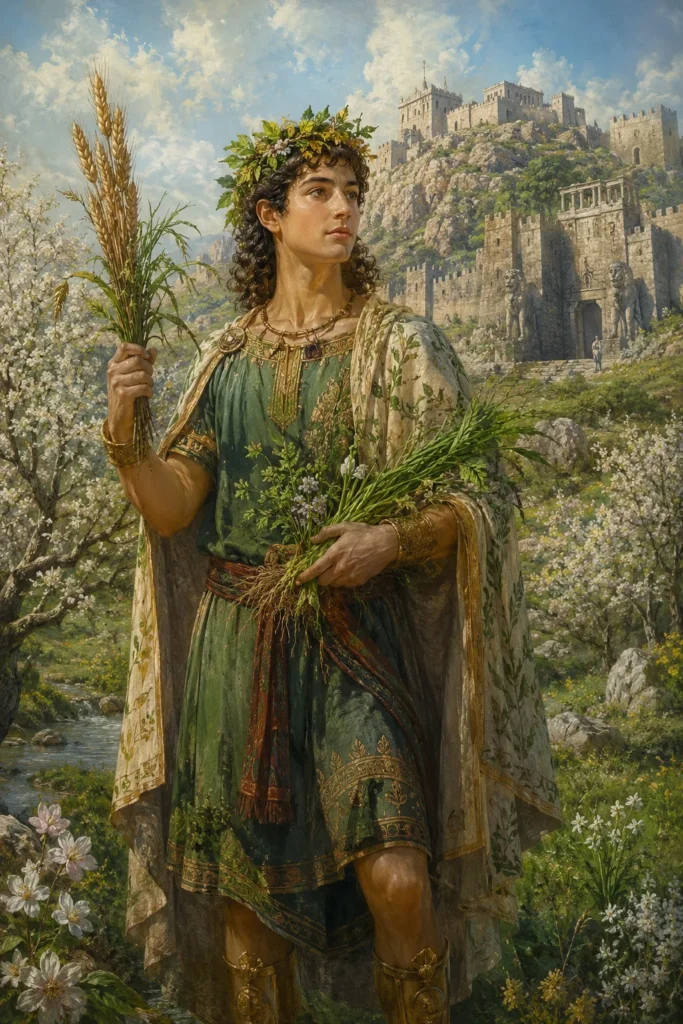
Telipinu is iconographically hard to pin down, because no clearly identifiable free-standing cult images survive. From the texts one can reconstruct that he appeared as a youthful god with a short kilt and a headdress with horns, holding a plant or a bundle of ears of grain in his hand.

The grain iconography links him with similar vegetation deities of Mesopotamia, above all with Dumuzi and Nisaba.

His sacred animal is the stag; in some texts he appears as ‘protective god of the field’ with a stag as mount or companion.

The stag iconography also becomes visible in the Hattic-Hittite cult standards of Alaca Höyük, those ring-shaped standards with animal finials that date from the Middle Bronze Age and can probably be assigned to Telipinu.

A special feature is his cult tree, the eya tree (probably an oak or pedunculate oak).

In the closing scene of the ritual of the Telipinu myth, an eya tree is set up, on which a fleece hangs containing ‘fat, grain, wine, sheep and cattle, long years and sons’. This ‘Telipinu fleece’ is one of the oldest attested cult objects of Hittite religion and probably a real item that was kept in his temples.

Mythological narratives

The Telipinu myth (CTH 324) survives in several versions, the most important translated in the edition by Gary Beckman, Hittite Myths (1998).

The plot in outline: Telipinu falls into anger (the reason is not expressly given), pulls his right sandals over his left feet and vice versa, leaves land and gods behind, and falls asleep in a distant meadow. Thereupon all life withers: ‘The grain grew no more, cattle, sheep and people no longer reproduced.’

Tarhunna searches for his son in vain, then the sun goddess, then an eagle that flies over the whole world. Finally a bee, sent by the mother goddess Ḫannaḫanna, manages to find Telipinu.

The bee stings him in his hands and feet, which only intensifies his anger. Only through a complicated calming ritual, led by the goddess Kamrušepa, is the anger removed from his interior and bound into symbolic vessels.

With Telipinu’s return the world blossoms again, and the Great King is placed under the eya tree, where the fleece of prosperity guarantees future fortune.

In terms of the history of religion, the myth is the Hittite example par excellence of a seasonal ritual with a seasonal myth; Volkert Haas interpreted it in detail as a spring ritual.

The theological structure of ‘anger, disappearance, search, return, prosperity’ was identified by Beckman as the basic pattern of the Hittite ‘vanishing god’ myths; the same structure is also found in myths about the disappearance of the sun god, of the storm gods, and even of the entire community of gods.

Cult and veneration

Telipinu’s main cult site was Tawiniya, the Hattic homeland of the Hittites in northern Anatolia. In addition there were Telipinu temples in Ḫattuša, Hanḫana and Durmitta. His festival calendar contained spring and autumn festivals; the most important was a spring festival in which the ritual retrieval of the god was re-enacted.

In the festival ritual a priestess appeared as the representative of the goddess Kamrušepa and carried out the calming actions.

The rites were prescribed in detail: certain breads, sounds, incense, but above all a fleece and clay balls that symbolically absorbed Telipinu’s anger. The divination was accompanied by bird observation and extispicy in order to test the divine state.

The priestly organization of the cult is well documented; Jared Miller, in Royal Hittite Instructions (2013), edited texts that describe Telipinu’s daily temple staff and their duties.

These included purity regulations, offerings of bread, beer, wine and occasionally animals, as well as the care of the cult statue. The temple possessed its own economic operations, fields and herds, whose yields served to supply the cult celebrations.

Protective practice and the apotropaic

The calming rituals for Telipinu were also used outside the great festival, above all in family crises, illnesses and anger between spouses.

Volkert Haas, in Materia Magica et Medica Hethitica (2003), compiled numerous texts in which the ‘anger-banishing‘ scheme of the Telipinu myth is transferred to real conflict situations: the anger is enclosed in vessels, wrapped in a fleece, or handed over beneath the earth ‘to the sun goddess of the earth’.

The Hittite ‘old woman’ (ḪAR.ḪAR) was a specialist for such rituals; she combined the art of healing, magic and priestly ritual practice in a single person.

Her activity is well documented and is among the best-researched aspects of Hittite religion. Known representatives are Anniwiyani, Maštigga and Tunnawiya, whose rituals are handed down through the court library of Ḫattuša.

In an apotropaic manner, the eya tree with fleece was reproduced in smaller domestic contexts: a forked branch on which a piece of sheepskin was hung, with symbolic offerings such as wool, olive oil and bread.

These ‘prosperity amulets‘ are mentioned several times in cuneiform inventories. The iWell Guard records this practice as historical and pertaining to the history of religion, not as a present-day protective recommendation.

Parallels in other cultures

The parallel in the history of religion to the Telipinu myth is clearly the Dumuzi myth of Mesopotamia, in which the young vegetation god descends into the underworld and returns in spring.

The Ugaritic Baal cycle (see Phoenician tradition) contains a structurally very similar scheme, with the dying of Baal after his fight against Mot and his revival through Anat.

Unlike Dumuzi, however, Telipinu does not die; he is merely angry and gone. His anger is an independent theological category and has no exact counterpart in the neighbouring pantheons.

Volkert Haas interpreted this as a specifically Anatolian theology of emotional control. The anger is not morally judged but understood as a dangerous yet transformable energy that can be banished through ritual.

In the Greek sphere, Demeter myths with the disappearance of the goddess after the abduction of Persephone recall the Telipinu narrative; scholars such as Walter Burkert have discussed possible cultural contact routes without postulating a direct dependence. Mary Bachvarova, in From Hittite to Homer (2016), examined the mechanisms of transmission in detail.

Present-day reception and research

The Telipinu myth has been standard material of ancient Near Eastern religious research since the edition by Emil Forrer (1922). Important more recent studies exist by Gary Beckman, Harry Hoffner, Volkert Haas and Piotr Taracha.

Hoffner, in his standard work Hittite Myths (with Beckman, 2nd ed. 1998), presented a translation that remains without competition to this day.

In popular reception Telipinu is little known; in Turkish school textbooks he is occasionally mentioned as an example of Anatolian mythology. In the logo of the Hittitology Congress at Çorum there appear symbols that can also be assigned to Telipinu. A spiritual revival in the neo-pagan sense is absent.

In religious-studies terms, Telipinu is today present above all in comparative studies on seasonal myths, the theology of emotion, and ancient Near Eastern ritual practice.

Current research priorities lie in the detailed investigation of the calming ritualism, in the diffusion of the ‘vanishing god’ motif, and in the question of how the Hittite variant relates to the Mesopotamian Dumuzi myth and to the West Semitic Baal cycle.

The iWell Guard regards the myth as a historical testimony pertaining to the history of religion, without reference to modern healing promises.

In comparative Anatolian studies, too, Telipinu occupies a special role, because he is the clearest example of the adoption of a Hattic deity into the Hittite imperial pantheon.

The linguistic investigations of H. Craig Melchert and Petra Goedegebuure have shown that the Hattic word forms were preserved in the cult right into the late imperial texts, a sign of the ritual conservatism that was characteristic of the Telipinu cult.

In the festival calendar Hattic songs were sung, Hattic formulas were spoken and Hattic implements were used, long after the Hattic language had died out as a vernacular.

The iWell Guard records this layering in the history of language as a finding remarkable in religious-studies terms: in the cult a language and a theology survived that had already vanished from everyday life.

A further line of research investigates the ritual-typological relationship between Telipinu calming and Mesopotamian incantation practice. The transitions between ‘myth‘ and ‘ritual‘ are especially fluid in the Hittite material; the myth is actualized in the ritual, the ritual lives from the mythical model.

This double structure has been addressed again and again in religious studies, from Gerardus van der Leeuw to more recent structuralists, and finds in the Telipinu complex one of its most impressive examples.

Literature and sources

The following selection brings together the most important editions and studies on the Telipinu myth and its cult. It is intended as an entry point for a deeper engagement with the material.

The edition by Beckman and Hoffner in particular provides a complete English translation of the myth in its best-preserved version, while Volkert Haas unpacks the contextual material of the calming rituals. Jared Miller’s edition of the royal instructions offers insight into the temple organization.

Anyone who wishes to study the Hittite ‘old woman’ and her anger-banishing rituals will find in Haas the most important text editions with German translation and extensive commentary.

Piotr Taracha’s synthesis is the most current overall account of the Anatolian religions of the 2nd millennium BC and also contains a concise placement of Telipinu within the Hattic-Hittite pantheon. An important supplement is offered by Itamar Singer in his Hittite Prayers, which contain several Telipinu invocations from the festival material.

The myth of the vanished Telipinu

The best-known Hittite text about Telipinu tells of his disappearance. Enraged, without the text naming the precise occasion, the god leaves his place.

He departs in a state of anger, puts the right shoe on the left foot and the left on the right, and disappears into the wilderness, where he lies down exhausted and falls asleep.

The consequences are devastating. The text describes with great vividness how life comes to a standstill. The smoke is stifled in the hearth, the sheep and cattle reject their young, the grain no longer thrives, gods and people starve. Even the sun god holds a feast, but no one is satisfied.

The gods search for Telipinu. The weather god and the eagle search in vain. Finally the mother goddess Hannahanna sends out a bee, which finds the sleeping god, stings him on his hands and feet, and purifies him with wax in order to wake him.

The awakened Telipinu is at first even angrier than before and causes further misfortune. Only a purification ritual, carried out by the goddess of magic Kamrushepa, calms him. His anger is symbolically banished into vessels of the underworld whose lids do not open again. Telipinu returns, and life resumes.

The text is so significant because it is a myth that was directly embedded in a ritual. It belongs to the genre of vanishing deity myths, of which there are several in Hittite writings, and it was apparently recited at rituals intended to restore a disturbed state.

The Telipinu myth and the mugawar ritual

The myth of the vanished Telipinu is not an independent literary work but part of a ritual. The clay tablets on which it has been handed down contain, besides the narrative, explicit ritual instructions. This combination of myth and rite makes the text a key example of Hittite religious practice.

The associated ritual belongs to the genre of the mugawar, which one translates as invocation or evocation, a ritual intended to call back a withdrawn deity.

In the Telipinu ritual, honey and butter, figs, olive oil and other substances are used, whose sweet, calming or purifying quality is meant to dissolve the god’s anger.

Paths are strewn with fine oil so that the god gently retraces his steps along them. An evergreen tree, the eya tree, is set up, on which a fleece hangs that symbolizes fat, grain, wine and the long life of the king.

Research mostly understands such rituals as analogy-based magical action. What the gods achieved in the myth, namely to find and appease the angry deity, is re-enacted in the ritual in order to avert concrete distress, such as a drought, a plague or the extinguishing of royal well-being.

Comparable disappearance myths are also handed down about the weather god and other deities, which shows that this was a flexible ritual scheme into which various deities could be inserted. The Telipinu myth is the best-preserved version and thus the central testimony for this Hittite ritual genre.

Telipinu between vegetation god and protective deity

The question of what kind of deity Telipinu actually is has been answered differently in research. An older, long influential interpretation saw in him a vegetation god.

James George Frazer, in his work The Golden Bough, had postulated a worldwide pattern of dying and returning vegetation gods, and the vanishing Telipinu, whose absence brings growth to a halt, seemed to fit well into this scheme.

More recent Hittitology has become more cautious here. Telipinu does not disappear regularly in the yearly cycle but out of anger, and his disappearance is not a death. The text binds the events not to a fixed calendar date but to situations of distress.

Moreover, in the god lists and in the cult Telipinu is graspable above all as the son of the weather god and as a protective deity, with his own temples in several Hittite cities. He bears the traits of a god responsible for flourishing, without therefore being a pure personification of the vegetation.

The disappearance myths can be understood more precisely as narratives about the consequences of divine anger and about the restoration of disturbed order. Volkert Haas and others have pointed out that the scheme of the vanishing god provided a model for dealing with crises.

Telipinu is therefore less a nature myth in Frazer’s sense than a god whose story exemplarily shows how Hittite religion thought about the relationship of divine anger, cosmic disturbance and ritual reconciliation. The discussion about his classification is a good example of how religious-studies models of interpretation changed in the course of the 20th century.

Literature (selection)

  • Volkert Haas: Geschichte der hethitischen Religion (Leiden 1994)
  • Gary Beckman: Hittite Myths (SBL 1998)
  • Harry A. Hoffner: Hittite Myths (with Beckman, SBL 1998)
  • Volkert Haas: Materia Magica et Medica Hethitica (Berlin 2003)
  • Piotr Taracha: Religions of Second Millennium Anatolia (Wiesbaden 2009)
  • Jared Miller: Royal Hittite Instructions (SBL 2013)

Telipinu is the Hittite vegetation god and vanishing son of the weather god, whose anger lets fertility be extinguished and whose return is achieved in a famous myth through a bee and a sacrificial ritual.

Related key terms: Telipinu Hittites vegetation god eya tree Kamrušepa anger Tawiniya.

iWell Guard and protective traditions

iWell Guard ties in with the cultural-historical tradition of portable protective objects, in the tradition of Hittite and many other cultures worldwide. 41 layers, solid gold, platinum, silver, made in Germany. 30-day right of return.

Personal experiences may vary. Not a medical device. No healing promise.

Classification & Protection

IIILEVEL
The Protection Compass assigns this being to influence level III, Burdensome influence.

Against its influence, cross-cultural tradition names these protective means:

Compare in the Protection Compass →

Recommended protective means

iWell Guard

The simplest protective means in this collection: 41 layers of fine gold 999, platinum, silver and silicon, manufactured in Ruhla, Thuringia. It requires no activation, is bound to no person, and is effective within a radius of around 50 meters, even without being worn.

All protective means at a glance →