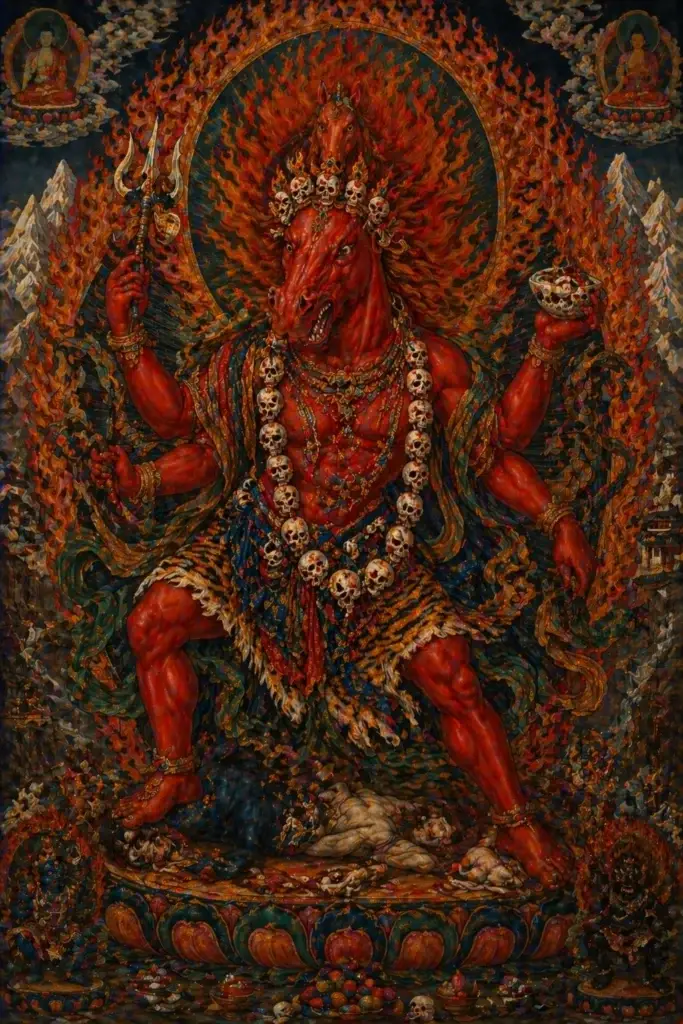
Mot, Phoenician-Ugaritic god of death and lord of the underworld
By Ralf Ittermann · last reviewed on
Mot (Ugaritic and Phoenician mt, literally ‘death’) is the god of death and ruler of the underworld in Ugaritic-Phoenician religion. In the Baal Cycle he swallows Baal and is subsequently destroyed by Anat, enabling Baal’s resurrection.
Mot is the Phoenician-Ugaritic god of death and personification of the dry season.
Classification and Brief Profile
Mot is the Phoenician-Canaanite embodiment of death. Mark Smith demonstrated in The Ugaritic Baal Cycle (1994/2009) that Mot is the second major antagonist in the Baal Cycle after Yam; his defeat by Anat enables Baal’s resurrection and thereby the return of the growing season.
Within the Phoenician tradition, Mot is the prototypical god of death and antagonist of the life-giving deities.
From the perspective of the history of religions, Mot represents the type of personified death that is rarely so clearly defined in ancient Near Eastern mythologies.
His Mesopotamian counterparts are Ereshkigal and Nergal, though each fulfils a different function; the Hittites have no exact parallel deity, but do have the ‘Sun Goddess of the Earth’ as a chthonic-underworld figure.
Mot’s conflict with Baal is not a single battle but a cyclical event: Mot defeats Baal in the dry season, Anat defeats Mot, Baal returns with the rains.
This seasonal structure makes the Mot myth a classic example of vegetation and seasonal mythology. Sabatino Moscati in Die Phöniker (1966) and Mark Smith in The Origins of Biblical Monotheism (2001) have analysed this theology.
A particular theological point of the Mot myth lies in the fact that Anat’s destruction of Mot, splitting, sifting, burning, grinding, sowing, constitutes a direct transfer of agricultural practices onto a divine conflict. Mot is treated like grain; his death enables new growth.
Compared with the Hittite tradition of the ‘Sun Goddess of the Earth’ as a chthonic counterpart to the celestial Arinna, Mot’s profile is markedly more aggressive and more developed at the narrative level.
Name and Etymology
The name mt is the common West Semitic word for ‘death’. Mot is therefore literally ‘Death’ itself, much as Yam is ‘the Sea’. This identity of divine name and cosmic category is typical of ancient Near Eastern theogony.
The Akkadian equivalent is mūtu (death); the Hebrew equivalent is māwet (with an identical etymology, likewise not primarily personified as a deity, but attested as a quasi-mythical figure in several poetic passages such as Job 18:13; Hos 13:14; Hab 2:5).
In the Ugaritic texts, Mot appears under several epithets: bn ʾilm mt ‘son of the gods, Mot’, ydd ʾil ġzr ‘beloved of El, the hero’, mdd ʾil ‘darling of El’. These epithets identify him as a son of the father-god El and underline his theological dignity.
Mot is not an evil counter-god but a legitimate son of the supreme deity with a cosmically necessary function.
In the Hebrew material, Mot appears polemically curtailed; monotheistic theology cannot accept an independent god of death alongside Yahweh. Hosea 13:14 (‘Death, where is your sting?’) has nonetheless preserved the Mot tradition verbatim; Paul cites this passage in 1 Corinthians 15:55 in his apology for the resurrection.
In certain Jewish-Aramaic magic texts of late antiquity, Mot still appears as a negative figure, particularly in amulet inscriptions from Nippur and Egypt. This late tradition demonstrates the persistent relevance of West Semitic theology in Jewish magic.
Description and Iconography
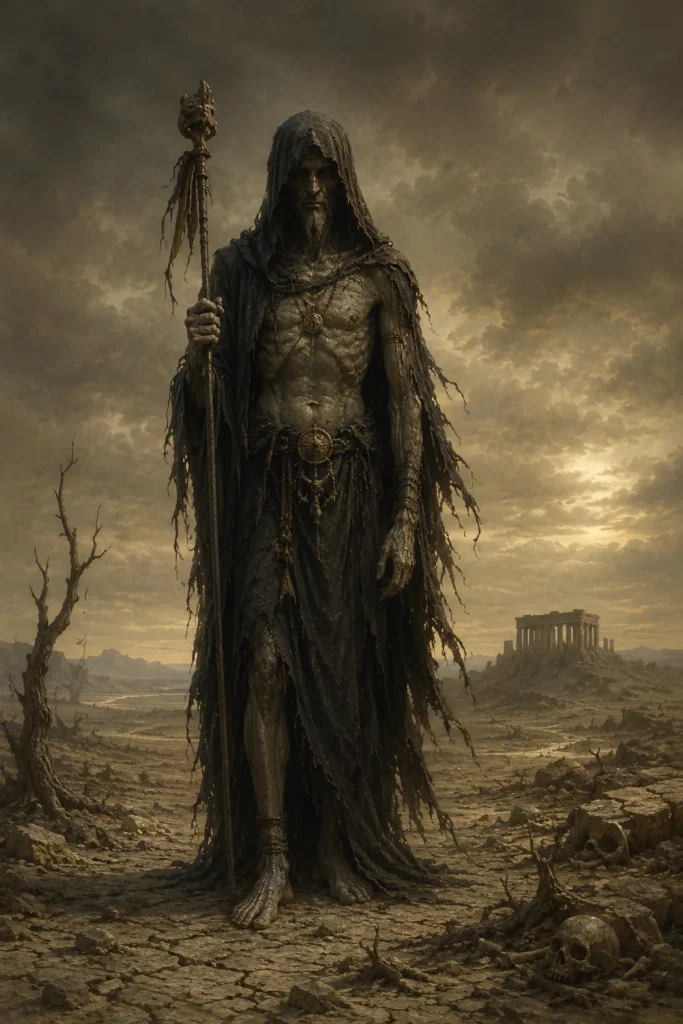
In the Ugaritic texts, Mot is described as a mighty giant whose one lip reaches the earth, the other the sky, whose tongue extends to the stars, and whose throat swallows all things. This hyperbolic description belongs to the theological-poetic style of the Baal Cycle and conveys Mot’s cosmic magnitude.
No unambiguous iconography has survived. A fragmentary Ugaritic stele may depict Mot as a bearded giant with a wide-open mouth, but the identification remains disputed. In modern Hittitology he is conceptually visualised as a ‘giant maw’ or a ‘monstrous devourer’.
His dwelling place is the underworld, frequently described as the ‘city of turmoil’ (qrt) or as ‘earth, swamp’. This underworld is a dark, muddy realm without light or water, whose atmosphere is accessible only to Mot himself and his messengers.
Living deities who descend into the underworld must take special precautions to avoid falling into Mot’s throat.
Mythological Narratives
The principal source for Mot is the Ugaritic Baal Cycle (KTU 1.4, 1.6), in particular tablets V and VI. The plot in outline: after building his palace on Mount Zaphon, Baal sends messengers to Mot to announce his kingship.
Mot responds with a threat to swallow Baal, declaring that Baal is merely a mortal among mortals. Baal initially resists, then accepts: he descends into the underworld.
Mot swallows Baal; the earth withers, vegetation dies, and the cattle cease to bear young. Anat, Baal’s sister and companion, searches for him in vain. Eventually she finds his corpse and buries it in tears.
She then turns against Mot: ‘She seizes divine Mot, splits him with a sword, winnows him with a sieve, burns him in fire, grinds him with a millstone, and scatters him over the field.’
This spectacular destruction scene is among the most striking episodes in ancient Near Eastern mythology. With Mot’s death, Baal is able to rise again and vegetation returns. Yet Mot’s defeat is not final: he regenerates after seven years, and the conflict with Baal continues cyclically. This cyclical structure corresponds to the annual vegetation period.
In the seventh year after his destruction, Mot rises again and demands that Baal surrender a brother as a substitute. Baal and Mot fight until the sun goddess Shapash induces Mot to yield. This closing scene is fragmentarily preserved and belongs to the most contested passages of the Baal Cycle.
Cult and Veneration
Mot was not a cult addressee in a positive sense; as a god of death he was not worshipped but ritually warded off or appeased. In Ugaritic burial rituals he appears as the receiver of the dead; the burial formulas ask Mot to accept the deceased without tormenting him.
His myth was recited in the royal cult; the ritual re-enactment of the Baal-Mot sequence was presumably part of the autumn or winter solstice festival, when vegetation actually died.
Baal’s resurrection in spring was then ritually renewed through the spring festival complex. This seasonal ritual practice is an important feature of Phoenician religion in the history of religions.
In Phoenician inscriptions from Iron Age contexts, Mot is not attested as a deity. The sarcophagus inscriptions of the Phoenician kings (such as Eshmunazar II) contain protective formulas against grave robbers. These ‘death formulas’ are well documented in the history of religions.
Mot’s function in burial ritual is well attested; the Ugaritic marzihu associations, a form of funerary brotherhood, held regular meals in memory of the dead. These associations are known from numerous inscriptions and belong to the most important socio-religious institutions of Ugaritic society.
Protective Practice and the Apotropaic
In burial contexts, Mot’s name appears in connection with protective gifts for the dead: food, drink, jewellery, and personal objects were to accompany the deceased into the underworld. This ‘provision for the journey’ is comparable, from the perspective of the history of religions, to Egyptian and Mesopotamian burial practices.
From a religious-studies perspective, Mot’s protective function is paradoxical: he is not a protective deity but the one against whom protection is sought.
His role in religion is negatively connoted, without his being malevolent; he is a cosmic necessity, a function in the world cycle. The iWell Guard records Mot as a historical-mythological figure with no current protective function and no references to modern healing claims.
The inscription on the Eshmunazar sarcophagus contains curses against grave robbers. These curse formulas are among the most striking epigraphic testimonies to Phoenician death theology.
Parallels in Other Cultures
Mot belongs to the international family of death deities.
His Mesopotamian counterparts are Ereshkigal and Nergal, both gods of the underworld; his Egyptian counterpart is Osiris in his underworld phase; in the Hittite sphere, the ‘Sun Goddess of the Earth’. Mark Smith presented this comparative history of religions in detail in The Origins of Biblical Monotheism (2001).
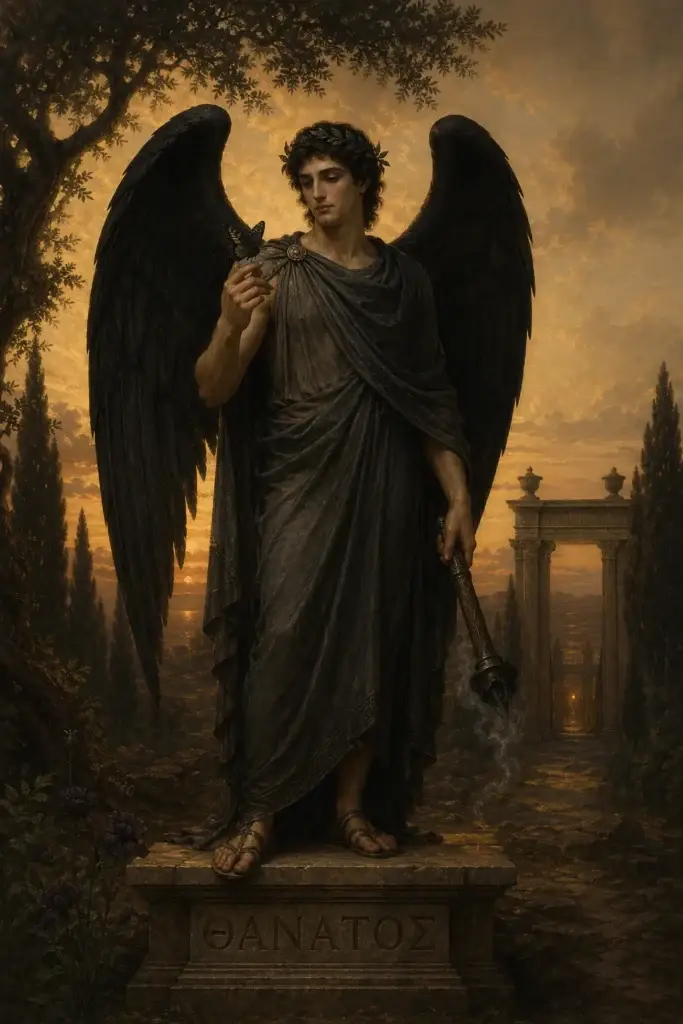
Mot shares the underworld sovereignty function with the Greek Hades, and the personified death function with Thanatos. Both Greek deities, however, have markedly different theological profiles from Mot, above all because they are not drawn into cyclical vegetation conflicts.
In the Hebrew material, Mot is not fully integrated as a cosmic counterpart to Yahweh; individual poetic texts (Hos 13:14; Isa 25:8), however, preserve the Mot tradition.
In the history of religions, Mot is for ancient Israel an ‘invisible opponent’ of monotheistic theology; his dissolution into a mere function belongs to the theological consolidation of Yahwism. With Hedammu and Ullikummi of the Hittite tradition, Mot shares the character of chaos beings, though in a distinct ‘death’ variant.
In Aramaic and Phoenician inscriptions of the first millennium BCE, Mot largely disappears as a personified deity; death is increasingly referenced only as a cosmic sphere, not as an acting deity.
This ‘de-divinisation’ of death is instructive from the perspective of the history of religions and runs parallel to a similar development in the case of Yam.
Modern Reception and Research
Mot scholarship is today at a high level. Mark Smith and Wayne Pitard’s edition of the Baal Cycle is the standard reference; John Day, Daniel Schwemer, and Corinne Bonnet have made important contributions to the history of religions.
Theodore Lewis examined the Ugaritic cult of the dead in Cults of the Dead in Ancient Israel and Ugarit (1989).
In popular reception, Mot is known primarily through the Ugaritic myths and through the Hebrew-biblical allusions. A spiritual revival in a neo-pagan sense is absent; the god of death is too foreign to modern forms of piety and too mythologically complex.
In religious studies, Mot is today regarded as a central object of study for ancient Near Eastern death and underworld religion.
Current research priorities include the connection between the Mot myth and Ugaritic burial rituals, the Hebrew-biblical parallels, and the question of the seasonal rituals that gave the Baal-Mot cycle its currency. The iWell Guard records Mot as a historical example in the study of religion with no practical protective reference.
Current research by Theodore Lewis and Joseph Lam on Ugaritic death religion places Mot in a broader context within the history of religions: as a representative of the archaic layer of West Semitic religion that was gradually dismantled in the later Iron Age through a process of theological revision.
Literature and Sources
The following selection brings together the most important standard works on Mot scholarship. It encompasses text editions, syntheses in the history of religions, and studies on the Hebrew-biblical parallels. Mark Smith’s edition of the Baal Cycle provides the primary-source foundation; Lewis offers the ritual-historical context; Day the biblical comparative level; Bonnet the Phoenician-Mediterranean perspective.
The Death of Baal and the Swallowing by Mot
The most detailed narrative about Mot is found in the latter part of the Ugaritic Baal Cycle, on tablets KTU 1.4 to 1.6. After Baal has built his palace, he challenges Mot or at least comes within his sphere of power.
Mot’s realm is described in drastic imagery: his throat reaches from the earth to the sky, his lips encompass everything, one lip at the underworld, one at the heavens. Whoever falls into this maw is swallowed.
Baal descends and is counted as dead. The text portrays El, the high god, and the goddess Anat falling into mourning; El descends from his throne, sits on the ground, and inflicts mourning wounds upon himself.
This scene is significant for the history of religions because it shows that in Ugaritic thought even the storm god can succumb to the power of death, though not permanently.
Deliverance comes through Anat. She finds Mot, seizes him, and treats him like grain: she splits him with a sword, winnows him with a fan, roasts him in fire, grinds him with millstones, and scatters him over the field.
This imagery has sparked an intensive debate about whether the Baal Cycle is an agricultural year cycle in which Mot embodies the dry season or the harvested grain.
More cautious readings, such as those of Mark S. Smith, warn against reading the text too hastily as a pure vegetation drama and emphasise the political and cosmic dimensions of the conflict.
Mot in Sanchuniathon and the Phoenician Cosmogony
Alongside Ugarit there is a second, entirely different source in which a Mot appears: the Phoenician cosmogony transmitted in Greek by the author Philo of Byblos, who attributes it to a supposedly ancient source named Sanchuniathon. This text survives only in quotations in the church writer Eusebius of Caesarea in his Praeparatio evangelica.
In this cosmogony, Mot is not a death demon in single combat but a primordial cosmogonic substance. From the union of wind and chaos there arises a muddy, moist mass, precisely Mot, from which the seeds of creation and ultimately living beings emerge.
Some scholars have seen in this a form of ‘slime’ or ‘putrid matter’; others have even understood the Greek word as a corrupted spelling of a different term.
The relationship between these two figures named Mot remains unresolved. It is not certain whether the Ugaritic god of death and the Phoenician primordial substance are even etymologically identical, or whether two different words happen to coincide here.
The Sanchuniathon tradition is itself a notoriously difficult text: for a long time it was regarded as a late invention, but since the discoveries at Ugarit a genuine ancient Phoenician core has again been conceded to it, without the extent of later reworking being determinable with certainty.
For Mot, this means: the figure stands at the intersection of two very different source worlds that do not fit together without discontinuity. For the adversary in the cycle, see also Yam.
Literature (Selected)
- Mark Smith / Wayne Pitard: The Ugaritic Baal Cycle (Leiden 1994/2009)
- Theodore Lewis: Cults of the Dead in Ancient Israel and Ugarit (Atlanta 1989)
- John Day: God’s Conflict with the Dragon and the Sea (Cambridge 1985)
- Mark Smith: The Origins of Biblical Monotheism (Oxford 2001)
- Corinne Bonnet: Les enfants de Cadmos (Paris 2015)
- Sabatino Moscati: Die Phöniker (Stuttgart 1966)
Mot is portrayed in the Ugaritic texts from Ras Shamra as the lord of the underworld who contends with the storm god over the world order in the Baal Cycle.
His name means simply “death,” and he embodies the consuming power of drought, famine, and dying. In Phoenician-Canaanite religion he remains a central figure of otherworldly powers.
In the Baal Cycle from Ugarit, Mot is regarded as the Phoenician and at the same time Ugaritic lord of the underworld, whose struggle with Baal reflects the alternation of dry season and rainy season.
Related key terms: Mot Phoenician god of death Baal Cycle Anat underworld season.
iWell Guard and Protective Traditions
iWell Guard draws on the cultural-historical tradition of wearable protective objects, in the tradition of Phoenician and many other cultures worldwide. 41 layers, real gold, platinum, silver, crafted in Germany. 30-day return policy.
Personal experiences may vary. Not a medical device. No healing claims.