iWell Guard

Hedammu, Hurrian-Hittite sea monster and serpent son of Kumarbi

Hedammu is a mighty sea monster from the Hurrian-Hittite Kumarbi cycle, begotten by Kumarbi with the daughter of the sea god. His insatiable appetite threatens the world; the sister of Teshub, Shaushka (Ishtar), lures him with dance and poisoned beer and so brings about his defeat.

Sea beingHittiteChaos being

Table of contents

Hedammu - Gods from the Hittite tradition, historical-illustrative

Hedammu is the Hurrian-Hittite sea monster from the Kumarbi myth.

Classification and brief profile

Hedammu belongs to the stone giants and chaos beings begotten in the Kumarbi cycle to threaten the divine order.

Volkert Haas, in Geschichte der hethitischen Religion (1994), and Jared Miller, in his detailed study Studies in the Origins, Development and Interpretation of the Kizzuwatna Rituals (2004), have described Hedammu as one of the most striking figures of Hurrian mythology.

Within the Hittite tradition he is the most important sea being of the myth cycle.

In the history of religion, Hedammu represents the chaotic sea in personified form, closely related to the Ugaritic Yam.

His insatiable appetite is a classic chaos-being motif: chaos devours creation if it is not contained. The myth shows that only through cunning and knowledge, not through sheer force, can the voracious chaos be subdued.

The Hedammu myth (CTH 348) survives only in fragments, however; the precise plot and above all the ending of the conflict with Teshub cannot be fully reconstructed.

Even so, the text belongs among the literarily and mythologically significant pieces of Hurrian theology. In 1989 Volkert Haas presented a detailed edition that serves as the standard reference.

The Hedammu narrative is especially interesting because it works out the gendered topos of seduction systematically. While Ullikummi is overcome by a ‘male’ tool, the saw of Ea, Hedammu is subdued by a ‘female’ means, the seduction by Shaushka. This complementarity of the sexes in the chaos-combat narratives is illuminating for the study of religion.

Name and etymology

The name Hedammu is Hurrian; the etymology is uncertain. Volkert Haas has proposed the Hurrian ḫed- ‘to eat, to devour’ as a possibility; Hedammu would then mean ‘the devourer’, which fits the myth very well. Other proposals connect the name with a West Semitic word for ‘water’ or ‘depth’.

In cuneiform texts the name appears as Ḫe-dam-mu. Outside the Kumarbi cycle it is not attested; evidently it does not belong to an established pantheon but is a narrative figure created ad hoc, much like Ullikummi. This narrative genesis distinguishes him from ‘genuine’ deities such as Teshub or Kumarbi.

The non-canonical standing of the name is illuminating for the history of religion: Hedammu exists only in the myth, not in the cult, and is thus a purely narrative construction to illustrate the chaotic sea.

He shares this purely literary existence with other chaos beings of the Kumarbi cycle, such as the silver creature and Ullikummi.

Description and iconography

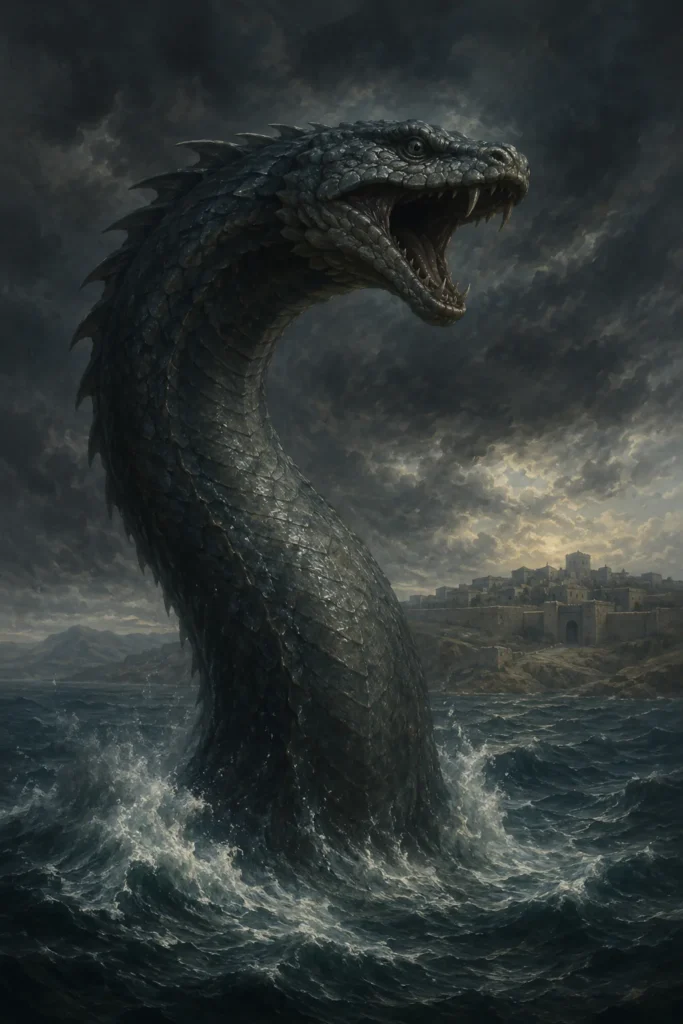
Hedammu is a mighty sea monster, presumably serpent or dragon shaped. The texts describe him as an enormously large ‘water worm’ that devours whole herds of cattle, fields and even parts of cities at once. His hunger is insatiable; with every bite he grows larger.

No clear iconography survives. Some seals from Nuzi and Alalaḫ may show a serpent-like sea being that could be identified with Hedammu, but the attribution is disputed. In modern Hittitology he is visualized conceptually as a ‘giant serpent’ or ‘dragon worm’.

Research often draws the parallel with the Mesopotamian Tiamat from the Enuma Elish; Tiamat too is a mighty sea being who is defeated by a younger storm god (Marduk). The Hurrian-Hittite pictorial tradition may have taken up Tiamat-like elements. The Ugaritic Litan (Leviathan) and the biblical dragon complex are likewise connected to this motif.

An important iconographic question concerns the identification of a fragmentarily preserved bronze figure from Boğazköy that shows a serpent-shaped being with a human head. Volkert Haas has proposed a cautious identification with Hedammu without fixing it definitively. Research remains undecided on this question.

Mythological narratives

The Hedammu myth (CTH 348) survives on several fragmentary tablets and was edited in detail by Volkert Haas (1989) and in the edition by Jared Miller (2001).

The plot in outline: Kumarbi seeks a further adversary against Teshub. He goes to the sea god and takes the latter’s daughter as his wife; from this union Hedammu is born.

Hedammu grows up in the sea and begins to devour the land. The gods are alarmed; Teshub’s sister Shaushka (Ishtar) takes the initiative.

She paints herself, anoints herself, dresses seductively and dances on the seashore with her servants Ninatta and Kulitta. Hedammu hears the music, raises his head from the waves and is captivated by her beauty.

Shaushka offers him beer laced with a sleeping draught or poison. Hedammu drinks too much and is stupefied. The end of the text is fragmentary, but it is certain that Hedammu is then defeated by Teshub.

The myth thus shows the classic ‘cunning and strength’ topos: the goddess’s cunning makes the victory of the weather god possible. In the history of religion this motif is connected with the Mesopotamian Ishhara myth and with the Ugaritic Anat-Yam complex.

At the Hurrian festivals this narrative may have been ritually reactivated through a performance of dance and music. The ritual performance combined myth and practice and turned the mythical defeat of Hedammu into an experience for the festival participants.

These ritualized myth performances are one of the most significant cultural features of Hurrian-Hittite religion and belong to the ancient Near Eastern heritage of the Late Bronze Age high culture.

Cult and veneration

Hedammu was not an addressee of cult. He is a purely narrative figure and does not appear independently in the festival calendar, the temple inventory or priestly texts.

The myth, however, was probably recited in the state cult; it presumably belonged to the repertoire of the Hurrian singers at great festivals, much like the ‘Song of Ullikummi‘.

The function of the myth in the history of religion is the confirmation of the divine victory over the chaotic sea. In Anatolia, far from the Mediterranean, the sea was a foreign and potentially threatening reality; the Hurrian texts from northern Syria had a direct relation to the Mediterranean and its dangers for ancient seafaring.

In the Hittite oath ritual and in treaties the sea is occasionally invoked as a witness to the oath, but not in the form of Hedammu, rather as a general cosmic category.

Joost Hazenbos examined the priestly organization of myth recitation in The Organization of the Anatolian Local Cults (2003). The Hurrian singers performed the songs in their original language, even though Hurrian as a spoken language had long been replaced by Hittite.

The priestly instructions for such performances included detailed directions for costumes, movements, song texts and musical instruments. These texts belong to the genre of the Hittite festival rituals and are published in the edition by Jared Miller and in the series Studien zu den Boğazköy-Texten.

Protective practice and the apotropaic

In Hurrian-Hittite magic rituals Hedammu does not appear directly; his myth, however, has structural parallels to protective rituals in which a chaotic being is overcome through cunning and poison. Volkert Haas edited corresponding texts in Materia Magica et Medica Hethitica (2003).

Apotropaic protective formulas against ‘the sea and its beings’ were used in the Hittite sphere, for example in travel rituals for sea voyages to Ugarit or Cyprus.

These formulas are, however, general and do not name Hedammu directly. In the Hurrian itkahi oath rituals the sea is invoked as a cosmic oath category together with heaven, earth and the mountains.

From the perspective of religious studies, Hedammu is an example of the personification of the chaotic sea. His narrative defeat through cunning and poison, not through direct combat, is remarkable in the history of religion and distinguishes him from other chaos beings such as Illuyanka or Typhon.

The iWell Guard regards him as a historical-mythological figure with no current protective function and with no modern claims of healing attached.

In the context of Hittite travel ritualism, the sea with its threats was ritually appeased before every important journey. An ‘Old Woman’ took water from a river and spoke protective formulas against ‘the beings of the deep’. These formulas did not refer directly to Hedammu, but belonged to the same cosmological world of ideas.

In the plague prayers of Muršili II as well, ‘the devouring sea’ is occasionally invoked as a metaphor for illness. The language of threat in Hittite religion is strongly shaped by images of the devouring sea; Hedammu is, as it were, the mythological personification of this language of threat.

Parallels in other cultures

The closest parallel is the Ugaritic Yam, the sea being who fights against Baal and is defeated by him.

Here too the combat between storm god and sea is the central mythologem; Yam, however, is himself a god, whereas Hedammu is more a non-divine monster. In the Phoenician pantheon the Yam tradition is carried on in an Iron Age form.

In the Mesopotamian Enuma Elish, Tiamat, the personification of salt water, is defeated by Marduk; here too the chaotic sea is overcome by the younger storm god. Hans Güterbock and Walter Burkert have examined in detail the lines of connection between Mesopotamian, Ugaritic and Hurrian sea-combat mythology.

In the history of religion, Hedammu belongs to the international family of sea monsters that appear in almost all Mediterranean and Near Eastern mythologies.

Mary Bachvarova traced the transmission of these motifs into the Greek mythical material in detail in From Hittite to Homer (2016); among other things she traces the Triton complex and some Typhon episodes back to Hurrian models.

The Phoenician and Ugaritic tradition continues these sea-combat narratives; in the Baal cycle of Ugarit the conflict between storm god and sea being is worked out into a complex mythological sequence that later influenced Carthaginian religion and, through it, Greek cosmology.

Present-day reception and research

Hedammu research is part of Kumarbi cycle research. Important contributions have been made by Hans Güterbock, Volkert Haas, Jared Miller and Gary Beckman. Haas presented a detailed edition in 1989; Beckman’s translation in Hittite Myths (1998) makes the text accessible to a broader public.

Hedammu is not known in popular culture; unlike Tiamat or Typhon, he has no literary afterlife in the modern sense. In academic religious research he is an important example of Hurrian sea-combat mythology and of the cunning topos in combats among the gods.

In religious studies, Hedammu is today regarded as a noteworthy object of study for the connection between the seduction motif and the chaos combat.

Current research focuses on the text-critical treatment of the fragmentary tablets, on the comparison with the Anat-Yam complex from Ugarit, and on the question of how the Shaushka seduction scene was ritually actualized. The iWell Guard lists Hedammu as a historical pantheon member with no current protective relevance.

A particular line of research examines the gendered aspects of the Hedammu myth.

The Shaushka seduction scene is one of the most striking examples of the mythological construction of female power through cunning in ancient Near Eastern literature, and belongs in a series with the Anat-Yam complex from Ugarit and the Isis-Seth tradition from Egypt.

Literature and sources

Important standard works on Hedammu research are gathered in the following selection; they include editions, translations and syntheses in the history of religion that open up the fragmentary material.

Volkert Haas’s edition is the philological foundation; Beckman’s translation makes the material accessible in English. Jared Miller’s studies on the Kizzuwatna rituals provide the ritual-historical context. Mary Bachvarova and Walter Burkert deal with the Greek parallels.

The Kumarbi circle: Hedammu between song and myth

Hedammu, the voracious sea monster, is not a self-contained narrative figure but part of a larger group of texts: the so-called Kumarbi circle, a series of Hurrian-Hittite poems that revolve around the god Kumarbi and his attempts to push the weather god Teshub from the throne.

To this circle belong the ‘Song of Kingship in Heaven’ (also ‘Song of Kumarbi’), the ‘Song of Ullikummi’, the ‘Song of Hedammu’ and further compositions, often preserved only in fragments.

The ‘Song of Hedammu’ (treated in scholarship as a work of the Kumarbi cycle) is handed down only on damaged clay tablets from the archives of Hattuša. The beginning and the end are missing, and the course of the action must be inferred from the surviving fragments.

This makes every retelling a piece of reconstruction. The authoritative treatment of the Hittite Hedammu fragments comes from Jana Siegelová; the texts of the entire Kumarbi circle have been made accessible in English translation by Harry Hoffner, among others.

The classification is important: Hedammu is one of several ‘weapons’ that Kumarbi deploys against Teshub, much like the stone being Ullikummi in another song. These songs thus do not form a random miscellany but variations on the same fundamental conflict.

Anyone who wants to understand Hedammu must read him as an episode in a contest for the throne among the gods, not as an isolated sea monster.

Shaushka and the taming of the monster

In the surviving part of the ‘Song of Hedammu’ the decisive opposing figure is not the weather god himself but the goddess Shaushka, the Hurrian goddess of love and war, often equated with Ishtar in Hittite texts.

Hedammu, a being with an enormous appetite that devours whole stretches of land and their inhabitants, is not defeated in open combat but through cunning.

Shaushka adorns herself, bathes, anoints herself and confronts the monster at the sea. She enchants it, offers it food and drink, and apparently stupefies it with an intoxicant or aphrodisiac that is woven into the text.

Hedammu is thereby lured out of the water and robbed of his destructive power. How exactly the story ends is not assured because of the gaps in the text; what is clear is that the seduction is the central narrative means of the taming.

This episode is interesting in terms of motif history. It shows a recurring pattern of ancient Near Eastern narratives in which a chaotic, greedy being is brought under control not through brute force but through the cultural techniques of cosmetics, banquet and intoxication. Comparisons are readily drawn to the biblical Leviathan conception or to the Mesopotamian Tiamat myth, but these are typological parallels. The specific appeal of the Song of Hedammu lies in the fact that a goddess takes on the role that in other dragon-combat narratives falls to the male hero.

Literature (selection)

  • Volkert Haas: Hethitische Mythen aus dem Kumarbi-Kreis (1989)
  • Gary Beckman: Hittite Myths (SBL 1998)
  • Jared Miller: Studies in the Origins of the Kizzuwatna Rituals (Wiesbaden 2004)
  • Volkert Haas: Geschichte der hethitischen Religion (Leiden 1994)
  • Mary Bachvarova: From Hittite to Homer (Cambridge 2016)
  • Walter Burkert: Die orientalisierende Epoche (Heidelberg 1984)

Hedammu is a Hurrian sea monster, translated into Hittite textual material, and is regarded as the serpent son of Kumarbi, whose ravenous hunger and seduction by Ishtar are recounted in the Kumarbi cycle.

Related key terms: Hedammu Hurrian sea monster Shaushka seduction cunning beer Kumarbi.

iWell Guard and protective traditions

iWell Guard draws on the cultural-historical tradition of wearable protective objects, in the tradition of Hittite and many other cultures worldwide. 41 layers, solid gold, platinum, silver, made in Germany. 30-day right of return.

Personal experiences may vary. Not a medical device. No promise of healing.

Classification & Protection

IVLEVEL
The Protection Compass assigns this being to influence level IV, Severe influence.

Against its influence, cross-cultural tradition names these protective means:

Compare in the Protection Compass →

Recommended protective means

iWell Guard

The simplest protective means in this collection: 41 layers of fine gold 999, platinum, silver and silicon, manufactured in Ruhla, Thuringia. It requires no activation, is bound to no person, and is effective within a radius of around 50 meters, even without being worn.

All protective means at a glance →