Yam, Phoenician-Ugaritic sea god and adversary of Baal
By Ralf Ittermann · last reviewed on
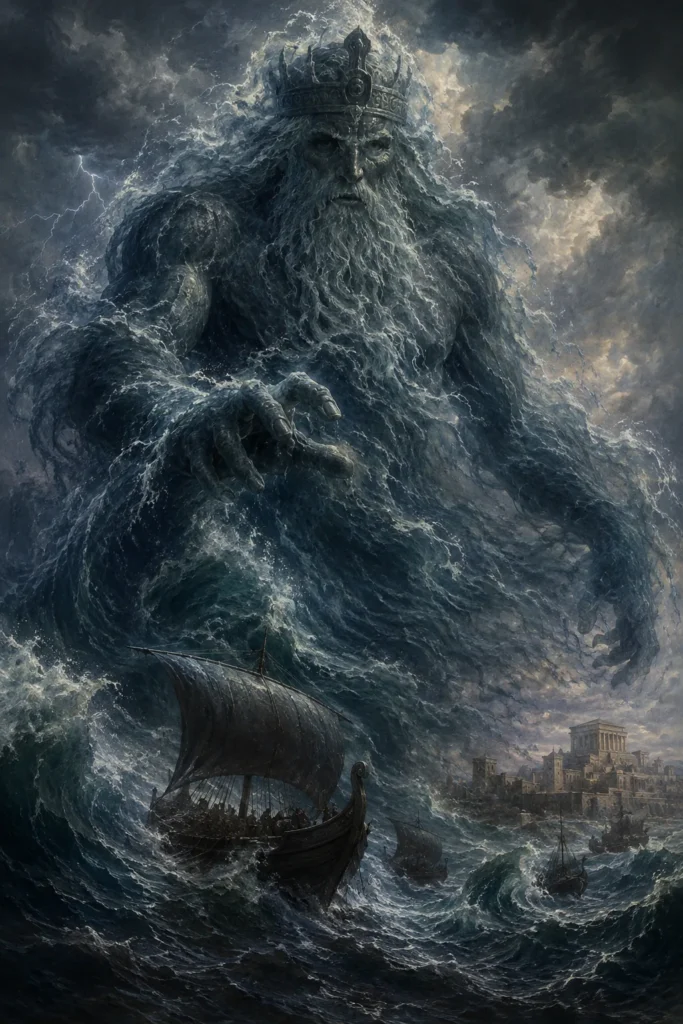
Yam (Ugaritic ym, Phoenician ym) is the sea god of the Ugaritic-Phoenician tradition and the principal adversary of Baal in the Baal Cycle. His defeat marks the establishment of the divine order; he belongs to the chaos-being family of ancient Near Eastern mythology.
Yam is the Phoenician-Ugaritic sea god and adversary of Baal in the Baal Cycle.
Classification and Short Profile
Yam is the Phoenician-Canaanite personification of the chaotic sea. Mark Smith demonstrated in The Ugaritic Baal Cycle (1994/2009) that Yam is the central opposing figure in the Baal Cycle, whose defeat establishes the kingship of Baal. Within the Phoenician tradition, Yam is the prototypical chaos god of the sea.
In the history of religions, Yam represents the type of the divine chaos waters that appears in virtually all Near Eastern mythologies: Tiamat in Mesopotamia, the Apsu, the Marduk-Tiamat conflict, Hedammu in the Hurrian tradition, and Typhon in Greece.
These chaos-water deities are not simply evil but are ambivalent cosmic beings whose subjugation establishes divine order.
Unlike Hedammu or Ullikummi, Yam is a fully realized deity; he possesses his own palace, has messengers, and lays claim to kingship.
His defeat by Baal is not the destruction of a monster but the outcome of a divine contest for kingship. This theological distinction is important in the history of religions and sets the Ugaritic-Phoenician tradition apart from the Hurrian one.
A particular theological point of the Baal-Yam conflict lies in the fact that Yam is initially designated king by El, the venerable father god, in a legitimate act.
Baal’s rise thus takes place against the established divine hierarchy, not in accord with it. This detail underscores the revolutionary theology of the Baal Cycle, which establishes a new divine order.
This theological configuration of a reigning king (Yam) and a revolutionary storm god (Baal) has close parallels in the Hittite Kumarbi Cycle, where Teshub rises against the established father god Kumarbi. The interconnections among the religions of the eastern Mediterranean Late Bronze Age are especially dense here.
Name and Etymology
The name ym is the common West Semitic word for “sea”; Yam is thus literally “the sea” itself. This identity of divine name and cosmic category is typical of ancient Near Eastern theogony. The Akkadian equivalent would be tâmtu (Tiamat); in Hebrew, yam carries the same etymology, though it is not divinely personified.
In the Ugaritic texts, Yam appears under several epithets: zbl ym “Prince Yam,” tpṭ nhr “Judge River,” ʾyl rbn “Mighty God,” and tnn “Tannin” (sea dragon). This multiple nomenclature reflects cosmic multifunctionality: Yam is sea, river, dragon, and claimant to kingship simultaneously.
In the Hebrew material, Yam appears as the cosmic adversary of Yahweh in several psalms and prophetic texts (Ps 74; Ps 89; Isa 27; Hab 3); Leviathan (Liwyatan) and Tannin also belong to the extended Yam family.
John Day examined the Hebrew evidence in detail in God’s Conflict with the Dragon and the Sea (1985); Mark Smith provided the religious-historical contextualization in The Origins of Biblical Monotheism (2001).
In Aramaic and Phoenician inscriptions of the first millennium BCE, the personified figure of Yam disappears; the sea is increasingly referenced only as a cosmic sphere rather than as an acting deity.
This “de-divinization” of the sea is instructive in the history of religions and runs parallel to the consolidation of the Baal cult as the dominant cult.
Description and Iconography
Yam rarely appears in personified form in iconography; he is mostly depicted as the sea itself or as a massive sea serpent (Tannin). Some Ugaritic seals from the 14th and 13th centuries BCE show the Baal-Yam combat in symbolic form: Baal with raised club over a serpent figure.
In Phoenician contexts, Yam iconography is even rarer; the sea is more often symbolized as the cosmic setting of Phoenician seafaring, with images of ship prows, fish motifs, and wave ornamentation, without any direct Yam personification.
An important iconographic tradition develops in the Hellenistic-Roman sphere: Yam-Poseidon with trident and horse-drawn chariot. This transfer of Greek Poseidon imagery onto the Phoenician-West Semitic sea-god tradition is less pronounced in the Phoenician homeland than in the western Mediterranean colonies, where Greek influence was more intense.
The famous bull stele from Ras Shamra shows a small serpent form beneath Baal’s feet; scholarship frequently identifies this serpent with Yam-Tannin. This iconographic confirmation of Baal’s victory over the serpent is one of the most important pictorial witnesses to the Baal Cycle.
Mythological Narratives
The primary source for Yam is the Ugaritic Baal Cycle (KTU 1.1, 1.2), which narrates the conflict between Yam and Baal.
The basic plot: Yam, officially designated king by El, sends his messengers to the divine council and demands Baal’s surrender. The gods tremble and bow their heads; only Baal resists and accepts the challenge.
The craftsman god Kothar-wa-Khasis forges two magical weapons for Baal, named “Ayamur” and “Yagrush” (“the one that drives away” and “the one that chases off”). Baal fights with them against Yam; the first blow staggers Yam, the second shatters him.
Yam falls to the ground; Baal proclaims: “Yam is dead, Baal is king!” Mark Smith has provided detailed commentary on the text in his monumental edition.
A further Ugaritic episode describes the battle of Anat against Yam, supporting her brother Baal.
Anat “strikes the sea, destroys the river, subdues the Tannin, overpowers the twisting serpent.” This Anat-Yam sequence is instructive in the history of religions and shows that the battle against the chaos waters was a collective divine effort, not Baal’s act alone.
Another fragmentary episode describes Yam in connection with the “sons of El” (bn ʾil), who serve as a divine council. Yam’s demand is deliberated in the divine council; El agrees, and only Baal dissents.
This “divine council” tradition is significant in the history of religions and has parallels in the Hebrew “sons of God” motif (Job 1; Ps 82).
The Ugaritic singers presumably performed the Baal-Yam conflict as a complete performance, with tablet bearers, musical instruments, and cultic dances. This performative dimension has been systematically explored in recent Ugarit scholarship, notably by Wilfred Watson and Pierre Bordreuil.
Cult and Veneration
Yam was not a recipient of cult veneration; as a chaos god, he was not worshipped but ritually overcome. In some protective rituals he appears as a prototypical example of the cosmic danger that must be warded off through divine intervention.
His myth was, however, recited in the royal cult; the Baal Cycle belonged to the repertoire of Ugaritic singers and was presumably performed at major festivals. The ritual re-enactment of the Baal-Yam sequence may have been part of the spring festival rite, analogous to the Mesopotamian Enuma Elish in the New Year festival.
In Phoenician seafaring rituals, the sea was ritually appeased; ships’ captains and travelers brought offerings to the sea in hope of a safe crossing. This seafaring piety did not directly reference Yam but belonged to the same cosmological worldview. Sabatino Moscati described Phoenician maritime culture in several studies.
An important ritual connection exists between the Yam victory and the Ugaritic spring festival; the conflict was presumably ritually reenacted around the time of spring storms, when the heavy winter rains subsided and the sailing season began. This ritual seasonality is characteristic of the eastern Mediterranean Late Bronze Age in the history of religions.
Protective Practice and Apotropaic Tradition
Apotropaic practices against the chaotic sea were widespread in Phoenician contexts. Ship prow decorations feature apotropaic eyes, bull-horn symbols, or the “Tanit sign” as protection against the dangers of the sea. These images were standard equipment on Phoenician merchant and warships.
In harbor cities, protective formulas against “the raging sea and its beings” were used; Punic inscriptions contain votive offerings for a safe return from sea voyages. This seafaring piety is of interest in the history of religions because it directly frames the international mobility of the Phoenician world in religious terms.
From a religious-studies perspective, Yam is an example of the personification of the chaotic sea. His narrative defeat through Baal’s magical weapons is historically comparable to the Marduk-Tiamat conflict, in which magical weapons likewise enable victory.
The iWell Guard records Yam as a historical-mythological figure without any current protective function and without references to modern efficacy claims.
In Punic inscriptions from Carthage and Motya, “gods of the sea” (Phoenician ʾlm ym) appear as recipients of votive offerings before sea voyages; whether a direct Yam memory is present here or a generic sea-god invocation is disputed.
The Phoenician ship-prow eyes are to be interpreted as apotropaic in religious-historical terms; they transform the gaze of the ship into a protective force against Yam and his beings.
Parallels in Other Cultures
Yam belongs to the international family of chaos-water deities. In Mesopotamia, his counterpart is Tiamat from the Enuma Elish; in the Hurrian-Hittite tradition, Hedammu and the fragmentary “Song of the Sea” (CTH 346) against Teshub. Mark Smith and Mary Bachvarova have documented the interconnections among these mythologies in several studies.
In the Hebrew material, Yam is the cosmic adversary of Yahweh in several psalms; creation is interpreted as Yahweh’s victory over Yam, Leviathan, and Tannin (Ps 74:13-14; Isa 27:1). These texts belong to the “chaoskampf theology” of the Hebrew Bible and are directly dependent, in the history of religions, on the Ugaritic Yam tradition.
Yam shares the chaos-adversary profile with the Greek Typhon; with Poseidon he shares the personification of the sea, though in a markedly different theological configuration. In the Hellenistic-Roman period, the Phoenician Yam was identified with Poseidon; the active chaos-adversary profile was accordingly modified in favor of the seafaring-god function.
Modern Reception and Research
Yam scholarship today stands at a high level. Mark Smith and Wayne Pitard’s Baal Cycle edition is the standard reference; John Day examined the Hebrew parallels in detail in God’s Conflict with the Dragon and the Sea (1985). Daniel Schwemer provided the religious-historical framework in Die Wettergottgestalten (2001).
In popular reception, Yam is known primarily through the Ugaritic myths and the Hebrew-biblical allusions. A spiritual revival in the neo-pagan sense is absent.
In religious-studies terms, Yam is today regarded as a central object of study for ancient Near Eastern chaos-water theology and for the myth family of storm-god sea battles.
Current research focuses on differentiating the various sea beings (Yam, Leviathan, Tannin), on the biblical parallels, and on the question of the precise historical-religious relationship to the Mesopotamian Tiamat tradition. The iWell Guard records Yam as a religious-historical example without practical protective relevance.
In modern biblical scholarship, Yam is increasingly being systematically examined as the religious-historical background of the creation and chaoskampf texts. Bernard Batto and John Day have investigated the connection of the Yam tradition with the Hebrew creation account in detail across several studies.
Literature and Sources
The following selection brings together the most important standard works on Yam scholarship. It includes text editions, religious-historical syntheses, and studies on the Hebrew-biblical parallels. Mark Smith’s Baal Cycle edition is the primary-source foundation; John Day and Schwemer provide the religious-historical contextualization. Mary Bachvarova offers the connecting line to the Greek tradition.
The Baal Cycle of Ugarit as Primary Source
Nearly everything that can be said about Yammu as an active figure derives from a single textual complex: the so-called Baal Cycle, a series of alphabetic cuneiform clay tablets that came to light between 1929 and the 1930s during the French excavations under Claude Schaeffer at Tell Ras Shamra on the Syrian coast.
The tablets are catalogued today under the designations KTU 1.1 to 1.6; the Yam episode is concentrated in KTU 1.1 and 1.2. According to the colophon, they were written by the scribe Ilimilku, probably in the 14th or 13th century BCE.
The tradition is fragmentary. Tablet KTU 1.1 is heavily damaged; the beginning of the conflict is largely missing. Only KTU 1.2 opens with a coherent scene: Yam sends messengers to the divine assembly demanding that Baal be handed over.
Scholarship has debated since the first editions by Charles Virolleaud whether a further, lost tablet contained the beginning of the conflict. The sequence of the tablets itself is not secured by colophons but is a reconstruction by the editors.
For religious-studies work, this source situation is crucial: Yam is not a figure from a broad, multi-voiced tradition but is accessible almost exclusively from the perspective of a pro-Baalistic narrative text.
Statements about an independent Yam cult, about hymns addressed to him, or about his role outside the conflict with Baal therefore remain speculative. The standard edition is today Die keilalphabetischen Texte aus Ugarit (KTU) by Manfried Dietrich, Oswald Loretz, and Joaquin Sanmartin; a widely used English translation with commentary is by Mark S. Smith.
The Divine Assembly and Yam's Message
The best-preserved Yam scene (KTU 1.2 i) shows a session of the gods under the presidency of the high god El. Yam sends two messengers with the demand that Baal be surrendered as a tributary or prisoner.
The text gives the scene a precise choreography: upon the arrival of the messengers, the gods lower their heads to their knees, a gesture of fear. Baal rebukes them and straightens up.
El, the patriarch of the assembly, responds with deference. He calls Yam his favorite in several passages and seems willing to comply with the demand by designating Baal as Yam’s servant.
This attitude of El is a much-discussed point: it demonstrates that in the Ugaritic pantheon, the supreme god is not identical with the victorious storm god, and it lends the conflict a political dimension, almost that of a succession struggle within a family.
Yam bears fixed double designations in these lines.
Alongside ym, he appears as tpt nhr, often translated as “Judge River” or “Ruler of the Stream.” The parallel pairing of “sea” and “river” is a typical stylistic device of Ugaritic poetry and makes clear that Yam embodies all unruly water, not only the open sea.
The scene ends with Baal’s refusal and his announcement that he will attack the messengers and their master. It thus forms the immediate prelude to the single combat depicted on the same tablet in KTU 1.2 iv. For the opposing figure, see also Baal-Hammon as a later Phoenician manifestation of the Baal name.
Selected Bibliography
- Mark Smith / Wayne Pitard: The Ugaritic Baal Cycle (Leiden 1994/2009)
- John Day: God’s Conflict with the Dragon and the Sea (Cambridge 1985)
- Daniel Schwemer: Die Wettergottgestalten Mesopotamiens und Nordsyriens (Wiesbaden 2001)
- Mark Smith: The Origins of Biblical Monotheism (Oxford 2001)
- Sabatino Moscati: Die Phöniker (Zürich 1966)
- Mary Bachvarova: From Hittite to Homer (Cambridge 2016)
In the Ugaritic Baal Cycle, preserved on clay tablets from Ras Shamra dating to the fourteenth century BCE, Yam appears as the sea god and adversary of Baal, whom Baal ultimately defeats with the throwing weapons Ayamur and Yagrush.
Related key terms: Yam Phoenician sea god Baal Cycle Tannin Leviathan chaos waters.
iWell Guard and Protective Traditions
iWell Guard draws on the cultural-historical tradition of wearable protective objects, in the tradition of Phoenician and many other cultures worldwide. 41 layers, genuine gold, platinum, silver, crafted in Germany. 30-day return policy.
Personal experiences may vary. Not a medical device. No efficacy promises.