Teshub, Hurrian-Hittite Weather God and Imperial Ruler
By Ralf Ittermann · last reviewed on
Teshub is the supreme weather god of the Hurrian pantheon and, in the Hittite imperial religion from the 14th century BC onward, appears alongside Tarhunna as an equal or dominant imperial god. In the Kumarbi cycle he establishes the new divine order after the fall of his father Kumarbi.
Tešub is the Hurrian-Hittite weather god and the chief god of the Hittite state cult.
Classification and Short Profile
Teshub is among the best-documented deities of the Late Bronze Age. Daniel Schwemer devoted a monograph of more than 700 pages to him in Die Wettergottgestalten Mesopotamiens und Nordsyriens (2001).
In terms of religious history, Teshub is the Hurrian weather god, who probably originated among the northern Mesopotamian tribe of the Hurrians and, over the course of the 2nd millennium BC, radiated outward from the Mittani imperial period across the Levant and Anatolia.
In the Hittite imperial religion under Tudḫaliya IV and his successors, Teshub became, alongside Tarhunna, the highest male deity. The two are often used synonymously in texts; distinguishing them is a philological task and frequently difficult in individual cases. Hittite ‘translation theology‘ worked with functional equivalence without fully unifying the gods.
His function is comprehensive: thunderstorm, rain, battle, royal protection, treaty oath, victory over the powers of chaos. Trevor Bryce described him in The Kingdom of the Hittites (2005) as a ‘cosmic ruler’ whose victory over the stone giants guarantees the cosmic order.
In the vassal treaties Teshub appears as the supreme guarantor of oaths together with Tarhunna; the penalty formula threatens ‘being shattered like a clay jar’ in the event of an oath being broken.
Name and Etymology
The name Teshub is Hurrian and is written in cuneiform texts as Te-šu-ub, Te-eš-šu-pa, or logographically as DU. The etymology is not conclusively settled; one plausible derivation traces the element tešš- back to a Hurrian verb meaning ‘to thunder’, in which case Teshub would be ‘the Thundering One’. Volkert Haas and Schwemer have discussed this etymology as the most probable.
In Urartian the form Teišeba appears (Urartian pantheon); in Akkadian he is identified with Adad; in Hittite he is written logographically as DU, which facilitated his identification with Tarhunna. In Hieroglyphic Luwian he appears as DEUS.TONITRUS, the same logogram as Tarhunna.
This overlap of name and logogram is a classic example of Hittite ‘translation theology’: local deities are translated into one another through functional identity, without a complete merger taking place.
In West Semitic he corresponds to the Old Syrian Hadad, who in turn is related to Baal-Hadad of the Phoenician tradition. The Late Bronze Age weather-god constellation is densely interwoven across the northwest Asian and Levantine region.
Description and Iconography
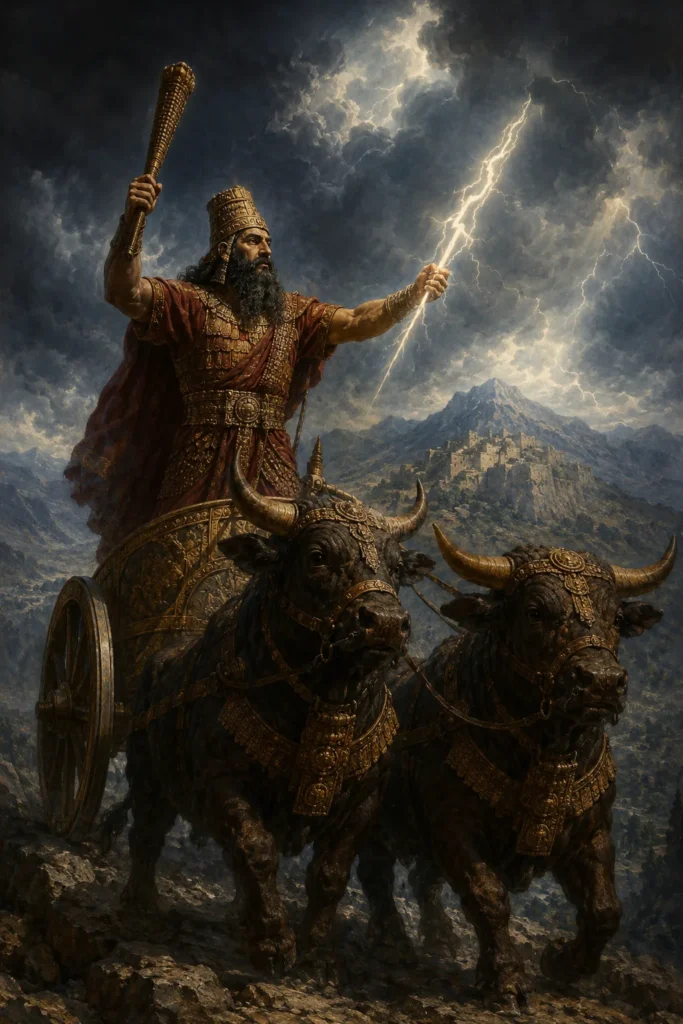
In Hurrian-Hittite iconography, Teshub appears as a bearded, powerful man in a short kilt, with a pointed divine cap, a bundle of lightning, and a battle axe.
His mount or chariot is a team of bulls, drawn by Šeri (‘Day’) and Ḫurri (‘Night’). This pictorial tradition is held canonical at Yazılıkaya, in the Hattuša reliefs, and on numerous seals and bronze figurines.
Famous is the procession of gods in Yazılıkaya Chamber A, in which Teshub leads the male row and faces his consort Hebat in the center; Sarruma, their son, stands beside Hebat on a leopard.
This triad is the most important Hurrian divine family and became the apex of the pantheon in the Hittite imperial cult.
On Hittite and North Syrian reliefs (Karkamiš, Aleppo), Teshub frequently appears with a raised axe, treading a bull before or beneath him; the pose is an Old Syrian storm-god formula.
Kay Kohlmeyer, in Der Tempel des Wettergottes von Aleppo (2000), published the monumental basalt reliefs of the Aleppo temple in detail; they show Teshub in several variants and are the most impressive weather-god images of the early Iron Age.
Mythological Narratives
Teshub is the main figure of the Kumarbi cycle. In the ‘Song of Kumarbi’ he is born from inside his father Kumarbi, after the latter has taken in the ‘manhood seed’ of Anu with his teeth.
Three gods grow inside Kumarbi: Teshub as the mightiest, a river, and another god. They split Kumarbi open and step out.
After the fall of Kumarbi, Teshub assumes kingship in heaven.
There follow repeated attempts by Kumarbi to overthrow him: through Ullikummi, the stone giant, who grows toward heaven on the shoulder of the primeval giant Upelluri and threatens Teshub’s Tempel in Kummiya; through the sea monster Hedammu, which threatens to devour the earth; through the ‘silver creature’ and other beings.
In all the narratives Teshub triumphs with the help of his sister Šaušga and the smith god Ea, who uses the saw with which heaven and earth were once separated.
A further narrative is the ‘Song of the Sea’ (CTH 346), a fragmentarily preserved text in which Teshub fights against the sea. The parallels to the Ugaritic Baal cycle, in which Baal fights against Yam, are especially clear here.
Mary Bachvarova treated these parallels in detail in From Hittite to Homer (2016) and showed that the sea-battle myths migrated into the Greek mythological circle around Typhon and Apollo via the Levant and Cyprus.
In a further mythological fragment, the ‘Song of Release’ (CTH 789), Teshub appears as a mediator in a conflict between the city gods Ebla and Megi.
The text is bilingual Hurrian-Hittite and was opened up by Erich Neu in a monumental edition (1996). Teshub demands the release of slaves of the city of Ikinkalis and threatens Ebla with destruction if the demand is not met.
This narrative is especially valuable in religious-studies terms because it shows Teshub as a socio-ethical god who advocates the liberation of the unfree. It is one of the few ancient Near Eastern god-stories with explicitly ethical content and stands in line with the biblical Exodus motif, without any direct dependence being demonstrable.
Cult and Veneration
Teshub’s most important cult sites were Aleppo (Ḫalab), Kummiya (location unknown, presumably in North Syria or southern Anatolia), and Šamuḫa. His Tempel in Aleppo had been the most important weather-god sanctuary of North Syria since the Old Syrian period; it was integrated into the imperial religion in the 14th century BC under Hittite suzerainty.
Excavations under Kay Kohlmeyer have uncovered magnificent basalt reliefs of the 9th century BC in the Tempel of Aleppo, which depict Teshub as a weather god.
In Ḫattuša there was a dedicated Teshub Tempel, as in the other great Hittite cities. The annual main festival was closely linked to the Hurrian-Hittite divine assembly ritual itkalzi, which guaranteed the purity of all Tempel.
Joost Hazenbos examined the organization of these Tempel in The Organization of the Anatolian Local Cults (2003).
Hittite vassal treaties include Teshub as the second oath god alongside Tarhunna; his oath formula states that an oath-breaker should be ‘shattered like a clay jar’. In Hurrian sources he appears as the supreme guarantor of treaties.
The priestly organization included Hurrian singers (kaluti), who linguistically transmitted the Hurrian festival songs in the original.
Protective Practice and the Apotropaic
Teshub was the supreme protective god of the king and of kingship. On royal seals he frequently appears as a protective figure; the pictorial formula of the ‘divine embrace’ from Yazılıkaya shows another god (usually Sarruma) embracing the king, but Teshub is the superordinate protective authority.
Apotropaically, Teshub figurines were deposited in the foundations of temples and palaces; bronze figures with a raised axe are known in considerable numbers from Ḫattuša, Karkamiš, and other sites.
In the Hurrian magic ritual itkahi, clay figures were used as protective images that brought Teshub’s power into the household. Volkert Haas described the domestic protective practices in detail in Materia Magica et Medica Hethitica (2003).
From a religious-studies perspective, Teshub’s protective function is closely tied to the political order: he protects the individual person less than the imperial order.
The iWell Guard regards him as a historical figure and not as a present-day addressee of protection. Healing promises or spiritual effect are, from a religious-studies viewpoint, not part of this lexicon presentation.
In the Hittite plague prayers of Muršili II, Teshub is invoked together with Tarhunna as a god who is asked to end the epidemic. This double invocation shows the close religio-political interweaving of both weather-god hypostases in the imperial cult.
In the Hittite vassal treaties with Mittani, with Aleppo, and with Karkamiš, too, Teshub stands at the forefront as a guarantor of oaths; his name in the treaty formulary is the guarantor of a very concrete political order.
Parallels in Other Cultures
Teshub is closely related to Tarhunna, to the Old Syrian Hadad and Adad, to the West Semitic Baal-Hadad, and to the Urartian Teišeba. His dragon-battle motif has close parallels to the Indra-Vrtra battle and to the Zeus-Typhon battle. Daniel Schwemer treated these parallels in detail in his monograph (2001).
With Baal, Teshub shares the battle against the sea (Yam); with Zeus, the battle against the stone monster (Typhon corresponds to Ullikummi).
Hans Güterbock and Walter Burkert dealt extensively with the influence of Hurrian-Hittite mythology on Greek theogony; Burkert reconstructed the cultural-historical paths of transmission in Die orientalisierende Epoche (1984) and in Babylon, Memphis, Persepolis (2003).
In terms of religious history, Teshub belongs to the northwest Asian storm-god type of the Late Bronze Age and is a key witness to the cultural interconnections between Anatolia, Syria, Mesopotamia, and the Aegean. His profile shows strong agreements with Baal-Hadad of the Phoenician tradition.
Teshub occupies a remarkable special position in the Urartian pantheon of the 9th to 7th century BC; there he appears as Teišeba in second place after the imperial god Ḫaldi and before the sun god Šiwini. The Urartian triad shows the unbroken continuity of Hurrian religion even after the fall of the Hittite empire.
Present-Day Reception and Research
Modern Teshub research begins with Hans Güterbock and Emmanuel Laroche (the CTH catalog). Important more recent contributions come from Daniel Schwemer, Volkert Haas, Itamar Singer, and Mary Bachvarova. Schwemer’s monograph remains to this day the most comprehensive presentation; it is the standard reference for Tarhunna and Baal-Hadad as well.
In popular reception, Teshub is hardly known. In Turkish tourism advertising for Çorum and Boğazkale he is occasionally mentioned as the ‘Anatolian thunder god’. In Syria the Tempel of Aleppo was, until the civil war, an important site of cultural heritage; its fate after 2012 is not fully clarified, and restoration work resumed from 2018.
In religious-studies terms, Teshub is today regarded as a central example of the ancient Near Eastern storm-god tradition.
Current research priorities lie in the precise determination of his relationship to Tarhunna, in the role of Teshub in the vassal treaties, and in the transmission of his myths into Greek theogony. The iWell Guard lists him as a historical pantheon member and not as a spiritual addressee.
The restoration work on the Aleppo Tempel after the war damage is an important current archaeological project; a portion of the basalt reliefs could be conserved and secured in the Museum of Aleppo. The research results of the Syrian-German Mission under Kay Kohlmeyer continue to be published in the series Damaszener Forschungen.
Literature and Sources
The most important standard works on Teshub research are compiled in the following selection. They comprise monographs, editions, and religious-historical syntheses. Schwemer’s monograph remains the most detailed, with an extensive bibliography and a detailed treatment of all known Teshub hypostases.
Kay Kohlmeyer’s Aleppo Tempel publication is the most important archaeological supplement; Bachvarova’s study on the Hittite-Homer connection is the most important comparative work of the last generation.
The Song of Ullikummi and the Fall of Teshub
Among the most impressive texts of the Hittite tradition is the so-called Song of Ullikummi, an episode of the larger Kumarbi mythological circle.
The dethroned god Kumarbi begets with a rock a being made of diorite, named Ullikummi and destined to topple Teshub from rulership. Ullikummi grows unhindered upward on the shoulder of the giant Upelluri, who carries the world, until he reaches heaven.
Teshub looks down from Mount Hazzi and recognizes the threat. A first attack by the gods fails, because Ullikummi is blind, deaf, and devoid of feeling, and nothing stops him.
The turning point is brought by the wise god Ea, who goes to the gods’ old storehouse and fetches the ancient cutting tool with which heaven and earth were once separated. With this tool Ullikummi is severed at the feet from Upelluri’s shoulder and thereby robbed of his strength.
The text is transmitted on clay tablets in the Hittite language from the archive of Hattusha, but goes back to a Hurrian original. Hans Gustav Güterbock edited the Song of Ullikummi in 1951 and 1952 and thereby made accessible one of the key texts for comparison with Greek theogony.
The narrative shows Teshub not as an unchallenged ruler but as a king whose position must be defended again and again. It is thus a central testimony to the Hittite conception of divine rule as a precarious condition.
Teshub and the Dragon Illujanka
Alongside the Kumarbi circle stands a second great myth in which the weather god plays the leading role: the battle against the dragon Illujanka. This text was bound to the Hittite New Year festival purulli and is transmitted in two versions, which the scribe Kella attributes to a priest of the city of Nerik.
In the older version the dragon at first defeats the weather god. The goddess Inara thereupon arranges a festival and wins the mortal man Hupasija as a helper, who stipulates a reward from her. At the festival the dragon and his brood are made drunk, bound, and slain by the weather god.
In the younger version the dragon has robbed the weather god of his heart and eyes. The god begets a son who marries the dragon’s daughter and demands back the heart and eyes as a bride-gift.
Thus restored, the weather god kills the dragon, but in doing so must also sacrifice his own son, who is on the side of the in-laws.
The binding of the myth to the purulli festival is significant in religious-studies terms. Here is a rare case in which a narrative text is expressly linked to a concrete ritual occasion.
Calvert Watkins treated the Illujanka myth in his comparative-linguistic work as an example of an Indo-European narrative pattern in which a hero slays a dragon. At the same time, the narrative is evidence that the Hittite weather god was thoroughly conceived as defeatable and owes his victory to human and divine help.
The Rock Sanctuary of Yazılıkaya
About two kilometers northeast of the Hittite capital Hattusha lies the rock sanctuary of Yazılıkaya, a natural rock chamber whose walls were covered in the 13th century before our era with reliefs of the Hittite divine world.
In the larger Chamber A, two processions move toward each other, a male one from the left and a female one from the right. At the point where they meet stands the weather god, identified in the reliefs by hieroglyph-like inscriptions as the Hurrian Teshub, facing him his consort Hebat.
Teshub stands on two bent mountain gods, a pictorial type that expresses his connection to the mountains. Behind him and before Hebat follow their children, among them the god Sarruma, who stands on a panther. The identification of the figures rests on the Luwian hieroglyphic signs and on comparison with god-lists from the clay-tablet archives.
Research interprets Yazılıkaya predominantly as a place connected with the New Year festival and possibly with the cult of the dead of the royal family. The smaller Chamber B contains a relief of King Tudhalija IV and is regarded by some as a memorial for this ruler.
Kurt Bittel, who excavated Hattusha over decades, documented the sanctuary in detail. Yazılıkaya is the only place where the entire state divine hierarchy of the late Hittite period is preserved in stone, and Teshub stands literally in its center. That makes the sanctuary the most important archaeological source for his position in the pantheon.
From the Hurrian Teshub to the Hittite Imperial God
Teshub was originally not a Hittite but a Hurrian god. The Hurrians, a people whose language is neither Semitic nor Indo-European, lived in northern Mesopotamia and in North Syria and exerted a strong cultural influence on the Hittite empire in the second millennium before our era.
With this influence Teshub too entered the Hittite pantheon, where he merged with the native weather god, whom the Hittites wrote with the Sumerogram for weather god.
The rise of Teshub to imperial deity is closely connected with the Hittite royal house of the late period. The queen Puduhepa in particular, a Hurrian by birth and consort of Hattusili III, promoted Hurrian cults at court.
Under her influence and that of her son Tudhalija IV, the Hurrian divine world with Teshub at its head was integrated into the state cult, visible precisely at Yazılıkaya.
Linguistically, this layering is clearly evident. The same god is called Taru in Hattic, in Hittite is usually written only logographically, in Hurrian Teshub, in Luwian Tarhunt, and in the Aramaic-Syrian region he corresponds to Hadad.
This variety of names attests that it is a deity function, the lord of the storm, that took on its own form in many languages of the ancient Near East.
Volkert Haas presented the Hurrian imprint on the late Hittite cult in detail in his Geschichte der hethitischen Religion. For Teshub this means that his history becomes understandable only as a history of cultural translation between Hurrians and Hittites.
Literature (Selection)
- Daniel Schwemer: Die Wettergottgestalten Mesopotamiens und Nordsyriens (Wiesbaden 2001)
- Volkert Haas: Geschichte der hethitischen Religion (Leiden 1994)
- Harry A. Hoffner (Hg. Gary M. Beckman): Hittite Myths (SBL 1998)
- Mary Bachvarova: From Hittite to Homer (Cambridge 2016)
- Trevor Bryce: The Kingdom of the Hittites (Oxford 2005)
- Kay Kohlmeyer: Der Tempel des Wettergottes von Aleppo (Münster 2000)
The cult of Teshub formed a central element of the imperial religion in the Hurrian-Hittite region. In Hattuša, Kummanni, and Aleppo, kings maintained Tempel in which bull sacrifices, weather prayers, and festival calendars honored the weather god.
His cult was closely tied to kingship: the ruler was regarded as the earthly viceroy, and alliance treaties were sworn under invocation of Teshub, which anchored his cult at once politically and cosmologically.
Teshub appears in Hurrian-Hittite sources as the supreme weather god and imperial ruler, who rides over the mountains with his chariot and, in the Kumarbi cycle, withstands the divine struggle for world dominion.
Related key terms: Teshub Hurrians weather god Kumarbi cycle Ullikummi Aleppo Kummiya Šeri Ḫurri.
iWell Guard and Protective Traditions
iWell Guard ties in with the cultural-historical tradition of portable protective objects, in the tradition of Hittite and many other cultures worldwide. 41 layers, solid gold, platinum, silver, made in Germany. 30-day right of return.
Personal experiences may vary. Not a medical device. No healing promise.