Šarruma appears in the Hurrian-Hittite cult as the son of Tešub and as a mountain god.
Sarruma (also Šarruma, Šarrumma) is the son of the Hurrian high gods Teshub and Hebat.
In Geschichte der hethitischen Religion (1994), Volkert Haas showed that he was originally the city god of Kummanni in Kizzuwatna and rose during the course of the 14th and 13th centuries BCE to become a central protective deity of the Hittite great kings.
Within the Hittite tradition he is the most prominent protective deity of the late empire.
His profile in the history of religion is that of a ‘divine son’ and personal protective deity: he does not stand at the head of the pantheon, but he is close to the great king in a special way.
Tudhaliya IV called himself ‘Beloved of Sarruma’ and had himself depicted in Chamber B of Yazılıkaya by Sarruma in a protective gesture of embrace. This iconic visual formula is one of the most important images of protection in ancient Near Eastern art.
In The Kingdom of the Hittites (2005), Trevor Bryce pointed to the political and religious significance of this personal relationship with the god: Sarruma stands for the Hurrianization of Hittite royal theology in the 13th century BCE.
Queen Puduhepa and her son Tudhaliya IV made Hurrianism into a state religion to a degree that was unprecedented in the Hittite empire.
A remarkable feature of Sarruma is his dual function as a mountain deity and as a personal protective deity of kings.
This combination of natural sanctity and court religion is rare in the religious history of the ancient Near East and makes him one of the theologically most interesting figures of the Hurrian-Hittite pantheon. In the late 13th century BCE his cult reached its peak under Tudhaliya IV.
In the Hieroglyphic Luwian corpus several royal figures bear the theophoric name element ‘Šarruma’ (e.g. Sarruma-DEUS, Sarruma-son-XY), which documents the vitality of his cult in the 1st millennium BCE.

The name Sarruma is Hurrian; a plausible etymology connects it with the element šarri-, which in several ancient Near Eastern languages means ‘king’ (Semitic šarru, Akkadian šarru). Sarruma would then be ‘the royal one’, ‘the one belonging to kingship’. Volkert Haas and Daniel Schwemer have discussed this etymology as probable.
In cuneiform texts he appears as Šar-ru-ma, Šar-ru-um-ma; in Hieroglyphic Luwian as ‘TUTELARY+ra/i-ma’ (the logogram TUTELARY refers to his function as a protective deity). In Akkadian he is not readily identified; his Hurrian character remains clearly recognizable.
A second etymology connects the name with a mountain name ‘Šarruma’ in Kizzuwatna; Sarruma would then originally be a mountain deity and only secondarily a protective deity of kings.
Both etymologies are probably compatible with one another: a mountain god at Mount Šarruma, whose name then refers to ‘king’. This dual connotation of ‘mountain’ and ‘king’ is illuminating for the history of religion and reflects the Old Anatolian tradition of sacred mountains as divine beings.
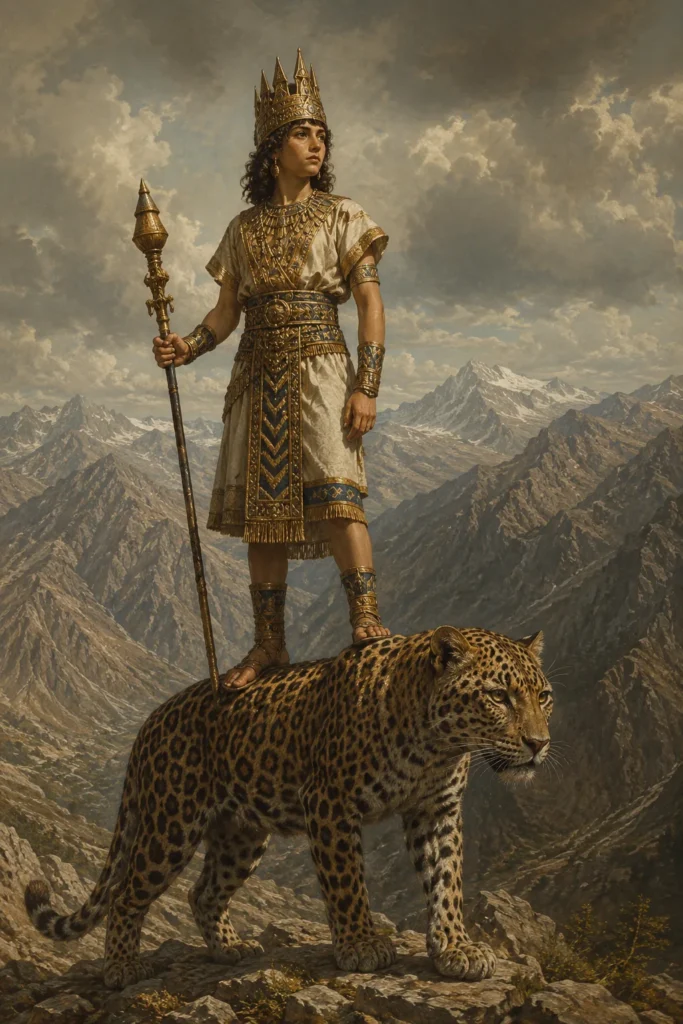
Sarruma appears in Chamber A of Yazılıkaya in the female row beside his mother Hebat, standing on a leopard. He wears a short kilt, a tall pointed cap and a battle axe.
In Chamber B he appears in a unique scene: he embraces the great king Tudhaliya IV with his right arm, his own face beside the face of the king. The visual formula is known as the ‘divine embrace’ and is regarded as a visual incorporation of royal protection.
His sacred animal is the leopard or panther, which he shares with his mother Hebat. In Late Hittite reliefs from Karkamiš and other sites he frequently appears as a striding young god with axe and staff.
On Tudhaliya’s royal seals his logogram appears together with the royal name, a visual formula of the direct bond to the protective deity.
A distinctive feature is his identification with a sacred mountain. In the Hurrian pantheon mountains were not merely the dwellings of gods but gods themselves; Sarruma was one of these divinely personified mountains in Kizzuwatna.
This mountain-god tradition is described in detail by Piotr Taracha in Religions of Second Millennium Anatolia (2009). The identity of mountain and god is an archaic Anatolian concept that was systematically elaborated in Hittite theology.
The iconographic tradition continues in the Late Hittite city-states of Karkamiš, Maraş, Malatya and Tabal into the late 8th century BCE. On the reliefs there Sarruma appears as a striding young god with axe and staff, frequently accompanied by the king.
This iconographic continuity beyond the end of the Bronze Age is a sign of the persistence of Hurrian-Hittite religion in the Neo-Hittite city-states.
Sarruma scarcely appears as an acting figure in the great divine epics; he is present in the ‘Song of Ullikummi‘, when his mother Hebat wants to rescue him from the besieged temple of Kummiya, but he has no mythological narrative of his own.
This narrative reticence is typical of protective deities: their function lies in the cult and in the relationship to the one under protection, not in narrative.
In ritual texts he appears as a son-god and as the recipient of specific offerings. The ‘oath formulas of Sarruma’ are preserved in vassal treaties; they connect him with Teshub and Hebat in a triad.
In the Hurrian festival calendar he is given his own offering days, on which bread, beer, wine and mutton in particular are offered to him.
Remarkable for the history of religion is his adoption by Tudhaliya IV. The king took Sarruma on as his personal ‘favorite god’ and introduced a special court cult, attested in the texts as (LÚ)SANGA Šarruma (‘Sarruma priest’).
Itamar Singer treated this personalization of the divine cult at length in Hittite Prayers (2002). The personal god-human relationship of the late imperial period is an important phenomenon in the history of religion, supplementing the abstract imperial religion with immediate piety.
A particular oath formula in the vassal treaties with Tudhaliya IV names Sarruma as the third divine member of a Hurrian triad after Teshub and Hebat. The oath-breaker was to be ‘cast into the mountains by Sarruma’, a drastic formula of punishment that directly invokes his mountain-god function.
Sarruma’s principal cult site was Kummanni in Kizzuwatna, presumably identical with the later Comana Cappadociae near Şar. In addition there were Sarruma temples in Ḫattuša, in Šamuḫa and at a number of smaller sites. The temple in Ḫattuša was expanded under Tudhaliya IV.
In the festival calendar he held an important position as a son-god; at the great spring and autumn festivals offerings were presented to him, frequently together with his parents.
Joost Hazenbos examined the priestly organization of his cult in The Organization of the Anatolian Local Cults (2003). Tudhaliya IV introduced a new ‘Sarruma festival’, created specifically for the personal veneration of the god and comprising detailed ritual instructions.
A distinctive feature is his status as the protective deity of the king in the Hieroglyphic Luwian inscriptions of the late and post-Hittite period.
In Karkamiš and Maraş he appears as a royal protective deity into the 8th century BCE, an impressive continuity. In Corpus of Hieroglyphic Luwian Inscriptions (2000), David Hawkins systematically documented the Luwian Sarruma tradition.
Tudhaliya IV also built the rock chamber B at Yazılıkaya specifically as a Sarruma sanctuary. The unusually narrow space with the famous embrace scene was presumably a royal burial and memorial room. Heinrich Otten and Kurt Bittel worked out this architectural and ritual function in several publications.
Sarruma was the protective deity of the king to a special degree. His symbols appear on the royal seals; in the ‘divine embraces’ of the reliefs he stands physically for protection. This visual formula is one of the most striking depictions of a protective gesture in ancient Near Eastern art.
For apotropaic purposes Sarruma figurines were deposited in the foundations of palaces and temples; bronze figures with axe and pointed cap are known in considerable number.
In the Hurrian itkahi oath rituals his name was regularly invoked together with that of his parents. In Materia Magica et Medica Hethitica (2003), Volkert Haas described the domestic protective practices in detail.
In the private sphere Sarruma was less present; he was primarily a protective deity of kings.
From a religious-studies perspective his ‘court-god’ function is remarkable: he represents the personalization of the god-human relationship at the highest political level. iWell Guard regards him as a historical figure and not as a present-day addressee of protection. Promises of healing or modern spiritual efficacy are not part of this lexicon entry.
On Hittite royal seals of the 13th century BCE his symbols, the mountain and the axe, appear as a personal protective formula of the king. The bullae from the Nişantaş archive of Boğazköy show this visual formula in numerous variants and attest to the intensive presence of Sarruma in royal self-representation.
Sarruma’s position as a ‘son-god’ in the pantheon has parallels with the Ugaritic Aliyan-Baal construct, with the Mesopotamian Ninurta tradition and with the Egyptian Horus son-god scheme. In the Phoenician pantheon he corresponds to Melqart in his function as son-god and city protective deity.
The visual formula of the ‘divine embrace’ is also found in Mesopotamia and Egypt; it is a standard form of royal-protection iconography of the Late Bronze Age. Sarruma’s variant at Yazılıkaya, however, is exceptional for the fidelity of detail in the rock depiction.
In the history of religion Sarruma belongs to the widespread family of young son-gods who came to play an increasing role in the cult of the Iron Age.
In From Hittite to Homer (2016), Mary Bachvarova pointed to parallels with the Greek Apollo; Apollo too is a son-god and personal protective deity with a strong animal aspect. The structural correspondences, however, are to be interpreted as functional, not genealogical.
In the late Carthaginian religion Melqart, the ‘king of the city’ of Tyre, appears as a figure related in function: a young protective deity of a royal dynasty, with a strong personal character. Sarruma thus stands in a long Mediterranean tradition of royal protective deities reaching from Anatolia by way of Phoenicia to Carthage.
Sarruma research is part of Yazılıkaya research and of Hurrian-Hittite religious studies. Important contributions have been made by Kurt Bittel, Volkert Haas, Piotr Taracha and David Hawkins (for the Late Hittite tradition). Hawkins’ Corpus of Hieroglyphic Luwian Inscriptions (2000) is the standard reference for the Luwian Sarruma tradition.
In modern Turkey Sarruma is modestly present as a Yazılıkaya icon; the ‘divine embrace’ is occasionally used as a logo by local cultural institutions. A popular reception is largely absent; a spiritual revival in a neo-pagan sense is not to be observed.
In religious studies Sarruma is regarded today as a central object of study for Hittite royal-protective-deity theology and for the personal god-human relationship.
Current research focuses on the study of the Late Hittite Sarruma tradition in the Neo-Hittite city-states, on the visual formula of the divine embrace and on the question of how the Hurrianization under Tudhaliya IV is to be explained theologically. iWell Guard accordingly lists him as a historical pantheon member.
A particular line of research pursues the connection between Sarruma and the later concept of the ‘personal god’ in the Neo-Assyrian and Neo-Babylonian texts. The personalization of the god-human relationship in the late Bronze Age is a phenomenon in the history of religion that appears in parallel in several cultural spheres.
Important standard works on Sarruma research are compiled in the following selection. They comprise religious-historical syntheses, archaeological publications on Yazılıkaya and epigraphic works on the Luwian tradition. David Hawkins’ corpus of Hieroglyphic Luwian inscriptions is the standard reference for the Late Hittite tradition.
One of the best-known individual scenes of Hittite pictorial art shows the god Šarruma in an unusually close relationship to a specific king.
In a side chamber of the rock sanctuary of Yazılıkaya, the so-called Chamber B, stands the relief in which a larger depicted god embraces the king Tudhaliya IV by placing his arm around the king’s shoulders and enclosing his hand with his own. The inscription identifies the god as Šarruma.
This ’embrace scene’ is illuminating for the history of religion, because it makes the relationship between protective deity and ruler physically tangible. Šarruma appears here as the personal protective deity of Tudhaliya IV, as it were his divine support, who guides and secures him.
It is one of the few surviving ancient Near Eastern depictions to show such an immediate contact between god and king.
The name of Tudhaliya IV appears several times at Yazılıkaya, and scholarship connects the construction of Chamber B with his reign in the late 13th century BCE. It is debated whether the chamber had a memorial or funerary-cult function for this king. Šarruma is thus not merely a member of the Hurrian divine family, but a god who was concretely anchored in the dynastic self-understanding of a particular ruler. The investigation of Yazılıkaya goes back substantially to Kurt Bittel.
Šarruma is firmly anchored in the Hurrian-Hittite texts as the son of the weather god Teššub and the goddess Hebat.
This triad of father, mother and son forms a core of the Hurrian-shaped imperial pantheon of the late Hittite period and appears again and again together in offering lists, festival rituals and on the reliefs.
His origin probably lies in the South Anatolian and North Syrian region; an important cult site was the region around the mountain whose name may echo in his own.
In some texts Šarruma himself appears as a mountain god, which fits the close connection of deities and specific mountains that is typical of Anatolian religion. His name is often written with the pictogram, and his iconography occasionally shows him standing on a leopard or a mountain, with the conical divine cap.
His rise into the imperial cult is connected, like that of Hebat, with the promotion of Hurrian cults by the Hittite royal house of the 13th century, especially through Queen Puduhepa. It is telling that Tudhaliya IV, whose personal protective deity Sarruma was, himself bore a name referring to a mountain, and that it is debated in scholarship whether the king as a child or heir to the throne even carried a name related to Šarruma. Šarruma is thus a good example of how a regional deity could move into the center of an imperial cult through dynastic piety. Important works on Hurrian religion come from Volkert Haas and Gernot Wilhelm.
As a Hittite mountain god and son of the weather god Teshub, Sarruma stands in myth for the binding of the king to the world of the gods, visible in the rock reliefs of Yazılıkaya.
Related key terms: Sarruma Hurrian mountain god Tudhaliya protector of kings divine embrace.
iWell Guard draws on the cultural-historical tradition of wearable protective objects, in the tradition of Hittite culture and many other cultures worldwide. 41 layers, solid gold, platinum, silver, made in Germany. 30-day right of return.
Personal experiences may vary. Not a medical device. No promise of healing.
Against its influence, cross-cultural tradition names these protective means:
Compare in the Protection Compass →Recommended protective means
The simplest protective means in this collection: 41 layers of fine gold 999, platinum, silver and silicon, manufactured in Ruhla, Thuringia. It requires no activation, is bound to no person, and is effective within a radius of around 50 meters, even without being worn.
Related Beings

Ququmatz, the Feathered Serpent and creator of the K'iche' Maya. Origin, role in the Popol Vuh an...

Mielikki, Lady of the Forest and wife of Tapio in Finnish mythology: hunting luck, bear mythology...

Tara is the most important female Buddha figure of Vajrayana: Green Tara (activity), White Tara (...

Shehbui, the Egyptian god of the south wind. Origin, the lion-headed form and religious-studies c...

Baron Samedi, Loa of the dead in Haitian Vodou. Skull face, rum offerings, Fète Gede and the conn...

Hwanin is the heavenly grandfather of Korea, father of Hwanung and grandfather of Dangun, the sup...