Tangaroa: Maori God of the Sea, Fish, and Maritime Order
By Ralf Ittermann · last reviewed on
Tangaroa is, in the religion of the Maori, the Atua of the sea, fish, reptiles, and all maritime beings. He is regarded as one of the great sons of Ranginui and Papatuanuku, and stands in myth in a lasting conflict with his brother Tane Mahuta.
This description outlines his position in the Polynesian pantheon, his iconographic manifestations, and his ritual role in Aotearoa that continues to this day.
Tangaroa is the Maori god of the sea and guardian of maritime order.
Tangaroa, the Maori sea god, rules over all beings of the ocean and holds a central position in the pantheon of Polynesia.
Profile: Tangaroa
Tangaroa: the most important aspects at a glance. The following fields summarise origin, function, appearance, veneration, symbols and parallels.
Tangaroa belongs in almost all Polynesian mythologies among the highest Atua. In the Maori tradition of Aotearoa he is a son of Ranginui and Papatuanuku, equal in rank with Tane Mahuta, Tu Matauenga and Rongo. In Tahiti he appears as Ta’aroa as high god and creator.
Tangaroa is the Atua of the sea, of fish, of reptiles and of all maritime beings and is regarded as the ancestor of all fishermen. In conflict with Tane, since the flight of his children into the forests, he lets the sea decompose the wood of canoes and erode the coasts.
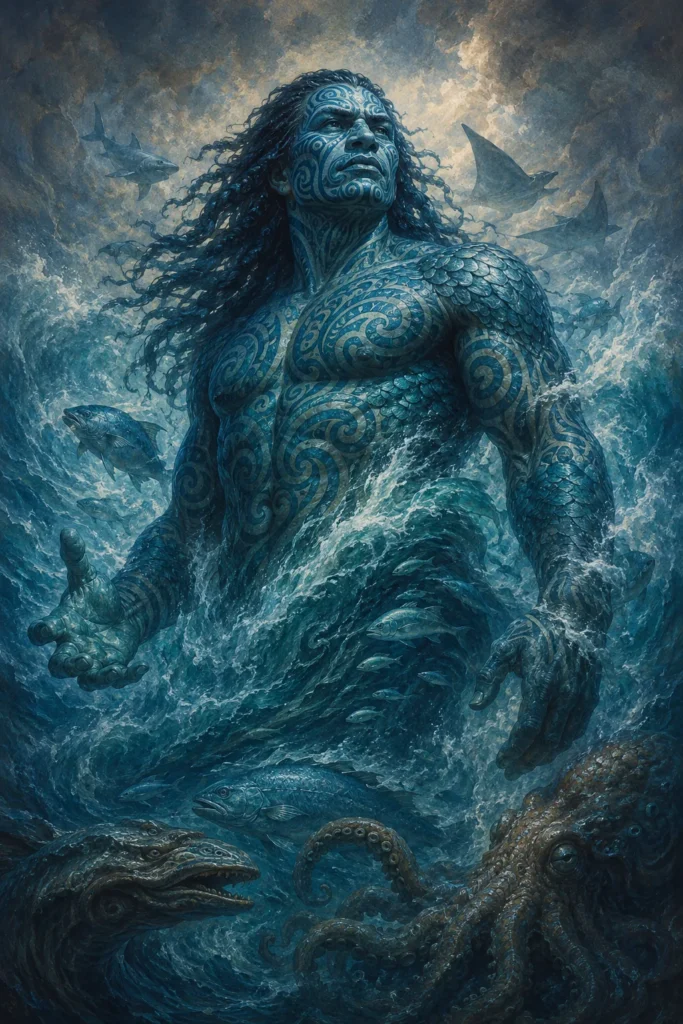
Carvings on canoes and on bow and stern posts often show his zoological domain: fish, shark, whales, squid and lizards. The Maori variant remains symbolic and abstract. The sea itself is regarded as the most immediate visible manifestation, every wave as an expression of his mana.
Aotearoa knew no large, permanent stone temples for Tangaroa. The cult sites were tuahu near the coast, often groupings of stones or particular rocks. Before setting out, karakia were spoken, and the first fish of the day was often returned to the sea as a first offering (mata-ika) or laid on a tuahu.
Connected with Tangaroa are fish scales, reptile skin and maritime symbols. Tuatara and lizards are regarded as special manifestations. Pendants of pounamu in the shape of a fish hook (hei matau) are regarded as protection for travellers, especially over water.
Compared are Poseidon, Neptune, Njörd and Varuna, who personify the sea as an ambivalent power. Within Polynesia Kanaloa in Hawai’i and Tagaloa in Samoa correspond to him, Tagaloa being regarded there as high god and creator of the world.
Classification within the Polynesian Pantheon
Tangaroa belongs to the highest Atua in nearly all Polynesian mythologies.
In Tahiti he appears as Ta’aroa, even as the supreme god and creator who shapes the world from his own body; in the Maori tradition of Aotearoa he is a son of Ranginui and Papatuanuku, equal in rank with Tane Mahuta, Tu Matauenga, and Rongo.
Margaret Orbell points in her encyclopedia to this differing hierarchization as a key observation: from a religious-studies perspective, it becomes clear that the Polynesian mythological tradition possesses a shared reservoir of figures and motifs from which regional theologies composed distinct pantheons.
In Aotearoa, Tangaroa is primarily lord of the sea; in Tahiti he is creator of the world.
This tension is central to understanding Polynesian religious history, as Patrick Kirch reconstructs it in On the Road of the Winds (2000) using archaeological and linguistic data.
A second finding: in some Maori tribal traditions, Tangaroa is less a “brother” than a “father of a lineage” – a Whakapapa variant common among Iwi of the East Coast.
Name and Etymology
The name Tangaroa is rendered in Polynesian languages as Ta’aroa (Tahiti), Kanaloa (Hawai’i), Tagaloa (Samoa), and Tangaloa (Tonga). Bruce Biggs derives the proto-Polynesian *Ta(n)galoa as their common root. A secure etymological meaning has not been reconstructed; proposals range from “the one who attains,” “the outstretched one,” to “the standing one.”
The variety of spellings is linguistically documented: where Maori forms the hard “k” from the proto-Polynesian *k, Hawaiian undergoes a sound shift to a glottal stop. The close relationship makes Tangaroa one of the best-attested pan-Polynesian deities.
His counterpart Kanaloa in Hawai’i is a linguistic and mythological close relative, although Kanaloa, as one of the four supreme gods in the Hawaiian system, occupies a more institutionalized position.
Epithets of Tangaroa in the Maori tradition include Tangaroa-whakamau-tai (“Tangaroa who holds back the tide”), Tangaroa-pukanohi-nui (“Tangaroa with large eyes”), and Tangaroa-i-te-rupetu (referring to the stormy sea). The name Tangaroa itself also carries in some Iwi the epithet “whaiao,” designating him as a bringer of light upon the sea.
Description and Iconography
In the Maori tradition, Tangaroa is visually associated with fish scales, reptilian skin, and maritime symbols. Carvings on canoes (waka), on bow and stern posts, often display his zoological domain: fish, shark, whale, octopus, lizards.
Because reptiles in Aotearoa, as tuatara and lizards, are very rare and considered tapu, they are regarded as special manifestations of Tangaroa.
On Rurutu (Austral Islands), a famous carved figure (now in the British Museum) depicts the creator figure A’a with small gods and humans emerging from its body; it is regarded as Tangaroa only to a limited extent. This iconography is not recorded in Aotearoa.
Roger Neich discusses the difference as a regional religious contrast. The Maori variant remains symbolic and abstract, avoiding the hyperrealistic statuary of the eastern Polynesian island world.
The sea itself is the most immediate visible manifestation of Tangaroa. Every wave, every current is regarded as an expression of his mana.
In particular, the eastern coast of Aotearoa and the Cook Strait, with their strong currents, are considered places where his essence can be experienced directly. Whakaari (White Island), an active volcano, is also interpreted in some Iwi as a manifestation of Tangaroa in his destructive aspect.
Mythological Narratives: Conflict with Tane
One of the best-known narratives concerns Tangaroa’s lasting conflict with Tane Mahuta. After the separation of sky and earth, some of Tangaroa’s children, including reptiles, fled into the forests rather than joining him in the sea.
Tane took them in. In revenge, Tangaroa has since caused the sea to rot the wood of canoes and erode the coastlines. Tane responds by fashioning from his trees the boats, nets, and spears with which humans catch Tangaroa’s children.
This narrative is instructive from a religious-studies perspective because it uses cosmic conflicts to explain everyday natural phenomena. Reidar Solsvik (Polynesian Religion in Context, 2008) places it within the typical Polynesian brother-conflict mythology. It also structures ecological awareness: forest and sea interact, humans make use of both but must honor both.
A second narrative tells how Tangaroa was initially allied with his brother Tawhirimatea (god of storms) but then withdrew when the storms became too destructive. These fractures in the cosmos form in Maori theology a network of relationships that is not static but dynamic.
Margaret Orbell points out that such narratives do not only explain natural phenomena but also contain guidance for right conduct. Whoever respects both realms – forest and sea – cannot resolve the lasting conflict of the Atua, but can soften its consequences. This ethical element is a consistent feature of Maori theology.
Tangaroa as Ancestor of Fishers
Fishing in the Maori world is a profoundly religious activity. Tangaroa is regarded as the ancestor of all fishers.
Before a boat set out, karakia were spoken to him; certain areas of the sea were considered tapu, and the purity of the fisher had to be maintained. Elsdon Best describes the ritual prescriptions in detail in Fishing Methods and Devices of the Maori (1929).
Whoever caught the first fish of the day often returned it to the sea as a firstfruits offering (mata-ika) or placed it on a tuahu (altar). Some Iwi still practice such firstfruits returns today.
Cleaning the nets is also part of the Tangaroa connection. From a religious-studies standpoint, this behavior corresponds to the globally widespread principle of the firstfruits offering as recognition of divinity.
Anne Salmond shows in The Trial of the Cannibal Dog (2003), drawing on early encounters between Maori and Europeans, how Tangaroa references were active in intercultural contact rituals of the 18th century: fish was exchanged as a symbol of peace and hospitality, always with the implicit acknowledgment of Tangaroa as giver.
The concept of the mata-ika return corresponds phenomenologically to the firstfruits offering in many agrarian religions. It marks the boundary between human claim and divine giving. Without this acknowledgment, humans cannot legitimately draw from Tangaroa’s realm. This logic is operative without needing to be explicitly theologized.
Cult and Rituals
Unlike the Tahitian marae system, Aotearoa knew no large, permanent stone temples for Tangaroa. Cult sites were primarily coastal tuahu, often stone groupings or particular rocks. Today the karakia to Tangaroa is part of many public occasions, for example when a new canoe is launched or a swimming group enters the sea.
A pre-event karakia to Tangaroa is not unusual among Maori swimmers, surfers, and divers. This practice has been documented by Hirini Mead and the Te Puni Kokiri ministry. In education there are learning pathways through which students learn about Tangaroa and maritime knowledge.
The establishment of rahui (time-limited protected areas) at sea often takes place in the name of Tangaroa. When fish stocks are threatened, the responsible hapu can declare a rahui and place the sea in that area under tapu for a specified time.
This practice is legally recognized within the Treaty of Waitangi framework and is implemented in cooperation with the Department of Conservation.
The lunar calendar also plays a central role: certain phases of the moon are attributed to Tangaroa, during which fishing is said to be especially productive.
The maramataka revival of recent decades has brought these connections back to awareness. Hapu such as Ngati Awa and Ngati Porou organize maramataka courses that systematically convey these Tangaroa connections.
Protective Traditions and Apotropaic Connections
Protective practices within Tangaroa’s domain focus on purity when entering the sea, on gestures of return, and on the crafting of protective objects (taonga) from maritime materials.
Pounamu pendants in the shape of a fishhook (hei matau) are today known worldwide; they are regarded as protection for travelers, especially over water. Mead describes these objects as cultural condensations of Tangaroa-relatedness, not as amulets in the magical sense.
In accidents at sea, such as drownings or boat collisions, Maori tradition draws on tangihanga (mourning ceremonies) in which Tangaroa is explicitly addressed to escort the deceased home.
This practice remains alive today. Tangaroa is also a point of reference in the search for the drowned, where Maori families often independently seek clues about locations through whakapapa prayers.
Protective practice for travelers over the sea also includes wearing certain feathers or pounamu pendants. A karakia before boarding an airplane or boat is standard in some families. From a religious-studies perspective, this is a modernization of the practice that retains the underlying principle, namely the ritual acknowledgment of Tangaroa before entering his realm.
Parallels in Other Cultures
In comparative religion, Tangaroa can be compared with Poseidon of the Greek tradition, Neptune of the Roman, Njord of the Norse, or Varuna of the Vedic tradition. All these figures personify the sea as an ambivalent power: source of life and at the same time of terror.
Important, however, is the difference: Tangaroa is not primarily a “storm god” but the holder of fish and maritime creatures. Storm and wind are assigned in Maori theology to Tawhirimatea, another brother.
Within Polynesia the parallels are particularly close. Beckwith (Hawaiian Mythology, 1940) presents in detail the correspondences with Kanaloa.
In Samoa, Tagaloa is considered the supreme god and world creator, a theology that corresponds in some points to the Tahitian. This diversity demonstrates the creative independence of individual island cultures working with a shared mythic heritage.
The phenomenology of the water god as an ambivalent power between nourishment and death is universal. Eliade describes this type in Patterns in Comparative Religion (1958). Within such universal structures each culture develops its own narrative and ritual expression. The Polynesian expression is especially intensely differentiated by its maritime geography and centuries-long seafaring culture.
Contemporary Reception and Significance
Tangaroa is a very living figure in contemporary Maori culture. Maori Language Week regularly features him. In the traditional lunar calendar (maramataka), three consecutive nights are known as Tangaroa nights: Tangaroa-a-mua, Tangaroa-a-roto, and Tangaroa-kiokio. On these nights fishing is considered especially productive.
In the public discourse of Aotearoa, Tangaroa plays a role in ecological debates about overfishing, plastic pollution, and climate change. Organizations such as Te Ohu Kaimoana connect fisheries policy with cultural and religious references.
A deeper classification within Polynesian-Maori religion as a whole shows how Tangaroa functions as a cosmological point of reference across religion, law, and ecology.
In contemporary Maori literature (Patricia Grace, Witi Ihimaera), Tangaroa is also a recurring reference figure. The well-known novel The Whale Rider (1987) tells a Tangaroa-related story in which a girl carries the connection to the sea god within an Iwi tradition as Whale Rider.
Tangaroa is also present in the international sphere: through Pacific voyaging initiatives such as Hokule’a (Hawai’i) and Te Aurere (Aotearoa), which revive traditional navigation and integrate Tangaroa karakia into their practice.
Research and Sources
The most important sources on Tangaroa are the records of Te Rangikaheke (19th century), the collection of Sir George Grey, the ethnographic works of Elsdon Best (1900s to 1930s), Margaret Orbell’s encyclopedia, and the critical studies of Anne Salmond.
From an archaeological perspective, Patrick Kirch provides important context. A critical reflection on the colonial distortions of early sources can be found in Judith Binney and James Belich.
Religious-studies research stands in dialogue with Maori-internal knowledge traditions, which today are transmitted through wananga, universities, and hapu trusts. This dual perspective, academic and tradition-internal, is the methodological standard in the field. Research by Tipene O’Regan (Ngai Tahu) and Pou Temara combines Maori knowledge tradition with academic rigor.
An important recent contribution is Hirini Mead and Neil Grove‘s Nga Pepeha a nga Tipuna (2001), which makes transmitted proverbs and karakia available in bilingual edition, supporting both research and tradition-internal use equally.
Tangaroa remains a central point of reference across disciplinary fields: Maori Studies, religious studies, anthropology, linguistics, ecology, and law.
This interdisciplinarity is methodologically demanding but generates new research approaches that seek to grasp the Polynesian religious system as a whole without falling back into colonial simplifications. Recent Maori research initiatives such as Te Tumu Herenga are setting important impulses here.
Current research increasingly combines ethnographic depth with interdisciplinary connections to the psychology of religion, trauma research, and performance studies.
Tangaroa across the Various Polynesian Regions
Tangaroa is one of the few deities whose name is spread across nearly the entire Polynesian language area, yet his position differs considerably from island group to island group.
In New Zealand he appears among the Maori as Tangaroa, one of the sons of the primal couple Ranginui and Papatuanuku, responsible for the sea and its inhabitants.
On the Society Islands, however, for example in the Tahitian tradition, he bears the name Taʻaroa and plays a far more central role as creator, bringing forth the world from his shell.
In Hawai’i he appears as Kanaloa, though not there as supreme creator but often as the companion of the god Kane, connected with the sea and in part with the underworld.
In Samoa and Tonga, Tangaloa is a sky deity from whom noble genealogies are derived. These shifts are not a sign of confusion in the tradition but the result of long independent development of individual societies following the settlement of the Pacific.
The sources for this regional variety derive predominantly from the 19th century: from records by missionaries such as John Williams, from the collections of colonial officials, and from the work of indigenous informants.
They are colored by their respective contact situations, particularly where the missions had already displaced the old cults by the time the records were made. A unified Tangaroa theology for all of Polynesia cannot be derived from these sources. The regional attachment to specific island groups must be named alongside every statement.
Taʻaroa and the Creation of the World from the Shell
The most detailed creation narrative centered on Tangaroa comes from the Society Islands and was collected, among others, by the missionary John Orsmond, whose materials were later compiled by his granddaughter Teuira Henry in her work on ancient Tahiti.
In this version the god bears the name Taʻaroa and exists at the beginning alone, enclosed in a shell called rumia, amid endless darkness and void.
Taʻaroa eventually breaks open the shell and emerges. From the upper part of the shell he forms the sky, from the lower the bedrock and the earth.
He then continues to create the world from his own body: his spine becomes a mountain range, his ribs ridge lines, his flesh the earth, his feathers and hair trees and shrubs, his entrails clouds, his blood the red of the sky at sunrise and sunset.
Finally he calls other gods into being, among them the craft god Tane.
This narrative combines two motifs: the world within a sealed container that comes into being through an opening, and the cosmic body whose parts become constituents of the world.
The shell motif is especially prominent on the Society Islands and clearly distinguishes this tradition from the New Zealand one, in which the separation of sky and earth stands at the center.
The Henry edition is an important but late and editorially reworked source, whose relationship to the original oral versions cannot be determined with certainty in every detail.
Selected Bibliography
- Margaret Orbell: The Illustrated Encyclopedia of Maori Myth and Legend (1995)
- Elsdon Best: Fishing Methods and Devices of the Maori (1929)
- Patrick Kirch: On the Road of the Winds (2000)
- Martha Beckwith: Hawaiian Mythology (1940)
- Anne Salmond: Tears of Rangi (2017)
- Sir George Grey: Polynesian Mythology (1855)
The cult of Tangaroa was devoted to seafaring, fishing, and the preservation of cosmic order: before casting nets and before long canoe voyages, prayers and firstfruits offerings were presented to secure his protection.
In Maori cosmogony, Tangaroa also stands for the separation of water and land; his cult places human activity at sea within the larger order of the Atua siblings.
Related key terms: Tangaroa Maori sea god fishery maramataka hei matau Tagaloa Kanaloa.
iWell Guard and Protective Traditions
iWell Guard draws on the cultural-historical tradition of wearable protective objects, in the tradition of Polynesia / Maori and many other cultures worldwide. 41 levels, genuine gold, platinum, silver, crafted in Germany. 30-day return policy.
Individual experiences may vary. Not a medical device. No healing claims.