Azrael, Angel of the Islamic Tradition
By Ralf Ittermann · last reviewed on
Azrael is the archangelic figure of the Islamic tradition, the angel of death and psychopomp of souls. His significance for religious studies lies in his mediation between life and death, in the Quranic-theological function of the dignified taking of the soul, and in his mystical role as guardian of the eschatological threshold to the hereafter.
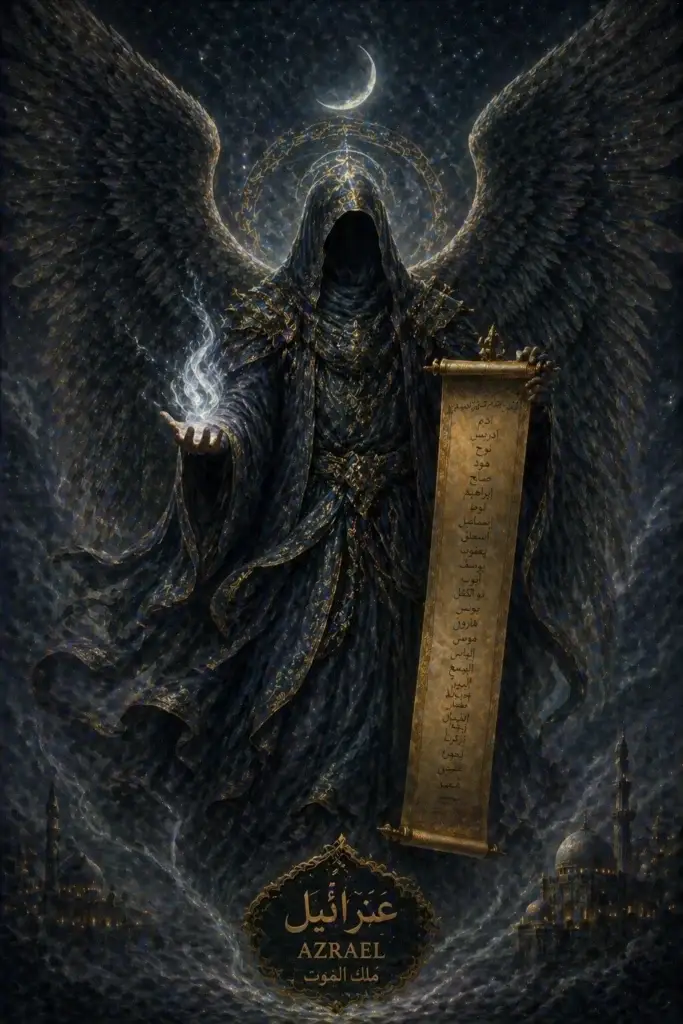
Azrael
Azrael (also Izra’il) acts as the angel of death and escort of souls. His characteristics include gentleness toward believers, severity toward sinners, and absolute obedience to Allah.
Central myths are: Azrael’s appearance at the deathbed (Hadith), the gathering of the soul with 40 angels (Tirmidhi), the negotiation of the soul at the Last Judgement (Yawm ad-Din), and Azrael’s conversation with the dying soul about its fate.
Quick overview: Azrael
Azrael is mentioned in Hadith collections (Bukhari, Muslim, Tirmidhi, Arabic, 8th to 9th century) and indirectly in the Quran under Mal’ak al-Mawt (angel of death, 32:11).
The framework attribution occurs in the early Islamic period. The state of research (Schimmel, Hughes, Wild, McLeod) documents Azrael as a central figure of Islamic eschatology and Sufi mysticism.
Classification
The tradition can be traced over a good one and a half millennia: the Quran knows the angel of death without a name, the hadith and narrative literature of the first Islamic centuries gave him the name Azrael and a detailed profile of tasks, and in parallel the Jewish tradition knows the Malach ha-Mawet. To this day the figure remains present: in Islamic popular piety, in preaching and devotional literature, and also in the literature and pop culture of the West, where Azrael often appears detached from the theological context as a variant of the Grim Reaper.
Azrael was not confined to a particular region or locations but was universally known throughout the Islamic world and venerated or respectfully feared. Whether in large urban centres or in peripheral rural regions, whether among the social elite or among ordinary people, the spiritual or cultural significance of this entity was consistently recognised and universal.
That the angel of death is known under related names in Jewish, Islamic, and later also Christian-influenced cultures is explained by the shared textual foundation of the monotheistic traditions and their exchange in the Near East. As Islam spread from Andalusia to Southeast Asia, the conception of Azrael traveled with it and remained essentially uniform: an angel who takes souls on God’s behalf, without arbitrariness of his own and without a cult of his own.
Primary sources are the Quran (32:11 “We will cause you to die” with an implication of the angel of death, Arabic, 7th century), Hadith collections (Sahih al-Bukhari 2:23, Sahih Muslim 2159, Jami’ at-Tirmidhi 2332, Arabic), Tafsir literature (Tabari, Ibn Kathir) and Sufi texts (Al-Ghazali, Ihya Ulum ad-Din, 11th century Arabic). In secondary works, Schimmel (Mystical Dimensions), Hughes (Dictionary of Islam), Wild (Islamic Angelology) and McLeod (Judeo-Islamic Angelology) analysed Azrael’s central role as an eschatological angel.
Name
Azrael is depicted in the various sources and artistic traditions with certain recurring iconographic elements that remain relatively constant across decades and across different geographical regions. These elements are not purely decorative or chosen at random but are deeply symbolically coded and carry great meaning.
The descriptions of Azrael in Islamic and Jewish tradition are not free embellishment but theologically intended statements about his office: when tradition ascribes to him thousands of eyes and wings, or reports that he carries a scroll with the names of the living, this illustrates his task of reaching every human being at the appointed hour. The Quran itself gives no name, speaking only of the angel of death (Surah 32:11); the name and attributes come from post-Quranic literature. Those familiar with this textual tradition can read the individual pictorial elements as statements about the angel’s reach, his commission, and his obedience to God.
The overall system is like a sacred scripture or a coded image: it allows the initiated or the culturally educated to grasp and correctly understand the essential deeper meaning. Colours, sacred objects or weapons, physical attributes, specific accessories: everything is significant and traditionally handed down.
Description
Azrael was central to religious practice, everyday rituals and the everyday understanding of Islam. People turned to this entity in critical or particular life situations or at certain ritual times of year.
In the Islamic tradition, dealings with the angel of death were embedded in theology and law: scholars discussed the duties of the Malak al-Maut in Quranic exegesis and hadith commentaries, and the rituals surrounding dying, from speaking the profession of faith at the deathbed to the washing of the body, were governed by religious prescriptions and accompanied by persons instructed for the task.
The continuity of these practices over many generations clearly shows that the practice was regarded as effective and necessary. The functions were varied: some were preventive (warding off potential misfortune), some healing (relief of illness or suffering), some transformative (accompaniment through transitions between stages of life).
Profile: Azrael
The Profile captures Azrael across six dimensions: his origin in Quranic and hadith-supported traditions, his target group among believing Muslims and the dying, iconographic features of the death scenario, his functional role as a dignified escort of souls, comparisons with Christian and Jewish powers of death, and his mystical role in Sufi contemplation on transience.
Azrael is mentioned in early Hadith texts of the 8th to 9th century, with roots in Judaeo-Christian angelology (Uriel, Samael). The geographical origin lies on the Arabian Peninsula and in the Near East.
The Quran does not mention the name Azrael; Surah 32:11 (Meccan period, 610 to 622 CE) speaks only of the angel of death, and the name stems from post-Quranic literature. The theological framing as the chief angel of death took place in Hadith commentaries and Sufi works (10th to 11th century).
Azrael was directed primarily at all believers, especially the dying and the mourning. The target group is the pious (hope for a gentle death), sinners (fear), mystics (contemplation on death), and caring relatives (prayer for deliverance).
The occasions are deathbeds, fear of death, times of mourning and mystical meditations (Muraqaba) on transience (Zawal). The invocation takes place in silent devotion and reverent awe (Khawf).
Azrael iconographically: a male figure with large, black or dark blue wings, an expressionless or sorrowful physiognomy. His attributes are a book or sheet listing the dead (a record of the hours of death), sometimes light or darkness.
In Sufi miniature depiction: a grave gaze, a solemn bearing. The iconographic connection to record-keeping and silence distinguishes Azrael from Western Grim Reaper figures.
Azrael (ʿIzrāʾīl, Malak al-Mawt, angel of death) is a canonical figure in Islam, not apocryphal.
Azrael was regarded as neutral and dutiful, neither evil nor benevolent, but as the executor of Allah. The invocation practices included prayers for a gentle death (Karamah), protection from a painful dying, and forgiveness before the questioning of the soul.
In Sufi traditions, meditations on Azrael were practised (Muraqaba ala-l-mawt) in order to attain renunciation (Zuhd) and preparation of the soul. Respect for Azrael was expressed as reverent acceptance of death as the will of Allah.
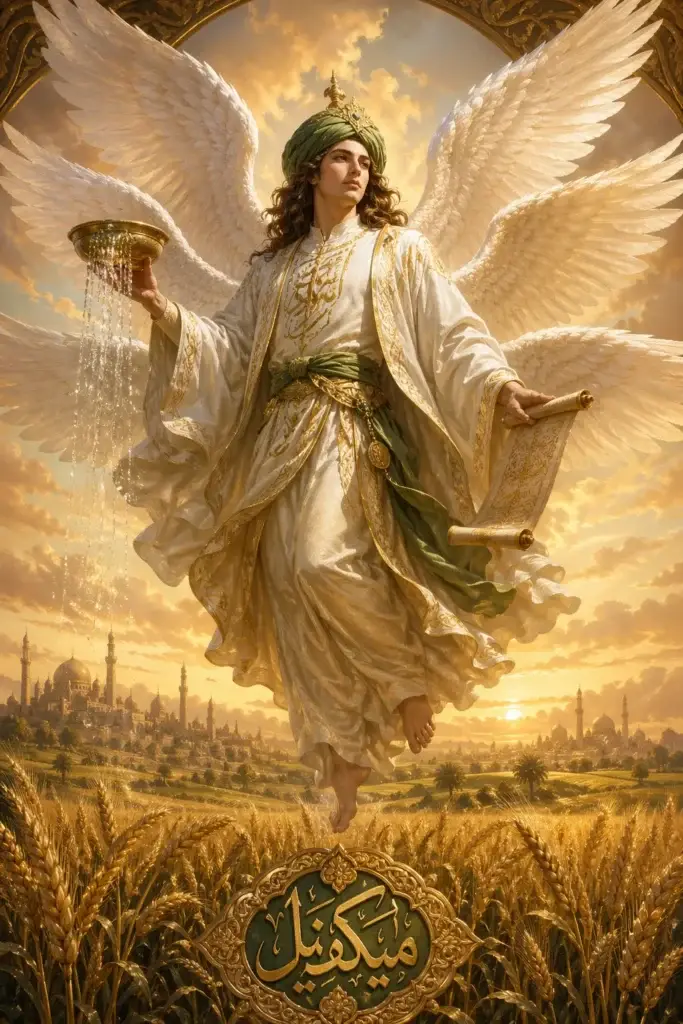
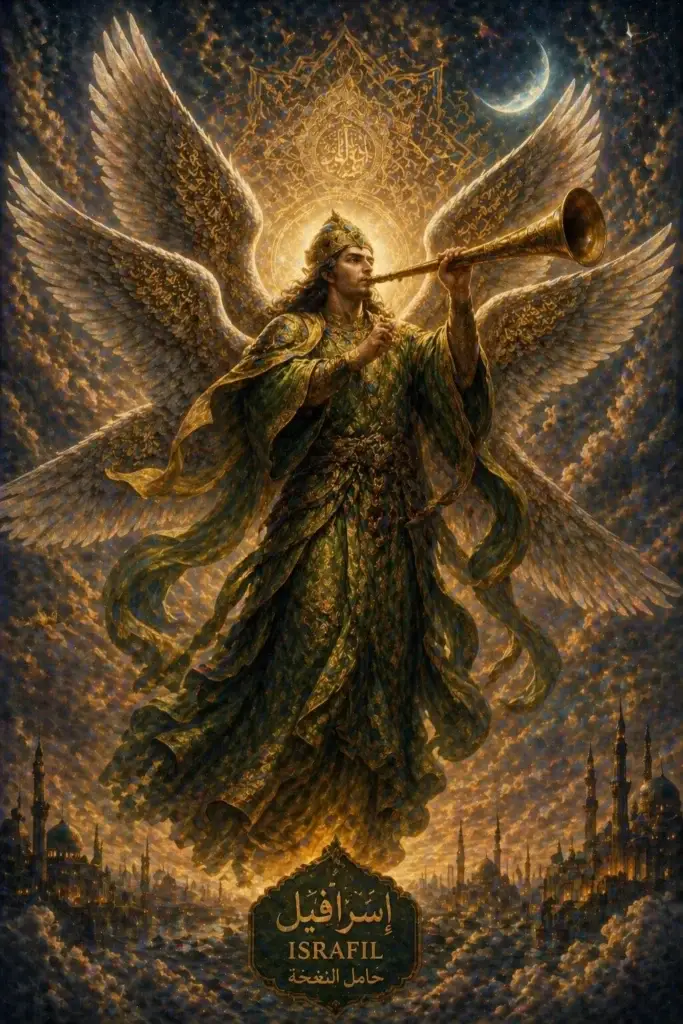
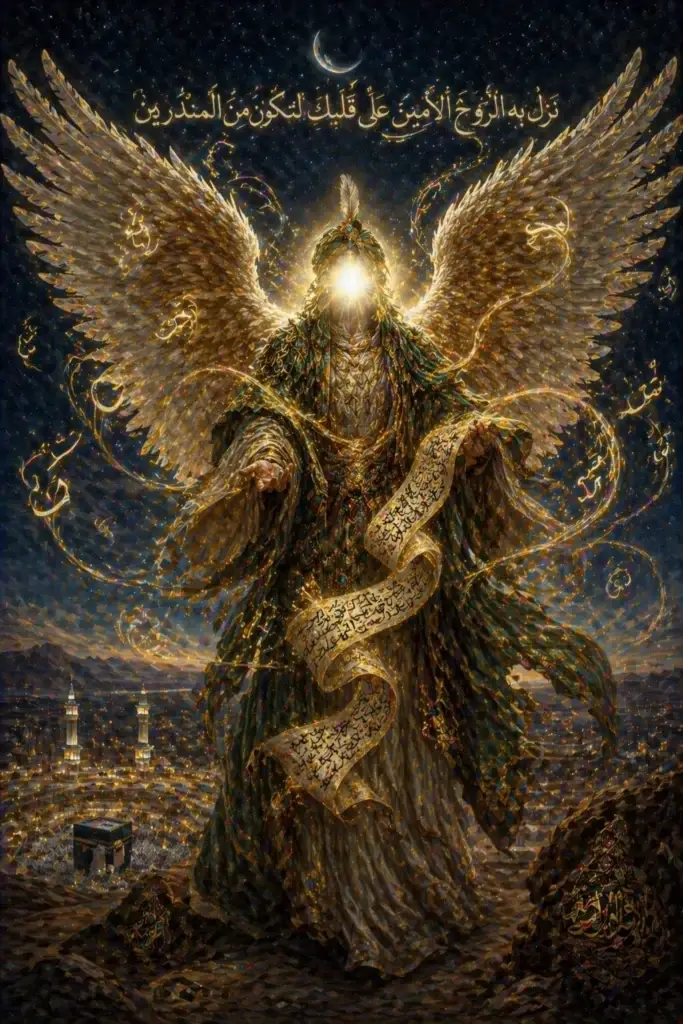
Comparable figures in Islam: Israfil (angel of the trumpet of resurrection), Mikail (protective angel), Jibril (angel of revelation). Outside Islam: Hermes Psychopompos (escort of souls, Greek), Charon (ferryman of the underworld, Greek), the Jewish Samael (power of death, but demonic). His neutral, dignified role makes Azrael unique.
Warding off in everyday life
Invocations during deathbed care
In practical Islam (especially in Shia Islam and Sufism) prayers (Du’a) are recited during the deathbed visit.
Rituals and meditative preparation
There are no direct rituals of invocation for Azrael. Instead, daily remembrance of death (Zikr al-Mawt) is the practice.
Protective amulets and preparation for death
The central protective amulet is trust in Allah (Tawakkul) and the profession of faith (Shahada).
Azrael, parallels in other cultures
Jewish tradition: Jewish parallel: Samael or Uriel as the angel of death (but rather as a bringer of punishment). The difference: Azrael brings a dignified, accepted death; Samael is rather demonic. Rabbinic literature does not sharply distinguish between classifications of the angel of death.
Greco-Roman world: Greek equivalent: Hermes Psychopompos (escort of souls, but not an angel of the moment of death). Also Thanatos (deity of death, but rather abstract, not personal). Charon (ferryman of the Styx, but for transit to the underworld, not the moment of death). Azrael’s most intimate role at the deathbed is specifically Islamic.
Mesopotamia: Mesopotamian equivalent: Ereshkigal (ruler of the underworld) or Ganzir (gate to the underworld). Closer: Namtar (messenger of plague and death). Azrael and Ereshkigal/Namtar share the quiet, organising function.
India/Asia: Indian equivalent: Yama (god of death, Hindu). Buddhist parallel: Kshitigarbha (bodhisattva of the dead). Both share the function as dignified powers of soul administration, not as bringers of punishment like Western scenarios of death.
Azrael in the sources: Quran, Hadith and later angelology
The name Azrael (ʿArzāʾīl, ʿAzrāʾīl) does not appear in the Quran itself.
The holy scripture of Islam speaks instead of malak al-maut, the “angel of death”, most clearly in Sura 32:11: “Say: The angel of death, who is charged with you, will call you away.” The proper name Azrael is a later formation that established itself only in post-Quranic narrative literature and in popular piety.
Its roots probably lie in Jewish and Eastern Christian angel names that go back to the Hebrew element ʿezer (“help”) and the divine name El.
In the Hadith literature and in the Qiṣaṣ al-anbiyāʾ, the “Stories of the Prophets”, for example in al-Thaʿlabī (died 1035) and al-Kisāʾī, the figure takes on contour.
There it is told how God sent out four archangels to fetch earth for the creation of Adam. Only Azrael completed the task against the resistance of the earth, and as a reward, or as a burden, the gathering of souls was entrusted to him.
The theological handbooks classify Azrael among the four highest-ranking angels, alongside Jibril, Mikāʾīl and Isrāfīl. Unlike the other three, he has no function of revelation or provision, but solely that of transition.
The mystics, especially in the tradition of Ibn ʿArabī, interpreted this as an indication that death is not a rupture but a leading back. The state of the sources clearly shows that Azrael is less a dogmatically fixed figure than a point of crystallisation at which Quranic brevity, exegetical embellishment and pious imagination meet.
The narrative of the dispute with Moses
One of the best-known episodes about the angel of death is found in a hadith transmitted in al-Bukhari and Muslim and later embellished many times over. When Azrael comes to Moses to take his soul, the prophet strikes him, so that one of the angel‘s eyes is struck out.
Azrael returns to God and reports that he was sent to a servant who does not want death. God gives him back the eye and instructs him to offer Moses a choice.
Moses is to lay his hand on the back of a bull. For every hair that his hand covers, a further year of life will be granted to him. Moses asks what comes after that and receives the answer: death. Thereupon he declines and asks to be allowed to die near the Holy Land.
In Islamic piety the episode was read not as a disrespectful anecdote but as a lesson about the inevitability of death and about the right attitude toward it. Even a prophet at first recoils, but then recognises that an endless life would be no deliverance.
The commentators emphasised that Moses’ blow was not rebellion against God but fright at an unannounced apparition, since according to a widespread interpretation Moses at first did not recognise the angel. Later Sufi authors used the story to distinguish between the natural fear of death and the believing acceptance of death.
Reception in Western literature and modern culture
Through Jewish and Islamic narrative material, the figure of Azrael entered European literature. In 1878, in the poem Azrael from the Birds of Passage, Henry Wadsworth Longfellow gave him a gentle, almost comforting voice.
In the theosophical and occultist literature of the 19th century, Azrael was taken up into lists of angels that mingled Jewish, Christian and Islamic traditions, which anchored his name in Western esotericism.
In the 20th and 21st centuries, Azrael is a frequent name for figures of death in novels, comics and games.
In the process, the interpretation often shifts considerably: the obedient servant of God sometimes becomes an ambivalent or even dark figure. This reinterpretation says more about modern conceptions of death than about the religious tradition.
It is remarkable, by contrast, how stable the core remained in lived Islamic piety.
In accompanying the dying, in funeral addresses and in religious instruction, the angel of death continues to be regarded as the one commissioned by God, whose coming no one can halt and whose appearance should be no cause for despair for the believer.
The tension between the popular-cultural darkening and the theological composure shows how differently the same figure can turn out depending on the carrier culture. Whoever wants to understand Azrael must keep these two strands of tradition apart.
Further links
Research literature
In the Islamic tradition, Azrael (ʿAzrāʾīl) is regarded as that deity-like angelic figure to whom the task of the angel of death (malak al-mawt) is attributed.
Theologically he is not an independent deity but a servant of Allah; in popular belief, however, he is frequently described with a being-nature of his own and named alongside other great angelic figures such as Gabriel, Michael and Israfil.