Jibril, Archangel of the Islamic Tradition
By Ralf Ittermann · last reviewed on
Jibril is the archangel figure of the Islamic tradition, revelation angel of the Quran and mediator between Allah and prophets. His significance in religious studies lies in the embodiment of divine message (Wahy), in the direct connection between transcendence and history, and in Quranic theology as the most trustworthy heavenly messenger of Allah.
Jibril
Jibril (also Jabrail) functions as the revelation angel and companion of the prophets. His qualities include faithfulness, dignity, immediate nearness to Allah’s throne, and incorporeal purity.
Central myths are: Jibril’s delivery of the Quran to Muhammad (surah 26:193, 194), Jibril’s appearance to the Prophet (17:85 Ruh = Jibril), Jibril’s assistance during Muhammad’s ascension (Isra and Mi’raj, hadith), and Jibril’s announcement of the birth of Jesus (surah 19:16, 21).
At a Glance: Jibril
Jibril is mentioned several times in the Quran (2:97, 98, 16:102, 26:193, 194) and is treated prominently in hadith collections (Bukhari, Muslim, Arabic, 9th c.).
The framing attribution occurs in the early Islamic period (7th c.). The state of research (Schimmel, Hughes, Wild, McLeod) documents Jibril as the central archangel of the Quranic revelation and of mystical theology.
Context
The continuity of the tradition across these long spans of time is remarkable and shows a deep, stable cultural rootedness. In modern times too, the memory and sometimes also active veneration is alive, sometimes transformed, but in its basic features still recognizable.
Jibril was not confined to a particular region or locations, but was universally known and venerated or respectfully feared throughout the entire Islamic world.
City dwellers and rural communities alike acknowledged the spiritual weight of this figure; its significance did not depend on social rank and reached from the elite to the common people.
This clearly points to a central role in the self-understanding of the whole people. Trade, migration and cultural exchanges contributed to the geographical distribution and to the stable uniformity of the veneration.
Primary sources are the Quran (2:97 Jibril, with Allah’s permission, 16:102 the Holy spirit, 26:193, 194 Quran revelation verse, Arabic, 7th c.), hadith collections (Sahih al-Bukhari 1:1, Sahih Muslim, Arabic) and Tafsir works (Tabari, Ibn Kathir). Secondarily, Schimmel (Mystical Dimensions of Islam, 1975), Hughes (Dictionary of Islam), Wild (Islamic Angelology) and McLeod (Judeo-Islamic Angelology) analyzed Jibril’s central role in Islamic revelation and mysticism theology.
Name
Jibril is depicted in the various sources and artistic traditions with certain recurring iconographic elements that remain relatively constant over decades and across different geographical areas.
These elements are not purely decorative or chosen at random, but are deeply symbolically coded and carry great meaning. They centrally convey the functions, sources of power, sphere of responsibility and cosmic role of the being.
The overall system is like a sacred scripture or a coded image: it allows the initiated or the culturally educated to grasp the essential deep meaning and understand it correctly. Colors, sacred objects or weapons, physical attributes, specific accessories, everything is significant and traditionally handed down.
Characteristics
Jibril was central to the religious practice, the everyday rituals and the everyday understanding of Islam. People turned to this entity in critical or particular situations of life or at certain ritual times of year.
According to Islamic tradition, the transmission of the revelation to Muhammad followed no random pattern: Jibril appeared in ordered sequence over roughly 23 years, recited the verses word for word, and had the Prophet repeat them until they were secured. The hadith literature describes this process as a regulated act of teaching, not as a spontaneous experience.
The continuity of these practices over many generations clearly shows that the practice was regarded as effective and necessary. Functions were diverse: some were preventive (warding off potential misfortune), some healing (alleviation of illness or suffering), some transformative (accompaniment through transitions between stages of life).
Profile: Jibril
The Profile captures Jibril across six dimensions: his origin in Quranic revelation narratives, his target audience among believing Muslims and mystics, iconographic features as a light being, his functional role as a mediator of revelation, comparisons with the Christian and Jewish Gabriels, and his mystical role in Sufi contemplation on Wahy (revelation).
Jibril is mentioned in Quranic texts of the 7th century, with roots in the Judaeo-Christian Gabriel tradition (etymologically identical: Jibril = Gabriel). The geographical origin lies in the Arabian Peninsula and the Near East.
The dating of the first mention is Quran 2:97 (Medina period, 623 and 632 CE). The theological framing as the chief revelation angel occurred immediately after the prophethood of Muhammad (610 and 632 CE).
Jibril addressed himself primarily to the Prophet Muhammad and the community of believers (Umma). The target audience comprises all Muslims as recipients of the Quranic message, mystics with an interest in revelation mysticism (Wahy knowledge) and theologians.
Occasions are the reading of the Quran, revelation meditations, mystical night prayers (Tahajjud) and the festival of the Quran revelation (Laylat al-Qadr). The invocation takes place in reverence before the Wahy.
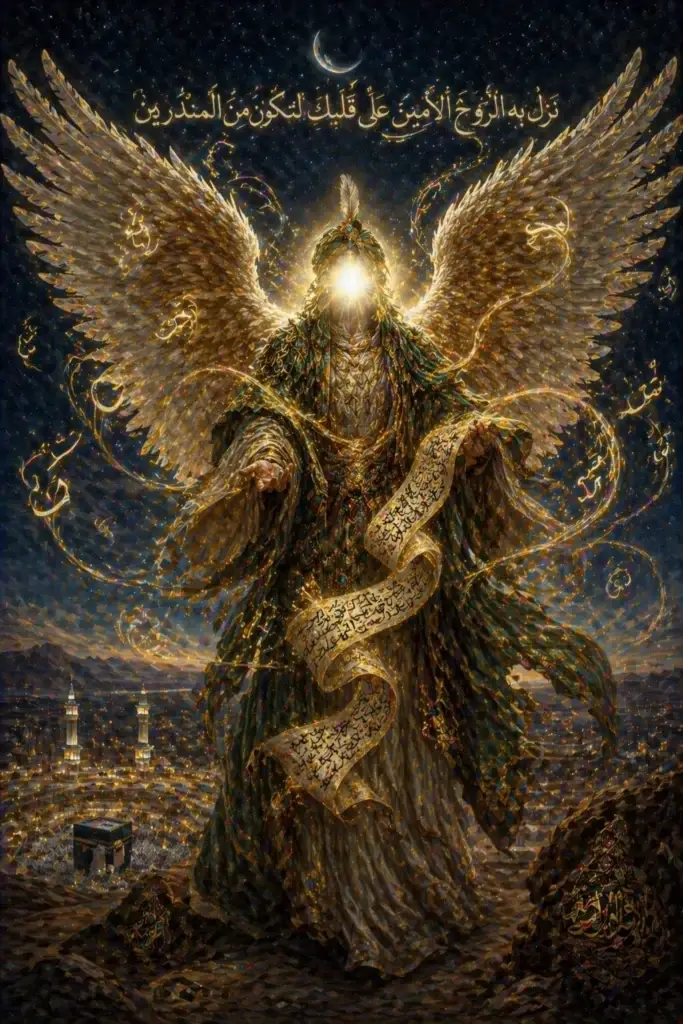
Jibril iconographically: a male figure with large, white or silver wings, radiant like light, with a dignified physiognomy. Attributes are a scroll or book (Quran text), a light aura (Nur), sometimes a lily or a greeting of peace.
In Islamic and Persian miniature depictions: glowing, almost dazzling to behold. The iconographic connection to pure light substance distinguishes Jibril in Sufi art.
Jibril (Gabriel, ǧibrīl) is in Islam one of the most significant archangels and the conveyor of the revelation to the Prophet Muhammad.
Jibril was regarded as trustworthy, holy and of the highest integrity. The invocation practices included prayers for an understanding of revelation (Fahm al-Wahy), for nearness to the divine message and for the purification of the heart (Tazkiyah).
In Sufi traditions, meditations on Jibril were practiced (Muraqaba ala-Jibril) in order to attain mystical knowledge (Ma’rifah) of Allah’s word. The respect for Jibril expressed itself as reverent devotion to the Quranic message.
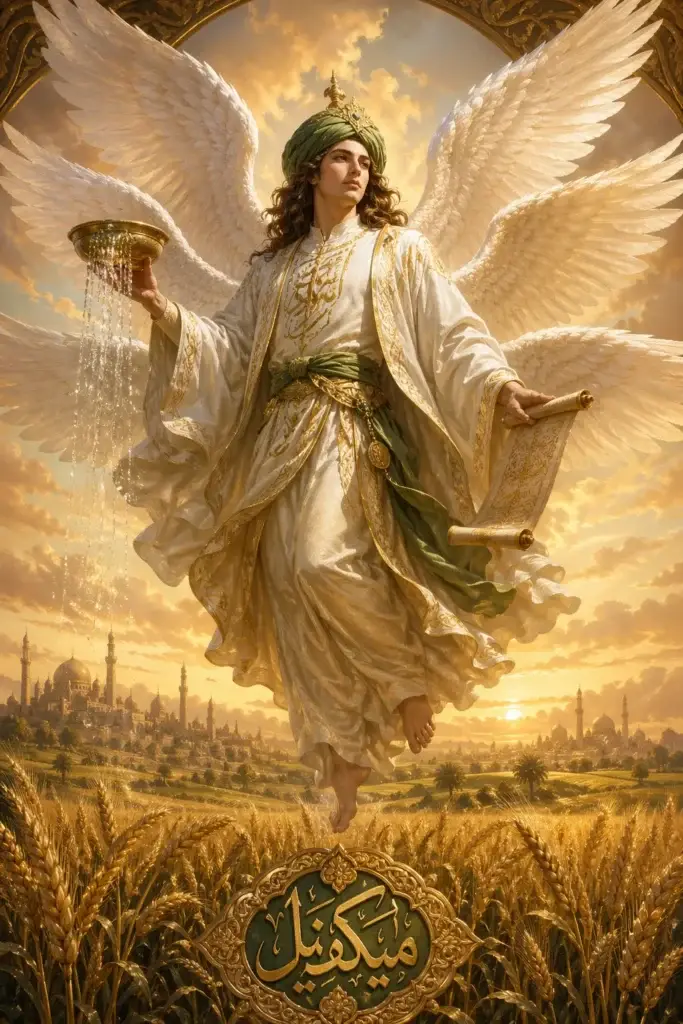
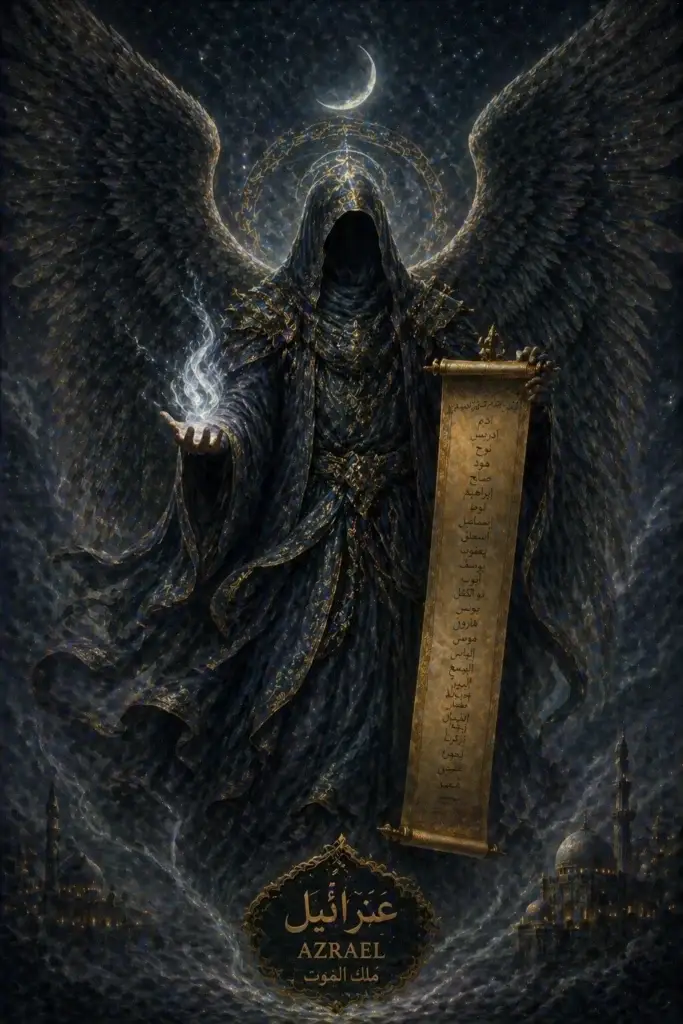
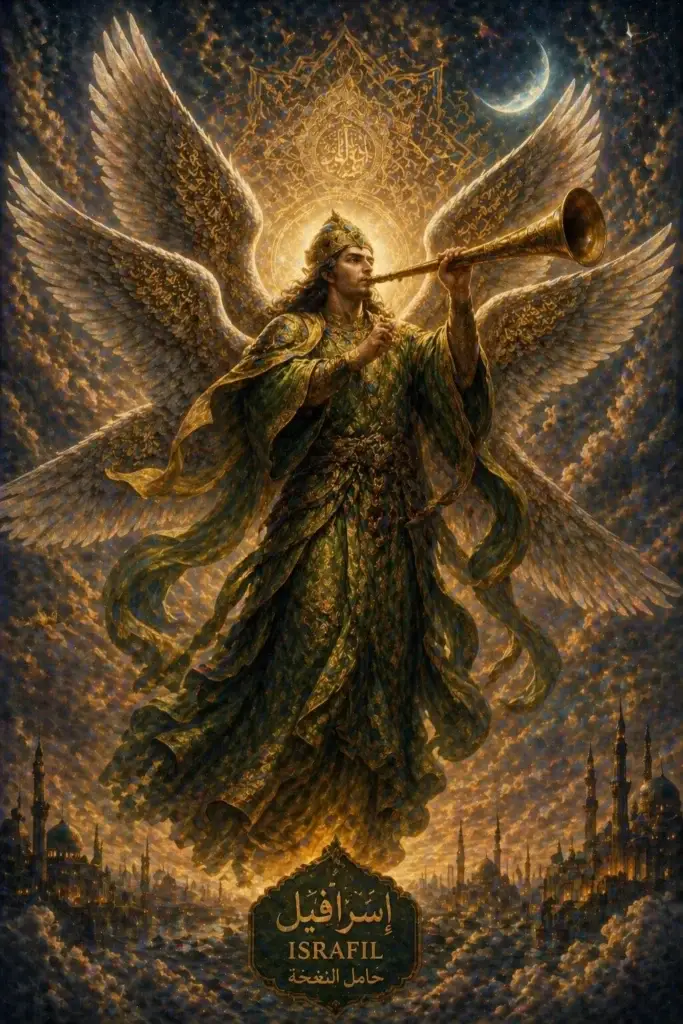
Comparable figures in Islam: Mikail (protection angel, but less central), Israfil (resurrection angel), Azrael (angel of death). Outside Islam: the Christian Gabriel (annunciation, identical with Jibril), the Jewish Gabriel (revealer, identical with Jibril). The identity across religious boundaries makes Jibril/Gabriel unique among archangels.
Defense in Everyday Life
Invocations and prophetic contemplation
Jibril is in no sense an object of direct invocation like a demon.
Textual traditions and names
In the Quran, Jibril is mentioned by name three times.
Marks of honor and ritual remembrance
There is no amulet practice for Jibril in the sense of an object of protection.
Jibril, Parallels in Other Cultures
Jewish tradition: Jibril is identical with the Jewish Gabriel (Hebrew, Greek, Arabic: all “God is my strength”). The function is parallel: revealer of the divine will. Difference: Gabriel in Judaism is also a herald of judgment; Jibril is primarily a messenger of revelation. Both are central archangels of their traditions.
Greco-Roman world: No direct parallels in classical mythology. Distantly related: Hermes (messenger of the gods, but not a mediator of revelation), Iris (heavenly message). The specific function of religious Wahy (revelation) does not exist in antiquity.
Mesopotamia: Mesopotamian correspondence: Nabu (scribe and revealer of Marduk’s will). The difference: Nabu writes earthly fates; Jibril conveys the cosmic, eternal message. They share the mediator-scribe function.
India/Asia: Indian correspondence: Saraswati (goddess of wisdom and the word, Hindu). Buddhist parallel: Manjushri (bodhisattva of wisdom, power of the word). Both share the function as mediator of divine wisdom and of the word of knowledge.
Jibril and the Descent of the Quran
The central function of Jibril (Jibrīl, in the West mostly Gabriel) in Islam is the conveying of the revelation. In surah 2:97 the Quran expressly designates him as the one who sent down the scripture “with God’s permission” upon the heart of the Prophet Muhammad.
He is also interpreted as ar-rūḥ al-amīn, the “trustworthy spirit” (surah 26:193), and as rūḥ al-qudus, the “holy spirit“.
The Islamic tradition locates the beginning of this conveying in the cave of Hira near Mecca, where Jibril is said to have appeared to the Prophet for the first time, with the command iqraʾ, “read” or “recite”.
The hadith describes the encounter as physically overwhelming: Jibril is said to have embraced Muhammad three times until he was able to recite the first verses of the later surah 96. In the further biography of the Prophet, Jibril appears again and again as a mediator who brings individual surahs, delivers instructions and renders assistance in difficult situations.
Theologically this mediating role is decisive, because it secures the purity of the revelation. The angel is not an independent speaker, but conveys solely the word of God. The Islamic doctrine of angels therefore emphasizes that Jibril is not worshipped, but is regarded as a servant.
At the same time his function places him at the head of the angelic hierarchy. A well-known tradition has the Prophet say that Jibril brought him the Quran in several “readings”, which helped to shape the later discussion about the canonical Quran recitations.
The Hadith of Gabriel: A Teaching Dialogue on Faith
One of the most influential episodes concerning Jibril is the so-called Ḥadīth Jibrīl, handed down among others in the collection of Muslim.
In it, Jibril appears in the form of a man in strikingly white clothes and with very black hair, on whom no trace of travel can be seen and whom none of those present knows. He sits down before the Prophet, touches his knees with his own knees and poses a series of questions.
He asks about Islam, that is the outward duties, about īmān, faith, about iḥsān, inner perfection, and about the Hour of the Last Judgment.
To every answer of the Prophet the stranger replies “you have spoken truly”, which astonishes the listeners, because a questioner usually does not possess the knowledge to confirm the answer. After the man has left, the Prophet explains to his companions that this was Jibril, who had come to teach them their religion.
This hadith became a foundational text of Islamic doctrine of faith. The threefold division into Islam, Iman and Ihsan structures works of religious education to this day and is the starting point for the distinction between law, theology and mysticism.
Remarkable is the didactic point of the narrative: the angel knows the answers, yet nevertheless asks, so that the community learns through the conversation. The form of the instruction, not only its content, was thus handed down.
Gabriel Across the Religions: Comparison and Distinction
Jibril shares his name and his core function with the Gabriel of the Jewish and Christian tradition, and this finding is instructive for religious studies. In the Book of Daniel of the Hebrew Tanach, Gabriel interprets visions, and is thus already an angel of explanation and mediation.
In the Gospel of Luke he announces the birth of John the Baptist and of Jesus. In all three traditions Gabriel is connected with the spoken divine word.
Islam did not simply take over this figure, but inserted it into its own understanding of revelation. While Gabriel in Christianity above all announces, Jibril in Islam conveys a complete text.
This shift corresponds to the differing understanding of scripture: the Quran understands itself as a literal sending-down, and the angel is the channel of this sending-down.
The Muslim tradition at the same time knows a polemic of distinction. Surah 2:97 to 98 reacts, according to classical exegesis, to a Jewish rejection of Jibril and declares that whoever is an enemy of God, of his angels and of Jibril by name, God is his enemy.
This verse shows that the figure of the angel was not only a connecting heritage, but also an object of religious dispute.
For comparative study, Jibril is thereby a model case: a figure that recurs across religions and precisely thereby makes visible the specific differences of the traditions. Whoever wishes to understand the doctrine of angels in Islam cannot avoid this web of adoption and reorientation.