Ayat al-Kursi: the Throne Verse of the Qur'an as a text of protection
By Ralf Ittermann · last reviewed on
Ayat al-Kursi, the Throne Verse, is one of the best-known verses of the Qur’an. It speaks of the all-encompassing power of God. In Islam it is regarded as a particularly powerful text of protection and preservation.
Classification
Ayat al-Kursi is a single verse from the Qur’an, the holy scripture of Islam. The name means something like the verse of the throne, and the verse is therefore called the Throne Verse in English.
The Throne Verse belongs to the second and longest Surah of the Qur’an. Within this Surah it is one of the best-known and most revered verses of all.
Ayat al-Kursi speaks of the power and the greatness of God. It describes God as the one who stands above all things, whose knowledge and whose power encompass everything.
In Islam the Throne Verse is regarded as a particularly powerful text. It is spoken, recited and also written down in order to ask for protection and preservation.
In religious studies, Ayat al-Kursi is a good example of the fact that not only objects but also texts can be understood as means of protection. According to Islamic understanding, however, it is God who protects, and not the text of itself.
This page treats Ayat al-Kursi from the point of view of protection. The Throne Verse is spoken and worn, and in both forms it is connected with the wish for preservation.
The Throne Verse in the Qur'an
Ayat al-Kursi stands in the second Surah of the Qur’an, the Surah by the name of al-Baqara. This Surah is the longest of the entire Qur’an.
Within this long Surah the Throne Verse occupies a prominent position. Islamic tradition honours it as one of the most significant, and some say as the most significant verse of the Qur’an.
The verse takes its name from a word that appears in it and is rendered as throne or seat. This throne is an image for the dominion and the power of God.
In terms of content, the Throne Verse speaks of the oneness and the sublimity of God. It describes that God is the Living and the Enduring, that neither slumber nor sleep overtakes him, and that his knowledge and his power permeate everything.
The verse is thus a condensed profession of the greatness of God. In a few sentences it sums up central statements of the Islamic faith concerning the nature of God.
This high standing in the Qur’an is the basis for the significance of the Throne Verse as a text of protection. Precisely because it expresses the power of God so impressively, it is regarded as particularly powerful.
The power of God as protection
The protective significance of the Throne Verse arises from its content. The verse speaks of the all-encompassing power of God, and it is precisely from this power that the protection is derived.
Whoever speaks the Throne Verse professes the greatness and the power of God. In doing so, they place themselves under the protection of the one who stands above all things.
The verse emphasises that nothing escapes the power of God. His knowledge encompasses everything, his power reaches over heaven and earth. Before such power, according to Islamic understanding, no misfortune is final.
The protection that Ayat al-Kursi grants is therefore not a magical effect of the text itself. It is the consequence of turning towards God, whose power the verse proclaims.
This distinction is important. According to Islamic understanding, it is not the verse that protects of its own accord, but God, to whom the verse points and towards whom it directs the one who speaks it.
Ayat al-Kursi is thus a text of protection whose effect remains bound to faith. It preserves by placing a person under the power of God and by reminding them of this power.
The Throne Verse in prayer and in everyday life
Ayat al-Kursi is deeply embedded in the daily religious life of Muslims. The verse is spoken on many occasions.
Widespread is the recommendation to speak the Throne Verse before going to sleep. Sleep was regarded as a state of vulnerability, and the verse was meant to preserve the sleeper.
The Throne Verse is also spoken in the morning and in the evening, when leaving and when entering the house, and after the prescribed prayers. It thus accompanies the turning points of the day.
In all these cases the verse is a spoken means of protection. Whoever speaks it places the coming portion of their day, sleep or the journey, under the protection of God.
This use shows that Ayat al-Kursi is first and foremost a spoken text. Its protection unfolds in speaking and in reciting.
The Throne Verse thus belongs to those texts that accompany and safeguard life through their regular recitation. It is a protection that is not bound to an object but is sought in the spoken word.
Ayat al-Kursi as a written sign
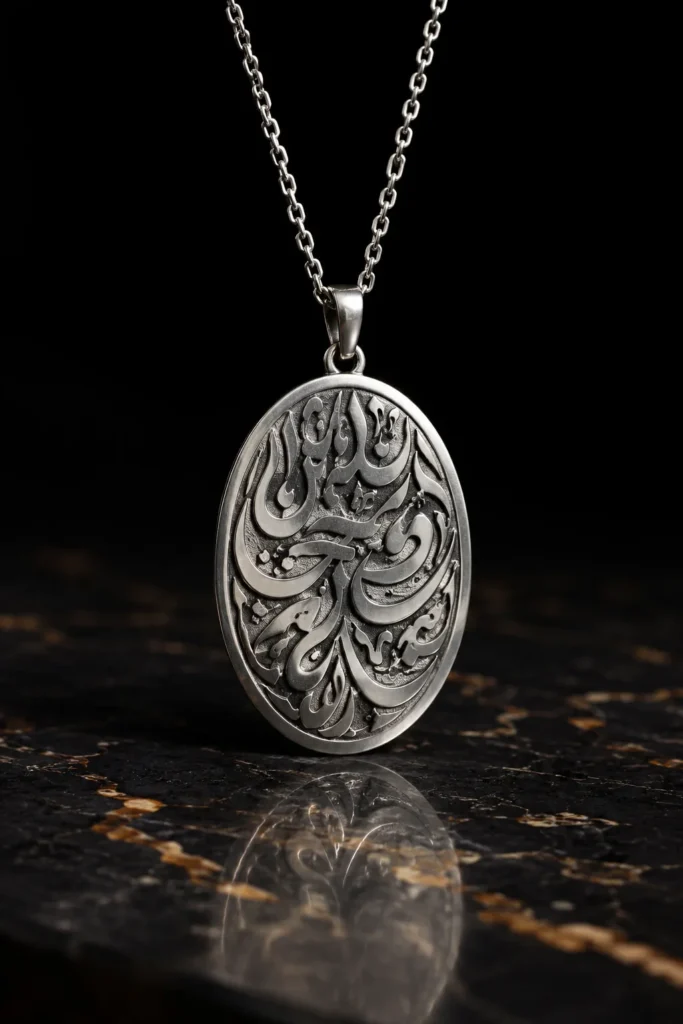
Beyond the spoken word, Ayat al-Kursi is also written down and depicted. In this form the Throne Verse becomes a visible protective sign.
The verse appears on pendants and on pieces of jewellery. In artful calligraphy the text is rendered onto small plaques that are worn on the body.
Often Ayat al-Kursi is also depicted as wall decoration. In homes the verse hangs on the wall, often artfully written and framed, placing the living space under the protection of God.
The Throne Verse is also placed in vehicles. Like the Omamori in Japan or the Saint Christopher plaque, the written verse accompanies the traveller on their way.
In this written form Ayat al-Kursi belongs to the written talismans. The holy text, written and worn or hung up, is meant to protect its bearer or the place.
The Throne Verse thus unites two forms. It is a spoken text of protection and at the same time a written protective sign. In both forms it works according to the same basic idea, the orientation towards the power of God.
Ayat al-Kursi and the Taʿwīz
Ayat al-Kursi stands in close connection with the Taʿwīz, the Islamic amulet. The Throne Verse is among the texts most frequently used for such an amulet.
The Taʿwīz is an amulet that holds a written holy text within a casing. On the page about the Taʿwīz this form is presented in more detail.
Ayat al-Kursi is one of the preferred contents of the Taʿwīz. The Throne Verse is written onto the paper that is kept inside the amulet.
In this way the Throne Verse is joined with the amulet. The text supplies the protective content, the amulet supplies the portable form.
Here applies the distinction that is also important in the case of the Taʿwīz. According to Islamic understanding, the verse protects because it is the word of God and points to God, not because the amulet had a power of its own.
Ayat al-Kursi thus shows how a text of protection and an object of protection work together. The verse is the core, the amulet is the casing. Together they form a widespread means of Islamic protection.
The protective Surahs of the Qur'an
Ayat al-Kursi does not stand alone. The Qur’an contains further texts that are regarded in Islam as particularly protective and are frequently named together with the Throne Verse.
Especially well-known are two short Surahs at the end of the Qur’an. In them the one praying expressly seeks refuge with God from evil in its various forms.
These two Surahs are therefore called the protective Surahs. Together with Ayat al-Kursi they form the core of the Qur’anic texts of protection.
Islamic tradition reports that the Prophet spoke these texts for protection. They thus hold a special, exemplary position.
Often Ayat al-Kursi and the protective Surahs are recited together, for instance before going to sleep. They complement one another and together form a comprehensive protection.
Ayat al-Kursi thus belongs to a group of Qur’anic texts of protection. Within this group it is the text that expresses the power of God most impressively, and it is regarded as the most powerful among them.
The effective word of God
The use of Ayat al-Kursi as a text of protection rests on a basic idea of Islam, the high rank of the Qur’an as the word of God.
To Muslims the Qur’an is the direct word of God. It is not an ordinary book, but revelation itself. From this rank arises the special power of its verses.
A verse such as Ayat al-Kursi is therefore, according to Islamic understanding, not merely a sentence. It is a piece of the divine word, and in it the power of the one who revealed it is present.
Whoever speaks or wears the Throne Verse thereby has the word of God with them. The protection lies in this nearness to the divine word.
This idea of the effective holy word is not confined to Islam. Other religions too know texts of protection and written talismans. The Jewish tradition, the East Asian paper talismans and further examples rest on the same basic idea.
Ayat al-Kursi is the Islamic expression of this basic idea. Its distinctiveness lies in the high rank of the Qur’an and in the impressive statement of precisely this verse about the power of God.
Reception today
Ayat al-Kursi is to this day extraordinarily present in the Islamic world. The verse is spoken daily by many Muslims and is part of the firm fabric of religious life.
As a written sign the Throne Verse is likewise widespread. Artful calligraphies of the verse adorn homes, and as a pendant it is worn by many people.
In vehicles, on walls and at entrances the Throne Verse can often be seen. Everywhere it places the location or the traveller under the protection of God.
The calligraphy of the Throne Verse is moreover an important subject of Islamic art. The artful design of the holy text combines the religious content with great care in its execution.
Ayat al-Kursi thus remains a living text of protection. Unlike some protective objects of the past, it is unchanged in its presence in the everyday life of many people.
The Throne Verse is thus an impressive example of a protection that, in Islamic understanding, proceeds from God and finds its expression in the word. In it are united the high rank of the Qur’an, an impressive statement about the power of God and the wish for preservation in everyday life.
References (selection)
Related key terms: Ayat al-Kursi Throne Verse Qur’an text of protection al-Baqara protective Surahs Taʿwīz Islam.
iWell Guard and traditions of protection
iWell Guard stands in the cultural-historical line of portable protective objects, to which the Throne Verse Ayat al-Kursi also belongs. A modern companion for people who live with protective symbols: made in Germany, 41 layers of solid gold, platinum and silver, with a 30-day right of return.
Personal experiences may vary. Not a medical device. No healing promise.