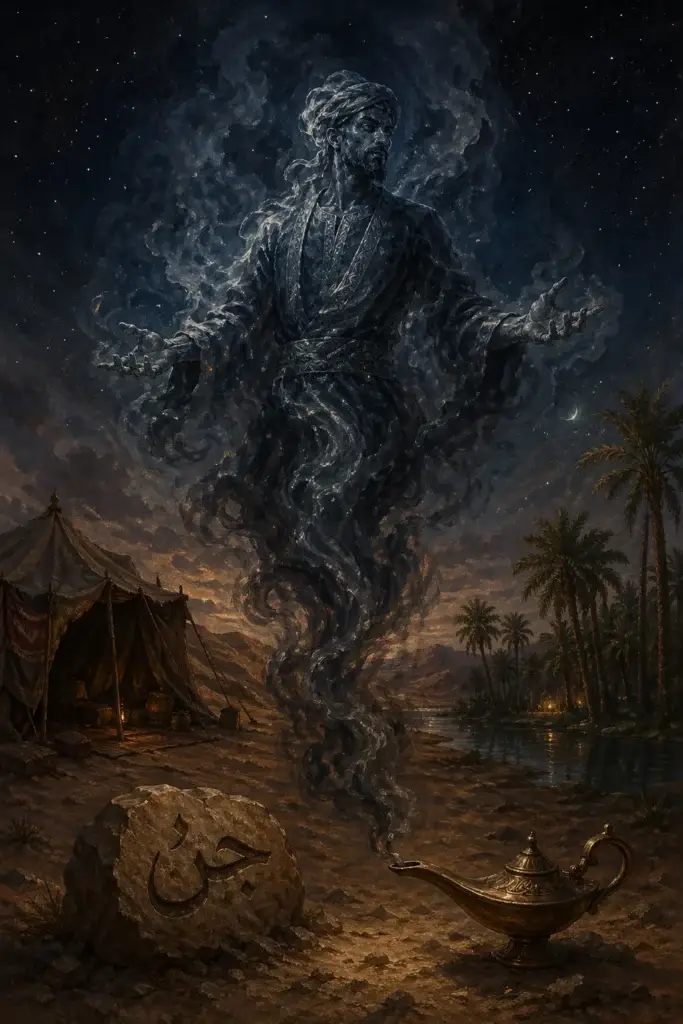
Jann, ancestor and subtype of the Djinn
By Ralf Ittermann · last reviewed on
The Jann is a spirit of Arabian tradition.
Progenitor of the Djinn and, at the same time, their weakest subtype.
The Jann is at once the progenitor of the Djinn and, in folklore, their weakest subtype. Both meanings exist side by side: al-Jann as a collective and ancestor of the Djinn, and Jann as a lower type of Djinn.
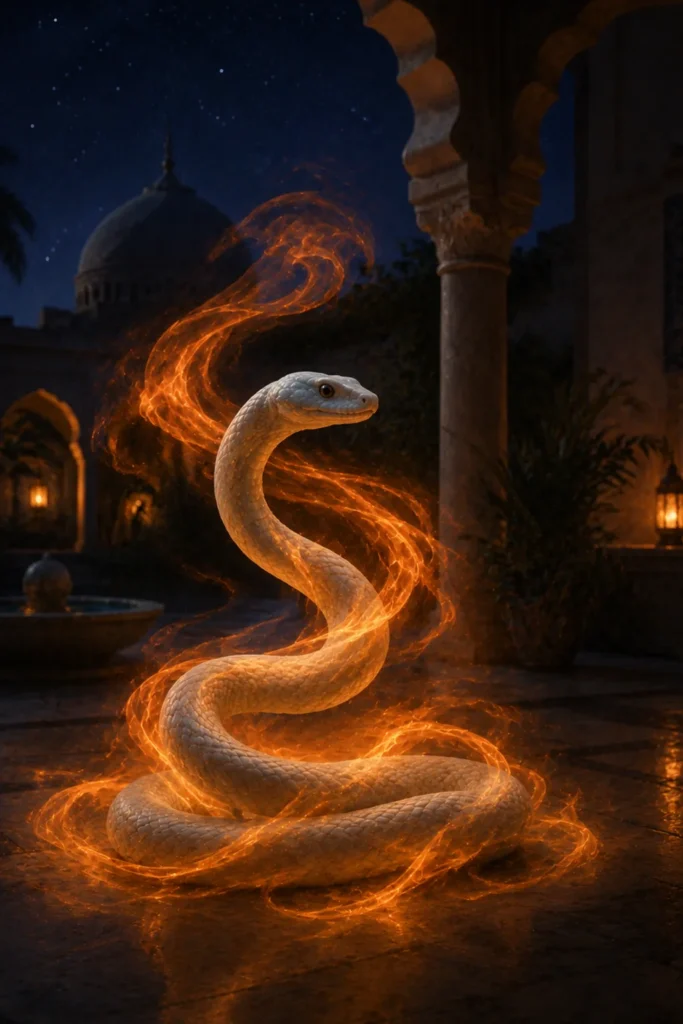
The Quran anchors the figure in the theology of creation: according to Surah 15:27, al-Jann is created from fire, and according to Surah 55:15, from a smokeless flame of fire. In the visible world, a fixed image belongs to it: the white, agile snake, especially in the house.
Type: Ancestor and collective of the Djinn; in folklore their weakest subtype
Origin: Quranic theology of creation with pre-Islamic roots
Texts: Quran (Surah 15:27; 55:15), Hadith, folk tradition
Period: pre-Islamic to the present
Appearance: white, agile snake, especially in the house
Historical Classification
Period of the Texts
Quranic-Islamic with pre-Islamic roots: behind the figure lies the older myth of the earth’s earlier inhabitants, who populated the world before humans.
Area of Diffusion
Arabia and the Arab-Islamic cultural world; as a house snake, the belief extends right into the everyday life of the household courtyards.
Sources
Well documented: the core Quranic passages, the Hadith on house snakes, and modern research, above all El-Zein.
Name and variants
Arabic: jann, from the root j-n-n, to conceal or veil, as in majnun, possessed, and janna, garden. The hidden is already contained in the name: the Jann belongs to the beings that the eye cannot grasp.
Description
Appearance
The Jann appears as a white, agile snake, especially in the house; in the Quran, Moses’ staff turns into a Jann snake. The word’s second meaning is precisely this nimble snake.
Effect
As a collective and progenitor, al-Jann denotes the Djinn as a race; the word is used especially when Jinn might otherwise also mean angels. In folklore, not in the Quran, the Jann is the weakest, demoted type of Djinn, the point of reference for the popular ranking scheme.
Profile: Jann
The key aspects of the Jann at a glance.
An intersection of linguistic imagery, Quranic theology of creation, and pre-Islamic mythology of the earth’s earlier inhabitants.
People and households: as a white house snake, the Jann enters the domestic space and is bound there to particular rules of conduct.
A white, agile snake; alongside this, the abstract collective al-Jann, the Djinn as a race, created from a smokeless flame of fire.
Ancestor and overarching term for the Djinn; in folk tradition, at the same time the lowest level in the ranking scheme of the fire creatures.
For house snakes, the Hadith holds that some may be Muslim Djinn, which should be warned three times before being killed; also recitation of the Quran and remembrance of God.
From Quranic word to folk tradition
The name comes from the root j-n-n, to conceal or veil, as in majnun, possessed, and janna, garden. The Quran anchors the Jann in the theology of creation: in Surah 15:27, al-Jann is created from fire, and in Surah 55:15, from a smokeless flame of fire. Behind this, pre-Islamically, stands the myth of the earth’s earlier inhabitants.
From this theological foundation, folk tradition developed its own image: the Jann as the weakest level of the Jinn, below Ifrit and Marid. This ranking scheme is popularly influential but recent; the Quranic use of al-Jann refers to the collective, not a level.
Mystical interpretation and classification
Ibn Arabi interprets the Jann mystically and allegorically as the hidden animal soul; Persian legend knows a King Jann ibn Jann, who reigned 2000 years before Adam.
From the perspective of religious studies, the Jann is an intersection of linguistic imagery, Quranic theology of creation, and pre-Islamic mythology. Three clarifications: presenting the subtype meaning as Quranic is a misconception; the Quranic sense is the collective one. Equating it with Iblis is a minority view. And the popular five-level ranking of the Djinn is modern, not classically canonical.
Traditional defence and the house-snake Hadith
Dealing with the Jann follows the general Islamic defence through recitation of the Quran and remembrance of God. A special feature concerns house snakes: according to the relevant Hadith, some of them may be Muslim Djinn, which is why they should be warned three times before being killed. The white snake in the house is thus not a mere animal, but a being with its own legal status within the world of faith.
The Jann within the structure of the Djinn
In the collective sense, the Jann is the overarching term for all Djinn; in the subtype sense, their lowest level. It is to be distinguished from the Shaytan, the rebellious spirit, as well as from Ifrit and Marid, the powerful Djinn. Iblis is also occasionally equated with the Jann; this, however, remains a minority view. Separate articles cover Hinn, Hatif, and Shiqq.
Frequently asked questions about the Jann
What is the Jann?
At once the progenitor of the Djinn and, in folklore, their weakest subtype. Both meanings exist side by side in tradition.
What is the Jann created from?
According to the Quran, from a smokeless flame of fire (Surah 55:15); Surah 15:27 names fire as the substance of creation.
Is the Jann the lowest level of Djinn?
Only in the folkloristic sense. In the Quran, al-Jann denotes the Djinn as a race; the five-level ranking is a modern systematisation.
Further links
Literature (selection)
Further standard works in the bibliography.
As the progenitor of the Djinn and, at the same time, the white fire-serpent of the House, the Jann unites two roles that could hardly be further apart: the origin of an entire class of beings and its most modest appearance.