Marid, Demon of the Islamic Tradition
By Ralf Ittermann · last reviewed on
The Marid is the demon of the Islamic tradition, a defiant jinn of extraordinary power and adversarial nature. Its significance in religious studies lies in embodying cosmic independence outside the divine order, in demonology as a harmful force, and in Sufi mysticism as a trial of temptation (fitna) for believers.
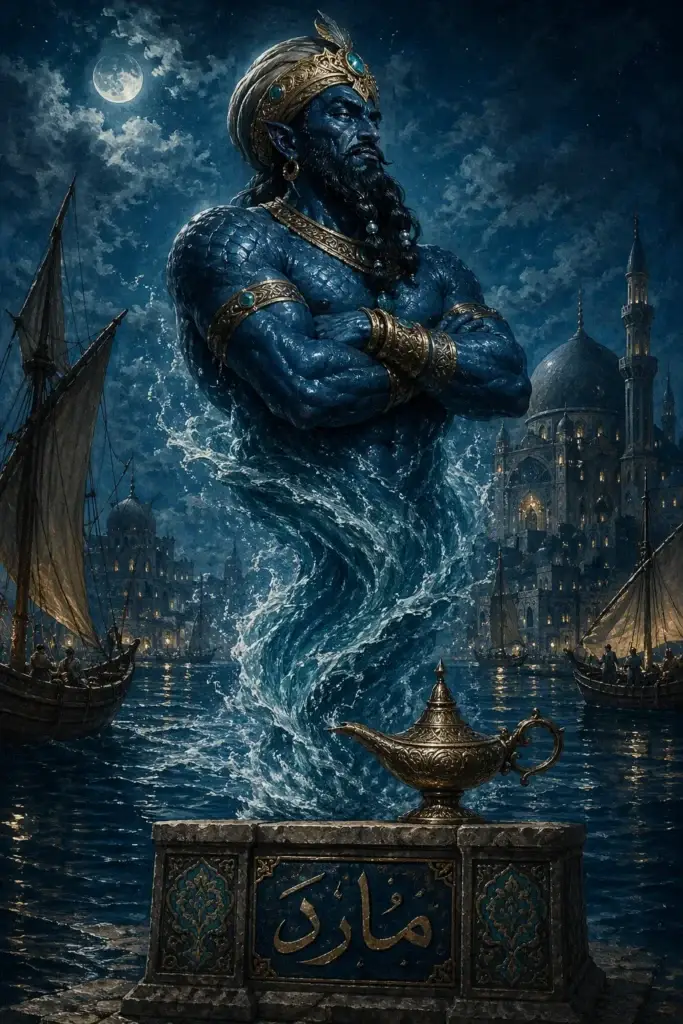
Marid
The Marid functions as a jinn prince and adversary. Its characteristics include supernatural power, defiance against God’s command, and the capacity to seduce.
Central myths are: Marids in the story of the bird throne (Sura 27:39, 40, where an ʿifrīt must serve Solomon), the endangering of prophets by Marids (hadith), Marids as leaders of rebellious jinn under Iblis (tafsir), and mystical traditions of the trial of temptation in Sufi texts.
Quick Overview: Marid
The Marid is mentioned in the Quran (37:7, a rebellious satan, Arabic: marid) and elaborated in hadith collections (Tirmidhi, Ibn Majah). The contextual placement occurs in the early Islamic period (7th century). The state of research (Schimmel, Hughes, Schmoldt) documents Marids as a prominent demonic figure in Islamic demonology and magical traditions.
Classification
Period of the Texts
The powerful jinn king. He rules the seas.
The continuity is remarkable and shows deep cultural rootedness. Even in modern times the memory remains alive, often transformed but recognizable in its basic features.
Mythological Classification
The Marid is a class of powerful demons or jinn in Islamic mythology. Marids belong to the strongest and most dangerous types of jinn. They are often mentioned as opponents or unwilling servants. Their position is one of ambivalence: creatures of fire, free and powerful.
Area of Distribution
The Marid was not confined to particular regions but was widely known throughout the Islamic world. Whether in urban centers or rural regions, whether among the elite or ordinary people, the spiritual significance was consistently acknowledged and respected.
This shows a central role in the cultural self-understanding. Trade, migration and cultural exchanges spread and stabilized the notion, which led to considerably differing regional traditions and produced no uniform picture of the Marid.
Source Situation
Primary sources are the Quran (37:7 Marid mention, 27:17, 44 bird-throne narrative with jinn capability, Arabic, 7th century), hadith collections (Jamiʿ at-Tirmidhi, Sunan Ibn Majah, Arabic), tafsir works (Tabari on Sura 27:39, Ibn Kathir) and magical literature (Kitab al-Ghayb, Shams al-Maʿarif, Arabic, 13th century). In secondary literature, Schimmel (Mystical Dimensions) and Hughes (Dictionary of Islam) analyzed the Marid’s role as a feared demonic power.
Name and Variants
The Marid is depicted with particular iconographic elements that are symbolically encoded and carry deep meaning. These elements convey above all the functions, sources of power, jurisdiction and cosmic role of this entity.
The visual system allows the initiated and the culturally educated to grasp the deeper meaning. Colors, sacred objects or weapons, physical attributes, specific accessories: all are significant and traditionally transmitted. The system remains stable and recognizable across generations, which points to fundamental archetypal structures.
Description
The continuity of these practices across many generations shows that they were regarded as effective and necessary. The functions were varied: preventive (warding off misfortune), healing (relief of suffering), transformative (accompaniment through transitions) and protective (continuous watch).
Appearance and Symbolism
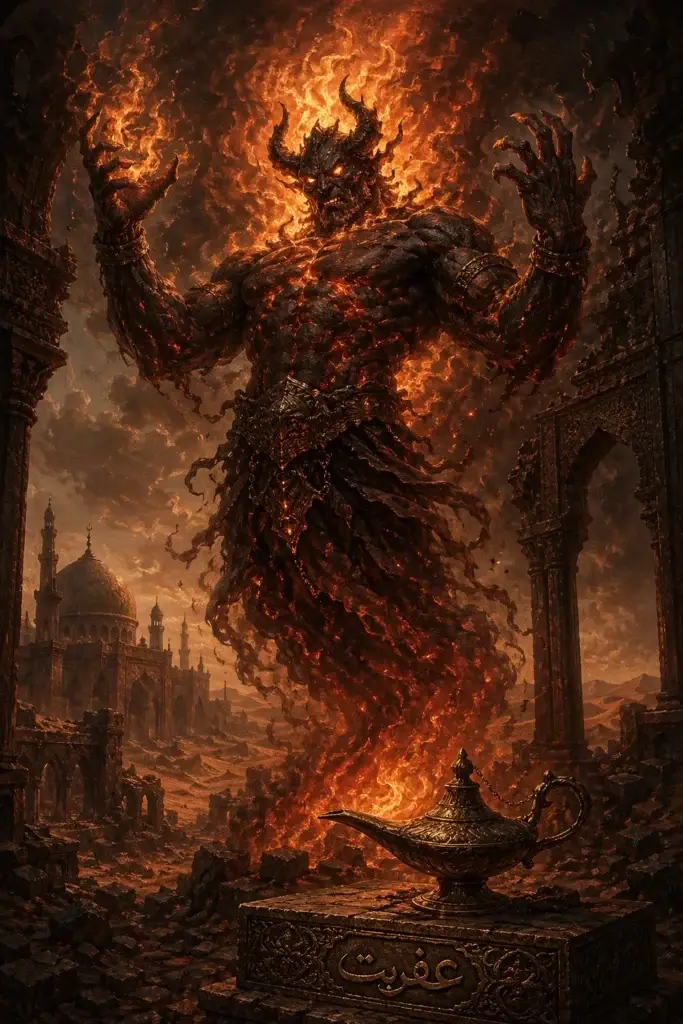
Marids are depicted as enormous, terrible beings, often with black or fire-red skin and wings. They can take on various forms. Their eyes burn like coals. Fire and turbulent air are their symbols. Chains and seals hold them in check.
Profile: Marid
The Profile captures the Marid across six dimensions: its origin in Quranic and literary demonological traditions, its target audience among believers as temptation and magician’s power, iconographic fire and water features of the jinn nature, its functional role as adversary and seducer, comparisons to other Islamic and non-Islamic demons, and its role as a trial (fitna) in mystical purification.
The Marid first appears in the Quran of the 7th century with roots in Arab and Semitic jinn traditions. The geographical origin lies in the Arabian Peninsula, particularly the deserts and waters as jinn habitats.
The dating of the first mention is Quran 37:7 (Meccan period, 610 to 622 CE). The theological framing as a defiant jinn class occurred in hadith commentaries and magical treatises (13th to 15th century).
The Marid was directed primarily at people with demonic contacts or magical intentions. The target audience comprises magicians (sahirun), the seduced (those who succumb to Marids), believers in times of temptation, and mystical beginners without sufficient protection.
The occasions are night hours (the time of jinn activity), solitude, (ritual) impurity, and inattention toward God’s commandment. The contact occurs against the will rather than by desire.
The Marid iconographically: a powerful, demonic figure with supernatural features. The typical depiction: gigantic, embodying fire and water elements, black or red in color, sometimes with wings, horns or animal features. The attributes are chains (Solomon’s binding), fiery breath, water power. In Arab tales and jinn descriptions: terrifying, almost uncontrollable.
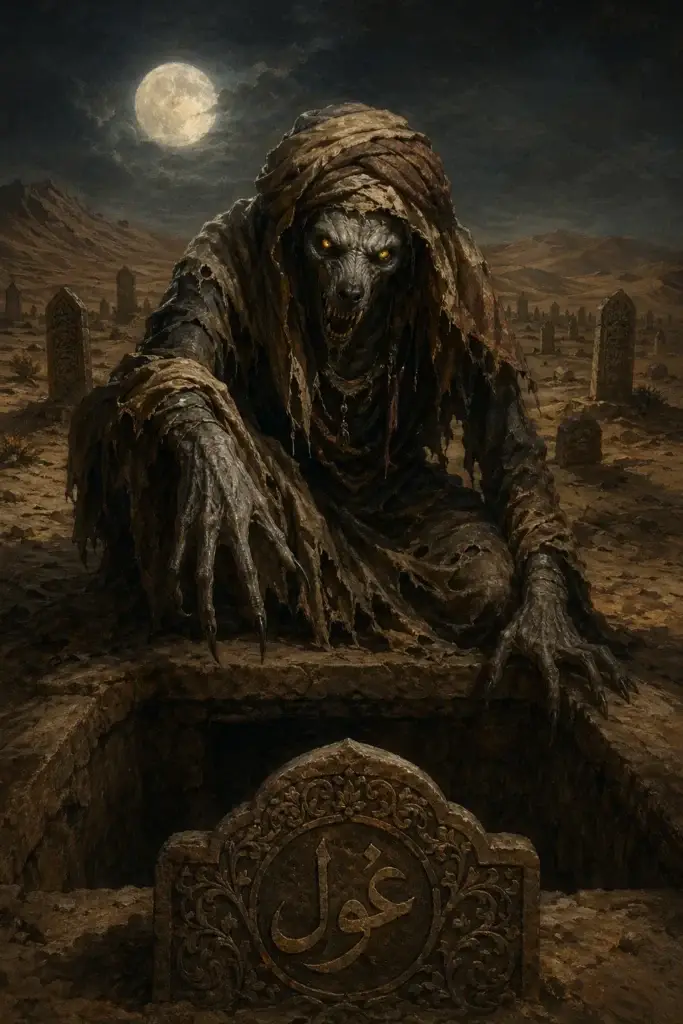
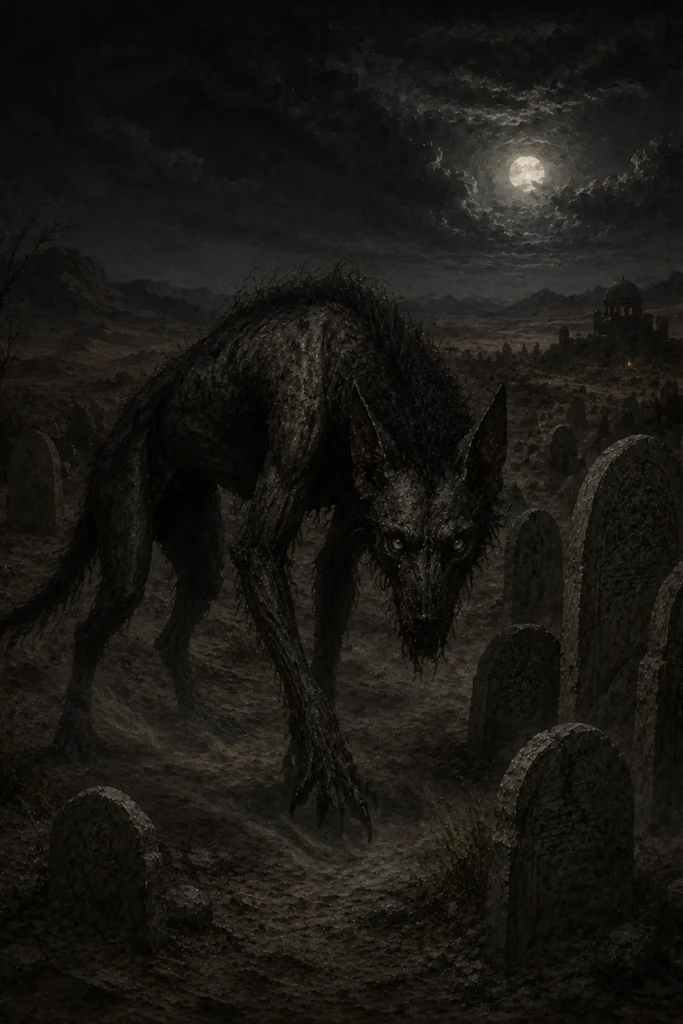
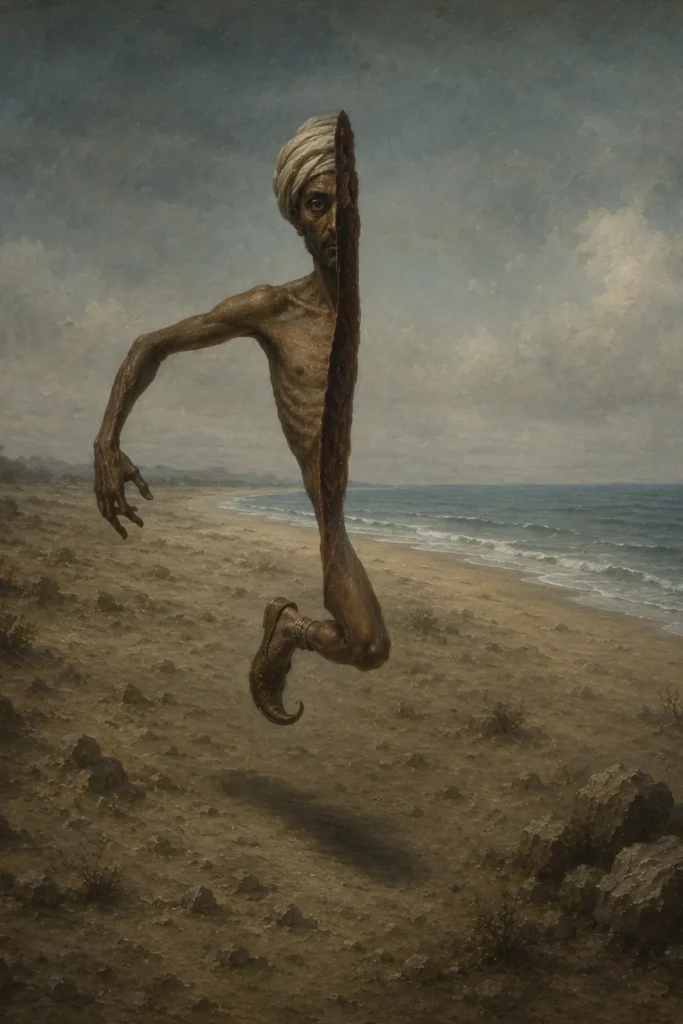
Sphere of effect: The Mārid (مارد, pl. marada) is, in classical Islamic demonology, the most powerful and rebellious class of jinn, standing above the lower classes jinn (in the narrower sense), shaitan, ʿifrīt and ghul.
The Quran already knows the Mārid in a formula of punishment (Sura 37:7: “We have adorned the heaven with stars, and guarded it against every rebellious satan / shaitan mārid“).
The narrative cycles of the Thousand and One Nights, above all the stories of Solomon (Sulayman) and his signet ring, attribute to the Mārid the power to move mountains, to part seas, and to appear at distant places.
In the mystical-occult tradition (al-Būnī, Shams al-Maʿārif, 13th century) they are the highest beings of the unseen world, who can be bound only by the most powerful names of God and seal-like conjurations.
The Marid was regarded as harmful and defiant. Protective practices included prayers (dua) for Allah’s protection against Marids, recitation of Quranic verses (Ayat al-Kursi, Sura 2:255), the use of a protective amulet with the holy names of Allah (taweez), and ritual purification (wudu).
In Sufi mysticism, Marids were understood as a trial (fitna) that the believer is to overcome through spiritual strength. Protection consisted in closeness to Allah’s commandment (taqwa).
Comparable figures within Islam: Iblis (chief demon, but with the status of a fallen angel), shayatin (general demons, but less powerful), other jinn classes (qarin, afrit).
Outside Islam: the Jewish Azazel (demon prince), Christian demonic figures (Beelzebub, Mammon), the Mesopotamian Lamashtu (defiant she-demon). The combination of elemental power and adversarial nature makes the Marid distinctive.
Marid, Parallels in Other Cultures
Marids count among the most powerful classes of jinn and mediate functionally between the yakshas of the Indian world and the daimones of the late-antique Mediterranean world. Unlike the mostly one-dimensionally malevolent spirits of other traditions, Marids in Islamic demonology are ambivalent: convertible, capable of making pacts, and in the Solomonic tradition even serviceable.
Jewish tradition: The Jewish parallel: Azazel (demon prince, scapegoat) or Samael (demonic archangel). The difference: the Marid is of original jinn nature, not a fallen being; Samael and Azazel are fallen angelic beings. They share the adversarial function.
Greco-Roman world: The Greek equivalent: Typhon (chaos power), Giants, or Titans. The difference: these are adversaries of the gods in cosmogony; the Marid is a demonic everyday power. Closer: the Harpies or Furies (evil beings with control over the elements).
Mesopotamia: The Mesopotamian equivalent: Tiamat (chaos demon, adversary of Marduk), Labartu or Lamashtu (defiant she-demon). The Marid and these powers share the cosmic adversarial nature and elemental power. But the Marid is more individual and more interactive.
India / Asia: The Indian equivalent: asuras (demonic counter-powers, Hindu) or rakshasas (a class of demons). They share the adversarial and seductive function. The Buddhist parallel: maras or demonic yakshas with supernatural and seductive power.
The Marid in the Classification of the Jinn
The Marid belongs to the broad class of the jinn, those beings created from smokeless fire who, in the Islamic worldview, stand between the angels and humans. Within this class, Islamic scholarship attempted to establish various orderings, and in several of these divisions the Marid appears as a particularly powerful subgroup.
A widespread, though not uniformly transmitted, division distinguishes several types of jinn by power and malevolence. The simple jinn stands for the genus in general, the ʿifrit for especially strong and dangerous representatives, the shaytan for those inclined toward evil, and the marid for the most powerful, often described as defiant and rebellious beings.
The Arabic word mārid itself means “rebellious,” “defiant,” “obstinate,” and belongs to a root that denotes insubordination and resistance.
This classification is not a fixed doctrinal structure of the Quran.
The Quran speaks of the jinn as a creation of their own, of their capacity for belief and unbelief, and of their accountability before God, but it does not know the later subdivision into ʿifrit, marid and further types in this form.
The graded ordering developed only in post-Quranic literature, in folk tradition and above all in narrative literature. The Marid is therefore less an object of theology than of the popular imagination, in which it holds the rank of the strongest and most difficult to tame jinn.
The Marid in the Thousand and One Nights
The Marid has its best-known literary home in the collection Thousand and One Nights, that corpus of Arab tales grown over centuries.
There, jinn of every kind appear, and the Marid emerges as the most powerful among them, often of enormous size, with superhuman powers and the ability to cover vast distances in the shortest time or to erect entire structures.
Characteristic of the tales is the relationship between the Marid and a human counterpart. In many stories the powerful jinn is bound to an object, to a ring, a lamp, a bottle or a seal, and must serve whoever possesses this object or knows the right formula.
The tension of these tales lives on the disparity between the immense power of the being and its enforced servitude. The Marid can fulfill wishes, but is at the same time dangerous, because it can carry out commands according to the letter and not according to the intention.
Research on narrative literature emphasizes that the Thousand and One Nights is not a religious textbook but entertainment literature, which takes up religious notions and elaborates them freely. The Marid of these tales is therefore not simply to be equated with the Marid of theological or folk-religious imagination.
Nevertheless, it is precisely the literary figure that has most strongly shaped later perception. Through the European translations since the eighteenth century, the image of the wish-granting spirit bound to a lamp became known worldwide and detached itself from its original context in the Islamic world of imagination.
The Marid in Folk Belief and Conjuration Practice
Alongside theology and narrative literature, there is a third layer of transmission in which the Marid appears: the lived folk belief and the magical practice connected with it in various regions of the Islamic world.
Here the Marid is part of a differentiated world of spirits with which people reckon in everyday life, without this necessarily agreeing with learned religion.
In this layer the Marid is regarded as the most powerful and most difficult to control jinn. Certain illnesses, especially severe, protracted or seemingly inexplicable afflictions, were in some regions attributed to the working of a Marid.
In accounts of so-called possession as well, the Marid appears as a particularly stubborn intruder, harder to drive out than an ordinary jinn. Healers and persons credited with experience in dealing with the world of spirits occupied themselves with methods of calming, binding or expelling such a spirit.
Religious-studies research, for example the work on the jinn conception in folk Islam, urges a twofold caution here. First, the regional traditions differ considerably, so that there is no uniform image of the Marid in folk belief. Second, this practice stands in tension with normative Islamic doctrine, which largely rejects spirit conjuration and magical practices.
The Marid is thus a good example of the many-layered nature of religious reality: the same figure appears scarcely at all in theology, in narrative literature as a great granter of wishes, and in folk belief as a feared power of illness.
Which of these layers one considers depends on the respective source, and they cannot simply be translated into one another.
Further Links
Literature (Selection)
The protective practice described here is a religious-studies classification of historical traditions. iWell Guard ties into this cultural-historical line of wearable protective objects and represents a contemporary form of it. More about the iWell Guard →